
In the field of mechanical transmission, spiral bevel gears are widely recognized for their high load capacity, smooth operation, and low noise, making them indispensable in automotive, aerospace, and industrial applications. However, traditional manufacturing methods for spiral bevel gears often rely on trial-and-error approaches, such as trial cutting, which are inherently blind and偶然性, leading to inefficiencies and suboptimal gear performance. To address this, our research focuses on developing a systematic curvature adjustment method for spiral bevel gears, leveraging virtual manufacturing and finite element analysis (FEA) to optimize tooth contact and transmission characteristics. This study aims to provide a practical and precise approach for designing grinding wheel profiles based on tooth surface curvature, thereby enhancing the manufacturing process and performance of spiral bevel gears.
Our methodology integrates multiple software platforms, including Catia for virtual cutting, Abaqus for FEA, and Vericut for virtual grinding. We begin by calculating gear parameters and simulating the cutting process to create high-precision 3D models of spiral bevel gears. These models are then subjected to FEA to extract contact patterns and identify areas for improvement. Based on the analysis, we compute tooth surface curvature and nodal offsets to adjust the contact region. Finally, we design grinding wheel profiles accordingly and perform virtual grinding to validate the adjustments. This workflow not only reduces material waste but also aligns with actual manufacturing processes, offering a novel method for optimizing spiral bevel gear systems.
The core of our approach lies in the mathematical modeling of tooth surfaces and curvature adjustments. Spiral bevel gears have complex geometries, and their performance heavily depends on the accurate control of tooth surface curvature. Traditional methods often involve iterative cutting trials, but we propose a more efficient method by directly modifying the grinding wheel profile based on calculated curvature changes. This allows for precise adjustments without the need for multiple physical prototypes, making it highly relevant for industrial applications where accuracy and efficiency are paramount.
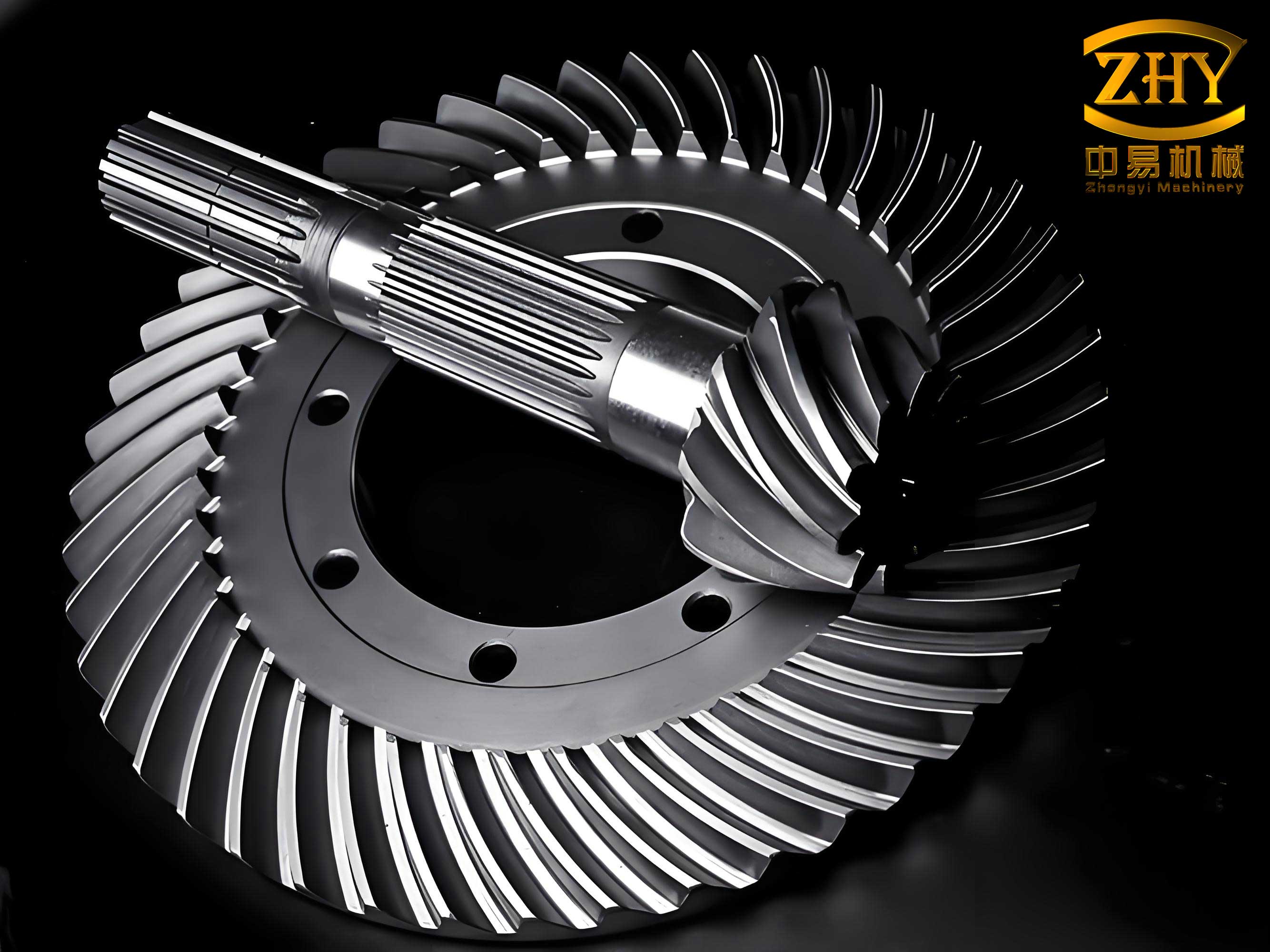
To illustrate the importance of curvature in spiral bevel gears, consider that the tooth surface is a parametric surface defined by coordinates in space. The curvature at any point on the surface influences how gears mesh during operation, affecting contact stress, transmission error, and overall durability. By adjusting the curvature, we can control the contact pattern, ensuring it is centered on the tooth surface and minimizes stress concentrations. This is critical for extending the lifespan of spiral bevel gears and improving their reliability in demanding applications.
In this article, we will detail each step of our methodology, starting with parameter calculation and virtual cutting, followed by FEA and curvature adjustment, and concluding with virtual grinding and validation. We will present formulas and tables to summarize key data and ensure clarity. Throughout, we emphasize the role of spiral bevel gears in mechanical systems and how our method enhances their manufacturing and performance. The findings demonstrate significant improvements in contact patterns after curvature adjustment, validating the effectiveness of our approach.
Parameter Calculation and Virtual Cutting of Spiral Bevel Gears
The first step in our study involves calculating the basic parameters of spiral bevel gears and simulating the cutting process using Catia. Spiral bevel gears, particularly the Gleason-type hypoid gears, require precise geometric definitions to ensure proper meshing. We developed custom software to compute gear blank parameters and machine adjustment settings based on standard design principles. The primary parameters for the gear and pinion are summarized in Table 1.
| Parameter | Gear (Large Wheel) | Pinion (Small Wheel) |
|---|---|---|
| Number of Teeth | 43 | 11 |
| Module | 7.00 mm | 7.00 mm |
| Hand of Spiral | Right-hand | Left-hand |
| Mean Pressure Angle | 22.5° | 22.5° |
| Midpoint Helix Angle | 31.84° | 50° |
| Tooth Width | 26.92 mm | 34.31 mm |
| Face Cone Angle | 74.66° | 22.73° |
| Pitch Cone Angle | 14.626° | 16.126° |
| Root Cone Angle | 66.21° | 14.61° |
These parameters form the foundation for virtual manufacturing. For the gear, we used the formed cutting method with a double-sided cutter, while for the pinion, we employed the single-sided cutting method with cutter tilt. The machine adjustment parameters, such as installation angles and wheel positions, were derived from our calculations and are essential for accurate simulation. In Catia, we utilized Visual Basic (VB) scripts to automate the cutting process, where the gear blank and cutter perform relative motions, and Boolean operations remove material to form the tooth spaces. This dynamic simulation replicates actual machining, resulting in high-fidelity 3D models of spiral bevel gears.
The virtual cutting process for the gear involves positioning the cutter relative to the blank based on Table 2 settings. The cutter remains stationary, while the blank rotates by 8.372° after each cut to generate all 43 teeth. Similarly, for the pinion, separate cuts are made for convex and concave surfaces using single-sided cutters, with specific machine adjustments as shown in Table 3. The cutting simulation produces tool mark lines, which are then processed to create continuous tooth surfaces through lofting and array operations.
| Parameter | Value (Gear) |
|---|---|
| Blank Installation Angle | 20.4° |
| Horizontal Wheel Position | 87.94 mm |
| Vertical Wheel Position | 76.59 mm |
| Axial Wheel Position | 3.63 mm |
| Surface | Blank Installation Angle | Horizontal Wheel Position (mm) | Vertical Wheel Position (mm) | Axial Wheel Position (mm) | Roll Ratio |
|---|---|---|---|---|---|
| Convex | 2.059° | 22 | -33.8135 | 5 | 4.039 |
| Concave | 1.482° | 25 | -15.7162 | -19 | 3.4266 |
To validate the accuracy of our virtual models, we compared them with theoretical tooth surfaces. We extracted 45 points from the mathematical model—9 points along the tooth height and 5 points along the tooth width—and measured their distances to the Catia model surfaces using Pro/E. The maximum errors were found to be 0.003 mm for the gear convex surface and 0.004 mm for the concave surface, confirming that our virtual cutting method produces high-precision spiral bevel gears suitable for further analysis.
Finite Element Analysis of Cut Spiral Bevel Gears
After obtaining the 3D models, we performed finite element analysis (FEA) using Abaqus to evaluate the contact behavior of spiral bevel gears. FEA is crucial for understanding stress distribution, contact patterns, and transmission errors in gear systems. We simplified the models by removing non-essential features like shafts and retaining only the teeth involved in meshing, as typically three pairs of teeth are in contact simultaneously for spiral bevel gears. This reduction minimizes computational effort while maintaining accuracy.
The FEA setup included defining material properties, contact interactions, and boundary conditions. We used steel (20CrMnTi) with a density of 7860 kg/m³, Young’s modulus of 207 GPa, and Poisson’s ratio of 0.3. The contact pairs were defined with the pinion tooth surface as the master and the gear tooth surface as the slave, with a friction coefficient of 0.1 based on standard gear handbooks. Reference points were coupled to the gear and pinion hubs using coupling constraints, and a torque of 500 N·m was applied to the gear to simulate operating conditions. The analysis used static, general steps and C3D8R elements for meshing.
From the FEA results, we extracted contact stress patterns at various rotation angles of the gear (e.g., 2°, 4°, …, 14°). The contact spots for the uncorrected spiral bevel gears showed undesirable characteristics, such as root contact and outer-edge contact, indicating improper curvature. The contact lines were elongated and covered large portions of the tooth surface, suggesting that both the tooth height and tooth length curvatures needed adjustment. This aligns with the theory that optimal contact for spiral bevel gears should be elliptical and centered on the tooth surface to reduce stress and improve durability.
The contact stress distribution can be mathematically related to tooth surface curvature. The principal curvatures at a point on a surface determine how stress is concentrated during meshing. For a parametric surface defined by vector $\mathbf{r}(u, v)$, the first and second fundamental forms are used to compute curvature. The first fundamental form coefficients are:
$$E = \mathbf{r}_u \cdot \mathbf{r}_u, \quad F = \mathbf{r}_u \cdot \mathbf{r}_v, \quad G = \mathbf{r}_v \cdot \mathbf{r}_v$$
and the second fundamental form coefficients are:
$$L = \mathbf{n} \cdot \mathbf{r}_{uu}, \quad M = \mathbf{n} \cdot \mathbf{r}_{uv}, \quad N = \mathbf{n} \cdot \mathbf{r}_{vv}$$
where $\mathbf{n}$ is the unit normal vector. The normal curvature $k_n$ in a direction given by $dv/du = \lambda$ is:
$$k_n(\lambda) = \frac{L + 2M\lambda + N\lambda^2}{E + 2F\lambda + G\lambda^2}$$
The principal curvatures $k_1$ and $k_2$ are the extremal values of $k_n$, computed as:
$$k_1 = H + \sqrt{H^2 – K}, \quad k_2 = H – \sqrt{H^2 – K}$$
where $H = \frac{EN – 2FM + GL}{2(EG – F^2)}$ is the mean curvature and $K = \frac{LN – M^2}{EG – F^2}$ is the Gaussian curvature. For spiral bevel gears, adjusting these curvatures through grinding changes the contact pattern, which we exploit in our method.
Curvature Adjustment Based on Tooth Surface Analysis
Based on the FEA results, we identified that the uncorrected spiral bevel gears had insufficient curvature, leading to poor contact patterns. To rectify this, we developed a curvature adjustment method that calculates nodal offsets on the tooth surface and designs corresponding grinding wheel profiles. This approach avoids the need for repeated trial cutting and directly modifies the surface geometry through virtual grinding.
We defined three levels of curvature correction (Curvature 1, 2, and 3) by varying the nodal offsets along the tooth height and tooth length directions. The offsets follow a sinusoidal distribution from a fixed reference point M at the tooth center. For example, for Curvature 3, the maximum offset in the tooth height direction is 0.025 mm, and in the tooth length direction is 0.161 mm. The offsets are applied along the surface normal vectors, effectively removing material to increase curvature and shift the contact region toward the center.
The nodal offset calculation involves extracting coordinates and normal vectors of points on the tooth surface from the Catia model. Let $\mathbf{P}_i$ be a point on the surface with normal $\mathbf{n}_i$. The adjusted point $\mathbf{P}_i’$ is given by:
$$\mathbf{P}_i’ = \mathbf{P}_i + \delta_i \mathbf{n}_i$$
where $\delta_i$ is the offset magnitude computed based on the desired curvature change. For a point located at distances $h$ from the tooth tip and $l$ from the tooth end, $\delta_i$ can be expressed as:
$$\delta_i = \Delta_h \sin\left(\frac{\pi h}{2H}\right) + \Delta_l \sin\left(\frac{\pi l}{2L}\right)$$
where $\Delta_h$ and $\Delta_l$ are the maximum offsets in height and length directions, and $H$ and $L$ are the total height and length. This ensures smooth transitions and avoids sharp edges on the spiral bevel gears.
Using these offsets, we modified the cutter profile to derive the grinding wheel profile for virtual grinding. The relationship between the cutter and wheel profiles is based on the gear geometry and machine kinematics. For a grinding wheel with radius $R_w$, the profile coordinates $\mathbf{Q}_j$ are calculated from the cutter coordinates $\mathbf{C}_k$ and offsets:
$$\mathbf{Q}_j = \mathbf{C}_k + \sum \delta_i \mathbf{n}_i$$
This design ensures that the grinding wheel accurately replicates the desired curvature adjustments on the spiral bevel gears.
| Curvature Level | Max Tooth Height Offset (mm) | Max Tooth Length Offset (mm) | Description |
|---|---|---|---|
| Curvature 1 | 0.020 | 0.081 | Minor adjustment for slight curvature increase |
| Curvature 2 | 0.0215 | 0.121 | Moderate adjustment for improved contact |
| Curvature 3 | 0.025 | 0.161 | Major adjustment for centered elliptical contact |
The choice of curvature level depends on the initial contact analysis. In our study, Curvature 3 was selected for virtual grinding as it provided the most significant improvement, but all levels were analyzed to understand the effects on spiral bevel gears.
Virtual Grinding of Spiral Bevel Gears Using Vericut
To implement the curvature adjustments, we performed virtual grinding using Vericut software. Vericut allows for realistic simulation of CNC machining processes, including 5-axis grinding, which is essential for spiral bevel gears. We built a virtual model of a Gleason PHOENIX-type gear grinding machine with Fanuc controls, incorporating linear axes (X, Y, Z) and rotational axes for the wheel and workpiece. This setup mimics actual manufacturing environments.
The grinding wheel profile was designed based on the offsets from Curvature 3 and imported into Vericut’s tool library. We then loaded the cut spiral bevel gear model from Catia and programmed G-code to control the wheel and workpiece motions. The grinding process involves simultaneous movements along multiple axes to accurately remove material according to the designed profile, effectively applying the curvature adjustments.
During virtual grinding, we observed that the tooth surfaces became smoother and the tooth spaces widened, confirming material removal. The process took approximately 20 minutes of simulation time and produced a modified gear model ready for validation. This step is critical as it demonstrates how curvature adjustments can be practically implemented in manufacturing spiral bevel gears, reducing reliance on physical trials.
Vericut also provided collision detection and dimensional verification, ensuring the process was feasible without machine errors. The success of virtual grinding highlights the potential of digital twins in gear production, where adjustments can be tested and optimized before physical machining.
Finite Element Analysis of Ground Spiral Bevel Gears
After virtual grinding, we exported the modified spiral bevel gear model and conducted FEA in Abaqus using the same setup as before. The goal was to compare the contact patterns of the ground gears with the original cut gears and assess the impact of curvature adjustment.
The FEA results for the ground spiral bevel gears (Curvature 3) showed a marked improvement. The contact spots were now elliptical and centered on the tooth surface, with reduced stress concentrations at the root and outer edges. We captured contact stress images at various rotation angles and synthesized them into a single tooth view for comparison. Table 5 summarizes the contact characteristics before and after grinding.
| Aspect | Uncorrected Gears | Ground Gears (Curvature 3) |
|---|---|---|
| Contact Shape | Elongated, irregular | Elliptical, uniform |
| Contact Location | Root and outer-edge bias | Centered on tooth surface |
| Maximum Stress | Higher, localized | Lower, distributed |
| Transmission Error | Larger fluctuations | Reduced, smoother |
These improvements are directly attributed to the curvature adjustment, which optimized the principal curvatures of the tooth surface. Mathematically, the adjusted curvature changes the normal curvature $k_n$ during meshing, leading to better load distribution. The contact pressure $p$ can be estimated using Hertzian contact theory:
$$p = \sqrt{\frac{F E^*}{2\pi R}}$$
where $F$ is the load, $E^*$ is the effective modulus, and $R$ is the effective radius of curvature. For spiral bevel gears, $R$ is influenced by the surface curvatures, so adjusting them reduces $p$ and minimizes wear.
We also performed a rolling test simulation by applying red lead paste to the gear teeth in a virtual environment, mimicking physical testing. The contact patterns matched those from FEA, further validating our method. This consistency confirms that virtual manufacturing and curvature adjustment can reliably predict and enhance the performance of spiral bevel gears.
Discussion on the Implications for Spiral Bevel Gear Systems
Our research demonstrates that curvature adjustment via virtual grinding significantly improves the contact and transmission characteristics of spiral bevel gears. This has several implications for gear design and manufacturing. First, it reduces the need for physical prototypes, saving time and materials. Second, it enables precise control over tooth surface geometry, which is crucial for high-performance applications like aerospace and automotive drivetrains. Third, it provides a systematic method for optimizing spiral bevel gears based on FEA feedback, aligning with industry trends toward digitalization.
The curvature adjustment method is particularly effective for spiral bevel gears because of their complex geometry. Unlike spur gears, spiral bevel gears have varying curvatures along the tooth surface, making traditional trial-and-error methods inefficient. By using mathematical models and virtual simulations, we can directly compute the required adjustments and implement them through grinding. This approach also allows for customization, such as designing gears for specific load conditions or noise reduction.
Moreover, our work contributes to the broader field of gear dynamics. Transmission error, which is a key factor in noise and vibration, can be minimized by optimizing contact patterns. The relationship between curvature and transmission error $\Delta \theta$ can be expressed as:
$$\Delta \theta = \int (k_{n1} – k_{n2}) ds$$
where $k_{n1}$ and $k_{n2}$ are the normal curvatures of mating surfaces, and $ds$ is the arc length along the contact path. By adjusting curvatures, we reduce $\Delta \theta$, leading to quieter and more efficient spiral bevel gear systems.
We also note that virtual grinding can be extended to other gear types, such as hypoid or bevel gears, with appropriate modifications. The integration of Catia, Abaqus, and Vericut showcases the power of software synergy in modern engineering. Future work could involve real-time feedback loops where FEA results automatically update grinding parameters, further enhancing accuracy.
Conclusion
In this study, we presented a comprehensive method for virtual manufacturing and curvature adjustment of spiral bevel gears. Starting with parameter calculation and virtual cutting in Catia, we created high-precision 3D models and analyzed them using FEA in Abaqus. Based on contact patterns, we computed tooth surface curvatures and nodal offsets to design grinding wheel profiles, which were then used for virtual grinding in Vericut. The results showed that curvature adjustment effectively centers contact spots on the tooth surface, reduces stress concentrations, and improves transmission performance.
Our approach addresses the limitations of traditional trial cutting methods by providing a systematic, simulation-driven process. It highlights the importance of curvature control in spiral bevel gears and offers a practical solution for manufacturers. By leveraging virtual tools, we can optimize gear designs without physical waste, contributing to more sustainable and efficient production. This research opens avenues for further exploration, such as integrating machine learning for automated curvature optimization or applying the method to large-scale gear systems.
Ultimately, the success of this study underscores the value of digital twins in mechanical engineering. As industries advance toward Industry 4.0, methods like ours will become increasingly vital for producing high-quality spiral bevel gears that meet the demanding requirements of modern machinery. We hope this work inspires further innovation in gear technology and virtual manufacturing techniques.