
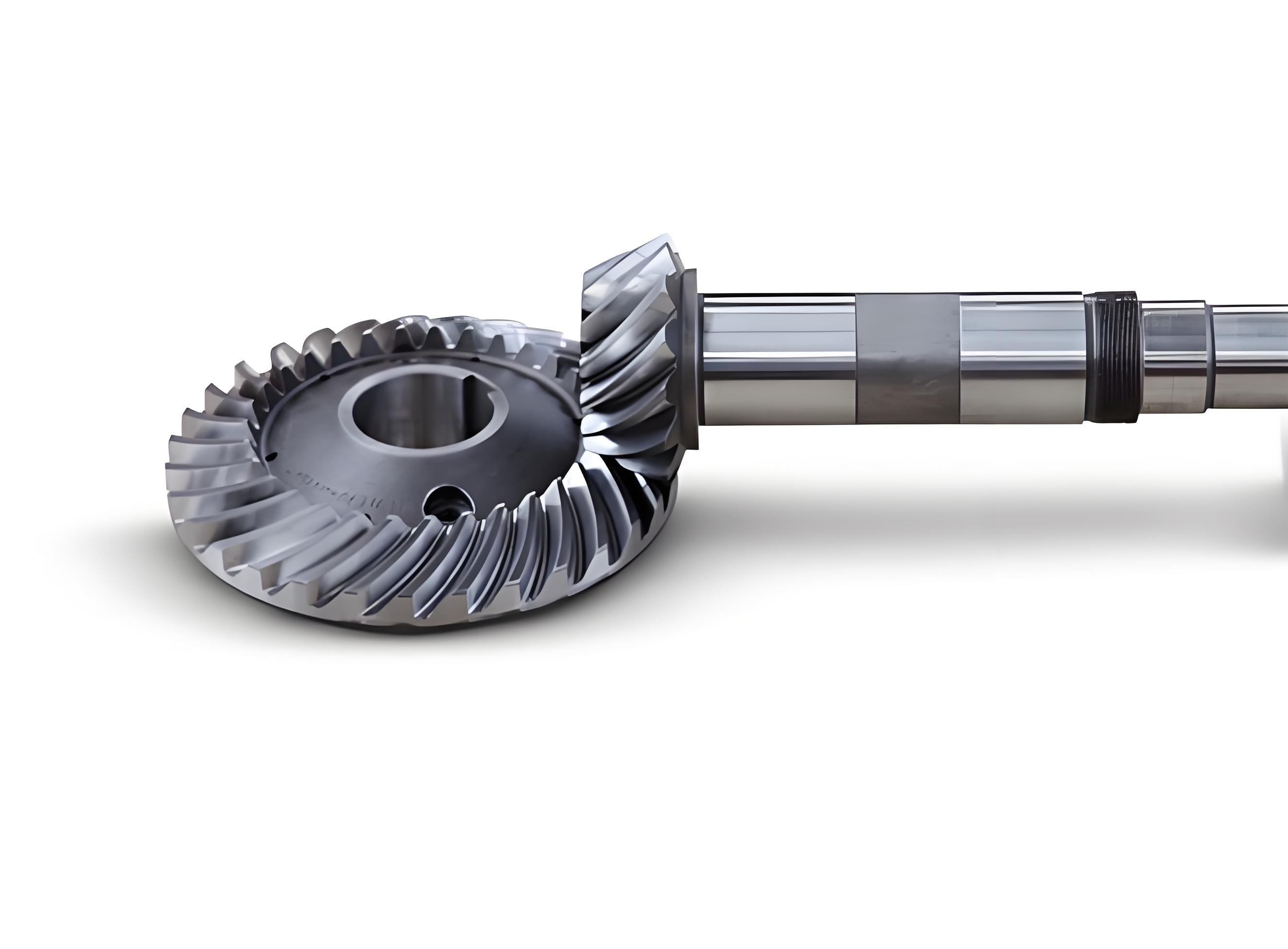
In this article, I present a comprehensive study on the dynamic contact analysis of spiral bevel gears using a flexible multibody approach. Spiral bevel gears are critical components in automotive and aerospace applications, where high-speed, high-load capacity, and reliability are paramount. The dynamic meshing contact characteristics significantly influence overall system performance, including transmission error patterns, dynamic design, and reliability analysis. Traditional methods often neglect the full-tooth model and multi-interface dynamic contact, leading to inaccurate predictions. Here, I develop a methodology based on digital tooth surfaces to simulate the precise three-dimensional dynamic contact behavior of spiral bevel gears, incorporating elastic deformations and multi-flexible body interactions. This approach provides a more realistic representation of gear transmission dynamics, offering insights for advanced design and optimization.
The analysis begins with the digitization of spiral bevel gear tooth surfaces. Using the local synthesis method, I calculate precise spatial coordinate points for the gear tooth surfaces. This involves deriving equations for the cutting tool surface and transforming them into the gear body coordinate system. The tooth surface equation and meshing condition are expressed as follows. The radial position vector and normal vector of any point on the conical generating surface in the cutter coordinate system are given by:
$$r’_g(s_g, \theta_g) = \begin{bmatrix} (r_g \pm s_g \sin \alpha_g) \cos \theta_g \\ (r_g \pm s_g \sin \alpha_g) \sin \theta_g \\ -s_g \cos \alpha_g \end{bmatrix}$$
$$n’_g(\theta_g) = \begin{bmatrix} \cos \alpha_g \cos \theta_g \\ \cos \alpha_g \sin \theta_g \\ \pm \cos \alpha_g \end{bmatrix}$$
where \( r_g = R_u \pm P_{\omega2}/2 \) is the constant blade radius, \( R_u \) is the nominal cutter radius, \( P_{\omega2} \) is the point width, \( \alpha_g \) is the tool profile angle, and \( s_g \), \( \theta_g \) are coordinate parameters of the cutter surface. The “±” sign corresponds to the concave and convex sides of spiral bevel gears. Through coordinate transformations to the gear body system, the tooth surface equation \( r_g \) and normal vector \( n_g \) are obtained:
$$r_g(s_g, \theta_g, \psi_g) = A_{gb} A_{ba} A_{am} A_{mr} A_{ru} r’_g$$
$$n_g = A_{gb} A_{ba} A_{am} A_{mr} A_{ru} n’_g$$
Here, \( A_{ru} \), \( A_{mr} \), \( A_{am} \), \( A_{ba} \), and \( A_{gb} \) are transformation matrices between coordinate systems. The meshing equation is:
$$n_g \cdot v_g = 0$$
where \( v_g \) is the relative velocity between the gear and cutter at the contact point. Solving these equations yields the tooth surface described by parameters \( \theta_g \) and \( \psi_g \):
$$r_g(\theta_g, \psi_g) = [x_g \quad y_g \quad z_g]^T$$
with \( x_g \), \( y_g \), and \( z_g \) as coordinate components in the gear body system. Using MATLAB, I compute discrete points on the spiral bevel gear tooth surface, which are then used to reconstruct the surface via quadrilateral patch finite element meshing in Hypermesh. The mesh model consists of quadrilateral patches that form contact blocks for dynamic analysis. For each patch, the unit outward normal vector is calculated based on parametric coordinates. The position vector of any point on a quadrilateral patch in local coordinates is:
$$x”(\xi, \eta) = \sum_{k=1}^4 N_k(\xi, \eta) x”_k$$
where \( N_k(\xi, \eta) = \frac{1}{4}(1 + \xi \xi_k)(1 + \eta \eta_k) \) is the shape function, and \( (\xi_k, \eta_k) \) are local coordinates of the nodes. The outward normal vector is:
$$n” = \frac{\partial x”(\xi, \eta)}{\partial \xi} \times \frac{\partial x”(\xi, \eta)}{\partial \eta}$$
and the unit outward normal and tangent vectors are:
$$n”_n = n” / \|n”\|$$
$$\tau”_1 = \frac{\partial x”(\xi, \eta)}{\partial \xi} / \left\| \frac{\partial x”(\xi, \eta)}{\partial \xi} \right\|$$
$$\tau”_2 = n”_n \times \tau”_1$$
To model dynamic contact, I implement a search algorithm using bounding boxes and a node-to-surface approach. The position vector of any point on flexible spiral bevel gear \( i \) is expressed in terms of reference frame coordinates and nodal deformations:
$$r^e_{ij} = r_{ig} + A^i_g (q^i_{g0} + S_{ij} q^i_{gf})$$
where \( r_{ig} \) is the position vector of the floating body frame origin, \( A^i_g \) is the orientation transformation matrix, \( q^i_{g0} \) is the nodal coordinate vector in undeformed state, and \( q^i_{gf} \) is the nodal deformation vector. For global contact search, bounding boxes are used to identify potential contact pairs. The position vector of bounding box origin in inertial frame is:
$$r_{ibb} = r_{ig} + A^i_g r’_{ibb}$$
and nodal positions in undeformed state are:
$$r^e_{ij0} = r_{ibb} + A^i_{bb} r”^{ibb}_{j0}$$
In local search, the relative position vector between a slave node on gear \( g1 \) and a master node on gear \( g2 \) is:
$$d^{e}_{lkj} = r^e_{2j} – r^e_{1j} = [r_{2g} + A^2_g (q^2_{g0} + S_{ij} q^2_{gf})] – [r_{1g} + A^1_g (q^1_{g0} + S_{ij} q^1_{gf})]$$
The normal gap between a slave node and a master surface is computed by projecting this vector onto the unit outward normal of the target patch:
$$g^{be}_{lkj} = d”^{be}_{lkj} \cdot n”_{jn}$$
where \( d”^{be}_{lkj} \) is the relative vector in local coordinates. Contact occurs when \( g \geq 0 \), and the penetration depth is:
$$\delta = d” \cdot n”_n$$
For contact force calculation, I employ a penalty-based hysteresis model. The normal contact force on spiral bevel gear tooth surfaces is:
$$F_{gn} = K_{gc} \delta^{1.5} + C_{gc} \dot{\delta}$$
where \( K_{gc} \) and \( C_{gc} \) are the average Hertzian contact stiffness and damping at the pitch point. The frictional force follows Coulomb’s law:
$$F_{g\mu} = \mu(v) F_{gn}$$
with friction coefficient \( \mu(v) \) varying smoothly between static and dynamic values based on relative tangential velocity \( v_{g\tau} \). The force distribution on a quadrilateral patch uses weight factors based on area interpolation, ensuring that the total normal force is shared among nodes:
$$F_{gn} = \sum_{i=1}^4 f_i$$
where \( f_i = \omega’_i F_{gn} \) and \( \omega’_i \) are weight factors derived from triangular areas within the patch.
The flexible multibody dynamics of spiral bevel gears are governed by the following equations of motion:
$$\begin{bmatrix} M_g & \Phi^T_{q_g} \\ \Phi_{q_g} & 0 \end{bmatrix} \begin{bmatrix} \ddot{q}_g \\ \lambda_g \end{bmatrix} = \begin{bmatrix} F \\ \eta \end{bmatrix}$$
where \( M_g \) is the mass matrix, \( q_g = [q^1_g \quad q^2_g]^T \) is the generalized coordinate vector, \( F \) is the generalized force vector, \( \Phi_{q_g} \) is the constraint Jacobian, \( \lambda_g \) is the Lagrange multiplier vector, and \( \eta \) encompasses constraint terms. This model is implemented in ADAMS/MaxFlex, integrating the quadrilateral patch contact blocks for high-fidelity simulation of spiral bevel gears.
To validate the methodology, I analyze a case study with spiral bevel gears having design parameters as summarized in the table below. The gears are made of steel with elastic modulus \( E = 2.1 \times 10^{11} \, \text{N/mm}^2 \) and Poisson’s ratio \( \nu = 0.3 \). The contact stiffness at the pitch point is \( K_{gc} = 7.2 \times 10^5 \, \text{N/mm}^{1.5} \). A torque load \( T_{zge} = 100 \, \text{N·m} \) is applied to the driven gear, with a mesh frequency of \( f = 1000 \, \text{Hz} \) and single-tooth contact time \( T_z = 0.001 \, \text{s} \). The driving gear is accelerated using a step function to reach \( 3000 \, \text{r/min} \).
| Parameter | Symbol | Driving Gear | Driven Gear |
|---|---|---|---|
| Module at Large End | \( m \) | 3.5 mm | 3.5 mm |
| Number of Teeth | \( z \) | 20 | 20 |
| Normal Pressure Angle | \( \alpha \) | 20° | 20° |
| Mean Spiral Angle | \( \beta \) | 35° | 35° |
| Face Width | \( b \) | 15 mm | 15 mm |
| Pitch Cone Angle | \( \gamma \) | 45° | 45° |
| Addendum Cone Angle | \( \psi_e \) | 49.198° | 49.198° |
| Dedendum Cone Angle | \( \psi_i \) | 40.802° | 40.802° |
| Outer Cone Distance | \( L_e \) | 49.497 mm | 49.497 mm |
| Spiral Direction | — | Right (R) | Left (L) |
| Radial Modification Coefficient | \( K_1 \) | 0 | 0 |
| Tangential Modification Coefficient | \( K_2 \) | 0.007 | -0.007 |
| Clearance | \( c \) | 0.188 mm | 0.188 mm |
| Fillet Radius | \( r_c \) | 0.2 mm | 0.2 mm |
| Cutter Diameter | \( d_c \) | 88.9 mm | 88.9 mm |
The dynamic transmission characteristics are evaluated. For flexible spiral bevel gears, the driven gear angular velocity oscillates with a small amplitude around 3000 r/min, whereas rigid gear models show larger fluctuations. The rotation angle error for flexible gears is periodic and smaller, indicating smoother operation. During meshing, up to three pairs of teeth engage simultaneously, leading to dynamic contact forces that peak during tooth entry and exit. The table below compares key dynamic metrics between rigid and flexible spiral bevel gear models.
| Metric | Rigid Spiral Bevel Gears | Flexible Spiral Bevel Gears |
|---|---|---|
| Angular Velocity Fluctuation | Larger amplitude | Smaller amplitude (~12 r/min) |
| Rotation Angle Error | Higher | Lower, periodic |
| Dynamic Contact Force | Lower due to no edge contact | Higher due to edge contact |
| Constraint Forces (Resultant) | Underestimated | Higher, periodic fluctuations |
| Radial Force \( F_X \) | Minimum reference | Cyclic with ~2180 N amplitude |
| Radial Force \( F_Y \) | Maximum reference | Cyclic with ~1850 N amplitude |
| Axial Force \( F_Z \) | Lower | Higher amplitude |
The dynamic contact forces on adjacent tooth surfaces reveal that flexible spiral bevel gears experience edge contact at the tooth addendum and toe regions, leading to higher contact forces compared to rigid gears. The constraint forces at the driven gear bearings also show greater magnitudes and cyclic variations, emphasizing the importance of considering elasticity in spiral bevel gear systems.
Stress analysis further highlights the impact of edge contact. The maximum von Mises stress on spiral bevel gear tooth surfaces occurs during startup and stabilizes into periodic peaks corresponding to single-tooth engagement. Stress patterns indicate that the dedendum at the large end bears higher stress, while the mid-face region shows stable stress distribution. Edge contact at the addendum, especially at the mid-addendum, results in prolonged high-stress periods. The following equations summarize stress-related observations, where \( \sigma_v \) denotes von Mises stress:
$$\sigma_{v,\text{max}} = f(T, \delta, \text{edge contact})$$
For nodes along the tooth width, stress varies as:
$$\sigma_v(x) = \sigma_0 + \Delta \sigma \sin(2\pi f t + \phi)$$
with \( x \) being the position from large to small end. The maximum stress during single-tooth contact for adjacent teeth shows distinct patterns due to dynamic load sharing. A table of stress values at critical locations over one mesh cycle illustrates this behavior.
| Tooth Pair | Location of Max Stress | Stress Magnitude (MPa) | Duration of High Stress |
|---|---|---|---|
| Pair 1 | Addendum Mid | 450-500 | ~60% of contact time |
| Pair 2 | Toe Region | 400-450 | ~40% of contact time |
| Pair 3 | Face Mid | 350-400 | ~50% of contact time |
Edge contact in spiral bevel gears alters load distribution, with addendum edge contact showing cyclic patterns over multiple teeth. The maximum stress during edge contact for ten adjacent teeth reveals a periodic trend every five teeth, underscoring the repetitive nature of meshing in spiral bevel gears. This phenomenon is critical for durability analysis, as edge contact can accelerate fatigue and failure.
In conclusion, the flexible multibody contact dynamics analysis for spiral bevel gears based on digital tooth surfaces provides a robust framework for simulating real-world gear behavior. I demonstrate that elastic deformations significantly influence transmission error, dynamic contact forces, and constraint reactions, which are underestimated in rigid-body models. Edge contact, particularly at the addendum, plays a pivotal role in stress distribution and load capacity. The methodology integrates precise tooth surface modeling, advanced contact search algorithms, and penalty-based force calculations, enabling high-fidelity predictions. This work contributes to the dynamic design and optimization of spiral bevel gear systems, ensuring enhanced performance and reliability in demanding applications. Future research could extend this approach to include thermal effects, lubrication, and manufacturing imperfections for even more comprehensive analysis of spiral bevel gears.