
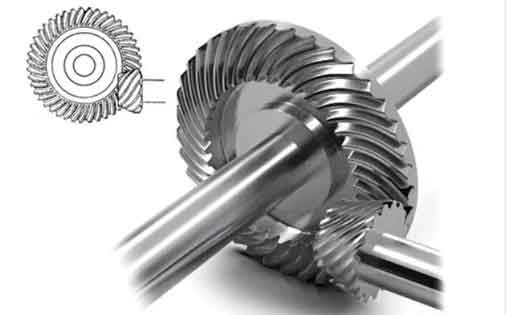
As critical components for power transmission in demanding applications, the performance of spiral bevel gears is paramount. Traditional design methodologies often fail to fully utilize the gear tooth surface, leading to pronounced issues with noise and strength under high-speed and heavy-load conditions. A primary limitation lies in the conventional contact path, which typically results in a low contact ratio and consequently poor load distribution. This research investigates an advanced design paradigm focused on actively controlling the inclination and length of the contact path to achieve high contact ratio spiral bevel gears. The core hypothesis is that a strategically inclined contact path promotes superior load sharing among multiple tooth pairs, thereby reducing the maximum contact and bending stresses and enhancing overall performance. This article presents a comprehensive analysis, integrating numerical simulation and experimental validation, to quantify the profound influence of contact path orientation on the stress state of spiral bevel gears.
Design Philosophy and Gear Geometry
The fundamental goal is to increase the transverse contact ratio of spiral bevel gears by tilting the path of contact across the tooth face. This is achieved through the local synthesis method, which allows for the manipulation of the contact path geometry while keeping the basic gear blank parameters constant. Three distinct designs are developed, characterized by their contact path inclination angles. The common baseline geometric parameters for all gear sets are listed in Table 1.
| Parameter | Pinion | Gear |
|---|---|---|
| Module (mm) | 5.5 | 5.5 |
| Number of Teeth | 11 | 45 |
| Pressure Angle (°) | 20 | 20 |
| Mean Spiral Angle (°) | 35 | 35 |
| Hand of Spiral | Left | Right |
| Addendum Coefficient | 0.85 | 0.85 |
| Tip Clearance Coefficient | 0.25 | 0.25 |
| Radial Shift Coefficient | +0.24 | -0.24 |
To realize the different contact paths, only the pinion machine-tool settings are modified. The gear machining parameters remain identical for all three designs. The specific settings for generating the concave side of the pinion for each design case are detailed in Table 2. The key outcome variable is the angle between the contact path on the gear tooth and the root line, which defines the design cases: Normal Inclination, Medium Inclination, and High Inclination.
| Setting Parameter | Gear (Fixed) | Pinion Concave Side (Normal Inclination) | Pinion Concave Side (Medium Inclination) | Pinion Concave Side (High Inclination) |
|---|---|---|---|---|
| Cutter Blade Point Radius (mm) | 114.30 | 114.30 | 114.30 | 114.30 |
| Cutter Point Width (mm) | 3.81 | 3.81 | 3.81 | 3.81 |
| Workpiece Install. Angle (°) | 58.240 | 21.868 | 21.952 | 22.036 |
| Swivel Angle (°) | 50.149 | 52.497 | 52.373 | 52.249 |
| Cradle Angle (°) | 68.205 | 37.351 | 37.484 | 37.617 |
| Machine Center to Back (mm) | 0.000 | 0.000 | 0.000 | 0.000 |
| Sliding Base (mm) | 0.127 | -0.254 | -0.216 | -0.178 |
| Ratio of Roll | 2.0811 | 1.5781 | 1.5769 | 1.5757 |
Analytical Framework: TCA, LTCA, and Stress Evaluation
The evaluation of meshing performance and stress state employs a multi-step computational procedure, combining Tooth Contact Analysis (TCA), Loaded Tooth Contact Analysis (LTCA), and finite element methods.
Tooth Contact Analysis (TCA)
TCA simulates the unloaded kinematic meshing of the spiral bevel gears. It determines the path of contact, transmission errors, and crucially, the principal curvatures and directions at each instantaneous point of contact. For a given contact point $k$, TCA provides the principal curvatures $\kappa_{1}^{(k)}$, $\kappa_{2}^{(k)}$ for the pinion and $\kappa_{1}^{(g)}$, $\kappa_{2}^{(g)}$ for the gear, as well as the angle $\phi^{(k)}$ between their principal directions. These geometric parameters are essential for subsequent contact stress calculation.
Loaded Tooth Contact Analysis (LTCA)
LTCA extends TCA by simulating the elastic deformation of the gear teeth under load. It solves for the load distribution along the instantaneous contact lines (approximated by the major axes of contact ellipses) by enforcing compatibility of deformations. The output is the detailed load distribution across the tooth surface for each meshing position, including the length of the contact ellipse semi-axis $a^{(k)}$ and the normal load $P^{(k)}$ carried by that contact ellipse. LTCA also provides the load sharing ratio among simultaneous contacting tooth pairs, which directly defines the contact ratio under load.
Contact Stress Calculation
Traditional empirical formulas, such as those from AGMA, are often based on nominal conditions at the pitch point and cannot accurately reflect the complex contact conditions in high-contact-ratio spiral bevel gears with modified topography. Therefore, a semi-analytical approach combining LTCA results with Hertzian theory is adopted.
For each loaded contact point $k$ identified by LTCA, the maximum contact pressure $\sigma_{H, max}^{(k)}$ at the center of the contact ellipse is calculated using the classical Hertz formula for general curved surfaces:
$$ \sigma_{H, max}^{(k)} = \frac{3P^{(k)}}{2\pi a^{(k)}b^{(k)}} $$
where $P^{(k)}$ is the normal load, and $a^{(k)}$ and $b^{(k)}$ are the semi-major and semi-minor axes of the contact ellipse, respectively. The semi-minor axis $b^{(k)}$ is derived from the contact geometry:
$$ \frac{1}{A^{(k)}} + \frac{1}{B^{(k)}} = \frac{1}{2} \left( \frac{1}{R_{1}^{(k)}} + \frac{1}{R_{1}’^{(k)}} + \frac{1}{R_{2}^{(k)}} + \frac{1}{R_{2}’^{(k)}} \right) $$
$$ \frac{1}{{A^{(k)}}^2} = \frac{1}{4} \left[ \left( \frac{1}{R_{1}^{(k)}} – \frac{1}{R_{1}’^{(k)}} \right)^2 + \left( \frac{1}{R_{2}^{(k)}} – \frac{1}{R_{2}’^{(k)}} \right)^2 + 2 \left( \frac{1}{R_{1}^{(k)}} – \frac{1}{R_{1}’^{(k)}} \right) \left( \frac{1}{R_{2}^{(k)}} – \frac{1}{R_{2}’^{(k)}} \right) \cos 2\phi^{(k)} \right] $$
Here, $A^{(k)}$ and $B^{(k)}$ are related to the relative curvature, and $R_{i}^{(k)}, R_{i}’^{(k)}$ are the principal radii of curvature. The elliptic integrals needed to find $a^{(k)}$ and $b^{(k)}$ from $A^{(k)}$ and $B^{(k)}$ are solved numerically. This method allows for the calculation of the complete contact stress history for any point on the tooth flank of the spiral bevel gears.
Bending Stress Calculation Using the Stress Influence Matrix Method
Calculating the time-varying bending stress at the tooth root via direct transient finite element analysis is computationally prohibitive. The Stress Influence Matrix (SIM) method offers an efficient alternative. First, a detailed finite element model of a single gear tooth segment is created. The tooth surface is discretized into $M$ potential load application points corresponding to the discrete points along the contact ellipses from LTCA.
A unit normal load is applied sequentially to each of these $M$ surface points. For each unit load case $j$ ($j=1,…,M$), the resulting stress tensor $\{\sigma\}_{j}^{i}$ at every node $i$ in the tooth root fillet region is computed and stored. This forms the Stress Influence Matrix $[S]$, where each element $S_{ij}$ represents the stress component at root node $i$ due to a unit load at surface point $j$.
During the meshing cycle, LTCA provides the actual load vector $\{F\}$, containing the loads $F_j$ at each of the $M$ surface points at every meshing instant. The bending stress history at any root node $i$ is then obtained by a simple superposition (linear elasticity assumed):
$$ \{\sigma(t)\}^{i} = [S]^{i} \cdot \{F(t)\} $$
where $\{\sigma(t)\}^{i}$ is the time-varying stress tensor at node $i$. The von Mises or principal stress can then be computed from this tensor throughout the meshing cycle to find the maximum bending stress. This method requires only $M$ static FE solves to generate $[S]$, after which stress histories for any loading condition are obtained via fast matrix multiplication.
Numerical Results and Comparative Analysis
The three spiral bevel gear designs (Normal, Medium, and High Inclination) were analyzed under a constant torque of $T = 1000$ Nm applied to the gear. The key performance metrics are summarized below.
Contact Path, Load Distribution, and Contact Ratio
- Normal Inclination Design: The contact path forms an angle of approximately $10^\circ$ with the root line. The loaded contact analysis reveals a low contact ratio of about $1.4$. A significant portion of the tooth surface remains unloaded, and the load sharing diagram shows that a single tooth pair carries 100% of the load for nearly 60% of the meshing cycle.
- Medium Inclination Design: The contact path angle increases to $22^\circ$. The contact ratio improves to approximately $1.8$. The load distribution across the tooth face becomes more uniform, and the period during which a single tooth pair carries the full load is reduced, occurring only near the pitch point.
- High Inclination Design: The contact path is significantly tilted at $38^\circ$. This yields a high contact ratio exceeding $2.0$. The tooth surface is utilized almost entirely, and the load sharing is excellent. The maximum load borne by any single tooth pair drops to only about 60% of the total torque.
Contact Stress History
The maximum contact stress $\sigma_{H, max}$ was calculated for each sequential contact position throughout the mesh cycle using the integrated TCA/LTCA/Hertz method.
- For the Normal Inclination spiral bevel gears, the stress peaks at around $1450$ MPa on the gear convex side. This peak occurs precisely when entering the single-pair contact zone, where the load per tooth is highest.
- For the Medium Inclination design, the peak contact stress shifts towards the center of the tooth face and reduces in magnitude to approximately $1320$ MPa, a reduction of about 9%.
- The High Inclination spiral bevel gears demonstrate the most significant benefit. The dramatic improvement in load sharing causes the maximum contact stress to fall to around $1150$ MPa, representing a reduction of over 20% compared to the traditional design.
Bending Stress History
The bending stress at the critical point on the tensile side (gear convex fillet) was computed using the SIM method.
- The Normal Inclination design exhibits a peak bending stress of $380$ MPa.
- The stress reduces to $340$ MPa for the Medium Inclination spiral bevel gears, an 11% reduction.
- The High Inclination spiral bevel gears achieve the lowest peak bending stress of $300$ MPa, which is 21% lower than the baseline design. The stress history curve is also noticeably smoother, indicating more stable and favorable loading conditions.
Experimental Validation of Bending Stress
To validate the numerical predictions, an experimental test was conducted on the three physical gear pairs. The primary objective was to measure the dynamic bending strain at the tooth root under various operating conditions.
Test Rig and Methodology
A back-to-back gear test rig was utilized. The driving motor delivered power to the test pinion via a torque/speed sensor. The test gearbox housed the specimen spiral bevel gears. Load was applied through a magnetic powder brake attached to the output shaft. Strain gauges were bonded at the midpoint of the face width on the tensile-side fillet (non-mating area) of the gear convex side. A half-bridge circuit with temperature compensation was used. Signals were transmitted via a slip ring assembly, conditioned by a strain amplifier, and recorded by a data acquisition system.
Experimental Results and Comparison
The tests were performed at a constant gear speed of 1000 rpm with varying load torques. Since the exact maximum stress location is difficult to instrument, the measured strain values (proportional to stress) are used for comparative analysis. Crucially, the same gear blank and identical strain gauge positioning were used for all tests, eliminating positioning errors and enabling direct comparison of the output voltage from the strain amplifier. The relative voltage under the same load torque is proportional to the relative bending stress.
Table 3 presents the measured strain signal (in voltage) for the three spiral bevel gear designs under two load conditions. The stress reduction rate is calculated relative to the Normal Inclination design.
| Gear Torque (Nm) | Normal Inclination (Baseline) | Medium Inclination | Stress Reduction | High Inclination | Stress Reduction |
|---|---|---|---|---|---|
| 500 | 1.00 (Ref.) | 0.89 | 11% | 0.78 | 22% |
| 1000 | 1.00 (Ref.) | 0.88 | 12% | 0.77 | 23% |
The experimental data conclusively supports the numerical findings. The spiral bevel gears with a highly inclined contact path consistently show a reduction in root bending stress of 22-23%, while the medium inclination design shows an 11-12% reduction. This confirms that increasing the contact ratio through contact path control effectively lowers the peak load per tooth, leading to a direct and measurable improvement in bending strength.
Conclusion
This integrated study demonstrates that the orientation of the contact path is a critical design parameter with a profound impact on the mechanical performance of spiral bevel gears. By deliberately increasing the inclination of the contact path, a high contact ratio condition can be achieved. The numerical simulations, combining advanced loaded tooth contact analysis with Hertzian contact theory and a finite-element-based stress influence matrix method, consistently predict significant reductions in both maximum contact pressure and tooth root bending stress. These theoretical predictions are strongly validated by experimental strain measurements on physically manufactured gears.
The underlying mechanism is the superior load-sharing capability of high-contact-ratio spiral bevel gears. A more inclined contact path ensures that a greater number of tooth pairs are in contact simultaneously during the meshing cycle. This distributes the transmitted load more evenly across the tooth surface and among the teeth, thereby reducing the peak load intensity on any single tooth pair. The result is a spiral bevel gear design that is not only quieter due to reduced transmission error fluctuations but also demonstrably stronger and more reliable, offering a clear solution for high-performance, heavy-duty power transmission applications.