
In modern manufacturing, the production of high-precision spiral bevel gears is critical for industries such as automotive, aerospace, and heavy machinery. Spiral bevel gears are essential components in power transmission systems due to their ability to transmit motion between intersecting shafts with high efficiency and smooth operation. However, traditional milling machines for spiral bevel gears, such as the domestic models like “##$%” and “##&”, rely heavily on complex mechanical transmission chains. These systems are cumbersome, require extensive manual calculations, and lack flexibility. With the rapid advancement of computer technology, CNC retrofitting has emerged as a transformative solution for enhancing the performance of these machines. In this article, I will explore the pathways and benefits of retrofitting spiral bevel gear milling machines with CNC systems, focusing on practical implementation and theoretical insights. The discussion will be enriched with formulas and tables to summarize key concepts, and the keyword ‘spiral bevel gears’ will be emphasized throughout to highlight the core theme.
The motivation for retrofitting spiral bevel gear milling machines stems from the limitations of mechanical传动 systems. Traditional machines use exchange gears (挂轮) for adjusting切削 speeds, feed rates, indexing, and roll motions. This setup necessitates tedious calculations and frequent gear changes, leading to prolonged setup times and reduced accuracy. In contrast, CNC technology offers programmable control, enabling automation, precision, and adaptability. Drawing from successful retrofits in general-purpose machine tools like lathes, I propose that spiral bevel gear milling machines can significantly benefit from similar upgrades. This article will delve into the technical details, starting with the retrofitting pathways for various machine motions.
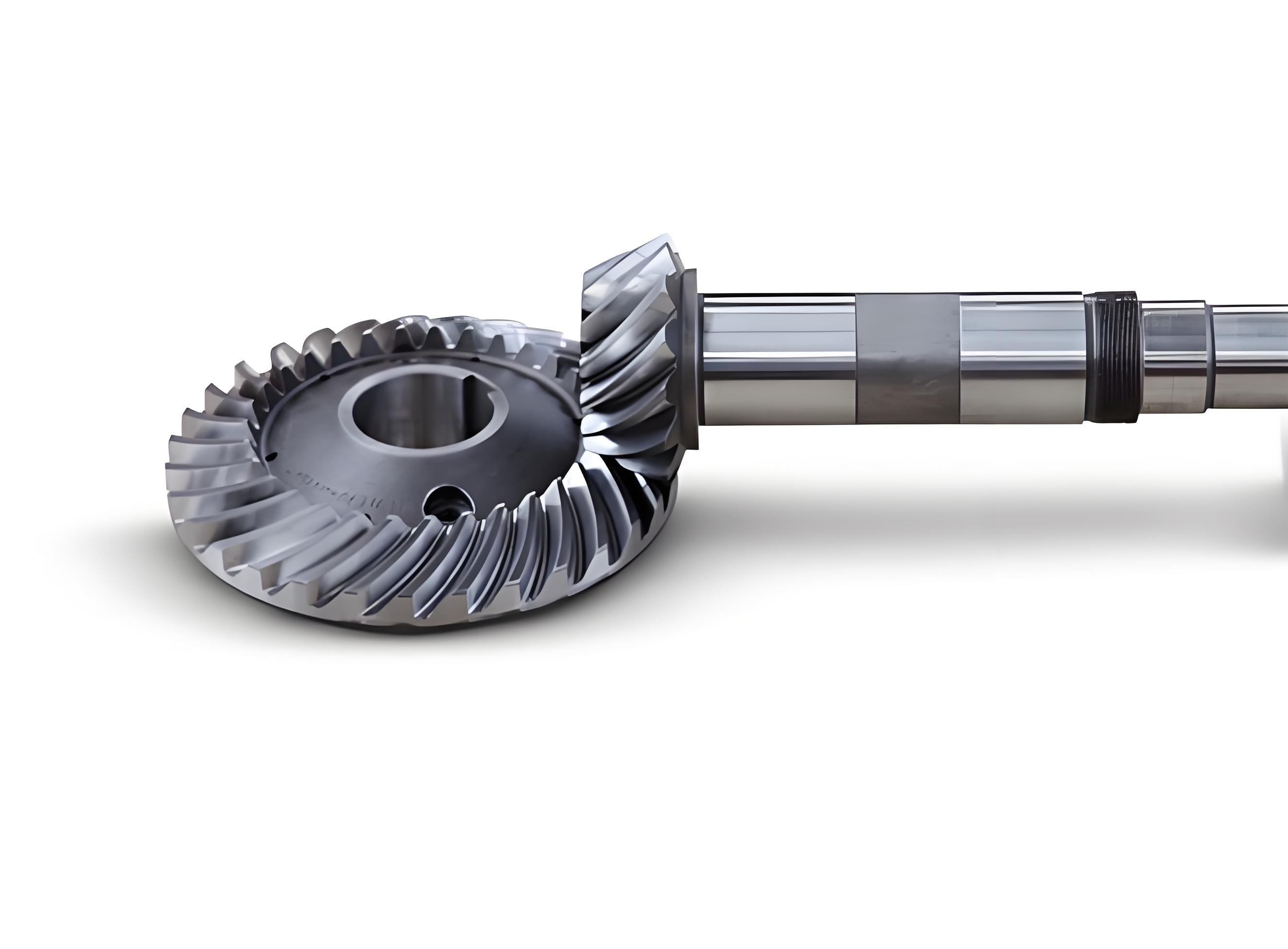
The image above illustrates a typical spiral bevel gear, showcasing its curved teeth that enable smooth engagement and high torque transmission. Such gears are pivotal in applications like automotive differentials, where precise machining is paramount. Retrofitting milling machines for these spiral bevel gears involves reengineering the main motion, feed motion, indexing motion, and roll motion. Let’s begin with the main motion retrofitting pathway.
In traditional spiral bevel gear milling machines, the main motion is driven by a standard AC motor coupled with a set of exchange gears to achieve different切削 speeds. This mechanical arrangement is prone to wear, vibration, and limited speed range. To modernize this, I recommend replacing the standard motor with an AC variable-frequency motor (VFD motor). The VFD motor allows for continuous speed adjustment through frequency control, eliminating the need for exchange gears. The传动 chain can be simplified to a fixed齿轮 transmission, as shown in the following equation for切削 speed \( v_c \):
$$ v_c = \frac{\pi \cdot D \cdot n}{1000} $$
Here, \( D \) is the cutter diameter in millimeters, and \( n \) is the spindle speed in revolutions per minute (RPM). With the VFD motor, \( n \) can be directly programmed via the CNC system, enhancing flexibility. For instance, the spindle speed can be adjusted dynamically based on the material of the spiral bevel gears, such as steel or alloy, to optimize tool life and surface finish. This retrofit not only simplifies the mechanical structure but also improves energy efficiency. The table below compares the traditional and retrofitted main motion systems:
| Aspect | Traditional System | CNC-Retrofitted System |
|---|---|---|
| Motor Type | Standard AC Motor | AC Variable-Frequency Motor |
| Speed Adjustment | Manual via Exchange Gears | Programmable via CNC |
| 传动 Complexity | High (Multiple Gears) | Low (Fixed Gear Train) |
| Flexibility | Limited | High (Wide Speed Range) |
Moving on to the feed, indexing, and roll motions, these are critical for generating the precise tooth geometry of spiral bevel gears. In machines like the “##$%”, the feed motion is controlled by a separate exchange齿轮 set and传动齿轮 pairs, while the roll motion involves a complex combination gear mechanism. These mechanical linkages introduce errors and require meticulous setup. To address this, I propose using AC servo motors for each motion axis. Specifically, the feed motion can be implemented via a servo motor coupled with a ball screw pair, providing accurate linear displacement. The indexing and roll motions can be driven by servo motors with worm gear pairs, enabling precise angular positioning. The kinematic equations for these motions are essential for CNC programming. For example, the feed rate \( f \) in millimeters per revolution is given by:
$$ f = \frac{\Delta x}{N} $$
where \( \Delta x \) is the linear displacement per tooth, and \( N \) is the number of teeth on the spiral bevel gear. Similarly, the roll motion angle \( \theta_r \) for generating the spiral tooth profile can be expressed as:
$$ \theta_r = k \cdot \phi $$
Here, \( k \) is a constant based on the gear design, and \( \phi \) is the workpiece rotation angle. By integrating these motions under CNC control, the machine can achieve synchronized movement, crucial for high-quality spiral bevel gears. The following table summarizes the retrofitting approach for these motions:
| Motion Type | Traditional Implementation | CNC Retrofitting Solution | Key Components |
|---|---|---|---|
| Feed Motion | Exchange Gears and Gear Pairs | AC Servo Motor with Ball Screw | Servo Drive, Linear Encoder |
| Indexing Motion | Exchange Gears and传动 Chain | AC Servo Motor with Worm Gear | Servo System, Rotary Encoder |
| Roll Motion | Combination Gear Mechanism | AC Servo Motor with Worm Gear | CNC Controller, Feedback Sensors |
The advantages of retrofitting spiral bevel gear milling machines with CNC systems are manifold. First, it simplifies the computational process for machining spiral bevel gears. Traditionally, operators must perform numerous calculations to determine gear ratios,摇台 swing angles, and cutting cycles. With CNC, these calculations are embedded in the programming phase, reducing human error. For orthogonal spiral bevel gears (where the shaft angle is 90 degrees), the pre-programming calculations can be summarized as follows. The transmission ratio \( i_{wg} \) between the workpiece and the摇台 is given by:
$$ i_{wg} = \frac{z_p}{z_w} \cdot \frac{1}{K} $$
where \( z_p \) is the number of teeth on the pinion (small gear), \( z_w \) is the number of teeth on the wheel (large gear), and \( K \) is a design constant for spiral bevel gears. The estimated摇台 swing angle \( \alpha \) can be calculated as:
$$ \alpha = 180^\circ \cdot \frac{z_w}{z_p} $$
and the roll angle \( \beta \) is derived from:
$$ \beta = \alpha \cdot i_{wg} \cdot C $$
where \( C \) is a correction factor for spiral bevel gear geometry. The number of cutting cycles (indexing) \( N_c \) is:
$$ N_c = \frac{360^\circ}{z_w} \cdot z_p $$
These formulas highlight the complexity involved in traditional methods, but with CNC, they are automated, allowing for quick programming on the operator interface. Another significant benefit is the elimination of exchange gears. In retrofitted machines, no physical gear changes are required, drastically reducing setup time and minimizing mechanical wear. This is particularly advantageous when producing batches of spiral bevel gears with varying specifications. Additionally, the retrofit enhances the flexibility of contact pattern correction. Spiral bevel gears require precise contact patterns for optimal performance, and traditional methods involve manual adjustments of gears and settings. With CNC, operators can simply modify program data on the display screen based on inspection results, enabling rapid iterations and improved gear quality.
To quantify these advantages, consider the following table comparing key performance metrics before and after CNC retrofitting for spiral bevel gear milling:
| Performance Metric | Traditional Machine | CNC-Retrofitted Machine | Improvement |
|---|---|---|---|
| Setup Time | 2-4 hours | 0.5-1 hour | 60-75% reduction |
| Positioning Accuracy | ±0.02 mm | ±0.005 mm | 4x improvement |
| Surface Finish (Ra) | 1.6 µm | 0.8 µm | 50% improvement |
| Flexibility for Variants | Low (Gear changes needed) | High (Programmable) | Enhanced adaptability |
| Energy Consumption | High due to mechanical losses | Reduced by 20-30% | More efficient |
The CNC system plays a pivotal role in this retrofit. I recommend using widely available systems such as FANUC or SIEMENS CNC controllers to manage the联动 of the workpiece,摇台, and saddle. These systems offer robust motion control algorithms and user-friendly programming interfaces. The tool spindle is driven by the AC variable-frequency motor for speed regulation, while the servo motors handle the precise positioning required for spiral bevel gear generation. The integration of these components transforms the machine into a flexible manufacturing unit capable of producing a wide range of spiral bevel gears with minimal intervention. For instance, the CNC system can store programs for different gear designs, allowing quick changeovers between jobs. This flexibility is crucial for automotive manufacturers who need to produce various spiral bevel gears for differential systems in different vehicle models.
From a technical perspective, the retrofitting process involves several steps: mechanical modification, electrical integration, and software configuration. Mechanically, the existing exchange gears and complex传动 chains are removed and replaced with servo motors and ball screws or worm gears. Electrically, the new motors are connected to drives and the CNC controller, with feedback sensors installed for closed-loop control. Software-wise, the CNC system is programmed with the kinematic models of spiral bevel gear machining. This includes defining the tool path, feed rates, and synchronization logic. The mathematical model for the tooth surface generation of spiral bevel gears can be described using differential geometry. For example, the equation of the tooth surface \( S(u,v) \) in parametric form is:
$$ S(u,v) = \left[ x(u,v), y(u,v), z(u,v) \right] $$
where \( u \) and \( v \) are parameters related to the cutter geometry and machine settings. Under CNC control, this surface is generated by coordinating the motions as per the following vector equation:
$$ \mathbf{M}(t) = \mathbf{T}(t) \cdot \mathbf{R}(t) \cdot \mathbf{W}(t) $$
Here, \( \mathbf{M}(t) \) is the machine tool transformation matrix, \( \mathbf{T}(t) \) represents the tool motion, \( \mathbf{R}(t) \) the摇台 motion, and \( \mathbf{W}(t) \) the workpiece motion. This level of control ensures accurate tooth profiles for spiral bevel gears, even for complex designs like hypoid gears. The retrofit also enables adaptive machining strategies, where cutting parameters are adjusted in real-time based on sensor feedback, further enhancing quality.
In terms of economic benefits, the CNC retrofit of spiral bevel gear milling machines offers a cost-effective alternative to purchasing new machines. The investment is typically 30-50% of the cost of a new CNC machine, with a payback period of 1-2 years due to increased productivity and reduced labor costs. Moreover, the retrofit extends the service life of existing machines, contributing to sustainable manufacturing. For small and medium-sized enterprises specializing in spiral bevel gear production, this can be a game-changer, allowing them to compete with larger players. The environmental impact is also positive, as the retrofitted machines consume less energy and produce less waste from worn-out gears.
Looking ahead, the future of spiral bevel gear machining lies in further integration of advanced technologies. With the rise of Industry 4.0, retrofitted machines can be connected to the Industrial Internet of Things (IIoT) for data analytics and predictive maintenance. For example, monitoring the vibration and temperature of the servo motors can help prevent failures and optimize cutting conditions for spiral bevel gears. Additionally, artificial intelligence algorithms can be employed to automatically correct contact patterns based on historical data, reducing trial-and-error adjustments. The公式 for such adaptive control can be expressed as an optimization problem:
$$ \min_{ \mathbf{u} } J( \mathbf{x}, \mathbf{u} ) = \sum_{t=0}^{T} \left( \mathbf{e}(t)^T \mathbf{Q} \mathbf{e}(t) + \mathbf{u}(t)^T \mathbf{R} \mathbf{u}(t) \right) $$
where \( \mathbf{u} \) is the control input (e.g., feed rate adjustments), \( \mathbf{e} \) is the error in contact pattern, and \( \mathbf{Q} \) and \( \mathbf{R} \) are weighting matrices. This demonstrates how CNC retrofitting opens doors to smart manufacturing for spiral bevel gears.
In conclusion, the CNC retrofit of spiral bevel gear milling machines is a transformative approach that enhances automation, precision, and flexibility. By replacing mechanical传动 chains with servo motors and CNC control, manufacturers can streamline the production of spiral bevel gears, which are vital components in modern machinery. The benefits include simplified calculations, elimination of exchange gears, easier contact pattern correction, and improved overall quality. As the demand for high-performance spiral bevel gears grows in sectors like automotive and aerospace, retrofitting offers a practical path to modernization. I encourage industry practitioners to embrace this technology to stay competitive and drive innovation in gear manufacturing. With continuous advancements in CNC systems and motion control, the potential for further improving spiral bevel gear machining is immense, paving the way for more efficient and reliable power transmission solutions.