
In modern engineering applications, such as aerospace and automotive transmissions, spiral bevel gears play a critical role due to their ability to transmit power between intersecting shafts with high efficiency and smooth operation. The complex geometry of spiral bevel gears, characterized by curved teeth and varying contact patterns, poses significant challenges in design and analysis. Traditional methods for studying tooth cutting and meshing often rely on rigid-body kinematics and differential geometry, which can be cumbersome and limited when dealing with non-conjugate points, installation errors, or loaded conditions. To address these limitations, I have developed a digital simulation approach that leverages numerical modeling and optimization techniques to analyze spiral bevel gears. This method not only simplifies the process but also enhances accuracy by directly describing tooth surfaces and meshing behavior without relying on explicit analytical forms. In this article, I will detail the principles of digital simulation for spiral bevel gears, covering tooth cutting and meshing processes, and demonstrate its application through examples, with an emphasis on using tables and formulas for clarity. Throughout, the term ‘spiral bevel gears’ will be frequently highlighted to underscore its relevance.
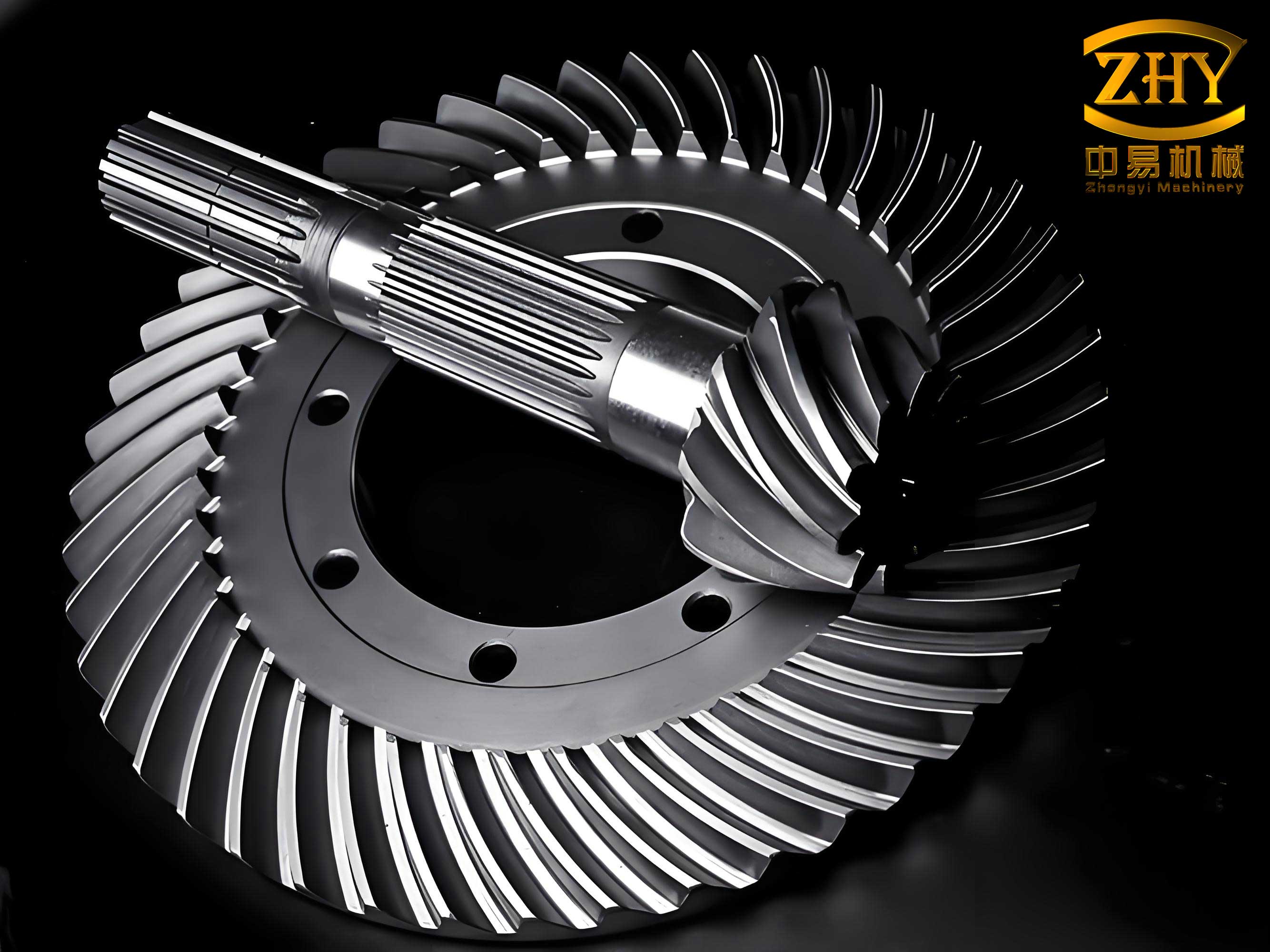
The digital simulation method I propose replaces conventional geometric conditions, such as the conjugate requirement expressed as $V^{(12)} \cdot n = 0$, with constrained optimization problems. This shift allows for a more flexible analysis, particularly in cases where ideal conjugate points do not exist due to manufacturing tolerances or operational deformations. For spiral bevel gears, the tooth surface is generated during cutting via a line-conjugate relationship between the workpiece and a cutter head, and during meshing, point-conjugate conditions determine contact patterns and transmission errors. By formulating these as numerical optimization tasks, I can derive a discrete numerical model of the tooth surfaces, which serves as the foundation for further analysis, including contact ellipse prediction and error curve generation. This approach is especially useful for spiral bevel gears used in high-performance applications, where precision and reliability are paramount.
To begin, let’s explore the tooth cutting simulation for spiral bevel gears. In this process, the tooth surface of a spiral bevel gear is generated by a hypothetical generating gear, often represented by a cutter head on a machine tool. The relationship between the workpiece (the gear being cut) and the generating surface is one of line conjugation, meaning that at any instant, a line of contact exists between them. Traditionally, this is described using coordinate transformations and the equation of meshing, but I recast it as a constrained extremum problem to facilitate numerical computation. For instance, when cutting the concave side of a right-hand spiral bevel pinion, I establish coordinate systems: a fixed system $\sigma_F$ on the machine cradle and a moving system $\sigma_1$ attached to the pinion. The generating surface $\Sigma_F$ is defined by parameters such as radial distance, pressure angle, and cutter rotation, with its position vector and normal vector expressed in $\sigma_F$ as follows:
$$ \mathbf{r}_F = \begin{bmatrix} x_F \\ y_F \\ z_F \end{bmatrix} = \begin{bmatrix} u_F \sin \alpha_F \cos(\theta_F – q_F + \phi_F) + s_F \cos(q_F – \phi_F) \\ u_F \sin \alpha_F \sin(\theta_F – q_F + \phi_F) – s_F \sin(q_F – \phi_F) \\ r_0 \cot \alpha_F – u_F \cos \alpha_F \end{bmatrix} $$
$$ \mathbf{n}_F = \begin{bmatrix} n_x \\ n_y \\ n_z \end{bmatrix} = \begin{bmatrix} \cos \alpha_F \cos(\theta_F – q_F + \phi_F) \\ \cos \alpha_F \sin(\theta_F – q_F + \phi_F) \\ \sin \alpha_F \end{bmatrix} $$
Here, $u_F$ and $\theta_F$ are surface parameters of the generating gear, $\alpha_F$ is the pressure angle, $r_0$ is the cutter radius, $s_F$ and $q_F$ represent radial and angular cutter settings, and $\phi_F$ is the rotation angle of the generating gear. For the pinion tooth surface $\Sigma_1$, points are described in $\sigma_1$ using coordinates $(R_1, L_1, \tau_1)$, where $R_1$ is the radial distance from the axis, $L_1$ is the axial coordinate from the pitch cone apex, and $\tau_1$ is the angular position. To simulate cutting, I transform $\mathbf{r}_F$ and $\mathbf{n}_F$ from $\sigma_F$ to $\sigma_1$ via a transformation matrix $M_{1F}$, which depends on the pinion rotation angle $\phi_1$:
$$ \mathbf{r}_F^{(1)} = M_{1F} \mathbf{r}_F, \quad \mathbf{n}_F^{(1)} = M_{1F} \mathbf{n}_F $$
At the cutting point, the position vectors must satisfy $\mathbf{r}_1 = \mathbf{r}_F^{(1)}$. However, instead of solving the conventional meshing equation, I treat this as an optimization problem: for a given $(R_1, L_1)$, find $\tau_1$ that minimizes the angular difference, subject to the constraint from the generating surface. Mathematically, this is expressed as:
$$ \tau_1 = \min_{\phi_1} \arctan\left( \frac{x_F^{(1)}}{y_F^{(1)}} \right) $$
This constrained optimization can be solved using numerical methods like mathematical programming, yielding a discrete set of points that form the numerical model of the pinion tooth surface. A similar process applies to the gear tooth surface $\Sigma_2$. This approach effectively captures the geometry of spiral bevel gears without requiring explicit analytical solutions, making it adaptable to various cutter profiles and machine settings. To summarize key parameters involved in cutting simulation for spiral bevel gears, I present the following table:
| Parameter | Symbol | Description | Typical Units |
|---|---|---|---|
| Cutter Radius | $r_0$ | Radius of the cutting tool head | mm |
| Pressure Angle | $\alpha_F$ | Angle defining tooth profile | degrees |
| Radial Setting | $s_F$ | Radial distance of cutter | mm |
| Angular Setting | $q_F$ | Angular position of cutter | radians |
| Generating Gear Rotation | $\phi_F$ | Rotation angle during cutting | radians |
| Pinion Rotation | $\phi_1$ | Workpiece rotation angle | radians |
| Surface Parameters | $u_F, \theta_F$ | Parameters for generating surface | unitless |
Once the numerical model of spiral bevel gears is established through cutting simulation, the next step is to analyze the meshing process. During operation, spiral bevel gears engage under point-conjugate conditions, where contact occurs at discrete points that move along the tooth surfaces. Traditional tooth contact analysis (TCA) relies on solving $V^{(12)} \cdot n = 0$, but this may fail in non-ideal scenarios. Instead, I formulate meshing as finding the closest points between the two tooth surfaces, which naturally accommodates mismatches and deformations. Consider the pinion surface $\Sigma_1$ and gear surface $\Sigma_2$, each defined in their respective coordinate systems. For meshing analysis, I transform $\Sigma_2$ into the pinion coordinate system $\sigma_1$, resulting in transformed position and normal vectors $\mathbf{r}_2^{(1)}$ and $\mathbf{n}_2^{(1)}$. To determine the initial contact point, I minimize the difference in normal vectors after rotating both gears by angles $\beta_1$ and $\beta_2$ around their axes:
$$ \min_{\beta_1, \beta_2} \| M(\beta_1, \mathbf{z}_1) \mathbf{n}_1 – M(\beta_2, \mathbf{z}_2) \mathbf{n}_2^{(1)} \| $$
Here, $M(\beta, \mathbf{z})$ denotes a rotation matrix around axis $\mathbf{z}$. If the position vectors also match after rotation, i.e., $M(\beta_1, \mathbf{z}_1) \mathbf{r}_1 = M(\beta_2, \mathbf{z}_2) \mathbf{r}_2^{(1)}$, then the point is conjugate. Otherwise, I compute installation adjustments—axial displacement $H$, offset $J$, and vertical shift $V$—by solving:
$$ \min \| M(\beta_1, \mathbf{z}_1) \mathbf{r}_1 – M(\beta_2, \mathbf{z}_2) \mathbf{r}_2^{(1)} – H \mathbf{z}_1 – J \mathbf{z}_2 – V (\mathbf{z}_1 \times \mathbf{z}_2) \| $$
These adjustments ensure that the computed point becomes the meshing point, typically at the center of the contact pattern. To simulate dynamic meshing, I increment the pinion rotation by $\delta \beta_1$ and find the corresponding gear rotation $\delta \beta_2$ and contact points by minimizing the distance between surfaces:
$$ \min \| M(\beta_1 + \delta \beta_1, \mathbf{z}_1) \mathbf{r}_1 – M(\beta_2 + \delta \beta_2, \mathbf{z}_2) \mathbf{r}_2^{(1)} – H \mathbf{z}_1 – J \mathbf{z}_2 – V (\mathbf{z}_1 \times \mathbf{z}_2) \| $$
This yields a series of contact points that form the contact path on the tooth surfaces of spiral bevel gears. For each point, I perform a local analysis to determine the contact ellipse. By fitting quadratic surfaces to the numerical model near the contact point, I approximate the tooth surfaces as:
$$ z = \frac{1}{2} K_x^{(1)} x^2 + G^{(1)} x y + \frac{1}{2} K_y^{(1)} y^2 $$
$$ z = \frac{1}{2} K_x^{(2)} x^2 + G^{(2)} x y + \frac{1}{2} K_y^{(2)} y^2 $$
where $K_x^{(i)}, K_y^{(i)}$, and $G^{(i)}$ are the principal curvatures and twist of surface $i$ at the contact point, obtained via numerical differentiation. Assuming a normal deformation $\Delta$ during meshing, the relative curvature leads to the contact ellipse equation in the tangent plane:
$$ \delta K_x x^2 + 2 \delta G x y + \delta K_y y^2 = 2 \Delta $$
Here, $\delta K_x = K_x^{(1)} – K_x^{(2)}$, $\delta K_y = K_y^{(1)} – K_y^{(2)}$, and $\delta G = G^{(1)} – G^{(2)}$. Solving this equation gives the semi-major axis $a$, semi-minor axis $b$, and orientation $\tau$ of the contact ellipse for spiral bevel gears. The collection of all such ellipses along the contact path represents the contact pattern, which is crucial for assessing gear performance. Additionally, transmission error, a key metric for spiral bevel gears, is computed from the kinematic relationship. When the pinion rotates uniformly, the gear may exhibit angular variations due to tooth flexibility and mismatches. The transmission error $\epsilon$ is given by:
$$ \epsilon = \delta \beta_2 + \frac{\Delta_y}{R_2} – \frac{\delta \beta_1}{i_{12}} $$
where $\Delta_y$ is the component of normal deformation along the gear axis, $R_2$ is the gear radius, and $i_{12}$ is the average gear ratio. Plotting $\epsilon$ against $\delta \beta_1$ produces the transmission error curve, which indicates the smoothness of meshing for spiral bevel gears. To encapsulate the meshing simulation parameters, I provide the following table:
| Parameter | Symbol | Description | Role in Meshing |
|---|---|---|---|
| Pinion Rotation | $\beta_1, \delta \beta_1$ | Angular position and increment | Drives meshing simulation |
| Gear Rotation | $\beta_2, \delta \beta_2$ | Angular response | Determines conjugate motion |
| Installation Adjustments | $H, J, V$ | Axial, offset, and vertical shifts | Account for assembly errors |
| Relative Curvatures | $\delta K_x, \delta K_y$ | Differences in principal curvatures | Define contact ellipse size |
| Relative Twist | $\delta G$ | Difference in surface twist | Influences ellipse orientation |
| Normal Deformation | $\Delta$ | Contact compliance | Affects ellipse dimensions |
| Transmission Error | $\epsilon$ | Angular deviation | Measures meshing quality |
To demonstrate the practical application of this digital simulation method for spiral bevel gears, I conducted an analysis on an aerospace gear pair. The primary parameters of these spiral bevel gears are listed below, which were used in the cutting simulation based on the SGM (Spread Gear Manufacturing) method:
| Parameter | Pinion (Gear 1) | Gear (Gear 2) |
|---|---|---|
| Number of Teeth | $z_1 = 35$ | $z_2 = 47$ |
| Transverse Module | $m_t = 2.875$ mm | $m_t = 2.875$ mm |
| Mean Spiral Angle | $\beta_m = 35^\circ$ | $\beta_m = 35^\circ$ |
| Normal Pressure Angle | $\alpha_n = 20^\circ$ | $\alpha_n = 20^\circ$ |
| Hand of Spiral | Right-hand | Left-hand |
Using the cutting simulation approach, I generated a numerical model of the pinion tooth surface. From this model, I constructed a tooth mesh grid, which visually represents the complex geometry of spiral bevel gears. The mesh consists of discrete points $(R_1, L_1, \tau_1)$ that define the surface, allowing for detailed inspection and further analysis. For meshing simulation, I considered the gear pair in their working position, with installation adjustments derived from the optimization process. The contact pattern on the gear convex side was computed by evaluating contact ellipses along the path, and the transmission error curve was generated by varying the pinion rotation. The results showed a well-defined contact patch centered on the tooth flank, with minimal edge contact, indicating good design quality for these spiral bevel gears. The transmission error exhibited low amplitude, suggesting smooth operation under ideal conditions. This example underscores the effectiveness of digital simulation in optimizing spiral bevel gears for high-performance applications.
The digital simulation method offers several advantages over traditional techniques for spiral bevel gears. First, by using constrained optimization instead of explicit meshing equations, it can handle non-conjugate and edge contact scenarios more robustly, which are common in real-world applications of spiral bevel gears. Second, the numerical model derived from cutting simulation can be directly utilized in finite element analysis (FEA) or boundary element methods for stress and durability assessments, eliminating the need for intermediate geometric approximations. Third, the approach simplifies the computation of contact ellipses through numerical differentiation, avoiding the complex formulas often required in conjugate surface theory. This makes it accessible for engineers working with spiral bevel gears in industries like aerospace, where precision is critical. Furthermore, the method can be extended to incorporate dynamic effects, such as loaded tooth contact analysis (LTCA), by integrating the numerical model with mechanical models of deformation. To highlight the computational benefits, I summarize the key equations used in the simulation of spiral bevel gears:
1. Cutting simulation constraint: $$ \tau_1 = \min_{\phi_1} \arctan\left( \frac{x_F^{(1)}}{y_F^{(1)}} \right) $$
2. Meshing point identification: $$ \min \| M(\beta_1 + \delta \beta_1, \mathbf{z}_1) \mathbf{r}_1 – M(\beta_2 + \delta \beta_2, \mathbf{z}_2) \mathbf{r}_2^{(1)} – H \mathbf{z}_1 – J \mathbf{z}_2 – V (\mathbf{z}_1 \times \mathbf{z}_2) \| $$
3. Contact ellipse equation: $$ \delta K_x x^2 + 2 \delta G x y + \delta K_y y^2 = 2 \Delta $$
4. Transmission error: $$ \epsilon = \delta \beta_2 + \frac{\Delta_y}{R_2} – \frac{\delta \beta_1}{i_{12}} $$
In conclusion, the digital simulation of spiral bevel gears tooth cutting and meshing processes provides a powerful tool for design and analysis. By transforming geometric conditions into numerical optimization problems, it enables accurate modeling of tooth surfaces and detailed study of meshing behavior, including contact patterns and transmission errors. This method is particularly valuable for spiral bevel gears used in demanding applications, as it accommodates real-world imperfections and facilitates integration with other engineering analyses. Future work could focus on enhancing the simulation with real-time data from manufacturing processes or expanding it to include thermal and lubrication effects for spiral bevel gears. As technology advances, such digital approaches will continue to drive innovation in gear design, ensuring that spiral bevel gears meet the ever-increasing standards of efficiency and reliability.