
In my extensive work with power transmission systems, particularly in aerospace and high-precision engineering, I have consistently encountered the critical role played by spiral bevel gears. These components are fundamental for transmitting power between intersecting shafts, especially in applications demanding high load capacity, smooth operation, and minimal noise. The design and analysis of spiral bevel gears hinge on reliable standards to ensure structural integrity and longevity. Among these, the ANSI/AGMA 2003-B97 standard has been a cornerstone for rating the pitting resistance and bending strength of generated straight bevel, Zerol bevel, and spiral bevel gear teeth. However, through rigorous application and comparison with advanced numerical methods like finite element analysis (FEA), I have identified a persistent issue: the standard’s formulation for bending stress calculation often yields values lower than those obtained from detailed FEA models. This discrepancy leads to an insufficient safety margin in bending strength checks, potentially compromising gear reliability in demanding service conditions. This article presents my comprehensive approach to addressing this problem. I will detail a methodology for modifying key parameters within the AGMA bending strength calculation, specifically targeting the geometric coefficient, to enhance the conservatism and accuracy of the safety assessment. Furthermore, I will describe how this modified standard forms the basis for an automated tooth surface optimization strategy and the development of dedicated software, significantly improving the efficiency and precision of the design process for spiral bevel gears.
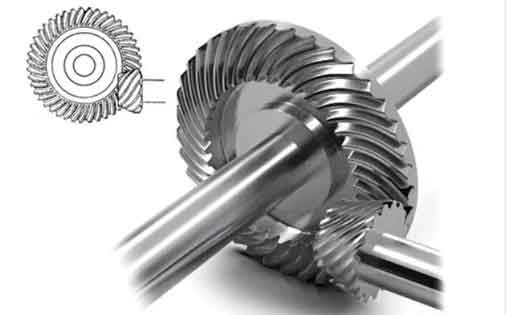
The performance and durability of spiral bevel gears are paramount in systems where failure is not an option, such as in aircraft engines, helicopter transmissions, and heavy-duty industrial machinery. The complex geometry of spiral bevel gears, characterized by curved teeth and varying cross-sections, makes analytical stress prediction challenging. Traditional standards like ANSI/AGMA 2003-B97 simplify this complexity through well-established empirical and semi-analytical models rooted in the Lewis bending theory. The core bending stress calculation in this standard is designed to predict the maximum tensile stress at the tooth root, which is the primary driver of fatigue failure. The fundamental equation for the calculated bending stress, $\sigma_F$, is given as:
$$
\sigma_F = \frac{2000 T}{b d_e} \cdot \frac{1}{m_{et}} \cdot K_A K_V K_{H\beta} \cdot \frac{Y_x}{Y_\beta Y_J}
$$
Where:
$T$ is the transmitted torque (N·m),
$b$ is the face width (mm),
$d_e$ is the pitch diameter at the gear’s outer end (mm),
$m_{et}$ is the transverse module at the outer end (mm),
$K_A$, $K_V$, $K_{H\beta}$ are the application factor, dynamic factor, and face load distribution factor, respectively,
$Y_x$ is the size factor,
$Y_\beta$ is the lengthwise curvature factor,
$Y_J$ is the geometry factor for bending strength.
The allowable bending stress, $\sigma_{FP}$, against which $\sigma_F$ is checked, is calculated considering material properties and life requirements:
$$
\sigma_{FP} = \frac{\sigma_{F \lim} Y_{NT}}{S_F K_\theta Y_Z}
$$
Where $\sigma_{F \lim}$ is the bending stress limit, $Y_{NT}$ is the life factor, $S_F$ is the safety factor, $K_\theta$ is the temperature factor, and $Y_Z$ is the reliability factor. The design condition is $\sigma_F \leq \sigma_{FP}$.
The heart of the potential underestimation lies in the geometry factor, $Y_J$. This factor encapsulates the influence of tooth shape, load position, and the contact pattern on the root stress. Its calculation in AGMA 2003-B97 is based on a set of idealized assumptions. Primarily, it assumes that the contact pattern under load is an ideal, fully developed ellipse that is inscribed within the boundaries of the tooth flank. This “full-bearing” contact assumption simplifies the load distribution model but rarely holds true in practical applications for spiral bevel gears. Factors such as misalignments, manufacturing errors, and deliberate design modifications (like tip and root relief) lead to contact patterns that are smaller and often shifted from the center of the tooth face. The standard’s model, by assuming ideal contact, effectively assumes the most favorable load distribution for minimizing bending stress. Consequently, the calculated $Y_J$ is often smaller than the reality, leading to an underestimation of $\sigma_F$. My analysis, corroborated by finite element contact analysis (FECA) on numerous spiral bevel gear sets, confirms this systematic bias. The FECA provides a more accurate, physics-based simulation of the contact mechanics and stress distribution, consistently showing higher root stresses than the AGMA standard predicts for the same operating conditions.
To rectify this and build a more reliable design tool, I propose a targeted modification to the procedure for determining the geometry factor, $Y_J$. The goal is to relax the ideal contact pattern assumption and consider a range of more realistic, non-ideal contact conditions that could occur due to permissible manufacturing tolerances and assembly errors. The modified approach seeks the worst-case (i.e., highest) bending stress within a defined envelope of possible contact patterns. This transforms the calculation into a constrained optimization problem. Let $\Omega$ represent a specific contact pattern characterized by its lengthwise position and its extent. We define two key parameters for any pattern $\Omega$: its face contact ratio, $S_\Omega$ (the ratio of contact length to face width), and its offset from the toe (small end), $l_\Omega$. Realistic design and assembly practice for spiral bevel gears suggests that a robust contact pattern should have $S_\Omega \geq 0.6$ and be located within the central region of the tooth face, say $l_\Omega \in [0.25b, 0.75b]$, to avoid sensitive edge-loading conditions.
The modified geometry factor, $Y_{J_{mod}}$, is then defined as the maximum value obtained from evaluating the standard $Y_J$ calculation over all admissible contact patterns $\Omega$:
$$
Y_{J_{mod}} = \max_{\Omega} \left( Y_J(\Omega) \right) \quad \text{subject to:} \quad S_\Omega \geq 0.6, \quad l_\Omega \in [0.25b, 0.75b]
$$
For a given pattern $\Omega$, the standard calculation of $Y_J(\Omega)$ involves finding the most critical point on the tooth root fillet. Using the parabolic construction method (essentially the 30° tangent method) on the equivalent spur gear in the mid-plane, the critical section parameters (fillet radius, chordal thickness) are determined based on the load application point projected from the instantaneous contact line. The effective face width $b’$ is also derived from the assumed load distribution along the contact line. By systematically varying the assumed contact pattern’s center and size within the admissible window, we compute multiple candidate values for $Y_J$. The largest among them, $Y_{J_{mod}}$, is the one that yields the highest predicted bending stress, thereby providing a more conservative and realistic estimate. Substituting this modified factor into the bending stress equation gives the corrected bending stress, $\sigma_{F_{mod}}$:
$$
\sigma_{F_{mod}} = \frac{2000 T}{b d_e} \cdot \frac{1}{m_{et}} \cdot K_A K_V K_{H\beta} \cdot \frac{Y_x}{Y_\beta Y_{J_{mod}}}
$$
This approach directly addresses the core issue. It no longer assumes a single, overly optimistic contact pattern but instead accounts for a spectrum of plausible patterns, selecting the one that induces the greatest stress. This inherently increases the calculated bending stress for a given gear set, thus restoring the necessary safety margin when compared to high-fidelity FEA results.
This modified calculation framework is not merely a verification tool; it actively informs the tooth surface design optimization process for spiral bevel gears. The traditional design sequence involves first defining the blank geometry (macro-geometry: numbers of teeth, module, face width, etc.) and then performing tooth flank modification (micro-geometry: ease-off topography) to achieve desired contact and stress characteristics. My methodology integrates the modified strength check into this process. After specifying the blank geometry and loading conditions, I use an algorithm to compute $\sigma_{F_{mod}}$ for a grid of potential contact pattern parameters ($S_\Omega$, $l_\Omega$). The results are stored in a matrix. The patterns that satisfy $\sigma_{F_{mod}} \leq \sigma_{FP}$ are identified as safe design points. Among these, the patterns with lower stress values or more central location are preferable as they offer better performance and are less sensitive to errors. This analysis provides clear guidance to the gear designer: it suggests the target contact pattern characteristics (size and position) that will ensure bending strength requirements are met with an adequate margin. For instance, the output might specify: “For this spiral bevel gear pair, aim for a contact pattern with a length ratio greater than 0.65 and centered between 0.4b and 0.6b from the toe.” This quantitative target directly guides the machine-tool setting calculations during the manufacturing phase.
To make this methodology practical and efficient for iterative design work, I developed a dedicated software application. Manual implementation of the modified $Y_J$ search and the subsequent optimization analysis is computationally intensive and prone to error. The software automates the entire workflow. Its core architecture involves several modules: a data input module for gear geometry, material, and load data; a computational engine that implements the modified AGMA standard (including the optimization loop for $Y_{J_{mod}}$); a post-processor that performs the strength check and generates the contact pattern guidance matrix; and a user interface for interaction. The software performs the following key functions automatically:
- Reads input parameters for the spiral bevel gear pair (pinion and gear).
- Calculates all necessary derived geometric quantities.
- Executes the search for the modified geometry factor $Y_{J_{mod}}$ over the defined domain of contact patterns.
- Computes the corrected bending stresses $\sigma_{F_{mod}}$ for both pinion and gear, and the contact stress.
- Compares the calculated stresses with the allowable stresses based on material properties.
- Outputs a definitive pass/fail result for the gear set’s strength.
- If the design passes, it further analyzes the matrix of safe contact patterns and provides a summary table of recommended pattern characteristics for tooth surface optimization.
The use of this software drastically reduces the time required for a comprehensive strength assessment from hours to minutes, while simultaneously improving accuracy and design insight. It effectively bridges the gap between the simplified standard and complex FEA, making robust spiral bevel gear design more accessible.
A detailed case study demonstrates the efficacy of this approach. I analyzed a non-orthogonal aerospace spiral bevel gear pair with the following key parameters:
| Parameter | Pinion (Driver) | Gear (Driven) |
|---|---|---|
| Number of Teeth, $z$ | 20 | 61 |
| Outer Module, $m_{et}$ (mm) | 6 | 6 |
| Face Width, $b$ (mm) | 60 | 60 |
| Spiral Angle, $\beta$ (°) | 35 | 35 |
| Pressure Angle, $\alpha$ (°) | 20 | 20 |
| Shaft Angle, $\Sigma$ (°) | 108.1667 | 108.1667 |
| Transmitted Power (kW) | 327.1 | – |
| Speed (rpm) | 1190 | ~390 |
| Material Bending Limit, $\sigma_{F \lim}$ (MPa) | 550 | 550 |
First, I performed a standard ANSI/AGMA 2003-B97 calculation. The results were as follows:
| Stress Type | Standard AGMA Calculation (MPa) | Finite Element Contact Analysis (MPa) |
|---|---|---|
| Pinion Bending Stress, $\sigma_{F1}$ | 223.7 | 242 |
| Gear Bending Stress, $\sigma_{F2}$ | 222.4 | 152 |
| Pinion Contact Stress, $\sigma_{H1}$ | 1340.1 | 990 |
| Gear Contact Stress, $\sigma_{H2}$ | – | 1009 |
The contact stress from AGMA is conservative (higher than FEA), which is desirable. However, for bending stress, the AGMA value for the gear (222.4 MPa) is significantly lower than the FEA result (242 MPa). This confirms the underestimation problem. The pinion’s AGMA bending stress is closer to its FEA value, but the discrepancy for the gear is critical. The standard calculation assumed an ideal, full contact pattern. An FEA-generated image of the actual contact pattern under load showed a pattern with a face contact ratio of approximately 0.65, offset slightly towards the heel (large end).
Applying my modified methodology, I computed the modified geometry factor $Y_{J_{mod}}$ by searching over patterns with $S_\Omega \geq 0.6$ and $l_\Omega / b \in [0.25, 0.75]$. The search identified a critical pattern that led to a higher $Y_J$ value. The recalculated bending stresses were:
| Component | Modified Bending Stress $\sigma_{F_{mod}}$ (MPa) |
|---|---|
| Pinion | 279.1 |
| Gear | 302.1 |
These modified stresses are now higher than the corresponding FEA results (242 MPa and 152 MPa). This ensures that the strength check has a positive safety margin when using the modified standard. The allowable bending stress $\sigma_{FP}$ for this material and application was approximately 380 MPa, so both modified calculated stresses are below the allowable, indicating a safe design, but with a much more realistic and conservative margin. The software’s optimization module then analyzed the space of admissible contact patterns. It generated a table indicating which combinations of $S_\Omega$ and $l_\Omega$ yielded safe bending stresses ($\sigma_{F_{mod}} \leq \sigma_{FP}$). A condensed version of this guidance is:
| Minimum Contact Ratio ($S_\Omega$) | Allowable Offset Range ($l_\Omega/b$) | Maximum Calculated Stress in Range (MPa) |
|---|---|---|
| 0.60 | 0.30 – 0.70 | 375 |
| 0.65 | 0.25 – 0.75 | 365 |
| 0.70 | 0.25 – 0.75 | 350 |
This output provides direct, actionable intelligence for the tooth surface design of these spiral bevel gears. It advises that to guarantee bending strength, the manufactured gear set should exhibit a contact pattern with a length ratio of at least 0.65, and its center should be maintained within the central 50% of the face width. This guides the selection of machine settings for grinding or lapping to achieve this robust contact condition.
The development and application of this modified bending strength standard for spiral bevel gears yield significant advantages. Firstly, it directly resolves the safety margin deficiency inherent in the unmodified ANSI/AGMA 2003-B97 standard for bending stress calculation. By incorporating a worst-case search over realistic contact patterns into the geometry factor, the method produces bending stress predictions that are consistently conservative relative to high-fidelity finite element analysis. This enhances the reliability of gear designs, especially in safety-critical applications like aerospace. Secondly, the methodology is not just a corrective patch; it is a proactive design tool. The same computational engine that performs the modified strength check can be used to map the relationship between contact pattern parameters and root stress. This generates clear, quantitative targets for the contact pattern during the tooth flank modification design phase. Instead of relying solely on experience-based “good practice,” the designer receives specific guidance: “achieve a contact pattern with these dimensional characteristics to meet strength goals.” This makes the design process for spiral bevel gears more scientific, efficient, and less iterative. Thirdly, the encapsulation of this methodology into user-friendly software democratizes access to this advanced level of analysis. It allows design engineers to perform rapid, reliable strength checks and obtain optimization guidance without needing expert-level knowledge in FEA modeling or complex mathematical optimization. The software automates the tedious and error-prone steps, enabling focus on higher-level design decisions.
In conclusion, the work presented here offers a substantial improvement in the design and analysis workflow for spiral bevel gears. By critically examining and modifying a key aspect of the widely used AGMA bending strength standard, I have developed a method that delivers more accurate and conservative stress predictions. This method seamlessly integrates into a holistic design strategy that links strength verification with tooth surface optimization. The automated software implementation makes this robust approach practical for everyday engineering use. Future work could involve extending this philosophy to other aspects of gear rating, such as refining the pitting resistance calculation, or adapting the methodology for other complex gear types like hypoid gears. Furthermore, integrating this modified standard-based software with CAD/CAE systems and machine tool path planners could create a fully digital, optimized design-to-manufacturing chain for high-performance spiral bevel gears. The ultimate goal is to ensure that every spiral bevel gear deployed in critical machinery operates with a demonstrable and adequate margin of safety, contributing to overall system reliability and performance.