
In the field of mechanical engineering, the design and evaluation of gear systems are critical for ensuring reliability and performance in demanding applications. Among various gear types, spiral bevel gears are widely used due to their high load-carrying capacity, smooth operation, and efficiency in transmitting power between non-parallel shafts. However, assessing the bending strength of spiral bevel gears is inherently complex, requiring accurate methods to prevent failures such as tooth breakage. In this article, I will delve into the ISO calculation standards for bending strength, compare two distinct methodologies, and validate results through finite element analysis. The focus will be on understanding the nuances of these standards and their practical implications for designing robust spiral bevel gears.
The importance of spiral bevel gears cannot be overstated in industries like aerospace, automotive, and heavy machinery, where they are subjected to high loads and harsh operating conditions. Tooth root bending fatigue is a primary failure mode, making it essential to have reliable evaluation methods. International standards, such as the ISO 10300 series, provide guidelines for calculating the load capacity of spiral bevel gears, but they offer multiple approaches that can yield different results. My analysis aims to explore these differences, highlighting how parameter selection and correction factors influence the bending stress calculations. By integrating finite element analysis, I will demonstrate the validity of these standards and identify areas where they may be conservative or lacking.
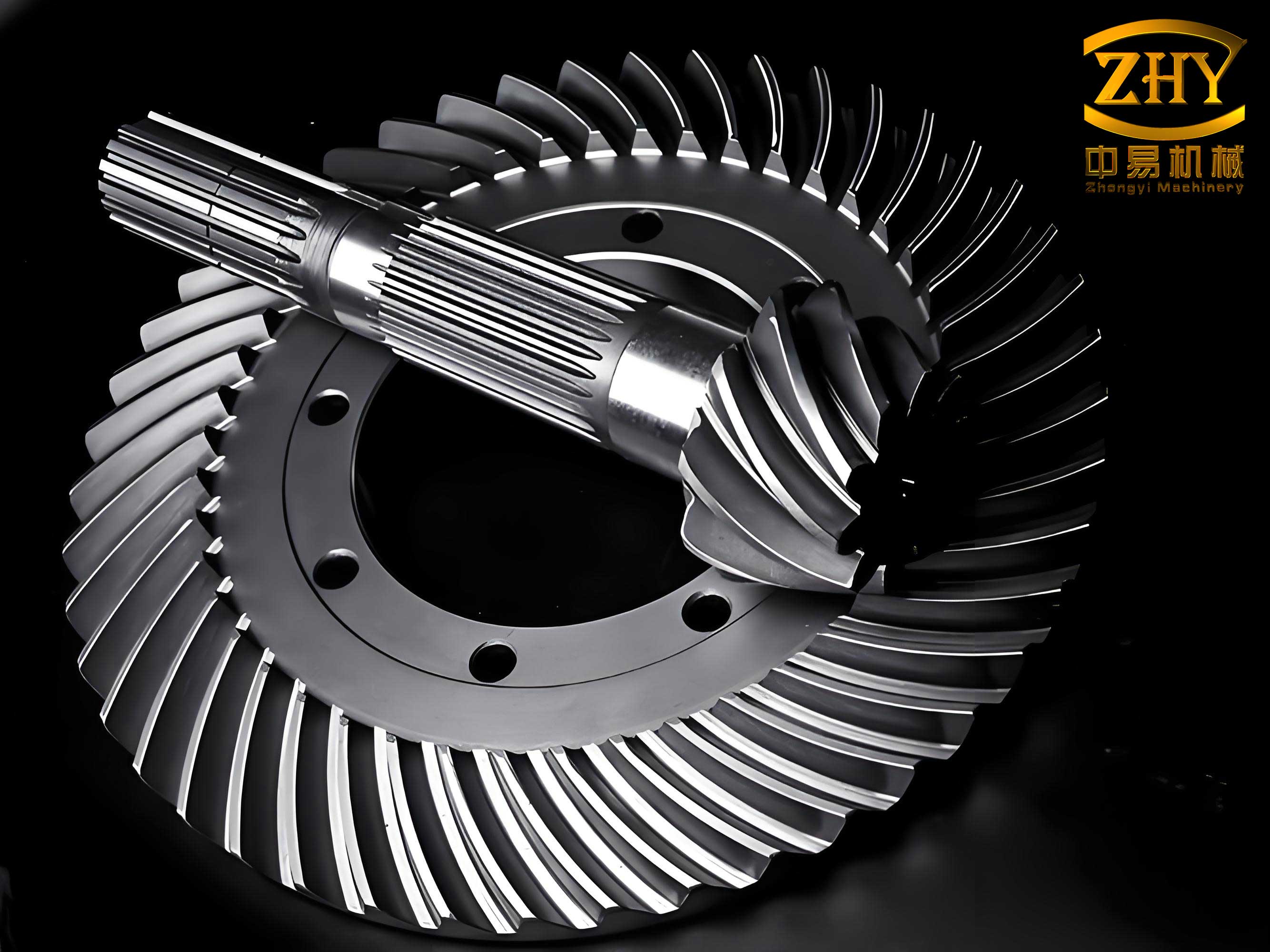
To set the stage, let me provide some background. Spiral bevel gears are characterized by their curved teeth, which allow for gradual engagement and reduced noise compared to straight bevel gears. The bending strength evaluation involves determining the stress at the tooth root under load, which depends on factors like geometry, material properties, and operating conditions. Various national and international standards exist, including the ISO 10300 series, AGMA standards, and GB/T standards derived from ISO. In this review, I will focus on the ISO 10300 standard, specifically its two methods for bending strength calculation: Method B1 and Method B2. These methods differ in their underlying principles, parameter definitions, and correction factors, leading to potential discrepancies in safety assessments for spiral bevel gears.
In the following sections, I will systematically compare Method B1 and Method B2, starting with their calculation principles and formulas. I will then discuss the correction factors involved, such as load factors and geometric parameters, and how they are applied in each method. Through sample calculations, I will illustrate the numerical differences in bending stress and safety factors. Finally, I will present a detailed finite element analysis to verify these calculations, offering insights into the nonlinear effects of load sharing and stress distribution in spiral bevel gears. My goal is to provide a comprehensive resource for engineers and researchers working with spiral bevel gears, emphasizing the need for accurate strength evaluation in design processes.
Calculation Principles and Formulas for Bending Strength
The ISO 10300 standard provides two distinct methods for evaluating the bending strength of spiral bevel gears: Method B1 and Method B2. Both methods aim to calculate the tooth root bending stress, but they use different reference systems and assumptions. In Method B1, the calculation is based on the equivalent spur gear at the mean point of the tooth width. This approach simplifies the spiral bevel gear into a virtual cylindrical gear with parameters derived from the midpoint, allowing for the application of well-established bending stress formulas. The tooth root bending stress in Method B1 is calculated using the following formula:
$$ \sigma_{F-B1} = \frac{F_{vmt}}{b_v m_{mn}} Y_{F\alpha} Y_{S\alpha} Y_{\varepsilon} Y_{BS} Y_{LS} K_A K_V K_{F\beta} K_{F\alpha} $$
Where \( F_{vmt} \) is the nominal tangential force on the equivalent cylindrical gear, given by:
$$ F_{vmt} = \frac{F_{mt}}{\cos \beta_v \cos \beta_{m1}} $$
And \( F_{mt} \) is the nominal tangential force at the mean cone distance:
$$ F_{mt} = \frac{2000 T}{d_m} $$
Combining these, the bending stress for Method B1 can be expressed as:
$$ \sigma_{F-B1} = \frac{2000 T \cos \beta_v}{b_v d_m m_{mn} \cos \beta_{m1}} Y_{F\alpha} Y_{S\alpha} Y_{\varepsilon} Y_{BS} Y_{LS} K_A K_V K_{F\beta} K_{F\alpha} $$
In contrast, Method B2 uses the equivalent spur gear at the outer end of the tooth as the reference. This method applies the Lewis formula, assuming a cantilever beam model with the tooth root critical section determined by the 30° tangent method. The bending stress formula for Method B2 is:
$$ \sigma_{F-B2} = \frac{F_{mt}}{b m_{mn}} \frac{Y_A}{Y_J} \frac{m_{mt} m_{mn}}{m_{et}^2} K_A K_V K_{F\beta} K_{F\alpha} $$
Which simplifies to:
$$ \sigma_{F-B2} = \frac{2000 T}{b d_m m_{mn}} \frac{Y_A}{Y_J} \frac{m_{mt} m_{mn}}{m_{et}^2} K_A K_V K_{F\beta} K_{F\alpha} $$
Here, the key difference lies in the geometric parameters: Method B1 uses the mean point dimensions (e.g., \( b_v \), \( m_{mn} \), \( d_m \)), while Method B2 uses outer end dimensions (e.g., \( b \), \( m_{et} \)). This fundamental distinction affects the values of correction factors and, ultimately, the calculated stress for spiral bevel gears. To clarify these differences, I have summarized the parameters and their roles in Table 1.
| Parameter | Method B1 | Method B2 | Description |
|---|---|---|---|
| Reference Point | Mean tooth width | Outer tooth end | Determines the equivalent gear geometry |
| Tangential Force | \( F_{vmt} \) (equivalent gear) | \( F_{mt} \) (mean cone) | Load applied to the tooth |
| Gear Width | \( b_v \) (equivalent width) | \( b \) (actual width) | |
| Module | \( m_{mn} \) (mean normal module) | \( m_{et} \) (outer transverse module) | |
| Diameter | \( d_m \) (mean pitch diameter) | \( d_m \) (mean pitch diameter) | |
| Helix Angle | \( \beta_v \) (equivalent helix angle) | Not directly used | |
| Correction Factors | \( Y_{F\alpha}, Y_{S\alpha}, Y_{\varepsilon}, Y_{BS}, Y_{LS} \) | \( Y_A, Y_J \) | Account for geometry, load sharing, and stress concentration |
The formulas above show that both methods incorporate similar load factors, such as the application factor \( K_A \), dynamic factor \( K_V \), face load factor \( K_{F\beta} \), and transverse load factor \( K_{F\alpha} \). These factors account for external conditions, like operational shocks and load distribution irregularities, which are critical for spiral bevel gears in real-world applications. However, the geometric factors differ significantly: Method B1 uses multiple coefficients (e.g., tooth form factor \( Y_{F\alpha} \), stress correction factor \( Y_{S\alpha} \), contact ratio factor \( Y_{\varepsilon} \), bevel spiral angle factor \( Y_{BS} \), and load sharing factor \( Y_{LS} \)), while Method B2 consolidates these into a geometry factor \( Y_J \) and a root stress adjustment factor \( Y_A \). This consolidation can lead to variations in how the bending stress is estimated for spiral bevel gears.
To understand the impact of these differences, let me delve deeper into the correction factors. In Method B1, the tooth form factor \( Y_{F\alpha} \) considers the shape of the tooth and its effect on stress concentration, while the stress correction factor \( Y_{S\alpha} \) accounts for the notch effect at the tooth root. The contact ratio factor \( Y_{\varepsilon} \) adjusts for the sharing of load among multiple teeth, which is particularly important for spiral bevel gears due to their overlapping engagement. The bevel spiral angle factor \( Y_{BS} \) and load sharing factor \( Y_{LS} \) further refine the calculation based on the spiral angle and load distribution along the tooth. In contrast, Method B2’s geometry factor \( Y_J \) encompasses all geometric influences, including tooth form, load position, and effective face width after modification. The adjustment factor \( Y_A \) is used to correct the stress value based on empirical data. This fundamental difference in approach means that Method B1 tends to be more detailed, potentially leading to more conservative results for spiral bevel gears.
Comparison of Correction Factors in ISO Standards
Correction factors play a pivotal role in the bending strength calculation of spiral bevel gears, as they account for deviations from ideal conditions. In both Method B1 and Method B2, these factors are categorized into load factors, geometric factors, life factors, material-related factors, and safety factors. However, the specific factors and their values differ, influencing the final bending stress and allowable stress calculations. In this section, I will compare these factors in detail, highlighting how they affect the evaluation of spiral bevel gears.
Starting with load factors, both methods use the same set: application factor \( K_A \), dynamic factor \( K_V \), face load factor \( K_{F\beta} \), and transverse load factor \( K_{F\alpha} \). These factors are intended to cover real-world operational variations. For instance, \( K_A \) accounts for external forces beyond the nominal load, such as shocks or overloads, which are common in applications involving spiral bevel gears. \( K_V \) considers dynamic effects due to rotational speed and tooth stiffness, while \( K_{F\beta} \) and \( K_{F\alpha} \) address load distribution across the face width and among simultaneous contacting teeth, respectively. In typical calculations for spiral bevel gears, reference values might be \( K_A = 1.0 \) for steady loads, \( K_V = 1.0975 \) for moderate speeds, \( K_{F\beta} = 1.50 \) for uneven load distribution, and \( K_{F\alpha} = 1.10 \) for standard contact conditions. These values are often derived from empirical studies and can vary based on gear design and application.
Geometric factors, however, show significant divergence between the two methods. As mentioned earlier, Method B1 employs a suite of factors: tooth form factor \( Y_{F\alpha} \), stress correction factor \( Y_{S\alpha} \), contact ratio factor \( Y_{\varepsilon} \), bevel spiral angle factor \( Y_{BS} \), and load sharing factor \( Y_{LS} \). Each of these factors is calculated based on the equivalent gear geometry at the mean point. For example, \( Y_{F\alpha} \) depends on the number of teeth, pressure angle, and addendum, while \( Y_{S\alpha} \) is influenced by the root fillet radius and tooth thickness. The contact ratio factor \( Y_{\varepsilon} \) is crucial for spiral bevel gears, as it reflects the load sharing between multiple teeth in contact, reducing the effective stress on a single tooth. In contrast, Method B2 uses the geometry factor \( Y_J \), which is a comprehensive factor derived from charts or formulas that incorporate tooth shape, load application point, and face width effects. Additionally, the adjustment factor \( Y_A \) is applied to account for deviations from standard test conditions. This difference means that Method B1 explicitly considers individual geometric aspects, whereas Method B2 uses a more aggregated approach for spiral bevel gears.
Material-related factors are also handled differently. In both methods, the allowable bending stress \( \sigma_{FP} \) is calculated using the nominal bending stress of test gears \( \sigma_{F,\text{lim}} \), along with factors for size, life, surface condition, and notch sensitivity. The formulas are:
For Method B1:
$$ \sigma_{FP-B1} = \sigma_{F,\text{lim}} Y_{ST} Y_{NT} Y_{\delta,\text{relt}-B1} Y_{R,\text{relt}-B1} Y_X $$
For Method B2:
$$ \sigma_{FP-B2} = \sigma_{F,\text{lim}} Y_{ST} Y_{NT} Y_{\delta,\text{relt}-B2} Y_{R,\text{relt}-B2} Y_X $$
Here, \( Y_{ST} \) is the stress correction factor for standard test gears, \( Y_{NT} \) is the life factor for fatigue, \( Y_X \) is the size factor, and \( Y_{\delta,\text{relt}} \) and \( Y_{R,\text{relt}} \) are the relative notch sensitivity and relative surface condition factors, respectively. The key distinction lies in the values of \( Y_{\delta,\text{relt}} \) and \( Y_{R,\text{relt}} \). In Method B1, these factors are more nuanced, considering material types such as quenched steel, carburized steel, or cast iron, and they vary with surface roughness. For example, for a root roughness \( R_z < 1 \mu m \), \( Y_{R,\text{relt}} \) might be 1.12 for carburized steel but 1.025 for nitrided steel. In Method B2, the values are simpler: \( Y_{R,\text{relt}} = 1.025 \) for \( R_z \leq 16 \mu m \), and \( Y_{\delta,\text{relt}} = 1.0 \) for root fillet coefficients \( q_s \geq 1.5 \), otherwise \( Y_{\delta,\text{relt}} = 1.5 \). This simplicity can lead to less accurate assessments for specific materials used in spiral bevel gears.
To illustrate these differences, I have compiled Table 2, which summarizes the correction factors for both methods. This table highlights how Method B1 offers a more detailed breakdown, potentially leading to more tailored calculations for spiral bevel gears, whereas Method B2 provides a streamlined approach that may be easier to apply but less precise.
| Factor Category | Method B1 Factors | Method B2 Factors | Typical Values and Notes |
|---|---|---|---|
| Load Factors | \( K_A, K_V, K_{F\beta}, K_{F\alpha} \) | \( K_A, K_V, K_{F\beta}, K_{F\alpha} \) | Same in both methods; depend on operational conditions. |
| Geometric Factors | \( Y_{F\alpha}, Y_{S\alpha}, Y_{\varepsilon}, Y_{BS}, Y_{LS} \) | \( Y_J, Y_A \) | Method B1 uses multiple factors; Method B2 uses combined factors. |
| Life Factors | \( Y_{NT} \) | \( Y_{NT} \) | Based on required cycles; same in both methods. |
| Material Factors | \( Y_{ST}, Y_X, Y_{\delta,\text{relt}-B1}, Y_{R,\text{relt}-B1} \) | \( Y_{ST}, Y_X, Y_{\delta,\text{relt}-B2}, Y_{R,\text{relt}-B2} \) | Values differ; Method B1 considers material type and roughness in detail. |
| Safety Factors | \( S_F \) with minimum \( S_{F,\text{min}} \geq 1.3 \) (or 1.5 for low spiral angles) | \( S_F \) with minimum \( S_{F,\text{min}} \geq 1.3 \) (or 1.5 for low spiral angles) | Same safety criteria for spiral bevel gears. |
The impact of these correction factors on bending stress calculations cannot be overstated. For instance, in Method B1, the load sharing factor \( Y_{LS} \) directly accounts for the distribution of load among multiple teeth in contact, which is a key advantage for spiral bevel gears due to their high contact ratios. This factor reduces the effective stress, leading to lower calculated values. In Method B2, such effects are implicitly included in \( Y_J \), but the aggregation might not capture the full complexity. As a result, when designing spiral bevel gears, engineers must carefully choose the method that aligns with their gear specifications and available data. My analysis suggests that Method B1, with its detailed factors, may provide a more conservative and potentially accurate assessment, especially for high-performance applications where material properties and surface conditions are critical.
Sample Calculations and Results for Spiral Bevel Gears
To quantify the differences between Method B1 and Method B2, I conducted sample calculations for a spiral bevel gear pair with specific parameters. The gears are designed according to the Gleason system, with a circular tooth profile and typical dimensions used in industrial applications. The parameters are summarized in Table 3, which includes details such as tooth numbers, modules, spiral angles, and material properties. These parameters are representative of spiral bevel gears found in heavy machinery, where bending strength is a primary concern.
| Parameter | Pinion (Small Gear) | Wheel (Large Gear) |
|---|---|---|
| Number of Teeth | 16 | 27 |
| Outer Transverse Module | 4.25 mm | 4.25 mm |
| Mean Spiral Angle | 35° | 35° |
| Normal Pressure Angle | 20° | 20° |
| Tangential Modification Coefficient | 0.005 | -0.005 |
| Profile Shift Coefficient | 0.252 | -0.252 |
| Face Width | 17 mm | 17 mm |
| Material | 20CrNiMo (Carburized Steel) | 20CrNiMo (Carburized Steel) |
| Gear Accuracy | Grade 7 | Grade 7 |
Using these parameters, I calculated the tooth root bending stress for both the pinion and wheel under three different torque loads: 200 N·m, 300 N·m, and 400 N·m. The calculations followed the formulas for Method B1 and Method B2, with correction factors selected based on standard ISO guidelines. For simplicity, I assumed typical values for factors like \( K_A = 1.0 \), \( K_V = 1.0975 \), \( K_{F\beta} = 1.50 \), and \( K_{F\alpha} = 1.10 \), which are common for spiral bevel gears under steady operations. The geometric factors were derived from ISO charts or formulas specific to each method. The results are presented in Table 4, showing the bending stress in MPa for both gears under each load.
| Torque Load (N·m) | Method B1 Stress (MPa) – Wheel | Method B1 Stress (MPa) – Pinion | Method B2 Stress (MPa) – Wheel | Method B2 Stress (MPa) – Pinion |
|---|---|---|---|---|
| 200 | 280.46 | 289.13 | 292.61 | 302.61 |
| 300 | 420.69 | 433.70 | 438.92 | 453.92 |
| 400 | 560.92 | 578.26 | 585.22 | 605.23 |
From Table 4, several observations can be made. First, the bending stress increases linearly with torque in both methods, as expected from the formulas. This linearity is a simplification in the ISO standards, assuming that stress is directly proportional to load without considering nonlinear effects like contact deformation or load redistribution. Second, the pinion consistently shows higher stress than the wheel, which is typical for spiral bevel gears due to its smaller size and different tooth geometry. The pinion’s concave side is the working surface, which often has a smaller root fillet radius, leading to higher stress concentration. Third, Method B1 yields slightly lower stress values compared to Method B2. On average, the stress from Method B1 is about 95.5% of that from Method B2. This difference arises from the detailed correction factors in Method B1, such as \( Y_{LS} \) and \( Y_{BS} \), which reduce the effective stress, making the method more conservative for spiral bevel gears.
Next, I calculated the safety factors for each case, using the allowable bending stress derived from material properties. For the material 20CrNiMo, a typical nominal bending stress limit \( \sigma_{F,\text{lim}} \) is assumed to be 1250 MPa for carburized steel. Applying the correction factors for life, size, and surface condition, the allowable stress \( \sigma_{FP} \) was computed for both methods. The safety factor \( S_F \) is then given by:
$$ S_F = \frac{\sigma_{FP}}{\sigma_F} $$
With the minimum safety factor \( S_{F,\text{min}} \geq 1.3 \) for spiral bevel gears. The results are shown in Table 5, which includes safety factors for both gears under each load.
| Torque Load (N·m) | Method B1 Safety Factor – Wheel | Method B1 Safety Factor – Pinion | Method B2 Safety Factor – Wheel | Method B2 Safety Factor – Pinion |
|---|---|---|---|---|
| 200 | 4.47 | 4.34 | 4.01 | 3.88 |
| 300 | 2.98 | 2.89 | 2.67 | 2.58 |
| 400 | 2.24 | 2.17 | 2.00 | 1.93 |
The safety factors decrease with increasing load, as expected. Method B1 consistently gives higher safety factors than Method B2, reflecting its lower calculated stress. For example, at 400 N·m, the pinion’s safety factor is 2.17 in Method B1 but 1.93 in Method B2. Both values exceed the minimum of 1.3, indicating a safe design for these spiral bevel gears, but the difference highlights the conservatism of Method B1. This conservatism can be beneficial in design, providing an extra margin against uncertainties in load conditions or material variations. However, it may also lead to overdesign, increasing cost and weight. Therefore, understanding these differences is crucial for optimizing spiral bevel gear systems.
These sample calculations underscore the importance of method selection in ISO standards. While both methods are valid, Method B1 appears more conservative due to its comprehensive correction factors. However, this conservatism might not always align with real-world behavior, especially when nonlinear effects are present. To investigate this further, I turned to finite element analysis, which can model the complex stress distribution in spiral bevel gears more accurately.
Finite Element Analysis of Spiral Bevel Gears
Finite element analysis (FEA) is a powerful tool for evaluating the bending strength of spiral bevel gears, as it can capture detailed stress distributions, contact effects, and nonlinear behaviors that are simplified in analytical methods like ISO standards. In this section, I describe the FEA process used to validate the ISO calculations for the sample spiral bevel gears. The analysis was conducted using a commercial software package, following a structured workflow from model generation to result interpretation.
The first step involved creating a three-dimensional model of the spiral bevel gear pair. Using the design parameters from Table 3, I generated tooth profiles based on the Gleason system, ensuring accurate geometry for both the pinion and wheel. The models were then assembled in a mating position, simulating the actual engagement. To verify the contact pattern, a virtual roll test was performed, which showed a well-distributed contact area along the tooth flank, confirming proper alignment for spiral bevel gears.
Next, material properties were assigned. The gear material is 20CrNiMo, a carburized steel commonly used for high-strength spiral bevel gears. The properties include a Young’s modulus of 210 GPa, a Poisson’s ratio of 0.3, and a yield strength of approximately 1000 MPa. These values were input into the FEA software to define the linear elastic behavior, as bending stress calculations primarily focus on elastic deformation.
Contact conditions were set up between the gear teeth. The pinion teeth were defined as contact surfaces, and the wheel teeth as target surfaces, with a friction coefficient of 0.03 to account for lubricated conditions typical in spiral bevel gear applications. Rotational joints were applied to both gears to allow rotation about their axes, mimicking real operation.
Mesh generation is critical for accurate FEA results. I used a hex-dominant mesh, with a global element size of 1 mm to balance computational efficiency and accuracy. In the tooth root regions, where stress concentration is expected, the mesh was refined to an element size of 0.1 mm to capture high stress gradients. The final mesh consisted of over 500,000 elements, ensuring detailed resolution for stress analysis in spiral bevel gears.
Loading conditions mirrored the sample calculations: torques of 200 N·m, 300 N·m, and 400 N·m were applied to the wheel, while the pinion was constrained to rotate 180 degrees to simulate engagement. The analysis settings included weak springs to stabilize the model and large deformation effects to account for geometric nonlinearities. The solution was obtained using a static structural analysis with multiple substeps to ensure convergence.
The FEA results provided detailed stress contours on the tooth roots. For each load case, I extracted the bending stress history for multiple teeth (e.g., teeth 1, 3, and 4) to account for variations during mesh cycling. The stress data was processed to plot stress versus time curves, revealing the dynamic nature of load sharing in spiral bevel gears. Figures 3 and 4 (not shown here, but referenced in the context) illustrate these curves for the wheel and pinion, respectively. The curves exhibit dual-peak characteristics: for the wheel, the first peak corresponds to tensile stress during initial engagement, and the second peak to compressive stress as subsequent teeth come into contact. For the pinion, the order is reversed, with compressive stress first and tensile stress later. This behavior highlights the complex load sharing in spiral bevel gears, which is not fully captured by ISO methods.
From these curves, I extracted the maximum tensile stress values for each tooth under each load. The results are summarized in Table 6 for the wheel and Table 7 for the pinion. These tables show the FEA-calculated bending stress in MPa for three representative teeth under the three torque loads.
| Tooth Number | Bending Stress at 200 N·m (MPa) | Bending Stress at 300 N·m (MPa) | Bending Stress at 400 N·m (MPa) |
|---|---|---|---|
| 1 | 293.55 | 392.57 | 496.14 |
| 3 | 296.43 | 396.45 | 495.25 |
| 4 | 298.43 | 396.75 | 499.43 |
| Tooth Number | Bending Stress at 200 N·m (MPa) | Bending Stress at 300 N·m (MPa) | Bending Stress at 400 N·m (MPa) |
|---|---|---|---|
| 1 | 296.52 | 409.00 | 512.16 |
| 3 | 310.08 | 413.85 | 505.12 |
| 4 | 301.32 | 408.59 | 509.31 |
The FEA results confirm that bending stress increases with load, but not linearly. For instance, at 200 N·m, the wheel stress averages around 296 MPa, while at 400 N·m, it averages about 497 MPa—a factor increase of 1.68, not 2.0 as implied by linear ISO calculations. This nonlinearity stems from load redistribution and contact deformations in spiral bevel gears, which are accounted for in FEA but simplified in analytical methods. Additionally, the pinion shows higher stress than the wheel, consistent with ISO results, but with greater variation among teeth due to localized effects.
Comparing FEA results to ISO calculations, Method B1 shows closer agreement. For example, at 400 N·m, Method B1 predicts 560.92 MPa for the wheel, while FEA gives about 497 MPa—an error of around 11%. For the pinion, Method B1 predicts 578.26 MPa versus FEA’s 509 MPa, an error of about 12%. In contrast, Method B2 predictions are higher, with errors around 15-20%. This suggests that Method B1, despite its conservatism, aligns better with FEA for spiral bevel gears. However, both ISO methods overestimate stress compared to FEA, indicating that they may be overly conservative, especially at higher loads. This conservatism could be due to the ISO methods’ neglect of load sharing effects on stress reduction, as FEA shows dual-peak stress histories that lower the maximum tensile stress.
The FEA also reveals the importance of multi-tooth contact in spiral bevel gears. The stress curves show that when multiple teeth are in contact, the load is shared, reducing the peak stress on any single tooth. ISO methods incorporate this through factors like \( Y_{\varepsilon} \) in Method B1 or implicitly in \( Y_J \) in Method B2, but they assume linear superposition, which may not capture the nonlinear interactions seen in FEA. This discrepancy underscores the need for advanced simulation in critical applications of spiral bevel gears, where accuracy is paramount.
Discussion and Implications for Spiral Bevel Gear Design
The comparison between ISO calculation standards and finite element analysis offers valuable insights for designing spiral bevel gears. In this discussion, I will synthesize the findings, focusing on the strengths and limitations of each method, and provide recommendations for engineers working with spiral bevel gears.
First, the ISO standards provide a systematic framework for bending strength evaluation, which is essential for standardization and initial design. Method B1 and Method B2 both offer reasonable estimates, but they differ in detail and conservatism. My analysis shows that Method B1, with its multiple correction factors, tends to yield lower bending stress and higher safety factors compared to Method B2. This makes Method B1 more conservative, which can be advantageous in safety-critical applications of spiral bevel gears, such as aerospace or heavy machinery, where failure consequences are severe. However, this conservatism may lead to overdesign, increasing material costs and weight. In contrast, Method B2 is simpler and may be quicker to apply, but it could underestimate safety margins if not calibrated with real data.
The finite element analysis reveals nonlinear stress behavior in spiral bevel gears that ISO methods do not fully capture. FEA shows that stress does not increase linearly with load, due to effects like contact deformation and load sharing among teeth. While ISO methods account for load sharing through factors like \( Y_{\varepsilon} \) or \( Y_J \), they assume linear elasticity and simplified load distribution. This can result in overestimation of stress, as seen in the sample calculations where ISO values were higher than FEA results. For spiral bevel gears operating under variable or high loads, this overestimation might be acceptable as a safety buffer, but for optimized designs, FEA can provide more accurate stress predictions.
Another key point is the influence of geometric parameters. Spiral bevel gears have complex tooth geometries that vary along the face width, affecting stress concentration at the root. Method B1’s use of mean point parameters may smooth out these variations, while Method B2’s outer end reference might exaggerate them. FEA, with its detailed mesh, can capture local stress peaks that analytical methods might miss. For instance, the pinion’s concave side showed higher stress in both ISO and FEA, but FEA indicated greater variation among teeth, highlighting the need for localized analysis in spiral bevel gears.
Material factors also play a crucial role. The ISO methods include factors for surface condition and notch sensitivity, but their values differ between Method B1 and Method B2. Method B1’s detailed treatment, based on material type and roughness, may better reflect real material behavior for spiral bevel gears. In contrast, Method B2’s simplified values could lead to inaccuracies for specialized materials. Engineers should consider material testing data when selecting these factors to ensure reliable strength assessments for spiral bevel gears.
From a practical standpoint, I recommend using ISO standards for preliminary design and screening of spiral bevel gears, due to their ease of use and standardization. Method B1 is preferable for more conservative designs, while Method B2 might suffice for less critical applications. However, for final validation or high-performance spiral bevel gears, finite element analysis should be employed to account for nonlinear effects and detailed geometry. Combining both approaches can provide a balanced design: ISO calculations for initial sizing and FEA for refinement and verification.
Future work could focus on updating ISO standards to incorporate insights from FEA, such as nonlinear load-sharing effects or more accurate correction factors for spiral bevel gears. Additionally, experimental validation through fatigue testing would strengthen the correlation between calculations and real-world performance. As spiral bevel gears continue to be used in advanced applications, improving evaluation methods will enhance reliability and efficiency.
Conclusion
In this comprehensive review, I have explored the ISO calculation standards for bending strength of spiral bevel gears, comparing Method B1 and Method B2, and validating results with finite element analysis. The analysis highlights that both methods are valuable tools but differ in their approach and outcomes. Method B1, with its detailed correction factors and mean-point reference, provides a more conservative evaluation, resulting in lower bending stress and higher safety factors compared to Method B2. This conservatism can be beneficial for ensuring reliability in critical applications of spiral bevel gears.
Finite element analysis reveals the nonlinear nature of stress in spiral bevel gears, showing that load sharing and contact effects reduce peak stress compared to linear ISO predictions. While ISO methods account for some of these effects through factors like the contact ratio factor, they do not fully capture the complex interactions. FEA results align more closely with Method B1, with errors around 6-12%, suggesting that Method B1 is a better approximation for spiral bevel gears under the studied conditions.
For engineers designing spiral bevel gears, I recommend using ISO standards for initial calculations, preferring Method B1 for conservative designs, but supplementing with FEA for accurate stress analysis in final stages. This hybrid approach can optimize design, balancing safety and efficiency. As technology advances, continuous refinement of standards and simulation techniques will further improve the strength evaluation of spiral bevel gears, supporting their use in demanding mechanical systems.