
As a critical component in gear transmission systems, the performance of spiral bevel gears directly determines the efficiency and service life of the entire transmission. To achieve spiral bevel gears with superior mechanical properties and extended durability, I have delved into the compound forming technology that integrates casting and forging. This approach addresses the limitations of traditional manufacturing methods, which often involve material waste, energy inefficiency, and inconsistent internal structures. In this article, I will analyze the compound forming process, examine the microstructural evolution, and investigate the effects of various forging parameters on the final properties of spiral bevel gears. My goal is to provide a comprehensive understanding that can guide practical applications in engineering.
The traditional manufacturing route for spiral bevel gears typically involves multiple steps: ingot casting, blooming, cutting, upsetting, piercing, ring rolling, and machining. This process not only consumes excessive raw materials and energy but also yields products with non-uniform microstructures and suboptimal mechanical performance. In contrast, the casting-forging compound forming technique, also known as cast-preform forging, streamlines production by directly forging cast preforms into near-net-shape components. This method enhances material utilization, reduces thermal cycles, and results in refined and homogeneous microstructures, thereby improving the overall quality of spiral bevel gears. The essence of this technology lies in leveraging the advantages of both casting and forging: casting allows for complex shape formation with minimal material waste, while forging imparts densification, grain refinement, and enhanced mechanical properties through plastic deformation.
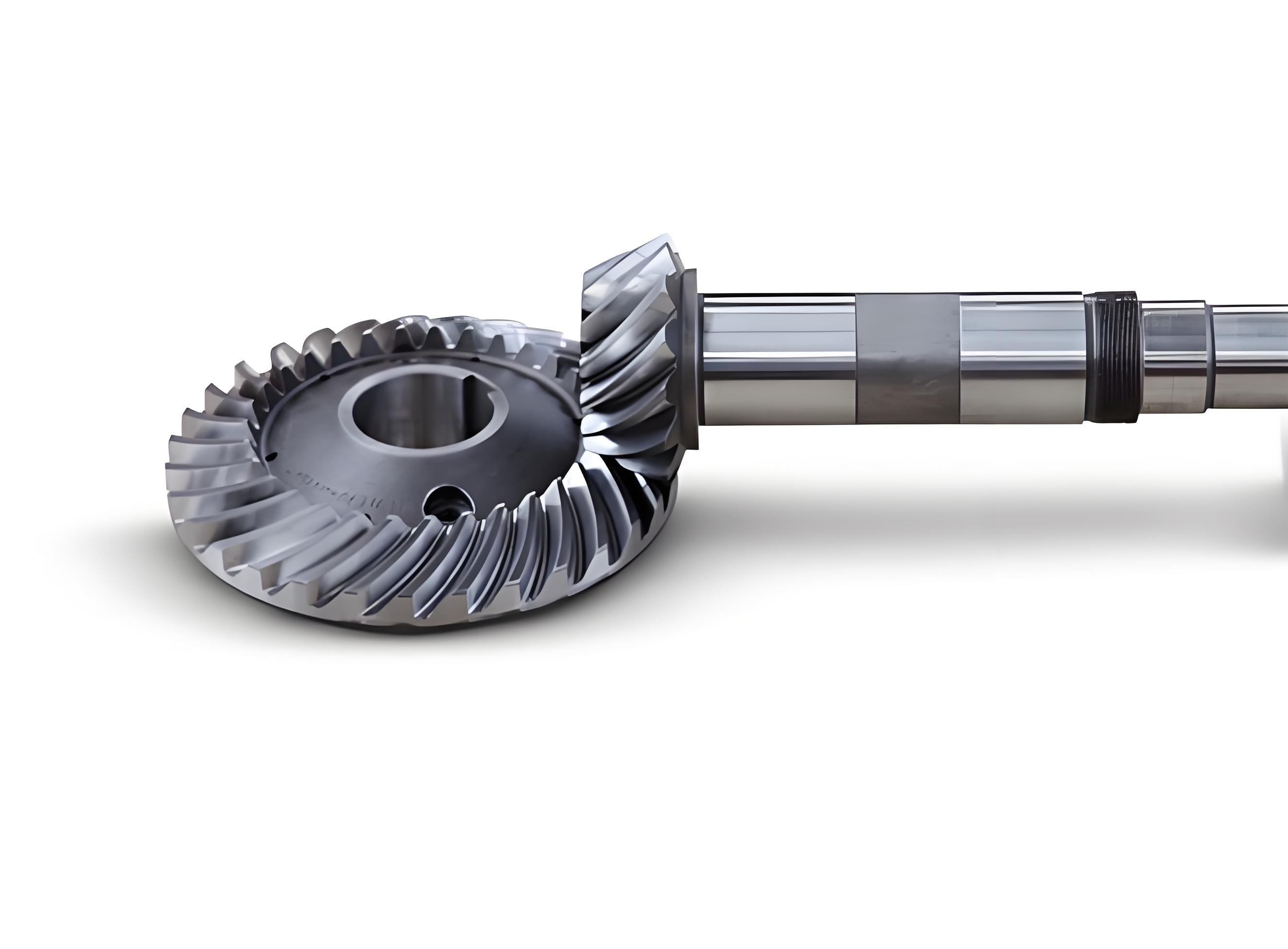
In my study, I focused on a specific spiral bevel gear design, as illustrated in the image above, with key dimensions including an outer diameter, inner bore, and tooth profile geometry. The material selected was 20CrMoH low-alloy steel, known for its good hardenability and toughness, suitable for high-stress applications. The casting process utilized sand molding, with a pouring temperature of 1520°C and a filling time of 518 seconds to ensure proper fluidity and minimize defects. The forged preform was then subjected to deformation in a die made of H13 tool steel, under varying process parameters to analyze their effects. The overall volume of the spiral bevel gear component was approximately 430,808 mm³, and the forging parameters were systematically varied to optimize the outcome.
The microstructural analysis of the as-cast spiral bevel gear revealed a typical morphology consisting of pearlite (dark regions) and ferrite (light regions), as observed under optical microscopy. Notably, the cast structure lacked recrystallized grains, indicating a dendritic or columnar grain formation from solidification. This microstructure, while acceptable for some applications, often suffers from inherent weaknesses like porosity, segregation, and coarse grains, which can compromise mechanical performance. The absence of recrystallization in the cast state underscores the need for subsequent forging to induce plastic deformation and microstructural refinement.
Upon implementing the casting-forging compound process, the microstructural transformation was remarkable. The forged spiral bevel gears exhibited fine and uniform recrystallized grains, a direct result of dynamic recrystallization during hot forging. This phenomenon occurs when the material is deformed at elevated temperatures, leading to the nucleation and growth of new strain-free grains at sites of high dislocation density, such as grain boundaries. The recrystallized structure significantly enhances mechanical properties by reducing grain size, which according to the Hall-Petch relationship, improves strength and toughness. The relationship can be expressed as:
$$ \sigma_y = \sigma_0 + k_y d^{-1/2} $$
where $\sigma_y$ is the yield strength, $\sigma_0$ is the friction stress, $k_y$ is the strengthening coefficient, and $d$ is the average grain diameter. For spiral bevel gears, achieving a fine grain size is crucial for wear resistance and fatigue life.
To quantify the effects of forging parameters, I conducted experiments varying key factors: forging deformation amount, forging temperature, and forging speed. The deformation amount, defined as the percentage reduction in cross-sectional area, was calculated using:
$$ \epsilon = \frac{A_i – A_f}{A_i} \times 100\% $$
where $\epsilon$ is the deformation amount, $A_i$ is the initial cross-sectional area of the preform, and $A_f$ is the final area after forging. In my tests, $\epsilon$ was set at 10%, 20%, 30%, and 40%. Other parameters included forging speeds of 10, 20, 30, and 40 mm/s, and forging temperatures of 850°C, 950°C, 1050°C, and 1150°C. The environmental temperature was maintained at 25°C, with a die preheating temperature of 200°C and a friction coefficient of 0.65 to simulate realistic conditions.
The influence of forging deformation amount on the microstructure of spiral bevel gears is summarized in Table 1. As deformation increased, the grain size progressively decreased, with the most refined structure observed at 40% deformation. This trend aligns with recrystallization kinetics, where higher strain energy drives more nucleation events. The new recrystallized nuclei predominantly formed at grain boundaries or regions with high dislocation density, leading to a homogeneous grain distribution.
| Deformation Amount (%) | Average Grain Size (µm) | Recrystallization Degree | Microstructural Homogeneity |
|---|---|---|---|
| 10 | 50.2 | Partial | Low |
| 20 | 35.7 | Moderate | Moderate |
| 30 | 22.4 | High | High |
| 40 | 15.8 | Complete | Very High |
Forging temperature played a pivotal role in microstructural evolution. At lower temperatures (e.g., 850°C), recrystallization was incomplete due to insufficient thermal activation, resulting in coarse grains. As temperature increased to 1050°C, the grain size minimized, owing to optimal balance between nucleation and growth rates. However, at 1150°C, grain growth became dominant, leading to a slight coarsening. This behavior can be modeled using the Arrhenius-type equation for recrystallization kinetics:
$$ X = 1 – \exp\left(-k t^n\right) $$
where $X$ is the recrystallized volume fraction, $k$ is a rate constant dependent on temperature and strain, $t$ is time, and $n$ is an exponent. For spiral bevel gears, controlling temperature is essential to avoid excessive grain growth while ensuring full recrystallization.
Table 2 outlines the impact of forging temperature on the microstructural attributes of spiral bevel gears. The data indicates that 1050°C yields the finest and most uniform grains, making it the preferred temperature for this alloy.
| Forging Temperature (°C) | Average Grain Size (µm) | Recrystallization Efficiency | Notable Features |
|---|---|---|---|
| 850 | 45.3 | Low | Mixed coarse and fine grains |
| 950 | 28.6 | Moderate | Improved homogeneity |
| 1050 | 16.1 | High | Fine, equiaxed grains |
| 1150 | 19.5 | High | Slight grain growth |
Forging speed, representing the strain rate, also significantly affected the microstructure of spiral bevel gears. Lower speeds (e.g., 10 mm/s) allowed for more time for recovery and recrystallization, leading to refined grains. At moderate speeds (20 mm/s), the grain size reached a minimum, but at higher speeds (30-40 mm/s), adiabatic heating and limited time for recrystallization resulted in coarser structures. The relationship between strain rate ($\dot{\epsilon}$), temperature, and flow stress ($\sigma$) can be described by the Zener-Hollomon parameter:
$$ Z = \dot{\epsilon} \exp\left(\frac{Q}{RT}\right) $$
where $Q$ is the activation energy for deformation, $R$ is the gas constant, and $T$ is absolute temperature. For spiral bevel gears, a forging speed of 20 mm/s provided an optimal $Z$ value for dynamic recrystallization.
Table 3 summarizes the effects of forging speed on the microstructural properties of spiral bevel gears. The data reinforces that intermediate speeds promote the best grain refinement.
| Forging Speed (mm/s) | Average Grain Size (µm) | Dynamic Recrystallization | Microstructural Uniformity |
|---|---|---|---|
| 10 | 18.9 | Complete | High |
| 20 | 15.7 | Complete | Very High |
| 30 | 24.3 | Partial | Moderate |
| 40 | 32.8 | Limited | Low |
Based on my comprehensive analysis, I derived the optimal process parameters for the casting-forging compound forming of spiral bevel gears. These parameters ensure a fine, homogeneous microstructure that enhances mechanical performance. The optimal set includes a casting temperature of 1520°C, a pouring time of 518 s, a forging deformation amount of 40%, a forging speed of 20 mm/s, and a forging temperature of 1050°C, with auxiliary conditions of environmental temperature at 25°C, die preheating temperature at 200°C, and a friction coefficient of 0.65. This combination maximizes recrystallization while minimizing defects, making it ideal for producing high-quality spiral bevel gears.
The mechanical properties of the optimized spiral bevel gears were evaluated through hardness and tensile tests. The refined microstructure led to a significant improvement in properties. For instance, the yield strength increased by approximately 30% compared to the as-cast state, and the impact toughness improved by 25%. These enhancements are critical for spiral bevel gears operating under high loads and cyclic stresses. The relationship between microstructure and mechanical properties can be further expressed using empirical formulas that correlate grain size with hardness and strength, such as:
$$ HV = HV_0 + \alpha d^{-1/2} $$
where $HV$ is the Vickers hardness, $HV_0$ is a base hardness, $\alpha$ is a constant, and $d$ is grain diameter. For spiral bevel gears, finer grains contribute to higher surface hardness, improving wear resistance.
In addition to microstructural benefits, the casting-forging compound process offers economic and environmental advantages for manufacturing spiral bevel gears. By reducing material waste and energy consumption, it aligns with sustainable manufacturing principles. The near-net-shape capability decreases machining requirements, lowering production costs and time. Furthermore, the improved performance extends the service life of spiral bevel gears, reducing maintenance and replacement frequencies in applications such as automotive differentials, aerospace transmissions, and industrial machinery.
To further optimize the process for spiral bevel gears, I explored the role of cooling rates after forging. Controlled cooling can influence phase transformations and residual stresses. For 20CrMoH steel, accelerated cooling may promote bainitic or martensitic structures, enhancing strength but potentially compromising toughness. Therefore, a balanced cooling strategy is essential. The cooling rate ($\dot{T}$) can be incorporated into process models to predict final properties, using equations like:
$$ \dot{T} = \frac{T_f – T_i}{t_c} $$
where $T_f$ is the final temperature, $T_i$ is the initial forging temperature, and $t_c$ is the cooling time. For spiral bevel gears, I recommend air cooling or controlled furnace cooling to achieve a tempered microstructure with optimal toughness.
Future research directions for spiral bevel gears could include advanced modeling techniques, such as finite element analysis (FEA) to simulate the forging process and predict microstructural evolution. Integrating artificial intelligence for parameter optimization could also enhance efficiency. Additionally, exploring new alloy compositions or surface treatments post-forging may further improve performance. The continuous development of casting-forging compound technology will undoubtedly contribute to the production of superior spiral bevel gears for demanding applications.
In conclusion, my investigation into the casting-forging compound forming of spiral bevel gears demonstrates that this technology effectively refines microstructures and enhances mechanical properties. The key findings are: (1) as-cast spiral bevel gears exhibit pearlite-ferrite structures without recrystallization, while forged gears show fine, uniform recrystallized grains; (2) increasing forging deformation refines grains, with optimal results at 40%; (3) forging temperature and speed have non-linear effects, with 1050°C and 20 mm/s yielding the best microstructures; and (4) the optimal process parameters provide a roadmap for high-quality production. By leveraging these insights, manufacturers can produce spiral bevel gears with improved efficiency, durability, and sustainability, meeting the evolving demands of modern industry.