
In the field of gear manufacturing, the processing of hardened tooth surfaces for spiral bevel gears presents significant challenges and opportunities. As a mechanical engineer specializing in gear technology, I have extensively studied various finishing methods for hard tooth surfaces, including lapping, grinding, and hard cutting. This article delves into the fundamental issues, characteristics, and applications of these processes, with a focus on hard cutting as an efficient alternative. Spiral bevel gears are critical components in automotive, tractor, and heavy machinery industries, where durability and precision are paramount. The trend toward higher loads and longer service lives necessitates advanced machining techniques for hardened surfaces. Here, I share insights based on practical experiences and theoretical analyses, aiming to provide a comprehensive guide for engineers and manufacturers.
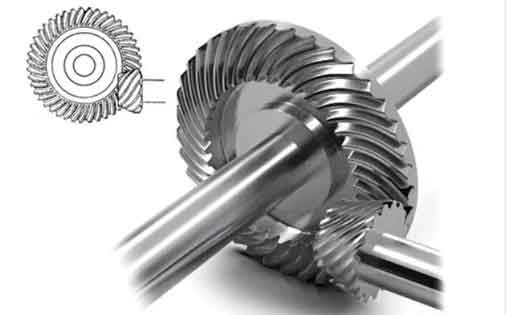
The common hard tooth surface finishing methods for spiral bevel gears include lapping, grinding, and hard cutting (also known as skiving or hard milling). Each method has distinct advantages and limitations. In mass production, such as in automotive and tractor industries, lapping is widely used after tooth cutting and surface hardening. However, heat treatment distortion significantly affects gear accuracy. For instance, spiral bevel gears often undergo carburizing or carbonitriding, leading to deformations that can reduce accuracy by 1–2 grades. The table below summarizes the impact of different heat treatments on gear accuracy, based on tests with spiral bevel gears having parameters like module m = 5 mm and initial accuracy equivalent to grade 6–7 (per ISO standards).
| Heat Treatment Method | Hardness | Hardened Layer Depth (mm) | Accuracy Degradation Grade |
|---|---|---|---|
| High-Frequency Quenching | HRC 50–55 | 1.5–2.0 | 1–2 |
| Carburizing Quenching | HRC 58–62 | 0.8–1.2 | 2–3 |
| Nitriding | HV 800+ | 0.3–0.5 | 1 |
Lapping offers high productivity and low cost but cannot eliminate errors like radial runout, pitch deviations, or tooth profile errors caused by heat treatment distortion. It primarily improves surface roughness and contact pattern alignment, but excessive lapping may degrade gear performance. Grinding, on the other hand, achieves high precision and is essential for high-accuracy spiral bevel gears. Yet, grinding efficiency is low, especially for large or high-precision gears, due to long machining times and high equipment costs. Grinding machines for spiral bevel gears are expensive and complex, limiting their widespread use. In recent years, advancements in machine tools and carbide tools (including CBN technology) have enabled hard cutting as a viable alternative. This method involves machining hardened surfaces with carbide or CBN cutters, offering benefits such as higher efficiency and better surface integrity.
Hard cutting of spiral bevel gears compares favorably with grinding in several aspects. Firstly, it provides higher metal removal rates—often 3 to 5 times that of grinding—making it suitable for roughing before fine grinding or as a final process for medium-precision gears. For high-precision spiral bevel gears, hard cutting can replace rough grinding to remove heat treatment distortion, leaving minimal uniform stock for finish grinding, thus reducing overall grinding time. Secondly, surface roughness achieved through hard cutting can be as low as $$ R_a \leq 0.4 \, \mu m $$, with reports indicating values down to $$ R_a = 0.1 \, \mu m $$ under optimal conditions. A phenomenon observed is that higher workpiece hardness often results in lower surface roughness. Thirdly, hard cutting enhances surface integrity. Unlike grinding, where heat can cause thermal damage, hard cutting directs most heat into the chips, minimizing surface alterations. Grinding is sensitive to factors that may induce cracks or softening, whereas hard cutting rarely causes surface annealing or cracking. Fourthly, residual stress states differ: grinding typically induces tensile stresses due to thermal loads, while hard cutting tends to produce compressive stresses, which are beneficial for fatigue life. Studies show that hard-cut surfaces exhibit compressive residual stresses, sometimes exceeding $$ -500 \, MPa $$, compared to tensile stresses from grinding. This is attributed to cold working effects and the removal of decarburized layers, exposing higher carbon concentrations. Additionally, hard cutting offers greater flexibility and lower machine investment compared to grinding.
To quantify errors in hard cutting, especially for large-module, few-teeth spiral bevel gears, formulas for polygonal error and wave height along the tooth direction are essential. For a carbide skiving cutter with a limited number of grooves, the polygonal error $$ \Delta f_f $$ and wave height $$ h $$ can be expressed as:
$$ \Delta f_f = \frac{f_a \cdot z_0}{2\pi \cdot m \cdot z} $$
$$ h = \frac{f_a \cdot z_0}{2\pi \cdot R} $$
where $$ f_a $$ is the axial feed per revolution (mm/rev), $$ z_0 $$ is the number of cutter grooves, $$ m $$ is the module (mm), $$ z $$ is the number of gear teeth, and $$ R $$ is the reference radius of the gear (mm). These errors arise from insufficient enveloping density due to cutter groove spacing. For example, with a module $$ m = 8 \, mm $$, axial feed $$ f_a = 0.5 \, mm/rev $$, cutter grooves $$ z_0 = 8 $$, and teeth $$ z = 20 $$, the polygonal error is approximately $$ \Delta f_f = 0.008 \, mm $$, and the wave height depends on the radius. This highlights the need for optimized cutting parameters to minimize surface irregularities.
The hard cutting process for spiral bevel gears involves specific steps to ensure quality. In small-to-medium batch production, the following sequence is recommended: gear blank machining (turning, milling, drilling), soft cutting (rough and finish cutting with stock allowance for hard cutting), contact pattern checking, heat treatment (typically carburizing and quenching), datum surface finishing (e.g., grinding inner holes or faces), hard cutting, and final inspection. Hard cutting usually starts with the larger gear, followed by adjustments to the pinion to achieve a proper contact pattern. The contact pattern length is modified by changing the cutter radius, while its position is controlled via machine settings. After verification, gears are checked for pitch accuracy on universal gear testers. Final inspections include dimensional checks, magnetic particle testing, and other specific requirements. The goal is to replicate the soft-cutting contact pattern as closely as possible. Although pairing checks are common, advancements in consistency from hard cutting may enable non-paired gear production, but this requires strict process control and standardized master gears.
Key considerations for successful hard cutting of spiral bevel gears encompass heat treatment control, datum surfaces, and tooling. Heat treatment must minimize distortion; excessive deformation leads to issues like insufficient case depth or extended machining times. Using quenching presses for ring gears helps, but trial pieces are advised for validation. Datum surfaces, such as end faces and bore diameters, must be precision-finished with tight tolerances—geometric errors should be within one-third of tooth tolerances. For spiral bevel gears, perpendicularity of end faces to axes and concentricity of bores are critical. Inconsistent face widths or mounting distances can necessitate individual machine adjustments, increasing cycle times. Soft-cutting tools should incorporate protuberances or grouped inserts to reduce hard cutting duration and prevent steps at tooth roots. Hard-cutting tools typically employ carbide or CBN inserts; for large-module spiral bevel gears, indexable inserts are suitable, while welded tips work for smaller modules. Tool grinding requires dedicated machines, fixtures, and diamond wheels to maintain edge quality. Cutting parameters like feed, speed, and depth must be optimized to balance efficiency and tool life.
To further illustrate the advantages of hard cutting for spiral bevel gears, a comparative analysis of different finishing methods is provided in the table below. This table summarizes key metrics such as productivity, surface roughness, residual stress, and cost implications.
| Finishing Method | Productivity (Metal Removal Rate) | Surface Roughness (Ra, μm) | Typical Residual Stress | Relative Cost | Suitability for Spiral Bevel Gears |
|---|---|---|---|---|---|
| Lapping | Low (0.1–0.5 cm³/min) | 0.4–0.8 | Near-neutral | Low | Mass production, low-precision |
| Grinding | Medium (0.5–2.0 cm³/min) | 0.1–0.4 | Tensile (50–200 MPa) | High | High-precision, small batches |
| Hard Cutting | High (2.0–10.0 cm³/min) | 0.1–0.4 | Compressive (-200 to -600 MPa) | Medium | Medium-to-high precision, various batches |
The efficiency of hard cutting for spiral bevel gears can be modeled using the specific cutting energy equation. The metal removal rate $$ Q $$ is given by:
$$ Q = a_p \cdot f_a \cdot v_c $$
where $$ a_p $$ is the depth of cut (mm), $$ f_a $$ is the axial feed (mm/rev), and $$ v_c $$ is the cutting speed (m/min). For spiral bevel gears, the effective cutting speed varies with the gear geometry, but an approximate formula for tangential speed at the mean cone distance is:
$$ v_c = \frac{\pi \cdot d_m \cdot n}{1000} $$
with $$ d_m $$ as the mean diameter (mm) and $$ n $$ as the spindle speed (rpm). Hard cutting typically operates at depths of cut up to $$ a_p = 0.5 \, mm $$ and feeds up to $$ f_a = 1.0 \, mm/rev $$, depending on gear size and hardness. Surface roughness in hard cutting is influenced by tool geometry and cutting conditions. An empirical relation for spiral bevel gears is:
$$ R_a = k \cdot \frac{f_a^2}{r_\epsilon} $$
where $$ k $$ is a material-dependent constant, and $$ r_\epsilon $$ is the tool nose radius (mm). Optimizing these parameters is crucial for achieving the desired finish on spiral bevel gears.
Heat treatment distortion remains a major concern for spiral bevel gears. The distortion can be quantified by the change in tooth profile deviation $$ \Delta F_\alpha $$ and helix deviation $$ \Delta F_\beta $$ after quenching. Statistical data from production of spiral bevel gears show that carburizing quenching often increases profile errors by 10–30 μm and helix errors by 15–40 μm. Compensation during soft cutting is challenging; hence, hard cutting serves as a corrective step. The allowable stock removal for hard cutting is typically 0.2–0.5 mm per flank, ensuring the hardened layer is not compromised. The hardness gradient in carburized spiral bevel gears follows a function:
$$ H(x) = H_0 + (H_s – H_0) \cdot e^{-\alpha x} $$
where $$ H(x) $$ is the hardness at depth $$ x $$ (mm), $$ H_0 $$ is the core hardness, $$ H_s $$ is the surface hardness, and $$ \alpha $$ is a decay constant. Hard cutting removes a thin layer, often exposing higher hardness regions, which enhances surface durability.
Tool life in hard cutting of spiral bevel gears is a critical economic factor. The Taylor tool life equation for carbide tools machining hardened steel (HRC 55–62) is:
$$ v_c \cdot T^n = C $$
where $$ v_c $$ is cutting speed (m/min), $$ T $$ is tool life (min), $$ n $$ is an exponent (typically 0.2–0.3 for carbide), and $$ C $$ is a constant. For spiral bevel gears, tool life is also affected by intermittent cutting and complex geometries. Monitoring tool wear through acoustic emission or force sensors can optimize change intervals. Additionally, the use of CBN tools extends life but at higher cost. A comparison of tool materials for hard cutting spiral bevel gears is shown in the table below.
| Tool Material | Typical Hardness (HV) | Max Cutting Speed (m/min) | Relative Wear Resistance | Cost Ratio |
|---|---|---|---|---|
| Carbide (K-type) | 1600–1800 | 80–120 | 1.0 (reference) | 1.0 |
| CBN (Polycrystalline) | 3000–4000 | 200–400 | 5.0–10.0 | 3.0–5.0 |
| Ceramic (Al₂O₃-based) | 2000–2200 | 150–250 | 2.0–3.0 | 1.5–2.5 |
For spiral bevel gears, carbide tools are often preferred due to balance of cost and performance, but CBN is used for high-volume or high-hardness applications.
Residual stress analysis in hard-cut spiral bevel gears reveals beneficial compressive layers. Using X-ray diffraction, residual stress $$ \sigma_{rs} $$ can be modeled as a function of cutting parameters. An approximate formula derived from experiments on hardened steel gears is:
$$ \sigma_{rs} = -A \cdot v_c^B + C \cdot f_a^D $$
where $$ A, B, C, D $$ are constants dependent on material and tool geometry. For spiral bevel gears with hardness HRC 60, typical values are $$ A = 300 $$, $$ B = 0.1 $$, $$ C = 150 $$, $$ D = 0.5 $$, yielding compressive stresses around $$ -300 \, MPa $$ at optimal conditions. This compressive state inhibits crack initiation and prolongs fatigue life, a key advantage for spiral bevel gears in demanding applications.
Process stability in hard cutting of spiral bevel gears depends on machine tool rigidity and control. Modern CNC gear cutting machines with high stiffness and dynamic response are essential. The machining force components—tangential $$ F_t $$, radial $$ F_r $$, and axial $$ F_a $$—can be estimated using mechanistic models:
$$ F_t = K_t \cdot a_p \cdot f_a $$
$$ F_r = K_r \cdot F_t $$
$$ F_a = K_a \cdot F_t $$
where $$ K_t, K_r, K_a $$ are specific force coefficients (N/mm²) for hardened steel. For spiral bevel gears, these forces vary along the tooth curve, requiring adaptive control to maintain accuracy. Vibration analysis is crucial; chatter can be minimized by optimizing spindle speed and depth of cut. The stability lobe diagram for a spiral bevel gear hard cutting process can be constructed using the formula:
$$ a_{p,\text{lim}} = \frac{1}{2 \cdot K_t \cdot \text{Re}(G(\omega))} $$
where $$ G(\omega) $$ is the frequency response function at chatter frequency $$ \omega $$. This ensures stable machining of spiral bevel gears without regenerative vibrations.
Surface finish and contact pattern alignment are vital for the performance of spiral bevel gears. After hard cutting, gears are often subjected to run-in testing to verify contact patterns. The contact pattern area $$ A_c $$ can be approximated as a function of misalignment errors:
$$ A_c = A_0 – k_1 \cdot \Delta E – k_2 \cdot \Delta P $$
where $$ A_0 $$ is the ideal contact area, $$ \Delta E $$ is the offset error, $$ \Delta P $$ is the pinion position error, and $$ k_1, k_2 $$ are sensitivity coefficients. Hard cutting allows precise control of these errors through machine adjustments, leading to consistent patterns. For spiral bevel gears in automotive differentials, contact patterns covering 50–70% of the tooth flank are typical, with hard cutting achieving this reliably.
Environmental and economic aspects also favor hard cutting for spiral bevel gears. Compared to grinding, hard cutting reduces energy consumption by 50–70%, as less power is needed for material removal. The carbon footprint of manufacturing spiral bevel gears can be lowered by adopting hard cutting processes. Additionally, dry cutting or minimal lubrication is possible with carbide tools, reducing coolant usage and disposal costs. A life-cycle analysis of spiral bevel gear production shows that hard cutting can decrease total energy use by 20–30% over conventional grinding-based routes.
In conclusion, hard tooth surface machining of spiral bevel gears via hard cutting offers a compelling combination of efficiency, precision, and surface quality. While lapping and grinding have their places, hard cutting emerges as a versatile solution for various production scales. Key challenges include managing heat treatment distortion, ensuring datum accuracy, and optimizing tool life. Future improvements in tool materials, machine dynamics, and process monitoring will further enhance the applicability of hard cutting for spiral bevel gears. As industries demand higher performance and lower costs, embracing advanced machining techniques like hard cutting will be essential for the next generation of spiral bevel gear manufacturing.