
As a key component in intersecting-axis power transmissions, spiral bevel gears offer significant advantages such as high transmission ratios, smooth operation, and large contact ratios. However, traditional manufacturing methods, primarily gear milling, present considerable drawbacks including low material utilization, low production efficiency, high cost, and reduced tooth root bending strength due to the severing of metal fiber flow lines. While precision forging has been successfully applied to the larger gear (gear) in a pair, forging the mating pinion remains challenging. The narrow tooth root space leads to thin mold teeth which rapidly anneal and deform under forging heat, resulting in unacceptably low mold life. Consequently, the manufacturing of precision forging dies for spiral bevel gears pinions is fraught with difficulty. To address this, my research explores hot rolling as a promising near-net-shape forming technology for pinions of spiral bevel gears. This paper details a comprehensive numerical simulation study to investigate the feasibility and characterize the physical fields of this innovative process.
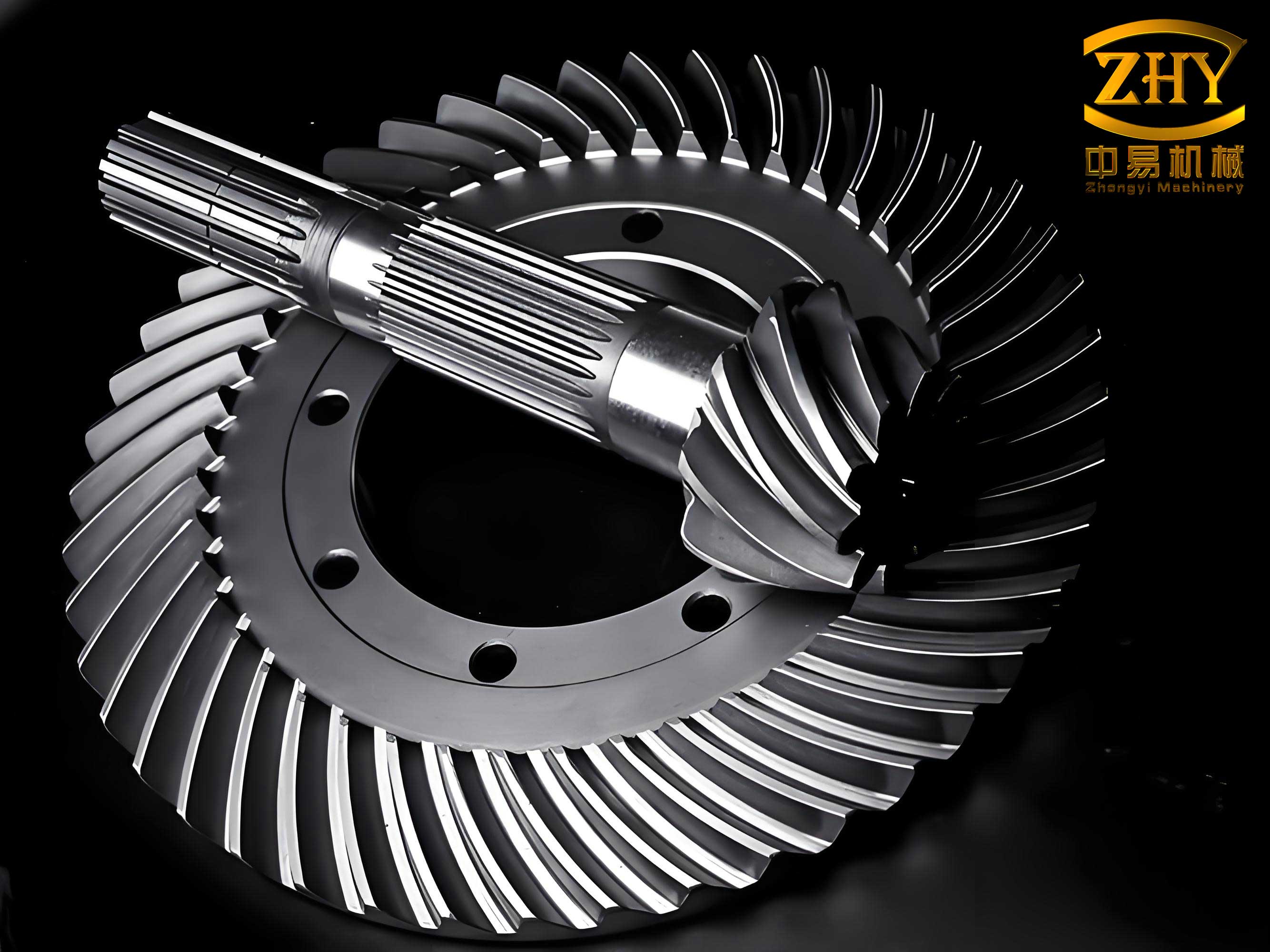
The application of rolling technology has seen substantial progress for cylindrical gears, threads, and splines. For instance, research has validated the feasibility of full-process rolling for spur gears, proposed novel rolling methods to improve pitch line accuracy, and utilized rolling to enhance the surface integrity of powder metallurgy gears. However, its application to spiral bevel gears, especially pinions with their complex geometry, remains largely unreported. My work aims to fill this gap by establishing a viable rolling process model, which is fundamentally based on gear meshing theory and the principle of full conjugation. The process involves the gradual formation of teeth on a blank through the infeeding of tool rolls along the tooth height direction.
Theoretical Foundation and Process Modeling
The success of the hot rolling process for spiral bevel gears hinges on two critical theoretical foundations: the accurate determination of the preform blank volume and the precise definition of the kinematic model between the tool and the blank.
1. Preform Blank Design Based on Volume Constancy
Unlike cylindrical gears where the blank diameter can be approximated by the pitch circle, the conical nature of spiral bevel gears necessitates a more rigorous approach. Using a blank with a diameter equal to the pitch cone circle would result in a volume far less than that of the finished gear, leading to underfilling and root undercut during rolling. Therefore, the preform is designed based on the principle of volume constancy, where the volume of the preform (VP) is designed to be equal to or slightly greater than the volume of the finished pinion (VL) to account for minimal flash and machining allowance. The geometry of the simplified preform model is defined by key dimensions as illustrated in the schematic. The total volume of the pinion is the sum of the shank volume and the volume of all teeth:
$$ V_L = V_z + z \cdot A_v $$
Where \( V_z \) is the volume of the conical shank, \( z \) is the number of teeth, and \( A_v \) is the volume of a single tooth, which can be obtained via 3D CAD software measurement. The volume of the conical shank is calculated using the formula for a conical frustum:
$$ V_z = \frac{1}{3} H \left( \frac{\pi d_1^2}{4} + \frac{\pi d_3^2}{4} + \frac{\pi d_1 d_3}{4} \right) $$
The preform volume \( V_P \) is also calculated as a composite of several conical frustums. By equating \( V_L \) and \( V_P \), the unknown geometrical parameter \( a \), which determines the final preform outer contour, can be solved. The initial contact diameter of the blank is set at the root cone circle to ensure proper engagement with the tool roll tooth tip at the start of the process.
2. Kinematic Model and Process Setup
The rolling setup is conceptualized with two identical tool rolls positioned above and below the pinion blank. They are mounted on corresponding spindles driven by a synchronous mechanism to rotate in opposite directions at identical speeds. The pinion blank is itself rotated via a splined shaft. The precise speed ratio between the tool rolls and the blank is critical for indexing and generating the correct number of teeth. The axial infeed motion of the tool rolls is the primary driving action for plastic deformation. As the rolls feed axially, they penetrate the blank, causing surface material to plastically flow and gradually form the tooth profile through a generating motion facilitated by the relative rotation. A key aspect of model construction is the accurate alignment of the tool roll axes relative to the blank axis to ensure correct tooth geometry generation. For simulation efficiency, the model can be simplified to a single tool roll interacting with a sector of the blank.
Finite Element Simulation of the Hot Rolling Process
To analyze the complex thermomechanical phenomena during the hot rolling of spiral bevel gears, a 3D finite element model was developed using DEFORM-3D software. The analysis employs a rigid-plastic formulation, which is appropriate for large plastic deformation processes where elastic strains are negligible compared to plastic strains, thereby enhancing computational efficiency while maintaining accuracy.
1. Model Configuration and Material Properties
The model components and their properties are summarized below:
| Component | Type | Material | Key Properties | Initial Temperature |
|---|---|---|---|---|
| Pinion Blank | Plastic | 8620 Steel | Young’s Modulus: 210 GPa; Poisson’s Ratio: 0.3; Density: 7850 kg/m³ | 950 °C |
| Tool Roll & Mandrel | Rigid | Tool Steel | – | 200 °C |
The blank was meshed with approximately 100,000 tetrahedral elements to balance accuracy and computation time. The friction conditions were defined using a shear friction model, with a friction factor of 0.25 at the roll-blank interface and 0.8 at the mandrel-blank interface to account for higher resistance to rotation. The process parameters for the simulation were set as follows: Tool Roll Infeed Velocity = 0.2 mm/s, Tool Roll Rotational Speed = 0.1 rad/s, Blank Rotational Speed = 0.30667 rad/s. This speed ratio ensures the correct indexing for the specified number of teeth.
2. Analysis of the Forming Stages
The simulation reveals that the hot rolling process for spiral bevel gears occurs in three distinct stages:
Initial Engagement Stage: As the tool roll contacts the blank, the rolling force increases with infeed. Once the induced stress exceeds the material’s yield limit, localized plastic deformation occurs on the blank surface. This results in the initial formation of evenly spaced protrusions and grooves corresponding to the tooth count. Metal flow is minimal and confined to the near-surface layer.
Primary Infeed Stage: With continued axial penetration of the roll, the zone of plastic deformation expands radially inward from the surface. Metal in the potential tooth gap is displaced toward the center. However, as the core material is dense and constrained, this displaced metal is forced to flow into the roll cavity, progressively filling it to form the tooth crest and flank. This stage involves extensive and complex metal flow.
Sizing Stage: The axial infeed is stopped once the roll has penetrated to a predetermined depth sufficient to fully fill the tooth cavity. The tool roll continues to rotate for one full revolution without further infeed. This stage ensures uniform tooth depth and refines the tooth profile accuracy across the entire blank circumference.
Comprehensive Analysis of Simulation Results
1. Effective Strain Field Evolution
The distribution of effective strain provides insight into the severity and location of plastic deformation. The evolution is characterized by a clear pattern:
- Initial Stage: Strain is highly localized at the nascent tooth root areas, with maximum values around 1.74.
- Infeed Stage: The high-strain region propagates from the root towards the entire tooth profile. At full infeed, the strain is distributed along the tooth contour with maximum values near 1.99.
- Sizing Stage: The strain distribution becomes more uniform along the tooth profile, stabilizing at a maximum of approximately 2.05.
Throughout the process, the cumulative strain is highest at the tooth surface and decreases gradually towards the interior, forming a gradient. This is expressed in the strain intensity \( \bar{\epsilon} \) which is a function of location and process time \( t \):
$$ \bar{\epsilon}(x,y,z,t) = \sqrt{\frac{2}{3} \dot{\epsilon}_{ij} \dot{\epsilon}_{ij} \cdot t} $$
Where \( \dot{\epsilon}_{ij} \) are the components of the strain rate tensor. This gradient is beneficial as it leads to work hardening on the tooth surface, potentially enhancing contact fatigue resistance.
2. Effective Stress Field Distribution
The effective stress field indicates the flow stress required to cause plastic deformation. Key observations include:
- Maximum stress is always concentrated in the material regions in immediate contact with the tool roll.
- During the infeed stage, the peak stress increases from approximately 241 MPa to 300 MPa as deformation becomes more severe.
- In the sizing stage, the peak stress drops to around 257 MPa as the deformation stabilizes.
- The stress distribution starts simply at the contact points and grows increasingly complex as the deformation zone expands inward, following the contours of the developing teeth.
The flow stress \( \bar{\sigma} \) is highly dependent on strain, strain rate \( \dot{\bar{\epsilon}} \), and temperature \( T \), following a constitutive law typical for hot working:
$$ \bar{\sigma} = K \cdot (\bar{\epsilon})^n \cdot (\dot{\bar{\epsilon}})^m \cdot \exp(\beta / T) $$
Where \( K \) is the strength coefficient, and \( n, m, \beta \) are the strain-hardening exponent, strain-rate sensitivity, and temperature coefficient, respectively.
3. Temperature Field Analysis
Temperature is a critical parameter influencing material flow stress and die life. The simulation tracks the coupled effects of heat generation and transfer:
- Heat Sources: Plastic deformation work and friction at the roll-blank interface generate heat.
- Heat Sinks: Heat is lost to the cooler tool rolls (200°C), the mandrel, and the environment through convection and radiation.
- Net Effect: During the infeed stage, the competition between generation and loss results in a relatively slow temperature drop from 950°C to 850°C.
- Sizing Stage: With infeed stopped, heat generation reduces significantly while conduction to the tools continues, causing a faster temperature drop to about 786°C.
- Hot Spot: The highest temperature is consistently found in an annular region between the formed teeth and the mandrel hole. This area is less exposed to direct contact with the cool tools, leading to slower heat dissipation.
The temperature evolution can be modeled by the energy balance equation:
$$ \rho c_p \frac{\partial T}{\partial t} = k \nabla^2 T + \eta \bar{\sigma} \dot{\bar{\epsilon}} $$
where \( \rho \) is density, \( c_p \) is specific heat, \( k \) is thermal conductivity, and \( \eta \) is the inelastic heat fraction (typically ~0.9 for metals).
4. Forming Load Analysis
The load-stroke curve for the tool roll in the infeed direction (Z-axis) is a critical output for machine design and process control. The curve exhibits three distinct phases corresponding to the forming stages:
- Elastic/Initial Contact Phase (0 – ~0.38 mm stroke): The load is very low and increases gradually as the roll establishes contact and begins to elastically deform the blank surface.
- Ramping Plastic Deformation Phase (~0.38 – ~7.56 mm stroke): The load increases almost linearly and sharply with stroke. This is due to the rapidly increasing volume of plastically deforming material and the corresponding rise in contact area and frictional resistance.
- Stabilization Phase (~7.56 – 9.00 mm stroke): The load increase rate slows and stabilizes, reaching a maximum of approximately 126 kN. This occurs when the tooth cavity is nearly completely filled, and the deformation mode shifts from bulk forming to localized sizing.
This load profile is essential for selecting the capacity of the rolling press. The total forming force \( F_z \) can be conceptually related to the average flow stress and the projected contact area \( A_c \):
$$ F_z \approx \bar{\sigma}_{avg} \cdot A_c \cdot f(\mu) $$
Where \( f(\mu) \) is a function accounting for the friction condition.
Process Parameter Determination and Optimization Guidelines
Based on the comprehensive analysis of the physical fields, key process parameters for the hot rolling of spiral bevel gears pinions can be systematically determined. The following table summarizes the critical parameters and their derived values or influences from the simulation:
| Parameter Category | Specific Parameter | Value / Influence from Simulation | Design Consideration |
|---|---|---|---|
| Kinematic Parameters | Tool Roll Rotational Speed (ω_r) | 0.1 rad/s (used in simulation) | Must be synchronized with blank speed for correct indexing. Affects strain rate and production cycle time. |
| Blank Rotational Speed (ω_b) | 0.30667 rad/s (for z_blank=15, z_tool=46) | Determined by gear ratio: \( \omega_b / \omega_r = z_tool / z_blank \). | |
| Axial Infeed Velocity (v_a) | 0.2 mm/s (used in simulation) | Controls forming time and strain rate. Lower speeds reduce loads but increase cycle time. | |
| Thermal Parameters | Blank Initial Temperature (T_b) | 950 °C | Must be within the hot working range of the material (e.g., above recrystallization temperature) to lower flow stress and aid formability. |
| Tool Initial Temperature (T_t) | 200 °C | Pre-heating tools reduces thermal shock and heat extraction rate, helping to maintain blank temperature. | |
| Geometric Parameter | Preform Volume (V_p) | > V_L (Finished Gear Volume) | Designed via volume constancy principle with a slight excess to ensure full cavity filling without excessive flash. |
| Final Infeed Stroke (s_max) | 9.0 mm (simulation endpoint) | The stroke required to fully form the tooth depth. Determined iteratively via simulation to achieve complete fill. | |
| Interface Conditions | Roll-Blank Friction Factor (μ_r) | 0.25 (Shear Model) | High enough to transmit torque for rotation but low enough to minimize surface shear and sticking. Lubrication is critical. |
| Mandrel-Blank Friction Factor (μ_m) | 0.8 | Intentionally high to ensure the blank rotates with the mandrel without slippage, ensuring proper indexing. | |
| Machine Requirement | Maximum Forming Force (F_max) | ~126 kN (from simulation) | Primary parameter for selecting or designing the rolling press. Provides a safety factor for machine capacity. |
Discussion on Feasibility and Quality Implications
The simulation results conclusively demonstrate the technical feasibility of the hot rolling process for manufacturing pinions of spiral bevel gears. The complete formation of tooth profiles without macroscopic defects (like folding or incomplete fill) under the simulated parameters is a primary indicator. Beyond feasibility, the analysis of physical fields provides deep insights into the potential quality attributes of rolled spiral bevel gears:
Microstructure and Strength: The gradient strain field, with high surface strain, suggests the possibility of a graded microstructure. The surface layer may experience significant grain refinement due to dynamic recrystallization during hot working, potentially leading to enhanced surface hardness and fatigue resistance—a key advantage over cut teeth where the fiber flow is interrupted.
Residual Stresses: The non-uniform cooling and deformation will induce residual stress patterns. Compressive residual stresses on the tooth flanks, often a result of such processes, are highly beneficial for improving contact fatigue life and resistance to micropitting.
Dimensional Accuracy: The sizing stage is crucial for achieving consistent tooth geometry and lead. The simulation shows that after infeed, a period of rotation under load helps homogenize the deformation. In practice, precise control of the final stroke and the alignment of the tool roll axis (the “machine root angle”) are paramount for achieving the correct localized tooth geometry and proper conjugate action with its mating gear.
Limitations and Challenges: The model assumes ideal conditions. Practical challenges include:
- Tool Design and Wear: The complex conjugate shape of the tool roll is expensive to manufacture. The high temperatures and cyclic loads will lead to wear and potential thermal fatigue, affecting tool life and part accuracy over time.
- Material Homogeneity: The simulation assumes a homogeneous, isotropic blank. Real material inclusions or segregations could cause non-uniform flow or defects.
- Springback and Distortion: The current rigid-plastic model does not account for elastic springback upon unloading or thermal distortion during cooling, which will affect final dimensions and require compensation in tool design.
Conclusion and Outlook
This in-depth numerical investigation establishes a foundational framework for the hot rolling forming process of pinions for spiral bevel gears. Through systematic finite element analysis, the study has:
- Confirmed the process feasibility by successfully simulating the complete tooth formation sequence.
- Established a methodology for preform blank design based on rigorous volume calculation.
- Defined the essential kinematic model and interface conditions required for proper tooth generation.
- Characterized the evolution of critical physical fields—strain, stress, temperature, and load—providing a comprehensive understanding of the thermomechanical behavior during rolling.
- Derived key process parameters, most notably a maximum forming force of approximately 126 kN, which is vital for equipment specification.
The results indicate that hot rolling presents a viable near-net-shape alternative to traditional machining for spiral bevel gears pinions, with the potential for improved material properties, higher efficiency, and greater material utilization. Future work should focus on:
- Experimental validation of the simulation results with physical trials to calibrate the model.
- Investigation of tool wear mechanisms and strategies for extending tool life.
- Multi-objective optimization of process parameters (infeed speed, temperature, rotation speed) to balance forming load, cycle time, and final gear quality.
- Extension of the model to include elastic effects for springback prediction and more advanced material models for microstructure evolution.
The successful development of this technology could significantly impact the manufacturing landscape for high-performance spiral bevel gears used in automotive, aerospace, and heavy machinery applications.