
In the field of power transmission, spiral bevel gears are critical components for transferring motion and power between intersecting axes, renowned for their high load capacity and smooth operation. The core to their performance lies in the management of transmission error (TE), a composite result of non-conjugate tooth action and fluctuating mesh stiffness. This TE curve encapsulates vital information regarding the dynamic behavior and strength of the gear pair. Extensive theoretical and experimental research has established a direct correlation between the shape of the TE function and the dynamic response of geared systems, influencing vibration, noise, and fatigue life. This work presents a comprehensive methodology for the design, synthesis, and analysis of spiral bevel gears with a pre-specified, symmetric, fourth-order parabolic transmission error profile, aiming to improve meshing stability and tailor performance across varying load conditions.
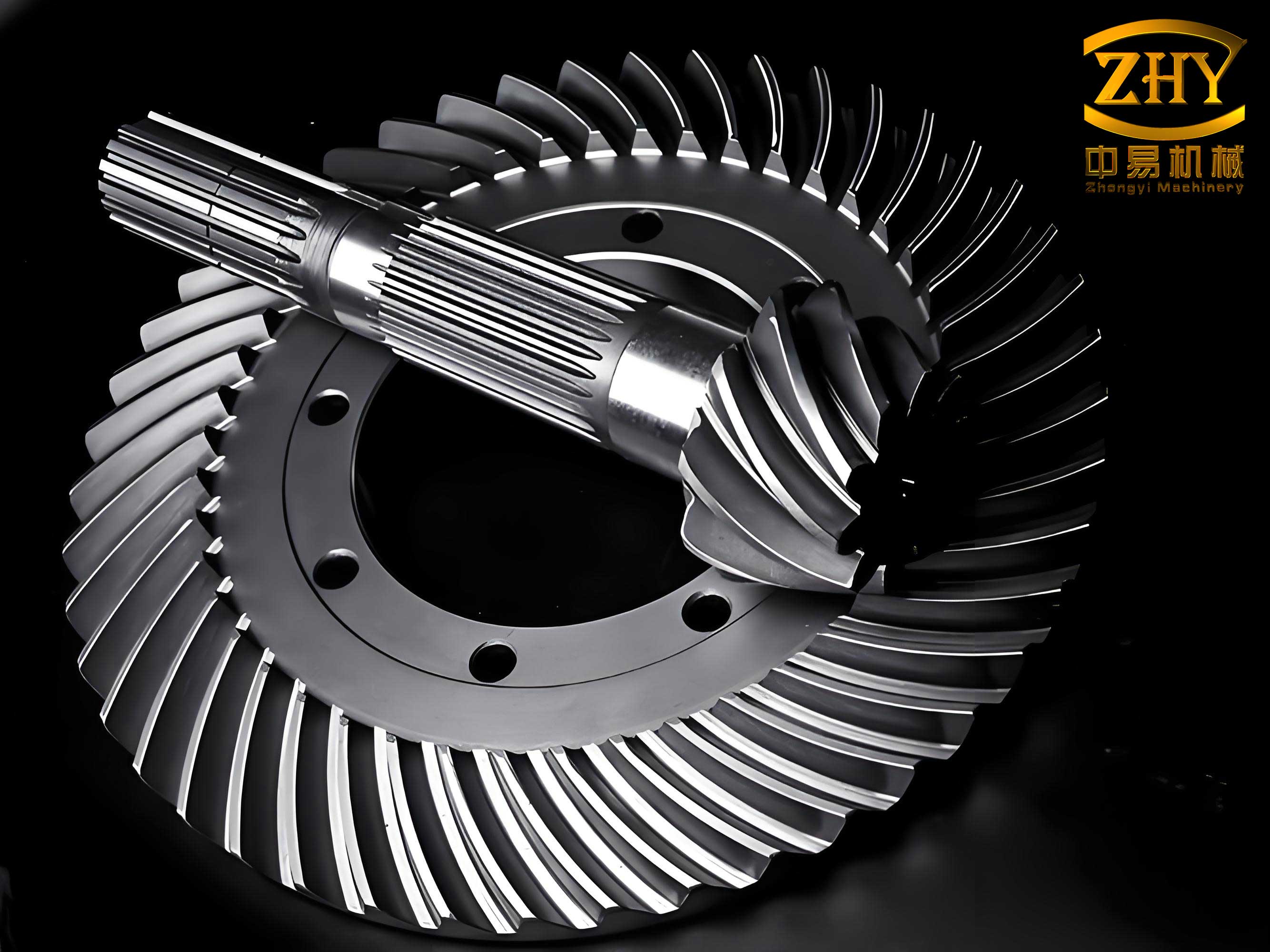
Traditional design paradigms for spiral bevel gears often target a second-order parabolic TE. While this shape offers some insensitivity to minor alignment errors, its fundamental characteristic—a change in the sign of its first derivative at the mesh-in and mesh-out points—can induce vibrational excitation and impact during tooth engagement and disengagement. This inherent trait motivates the exploration of higher-order TE functions. A fourth-order parabolic TE, formed by the superposition of quartic and quadratic terms, provides a designer with an additional degree of freedom. This extra parameter allows for the control of the TE amplitude at the pitch point (or meshing transfer point) independent of the amplitude at the entry and exit points, enabling a flatter central region of the curve. Such a profile can potentially reduce the fluctuation of loaded transmission error (LTE) under specific load ranges, thereby mitigating vibration and noise, while maintaining or even improving resistance to edge contact under misalignment.
The foundation of this design approach rests on the well-established principles of local synthesis and machine tool settings generation for spiral bevel gears. Local synthesis provides the initial conjugate conditions at a chosen reference point on the tooth surface, defining parameters such as the direction of the contact path. To achieve a symmetric meshing cycle—where the durations and TE amplitudes at entry and exit are equal—a systematic adjustment of the reference point’s location along the tooth height and the contact path direction angle is performed. This ensures the design contact ratio is met while centering the meshing cycle. The mathematical formulation for a symmetric, fourth-order parabolic transmission error, defined as the deviation of the follower gear’s angular position from its ideal conjugate motion, is given by:
$$ \Delta \phi_2(\phi_1) = a (\phi_1 – \phi_1^{(0)})^4 + b (\phi_1 – \phi_1^{(0)})^2 $$
where $\Delta \phi_2$ is the transmission error, $\phi_1$ is the pinion rotation angle, $\phi_1^{(0)}$ is the initial pinion angle at the reference point, and $a$ and $b$ are the coefficients defining the fourth-order parabolic shape. The conventional second-order parabola is a special case of this function where $a = 0$. The coefficients $a$ and $b$ are solved simultaneously using two boundary conditions: the desired TE amplitude at the mesh-in point ($\Delta \phi_2^{(in)}$) and the target, independently-specified TE amplitude at the pitch point ($\Delta \phi_2^{(T_p)}$). This system of equations is:
$$
\begin{aligned}
\Delta \phi_2^{(T_p)} &= a (T_0 – 0.5T_{mesh})^4 + b (T_0 – 0.5T_{mesh})^2 \\
\Delta \phi_2^{(in)} &= a T_{in}^4 + b T_{in}^2
\end{aligned}
$$
Here, $T_0$, $T_{in}$, and $T_{mesh}$ represent the roll angles (or time parameters) at the reference point, mesh-in point, and the total mesh cycle, respectively. Solving this yields the unique coefficients $a$ and $b$ for the desired fourth-order profile.
The realization of this pre-designed TE function on the physical spiral bevel gears is achieved through a modified roll (or变性法) process applied to the pinion member. This method involves a controlled, non-linear relationship between the cradle (cutting tool) rotation and the work-piece (pinion) rotation during generation. The fundamental kinematic relationship for gear generation is defined by the roll ratio, $R_{ap} = d\phi_c / d\phi_p$, where $\phi_c$ is the cradle angle and $\phi_p$ is the pinion blank rotation angle. To produce the fourth-order TE, a polynomial function is prescribed for $\phi_c$ in terms of $\phi_p$:
$$ \phi_c = c_0 + c_1 \phi_p + c_2 \phi_p^2 + c_3 \phi_p^3 + c_4 \phi_p^4 + … $$
The task is to determine the specific coefficients $c_i$ of this polynomial that will yield the pinion tooth surface which, in mesh with the given gear, produces the target $\Delta \phi_2(\phi_1)$. This is an inverse problem solved through an iterative numerical procedure often called inverse Tooth Contact Analysis (inverse TCA).
Let $\mathbf{r}^{(2)}(\theta_g, \phi_g)$ and $\mathbf{n}^{(2)}(\theta_g, \phi_g)$ be the known position and unit normal vectors of the gear tooth surface. For a successful mesh, the pinion and gear surfaces must be in continuous tangency. This condition, expressed in a fixed coordinate system $S_h$, leads to the classic TCA equations:
$$
\begin{aligned}
\mathbf{r}_h^{(1)}(\theta_p, \phi_p, \phi_1) &= \mathbf{r}_h^{(2)}(\theta_g, \phi_g, \phi_2) \\
\mathbf{n}_h^{(1)}(\theta_p, \phi_p, \phi_1) &= \mathbf{n}_h^{(2)}(\theta_g, \phi_g, \phi_2)
\end{aligned}
$$
In the forward TCA problem, the pinion surface $\mathbf{r}_h^{(1)}$ is known, and we solve for the relationship $\phi_2(\phi_1)$. In our inverse problem, we know the desired functional relationship $\phi_2(\phi_1)$, which is derived from the TE definition and the target fourth-order polynomial:
$$ \phi_2(\phi_1) = a (\phi_1 – \phi_1^{(0)})^4 + b (\phi_1 – \phi_1^{(0)})^2 + \frac{N_1}{N_2}(\phi_1 – \phi_1^{(0)}) + \phi_2^{(0)} $$
where $N_1$ and $N_2$ are the numbers of teeth on the pinion and gear. The unknown is the pinion surface, which is parameterized by the generation motion $\phi_c(\phi_p)$. The strategy is as follows: A sequence of pinion rotation angles $\phi_1^{(i)}$ is selected spanning the entire meshing cycle. For each $\phi_1^{(i)}$, the corresponding gear angle $\phi_2^{(i)}$ is calculated from the equation above. These $(\phi_1^{(i)}, \phi_2^{(i)})$ pairs are substituted into the TCA equations, which are then solved numerically for the remaining unknowns: the surface parameters $(\theta_p^{(i)}, \phi_p^{(i)}, \theta_g^{(i)}, \phi_g^{(i)})$ and, crucially, the cradle angle $\phi_c^{(i)}$ required to achieve that specific conjugacy condition. This process yields a discrete data set $(\phi_p^{(i)}, \phi_c^{(i)})$. A polynomial regression is performed on this data set to obtain the coefficients $c_0, c_1, c_2, c_3, …$ for the roll function in the polynomial. Introducing this polynomial function $\phi_c(\phi_p)$ into the pinion generation equation effectively creates the modified pinion tooth surface that embodies the pre-designed fourth-order transmission error. It is critical to note that this modification is applied only to the pinion; the gear tooth geometry remains unchanged from its base design.
The influence of the fourth-order TE design is most clearly visualized through the “ease-off” topography. The ease-off is defined as the normal deviation between the real pinion surface and the theoretical conjugate pinion surface that would perfectly match the unmodified gear. It represents the intentional, microscopic modification applied to the pinion flank. For a fourth-order parabolic TE, the ease-off distribution along the contact path exhibits a corresponding higher-order profile, directly responsible for shaping the TE curve.
To validate the proposed methodology and investigate the performance implications, a detailed case study was conducted on a spiral bevel gear pair. The basic geometric parameters of the gear set are summarized in Table 1.
| Parameter | Pinion | Gear |
|---|---|---|
| Number of Teeth | 23 | 65 |
| Module (mm) | 3.9 | |
| Normal Pressure Angle (°) | 25 | |
| Mean Spiral Angle (°) | 25 | |
| Shaft Angle (°) | 90 | |
| Face Width (mm) | 37 | |
Five distinct fourth-order TE designs were synthesized, each with an identical design contact ratio and symmetric entry/exit TE amplitude, but with varying amplitudes at the pitch point. The key coefficients for these designs, labeled Case 1 through Case 5, are presented in Table 2. Case 3, where coefficient $a$ equals zero, represents the traditional second-order parabolic TE and serves as the baseline for comparison.
| Case | Coefficient $a$ | Coefficient $b$ | Pitch Point TE Amplitude, $\Delta \phi_2^{(T_p)}$ [arcsec] | Key Roll Polynomial Coefficients ($c_1$, $c_2$, $c_3$) |
|---|---|---|---|---|
| 1 | -0.0010 | -0.0299 | -6.156 | (0.0222, -0.0590, 5.3318) |
| 2 | -0.0030 | -0.0099 | -12.312 | (0.0664, -0.0618, 1.7753) |
| 3 (Baseline) | -0.0039 | 0.0000 | -15.390 | (0.0885, -0.0628, 0.0019) |
| 4 | -0.0049 | 0.0100 | -18.468 | (0.1105, -0.0638, -1.7685) |
| 5 | -0.0064 | 0.0250 | -23.085 | (0.1435, -0.0657, -4.4178) |
The unloaded TCA results confirmed that all five designs achieved perfectly symmetric, parabolic-shaped TE curves with the same contact ratio. The contact patterns remained stable and centered, demonstrating that the modification primarily affects the micro-geometry along the path of contact rather than the overall contact location. The most significant observation from Table 2 is that the implementation of the fourth-order TE is accomplished primarily by adjusting the first few coefficients ($c_1$, $c_2$, $c_3$) of the roll polynomial. The constant term $c_0$ shows negligible change, indicating the fundamental machine setup remains stable.
The true performance characteristic of spiral bevel gears under operating conditions is revealed by Loaded Tooth Contact Analysis (LTCA). LTCA simulates the elastic deformation of the teeth under load, calculating the resulting Loaded Transmission Error (LTE) and contact pressure distribution. For the spiral bevel gears designed with different TE profiles, LTCA was performed across a wide range of output torques (from 5 Nm to 1000 Nm). The LTE fluctuation, defined as the peak-to-peak variation of the LTE curve over one mesh cycle, is a direct indicator of dynamic excitation. The results for Cases 1, 3, and 5 are summarized in Table 3 and reveal a critical trend.
| Output Torque (Nm) | LTE Fluctuation – Case 1 [arcsec] | LTE Fluctuation – Case 3 (Baseline) [arcsec] | LTE Fluctuation – Case 5 [arcsec] | Remarks |
|---|---|---|---|---|
| 5 – 300 (Light Load) | Smallest | Medium | Largest | Case 1 excels in light-load smoothness. |
| ~400 | Local Minimum for Case 3 | Absolute Minimum | Decreasing | Baseline design is optimal at this torque. |
| 600 – 800 | Increasing | Increasing | Absolute Minimum | Case 5 shifts optimal performance to higher load. |
| 1000 (Max Load) | Largest | Medium | Smallest | All cases avoid edge contact; Case 5 has flattest LTE. |
The analysis of these spiral bevel gears leads to several important conclusions. First, the design of a symmetric, fourth-order parabolic transmission error for spiral bevel gears is a feasible and effective method to gain an additional degree of control over the meshing behavior. The mathematical framework, combining pre-specified boundary conditions with an inverse TCA solution for the generating roll polynomial, provides a systematic pathway for its implementation. Second, the traditional second-order parabolic TE is confirmed to be a specific subset ($a=0$) of this more general fourth-order model. The physical realization on the spiral bevel gears is essentially a higher-order ease-off modification applied along the contact path on the pinion flank. Third, the adjustment required on the manufacturing side is minimal and practical; only the higher-order terms ($c_1$, $c_2$, $c_3$) of the roll ratio polynomial need modification, keeping the basic machine setup unchanged. This is particularly advantageous for finishing processes like grinding. Finally, and most significantly, the choice of the fourth-order coefficients provides a powerful tool for performance tuning. By reducing the TE amplitude at the pitch point (as in Case 1), the spiral bevel gear pair exhibits superior smoothness (minimal LTE fluctuation) under light to moderate loads. Conversely, increasing the pitch point TE amplitude (as in Case 5) shifts the load zone corresponding to the minimum LTE fluctuation to a higher torque range. This allows designers to tailor the dynamic performance of the spiral bevel gears to the specific predominant load regime of the application, whether it is for efficiency at partial load or for smoothness under high torque. Furthermore, all designed profiles maintain robustness against edge contact under maximum design load and inherent insensitivity to small alignment errors due to the parabolic nature of the curve. Future work will focus on integrating this geometric design methodology into a fully coupled dynamic model to quantitatively predict vibration and noise reduction, and to explore optimal fourth-order profiles for specific operational spectra of spiral bevel gears.