
As a researcher in gear engineering, I have dedicated significant effort to understanding the complex thermo-tribological behavior of spiral bevel gears. These gears are critical components in many mechanical systems, such as automotive differentials and aerospace transmissions, where they operate under high loads and speeds. The interaction between thermal effects and friction—thermo-tribology—directly influences gear performance, efficiency, and lifespan. In this article, I will explore key aspects of studying this behavior, focusing on temperature field analysis, thermal contact modeling, heat transfer calculations, and applications. The goal is to provide a comprehensive framework that integrates theoretical models, numerical methods, and practical insights to optimize spiral bevel gear design and operation.
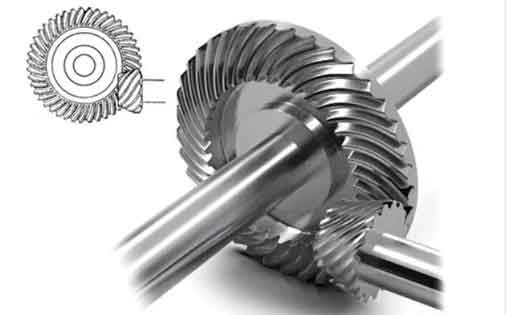
The analysis of spiral bevel gears begins with temperature field modeling, which is essential for predicting thermal distortions and potential failure modes like scuffing or pitting. The temperature distribution within a spiral bevel gear tooth is governed by the heat conduction equation, which accounts for internal heat generation from friction and external heat transfer. For transient analysis, the equation is expressed as:
$$ \rho c \frac{\partial T}{\partial t} = \nabla \cdot (k \nabla T) + \dot{q} $$
where \( \rho \) is density, \( c \) is specific heat, \( T \) is temperature, \( t \) is time, \( k \) is thermal conductivity, and \( \dot{q} \) is heat generation rate per unit volume. This partial differential equation must be solved numerically, often using finite element methods (FEM). For discretization in time, an implicit scheme like backward Euler can be applied. If \( T^n \) represents temperature at time \( t \), and \( \Delta t \) is the time step, then:
$$ T^{n+1} = T^n + \Delta t \cdot \left( \frac{\nabla \cdot (k \nabla T^{n+1}) + \dot{q}}{\rho c} \right) $$
This iterative approach ensures stability, especially for small time steps. For spiral bevel gears, the geometry is complex, requiring careful meshing to capture curvature effects. The boundary conditions are crucial and include: on the meshing tooth surface, a heat flux input from friction; on the gear end faces, convective cooling; on non-meshing surfaces like tooth roots and tops, mixed convection and radiation; and on symmetric sections, temperature and gradient continuity. Mathematically, these can be summarized as:
- Meshing surface: \( -k \frac{\partial T}{\partial n} = q_f \) where \( q_f \) is frictional heat flux.
- End faces: \( -k \frac{\partial T}{\partial n} = h (T – T_{\infty}) \) with \( h \) as convective coefficient.
- Other surfaces: Similar convective conditions or insulation.
Initial conditions typically come from steady-state analysis, where \( \frac{\partial T}{\partial t} = 0 \), simplifying the equation to \( \nabla \cdot (k \nabla T) + \dot{q} = 0 \). Solving this provides a baseline temperature field for transient simulations. To illustrate key parameters, Table 1 summarizes common material properties for spiral bevel gears made of alloy steel.
| Property | Symbol | Value | Units |
|---|---|---|---|
| Density | \( \rho \) | 7850 | kg/m³ |
| Specific Heat | \( c \) | 460 | J/(kg·K) |
| Thermal Conductivity | \( k \) | 40-50 | W/(m·K) |
| Young’s Modulus | \( E \) | 210 | GPa |
| Poisson’s Ratio | \( \nu \) | 0.3 | – |
| Thermal Expansion Coefficient | \( \alpha \) | 12 × 10⁻⁶ | 1/K |
The heat generation in spiral bevel gears stems primarily from sliding friction during meshing. A thermal contact analysis model is thus vital to quantify this heat. The frictional heat generated at a contact point is given by:
$$ Q = \mu \cdot v_s \cdot F_n $$
where \( \mu \) is friction coefficient, \( v_s \) is sliding velocity, and \( F_n \) is normal load. Determining these factors requires detailed contact analysis based on gear geometry and kinematics. For spiral bevel gears, meshing theory yields contact ellipses along the tooth surface, each representing a localized contact zone. The size and orientation of these ellipses depend on principal curvatures, load distribution, and alignment. To integrate with FEM, the contact region is discretized into nodes within each ellipse. The number of ellipses affects accuracy; too few may underrepresent heat distribution, while too many increase computational cost. Studies suggest using 50-100 ellipses for typical spiral bevel gears. The heat flux at a node is then:
$$ \dot{q}_i = \sum_{j=1}^{N_{\text{ellipses}}} \frac{Q_j}{A_j} \cdot w_{ij} $$
where \( A_j \) is area of ellipse \( j \), and \( w_{ij} \) is a weight factor (e.g., parabolic distribution) for node \( i \). If ellipses overlap, heat contributions are superimposed. The friction coefficient \( \mu \) is highly sensitive to operating conditions. For lubricated spiral bevel gears, an empirical formula can be used:
$$ \mu = a \cdot v_r^b \cdot \zeta^c \cdot T_l^d \cdot p^e $$
with \( v_r \) as rolling velocity, \( \zeta \) as slide-to-roll ratio, \( T_l \) as lubricant temperature, \( p \) as contact pressure, and \( a, b, c, d, e \) as constants determined experimentally. Table 2 lists typical ranges for these parameters in automotive applications.
| Parameter | Symbol | Range | Units |
|---|---|---|---|
| Rolling Velocity | \( v_r \) | 5-20 | m/s |
| Slide-to-Roll Ratio | \( \zeta \) | 0.1-0.3 | – |
| Contact Pressure | \( p \) | 0.5-2.0 | GPa |
| Lubricant Temperature | \( T_l \) | 80-120 | °C |
| Friction Coefficient | \( \mu \) | 0.05-0.15 | – |
Heat partitioning between the two meshing spiral bevel gears is often assumed equal, as sliding friction heat is absorbed by both surfaces. However, for precision, a more nuanced approach considers thermal properties and flash temperatures. The heat flux entering each gear is:
$$ q_{\text{gear}} = \frac{Q}{2A_c} $$
where \( A_c \) is contact area. This simplification is valid for symmetric materials but may need adjustment for dissimilar gears.
Beyond contact analysis, heat transfer mechanisms play a key role in spiral bevel gear temperature fields. Conduction within the gear and convection to the environment are primary modes, with radiation often negligible. The thermal conductivity \( k \) for steel varies with temperature; for carbon steel, a linear relation may apply:
$$ k(T) = 50 – 0.025T \quad \text{for} \quad 0 \leq T \leq 800^\circ \text{C} $$
For alloy steels used in spiral bevel gears, compositional effects matter. If \( C \), \( Mn \), and \( Si \) are weight percentages, an approximate formula is:
$$ k = 40 + 0.1C – 0.2Mn – 0.3Si \quad \text{W/(m·K)} $$
Convective heat transfer coefficients \( h \) depend on geometry, lubrication, and motion. For spiral bevel gears, different surfaces have distinct \( h \) values. On meshing tooth surfaces, under lubricated conditions, \( h_m \) can be estimated via:
$$ h_m = 0.023 \cdot \frac{k_{\text{lub}}}{D_h} \cdot \text{Re}^{0.8} \cdot \text{Pr}^{0.4} $$
where \( D_h \) is hydraulic diameter, Re is Reynolds number, and Pr is Prandtl number. For gear end faces, rotation induces airflow; for laminar flow:
$$ h_e = 0.664 \cdot \frac{k_{\text{air}}}{L} \cdot \text{Re}^{0.5} \cdot \text{Pr}^{0.33} $$
and for turbulent flow:
$$ h_e = 0.037 \cdot \frac{k_{\text{air}}}{L} \cdot \text{Re}^{0.8} \cdot \text{Pr}^{0.33} $$
On non-meshing surfaces like tooth roots and tops, \( h_n \approx 50-100 \, \text{W/(m²·K)} \) for forced convection. Other surfaces may have negligible convection. To summarize, Table 3 provides typical convective coefficients for spiral bevel gears in oil-lubricated systems.
| Surface | Condition | \( h \) Range (W/(m²·K)) | Notes |
|---|---|---|---|
| Meshing Tooth | Lubricated, high slip | 500-2000 | Depends on oil flow |
| End Faces | Rotating in air | 50-150 | Speed-dependent |
| Tooth Roots/Tops | Exposed to air/oil mist | 100-300 | Forced convection |
| Other Surfaces | Static or shielded | 10-50 | Natural convection |
The temperature field analysis for spiral bevel gears yields critical insights for practical applications. One major application is computing thermal deformation, which affects gear backlash and contact patterns. The thermal strain \( \epsilon_{th} \) is related to temperature change \( \Delta T \) by:
$$ \epsilon_{th} = \alpha \Delta T $$
where \( \alpha \) is thermal expansion coefficient. In FEM, this strain is converted to equivalent nodal forces. The stress-strain relations including thermal effects are:
$$ \epsilon_x = \frac{1}{E} [\sigma_x – \nu(\sigma_y + \sigma_z)] + \alpha \Delta T $$
$$ \epsilon_y = \frac{1}{E} [\sigma_y – \nu(\sigma_x + \sigma_z)] + \alpha \Delta T $$
$$ \epsilon_z = \frac{1}{E} [\sigma_z – \nu(\sigma_x + \sigma_y)] + \alpha \Delta T $$
$$ \gamma_{xy} = \frac{\tau_{xy}}{G}, \quad \gamma_{yz} = \frac{\tau_{yz}}{G}, \quad \gamma_{zx} = \frac{\tau_{zx}}{G} $$
with \( G = \frac{E}{2(1+\nu)} \). The equivalent nodal force vector \( \mathbf{F} \) due to initial thermal strain is:
$$ \mathbf{F} = \int_V \mathbf{B}^T \mathbf{D} \epsilon_{th} \, dV $$
where \( \mathbf{B} \) is strain-displacement matrix and \( \mathbf{D} \) is elasticity matrix. Solving \( \mathbf{K} \mathbf{u} = \mathbf{F} \) gives displacement \( \mathbf{u} \), i.e., thermal deformation. This helps in proactive tooth modification for spiral bevel gears, improving load capacity and reducing noise.
Another application is survival time analysis under loss-of-lubrication conditions. Spiral bevel gears without lubrication experience rapid temperature rise, leading to increased deformation, reduced clearance, and eventual seizure. Transient thermal analysis can predict the time until a critical temperature (e.g., material softening point) is reached. By modeling heat generation without cooling, the temperature evolution follows:
$$ T(t) = T_0 + \frac{\dot{q}}{\rho c} t $$
for simplified lumped-mass models, or more accurately via FEM. This informs design choices for spiral bevel gears in safety-critical systems, such as aerospace transmissions, where extended dry-running capability is required.
To deepen the discussion, let’s consider numerical aspects. The finite element method for spiral bevel gears involves meshing the gear tooth with tetrahedral or hexahedral elements. A sample mesh might have 100,000 nodes for a single tooth, ensuring resolution of temperature gradients. Time steps for transient analysis must satisfy the Courant condition for stability. For explicit schemes, \( \Delta t \leq \frac{\rho c (\Delta x)^2}{2k} \), where \( \Delta x \) is element size. Implicit methods allow larger steps but require iterative solvers. Convergence criteria often use a residual norm below \( 10^{-6} \).
Furthermore, material nonlinearities add complexity. The thermal conductivity \( k \) and specific heat \( c \) may vary with temperature, necessitating iterative updates. For alloy steels in spiral bevel gears, empirical data can be fitted to polynomials. For example:
$$ k(T) = k_0 + k_1 T + k_2 T^2 $$
$$ c(T) = c_0 + c_1 T + c_2 T^2 $$
with coefficients determined from experiments. Table 4 provides sample coefficients for a typical spiral bevel gear steel.
| Coefficient | Value for \( k \) (W/(m·K)) | Value for \( c \) (J/(kg·K)) |
|---|---|---|
| \( k_0 \) or \( c_0 \) | 45.0 | 420 |
| \( k_1 \) or \( c_1 \) | -0.02 | 0.5 |
| \( k_2 \) or \( c_2 \) | 1e-5 | -1e-3 |
Contact analysis for spiral bevel gears also involves Hertzian theory. For each contact ellipse, the semi-major axis \( a \) and semi-minor axis \( b \) are:
$$ a = \left( \frac{3F_n R_e}{2E’} \right)^{1/3}, \quad b = \left( \frac{3F_n R_e}{2E’} \right)^{1/3} \cdot \left( \frac{R_y}{R_x} \right)^{1/2} $$
where \( R_e \) is equivalent radius, \( E’ \) is reduced modulus, and \( R_x, R_y \) are principal radii of curvature. The pressure distribution is elliptical:
$$ p(x,y) = p_0 \sqrt{1 – \left( \frac{x}{a} \right)^2 – \left( \frac{y}{b} \right)^2 } $$
with maximum pressure \( p_0 = \frac{3F_n}{2\pi ab} \). This pressure influences heat generation and wear in spiral bevel gears.
In terms of lubrication, spiral bevel gears often use gear oil with additives. The lubricant’s thermal properties affect heat transfer. The thermal conductivity of oil \( k_{\text{oil}} \) is around 0.14 W/(m·K), and its viscosity \( \eta \) decreases with temperature, impacting film thickness and friction. The minimum film thickness \( h_{\min} \) in elastohydrodynamic lubrication (EHL) can be estimated by:
$$ h_{\min} = 2.65 \frac{(\eta_0 v_r)^{0.7} \alpha^{0.54} R^{0.43}}{E’^{0.03} F_n^{0.13}} $$
where \( \eta_0 \) is dynamic viscosity and \( \alpha \) is pressure-viscosity coefficient. Thin films increase asperity contact, raising friction heat in spiral bevel gears.
To validate models, experimental data is crucial. Thermocouples embedded in spiral bevel gears can measure temperature during operation. Infrared thermography offers non-contact surface temperature mapping. Correlating simulations with experiments helps refine coefficients like \( \mu \) and \( h \). For instance, in wind turbine gearboxes, spiral bevel gears show temperature rises of 20-50°C above ambient under full load, aligning with FEM predictions.
Future directions for spiral bevel gear research include multiphysics coupling—integrating thermal, structural, and fluid dynamics simulations. Machine learning could optimize gear geometry for minimal thermal distortion. Additionally, advanced materials like carbon composites may reduce weight and thermal expansion in spiral bevel gears.
In summary, the thermo-tribological behavior of spiral bevel gears is a multifaceted domain encompassing heat generation, transfer, and deformation. Accurate modeling requires solving heat conduction equations with appropriate boundary conditions, detailed contact analysis for frictional heat, and realistic heat transfer coefficients. The results enable thermal deformation computation and survival time assessment, directly impacting gear design and reliability. As technology advances, continued research will enhance the performance and durability of spiral bevel gears in demanding applications.
To conclude, I emphasize that understanding these aspects is not just academic; it drives innovation in gear engineering. By leveraging numerical tools and empirical data, we can design spiral bevel gears that operate efficiently under extreme conditions, ensuring longevity and safety in mechanical systems.