
In mechanical systems, gears are among the most critical components, and their strength design significantly impacts overall performance. Over the years, extensive research has been conducted on gear strength, leading to standards such as those by the American Gear Manufacturers Association (AGMA), the Japanese Gear Manufacturers Association (JGMA), and the International Organization for Standardization (ISO). The AGMA standard, derived from Gleason Company’s spiral bevel gear technology, is widely adopted due to its robust engineering foundation. However, a persistent challenge in strength calculation for spiral bevel gears is the determination of geometric factors, which often involves consulting tables or performing complex computations. These factors are crucial as they directly influence contact and bending strength outcomes. To address this, I employ the Monte Carlo method to simulate the distribution of strength geometric factors for spiral bevel gears, thereby enhancing accuracy and providing a foundation for reliability analysis. This approach allows for a more efficient handling of design parameters, especially in non-standard configurations.
The Monte Carlo method, also known as stochastic simulation, is a computational technique that relies on random sampling to obtain numerical results. Its fundamental principle involves constructing a probabilistic model whose parameters represent the solution to a problem. By repeatedly sampling from this model and observing the outcomes, statistical characteristics of the desired parameters can be estimated, yielding approximate solutions. In the context of spiral bevel gears, this method is particularly valuable because it can simulate the effects of manufacturing variations and parameter uncertainties on strength geometric factors. The process begins by considering independent basic variables, such as geometric parameters, each with its own distribution function. For each variable, a random number is generated and mapped to its distribution function to obtain a sample value. These sampled values are then input into the geometric factor functions, and the process is repeated numerous times to build a frequency distribution. This distribution can then be analyzed using statistical tests, such as the χ² test, to determine its probability distribution. The use of pseudo-random numbers in computer implementations makes the Monte Carlo method both convenient and fast, enabling high-precision simulations without the need for extensive manual calculations.
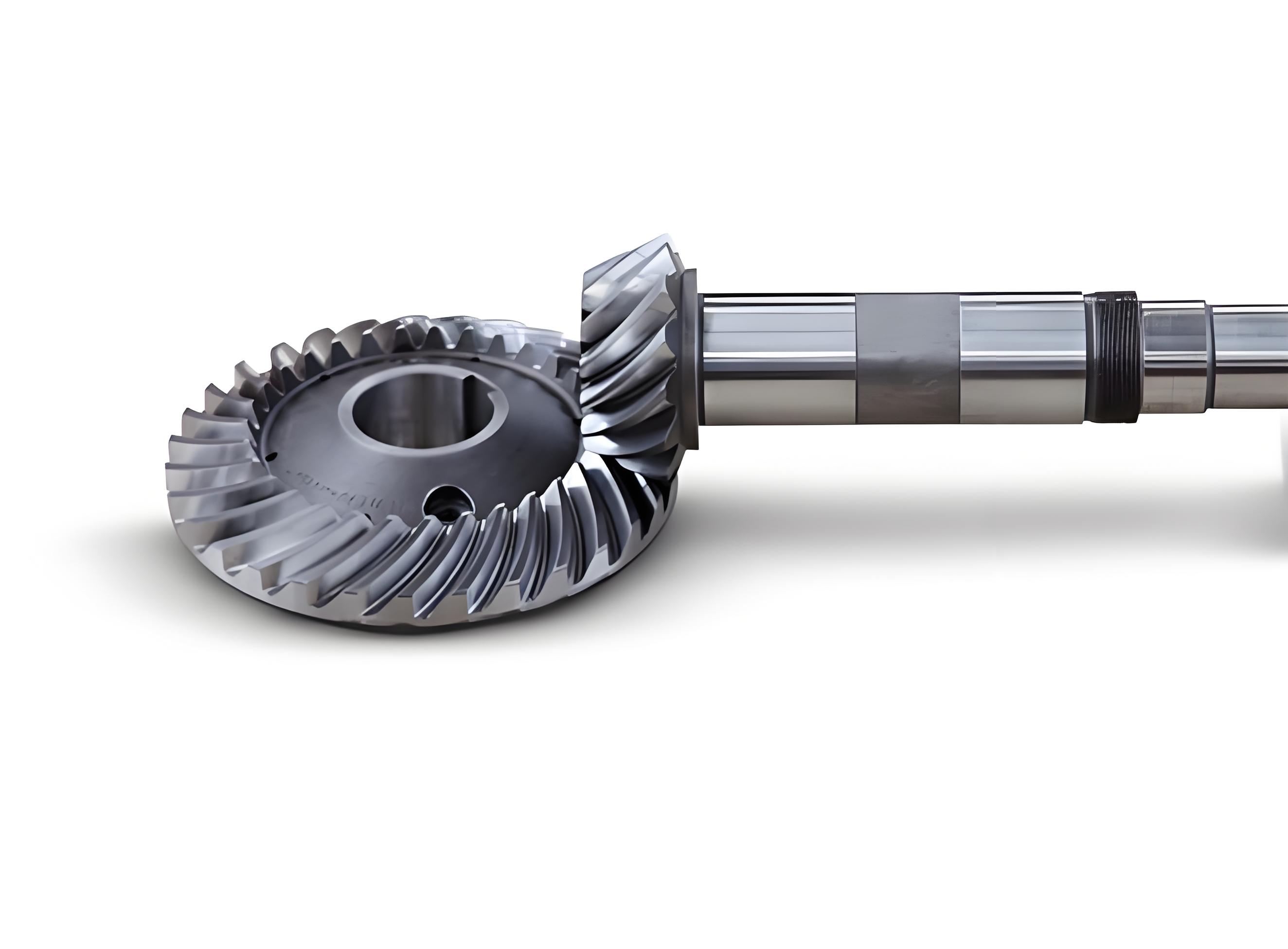
In strength design for spiral bevel gears, two key geometric factors are considered: the contact strength geometric factor (denoted as Z_I) and the bending strength geometric factor (denoted as Y_J). These factors account for the influence of tooth geometry on stress distributions and are essential for accurate strength predictions. The contact strength geometric factor for spiral bevel gears evaluates the effect of geometric elements on contact stress, focusing on the induced curvature radius at the calculation point on the tooth surface and load sharing between adjacent tooth pairs. It is calculated using the following formula:
$$ Z_I = \frac{g_c \rho_{y0} \cos \beta_m \cos \alpha_n}{b d_{e1} Z_i \varepsilon_{NI}} \frac{m_{mt}}{m_{et}} $$
Here, \(g_c\) represents the contact line length, \(\rho_{y0}\) is the induced curvature radius of the tooth profile, \(\beta_m\) is the midpoint spiral angle, \(\alpha_n\) is the normal pressure angle, \(b\) is the minimum face width (the smaller of the pinion and gear face widths), \(d_{e1}\) is the pinion outer pitch diameter, \(\varepsilon_{NI}\) is the load sharing ratio, \(Z_i\) is the inertia factor for low contact ratio gears, \(m_{mt}\) is the midpoint transverse module, and \(m_{et}\) is the outer transverse module. These parameters are derived from basic geometric variables such as the midpoint normal module \(m_n\), pinion teeth number \(z_1\), gear teeth number \(z_2\), normal pressure angle \(\alpha_n\), midpoint spiral angle \(\beta_m\), shaft angle \(\Sigma\), face width \(b\), addendum coefficient \(k_d\), and dedendum coefficient \(k_c\). For simulation purposes, \(m_n\), \(z_1\), \(z_2\), \(\Sigma\), \(k_d\), and \(k_c\) are treated as constants, while others like \(\alpha_n\), \(\beta_m\), and \(b\) are considered to follow normal distributions to account for manufacturing tolerances.
The bending strength geometric factor for spiral bevel gears considers tooth shape, the most critical loading position, stress concentration due to root fillet geometry, load sharing between adjacent tooth pairs, tooth thickness balance of mating gears, effective face width from longitudinal modifications, and the arching effect of extended face width. It includes both tangential (bending) and radial (compression) components of the tooth load. The formulas for the pinion and gear are as follows:
For the pinion:
$$ Y_{J1} = \frac{Y_{K1}}{\varepsilon_{NJ} Y_i} \frac{r_{myo1}}{r_{mpt1}} \frac{b_1′}{b} \frac{m_{mt}}{m_{et}} $$
For the gear:
$$ Y_{J2} = \frac{Y_{K2}}{\varepsilon_{NJ} Y_i} \frac{r_{myo2}}{r_{mpt2}} \frac{b_2′}{b} \frac{m_{mt}}{m_{et}} $$
In these equations, \(Y_{K1}\) and \(Y_{K2}\) are the tooth form factors including stress concentration coefficients for the pinion and gear, respectively; \(\varepsilon_{NJ}\) is the load sharing ratio; \(Y_i\) is the inertia factor for low contact ratio gears; \(b_1’\) and \(b_2’\) are the effective face widths of the pinion and gear; \(r_{myo1}\) and \(r_{myo2}\) are the radii at the midpoint load application point for the pinion and gear; and \(r_{mpt1}\) and \(r_{mpt2}\) are the midpoint transverse pitch radii for the pinion and gear. These parameters depend on \(m_n\), \(z_1\), \(z_2\), \(\alpha_n\), \(\beta_m\), \(b\), \(\Sigma\), \(k_d\), \(k_c\), as well as the cutter tip radii \(\rho_{ao1}\) and \(\rho_{ao2}\) and the cutter radius \(r_{co}\). For this analysis, \(\alpha_n\), \(\beta_m\), \(b\), and \(r_{co}\) are assumed to follow normal distributions, reflecting typical manufacturing variations in spiral bevel gears.
To simulate the distribution of strength geometric factors for spiral bevel gears, I focus on a specific spiral bevel gear pair with the following parameters: pinion teeth number \(z_1 = 14\), gear teeth number \(z_2 = 37\), outer transverse module \(m_{et} = 5.4\), face width \(b = 35 \pm 0.1\) mm, midpoint spiral angle \(\beta_m = 35^\circ \pm 0.1^\circ\), normal pressure angle \(\alpha_n = 20^\circ \pm 0.1^\circ\), shaft angle \(\Sigma = 90^\circ\), addendum coefficient \(k_d = 1\), dedendum coefficient \(k_c = 0.25\), and cutter radius \(r_{co} = 152.4 \pm 0.1\) mm. The variations in \(b\), \(\beta_m\), \(\alpha_n\), and \(r_{co}\) are modeled as normal distributions to represent production tolerances. Using the Monte Carlo method, I generate 10,000 random samples for each variable based on their distributions, compute the corresponding geometric factors using the formulas above, and then analyze the resulting data.
The simulation results for the contact strength geometric factor \(Z_I\) of spiral bevel gears are summarized in Table 1. The frequency histogram from the simulation shows a bell-shaped curve, indicating a normal distribution. A χ² test is performed to confirm this, with the test statistic falling within the acceptance region for a normal distribution at a 5% significance level. The mean and variance values from three independent simulation runs are highly consistent, demonstrating the reliability of the Monte Carlo method for spiral bevel gears.
| Simulation Run | Mean Value of \(Z_I\) | Variance of \(Z_I\) (×10⁻⁴) |
|---|---|---|
| 1 | 0.106752 | 1.270153 |
| 2 | 0.106745 | 1.302660 |
| 3 | 0.106766 | 1.281685 |
The probability density function for \(Z_I\) can be expressed as:
$$ f_{Z_I}(x) = \frac{1}{\sqrt{2\pi\sigma^2}} \exp\left(-\frac{(x-\mu)^2}{2\sigma^2}\right) $$
where \(\mu \approx 0.106754\) and \(\sigma^2 \approx 1.284 \times 10^{-4}\) based on the pooled data. This normal distribution implies that in practical manufacturing of spiral bevel gears, the contact strength geometric factor will vary around this mean with a standard deviation of approximately 0.01133, allowing for better reliability assessments.
Similarly, for the bending strength geometric factors \(Y_{J1}\) and \(Y_{J2}\) of spiral bevel gears, the Monte Carlo simulation yields the results shown in Tables 2 and 3. The frequency histograms for both factors also approximate normal distributions, as confirmed by χ² tests. The close agreement between simulation runs highlights the method’s precision for spiral bevel gears.
| Simulation Run | Mean Value of \(Y_{J1}\) | Variance of \(Y_{J1}\) (×10⁻³) |
|---|---|---|
| 1 | 0.222301 | 1.390128 |
| 2 | 0.222288 | 1.424244 |
| 3 | 0.222168 | 1.469120 |
| Simulation Run | Mean Value of \(Y_{J2}\) | Variance of \(Y_{J2}\) (×10⁻³) |
|---|---|---|
| 1 | 0.220474 | 2.371011 |
| 2 | 0.220273 | 2.318274 |
| 3 | 0.220503 | 2.382156 |
The probability distributions for these factors are given by:
$$ f_{Y_{J1}}(x) = \frac{1}{\sqrt{2\pi\sigma_1^2}} \exp\left(-\frac{(x-\mu_1)^2}{2\sigma_1^2}\right), \quad \mu_1 \approx 0.222252, \sigma_1^2 \approx 1.428 \times 10^{-3} $$
$$ f_{Y_{J2}}(x) = \frac{1}{\sqrt{2\pi\sigma_2^2}} \exp\left(-\frac{(x-\mu_2)^2}{2\sigma_2^2}\right), \quad \mu_2 \approx 0.220416, \sigma_2^2 \approx 2.357 \times 10^{-3} $$
To validate the Monte Carlo approach for spiral bevel gears, I compare the simulated mean values with results from traditional methods, such as chart look-up and direct calculation using nominal parameters. The comparison is presented in Table 4. While the differences are small, the Monte Carlo method provides a more realistic estimate by incorporating parameter variations, which is crucial for spiral bevel gears in high-precision applications.
| Geometric Factor | Chart Value | Calculated Value (Nominal) | Monte Carlo Mean |
|---|---|---|---|
| Contact Strength Geometric Factor \(Z_I\) | 0.108 | 0.106768 | 0.106754 |
| Bending Strength Geometric Factor \(Y_{J1}\) (Pinion) | 0.218 | 0.220417 | 0.222252 |
| Bending Strength Geometric Factor \(Y_{J2}\) (Gear) | 0.216 | 0.218275 | 0.220416 |
Sensitivity analysis is conducted to understand how changes in key geometric parameters affect the strength geometric factors of spiral bevel gears. I vary two parameters at a time while keeping others constant at their nominal values and compute the resulting geometric factors. The effects on the contact strength geometric factor \(Z_I\) are summarized in Table 5 and can be modeled by a response surface equation. For spiral bevel gears, the sensitivity of \(Z_I\) to the spiral angle \(\beta_m\) is particularly significant, as seen in the following approximation:
$$ Z_I \approx 0.1068 + 0.0021(\beta_m – 35) – 0.0015(\alpha_n – 20) + 0.0003(b – 35) $$
This indicates that increasing the spiral angle in spiral bevel gears raises \(Z_I\), thereby potentially increasing contact stress, while increasing the pressure angle reduces it. The face width has a non-monotonic influence due to its interaction with other parameters like load distribution.
| Parameter Pair Varied | Range of Variation | Effect on \(Z_I\) (Trend) | Approximate Change in \(Z_I\) per Unit Change |
|---|---|---|---|
| Spiral Angle \(\beta_m\) and Pressure Angle \(\alpha_n\) | \(\beta_m: 34.9^\circ \text{ to } 35.1^\circ\), \(\alpha_n: 19.9^\circ \text{ to } 20.1^\circ\) | Increases with \(\beta_m\), decreases with \(\alpha_n\) | \(\Delta Z_I / \Delta \beta_m \approx +0.0021\), \(\Delta Z_I / \Delta \alpha_n \approx -0.0015\) |
| Spiral Angle \(\beta_m\) and Face Width \(b\) | \(\beta_m: 34.9^\circ \text{ to } 35.1^\circ\), \(b: 34.9 \text{ mm to } 35.1 \text{ mm}\) | Correlated effect; non-monotonic with \(b\) | Interaction term significant |
| Pressure Angle \(\alpha_n\) and Face Width \(b\) | \(\alpha_n: 19.9^\circ \text{ to } 20.1^\circ\), \(b: 34.9 \text{ mm to } 35.1 \text{ mm}\) | Decreases with \(\alpha_n\), slight increase with \(b\) | \(\Delta Z_I / \Delta \alpha_n \approx -0.0015\), \(\Delta Z_I / \Delta b \approx +0.0003\) |
For the bending strength geometric factors \(Y_{J1}\) and \(Y_{J2}\) of spiral bevel gears, the sensitivity analysis results are shown in Table 6. The pressure angle \(\alpha_n\) has a pronounced effect, as captured by the following empirical relation:
$$ Y_J \approx 0.2213 + 0.0032(\alpha_n – 20) – 0.0018(\beta_m – 35) + 0.0005(b – 35) $$
This suggests that in spiral bevel gears, a higher pressure angle increases the bending strength geometric factor, potentially elevating bending stress, whereas a higher spiral angle decreases it. The face width shows a positive correlation, but its interaction with the spiral angle introduces complexity, emphasizing the need for integrated design in spiral bevel gears.
| Parameter Pair Varied | Range of Variation | Effect on \(Y_J\) (Trend) | Approximate Change in \(Y_J\) per Unit Change |
|---|---|---|---|
| Pressure Angle \(\alpha_n\) and Spiral Angle \(\beta_m\) | \(\alpha_n: 19.9^\circ \text{ to } 20.1^\circ\), \(\beta_m: 34.9^\circ \text{ to } 35.1^\circ\) | Increases with \(\alpha_n\), decreases with \(\beta_m\) | \(\Delta Y_J / \Delta \alpha_n \approx +0.0032\), \(\Delta Y_J / \Delta \beta_m \approx -0.0018\) |
| Pressure Angle \(\alpha_n\) and Face Width \(b\) | \(\alpha_n: 19.9^\circ \text{ to } 20.1^\circ\), \(b: 34.9 \text{ mm to } 35.1 \text{ mm}\) | Increases with both, but correlation exists | \(\Delta Y_J / \Delta \alpha_n \approx +0.0032\), \(\Delta Y_J / \Delta b \approx +0.0005\) |
| Spiral Angle \(\beta_m\) and Face Width \(b\) | \(\beta_m: 34.9^\circ \text{ to } 35.1^\circ\), \(b: 34.9 \text{ mm to } 35.1 \text{ mm}\) | Decreases with \(\beta_m\), increases with \(b\); non-monotonic interaction | Interaction term notable |
The sensitivity analysis for spiral bevel gears reveals that parameter influences are multifaceted and often interrelated. For instance, the spiral angle and face width impact both contact and bending strength geometric factors in correlated ways, likely due to their effects on tooth contact ratio and load distribution in spiral bevel gears. This complexity underscores the importance of holistic design approaches when optimizing spiral bevel gears for specific strength requirements. Designers must balance these parameters to achieve desired performance while accounting for manufacturing tolerances simulated via the Monte Carlo method.
In conclusion, the application of the Monte Carlo method to analyze strength geometric factors in spiral bevel gears offers significant advantages. First, it enables efficient and high-precision simulation of these factors, outperforming traditional algebraic methods by incorporating random variations inherent in manufacturing processes. The simulations confirm that, within typical tolerance ranges, both contact and bending strength geometric factors for spiral bevel gears follow normal distributions, with means closely matching values computed from nominal parameters. This finding resolves the issue of dispersion and inaccuracy in geometric factor determination for spiral bevel gears, providing a more reliable basis for strength calculations and reliability analysis. Second, sensitivity analysis highlights that the spiral angle is a key driver for the contact strength geometric factor, while the pressure angle predominantly influences the bending strength geometric factor in spiral bevel gears. However, parameter interactions, such as those between spiral angle and face width, necessitate careful consideration during design. By leveraging the Monte Carlo method, designers can better account for uncertainties and optimize spiral bevel gear geometries for enhanced performance and durability. Future work could extend this approach to full reliability analysis, integrating these geometric factor distributions with load and material property variations for comprehensive risk assessment in spiral bevel gear systems.
The mathematical framework used in this analysis can be generalized for other gear types, but the focus here remains on spiral bevel gears due to their complexity and widespread use in power transmission. The Monte Carlo method’s flexibility allows it to adapt to various design scenarios, making it a valuable tool in the advancement of gear technology. As industries demand higher efficiency and reliability from spiral bevel gears, such stochastic simulations will become increasingly integral to the design process, ensuring that these critical components meet stringent performance standards while accommodating real-world variations.