
In the field of gear manufacturing, spiral bevel gears and cycloid bevel gears represent two predominant systems, often associated with the Gleason and Oerlikon methods, respectively. The spiral bevel gear has long been dominant in many regions due to historical reasons, while the cycloid bevel gear, known for its advantages in strength, noise reduction, high production efficiency, and suitability for dry cutting, is gaining traction. This shift has spurred interest in understanding the intrinsic relationships and differences between these gear types. A key practical question arises: can spiral bevel gear cutters be used for rough machining of cycloid bevel gears? This article delves into this topic by establishing a unified mathematical model for both gear types, focusing on their tooth flank geometry. The goal is to provide theoretical insights that could guide manufacturing processes, such as using spiral bevel gear cutters for preliminary operations on cycloid bevel gears, thereby reducing tool costs and improving durability.
The core of this analysis lies in developing a universal mathematical framework that encompasses both spiral bevel gears and cycloid bevel gears. By examining cutter head structures and machining kinematics, we can derive models that highlight similarities and disparities. This approach not only aids in theoretical comparisons but also paves the way for unified software development for tooth flank design and contact analysis, as well as advancements in machine tools and measurement systems capable of handling both gear types. Throughout this discussion, the term ‘spiral bevel gear’ will be frequently emphasized to underscore its relevance in this comparative study.
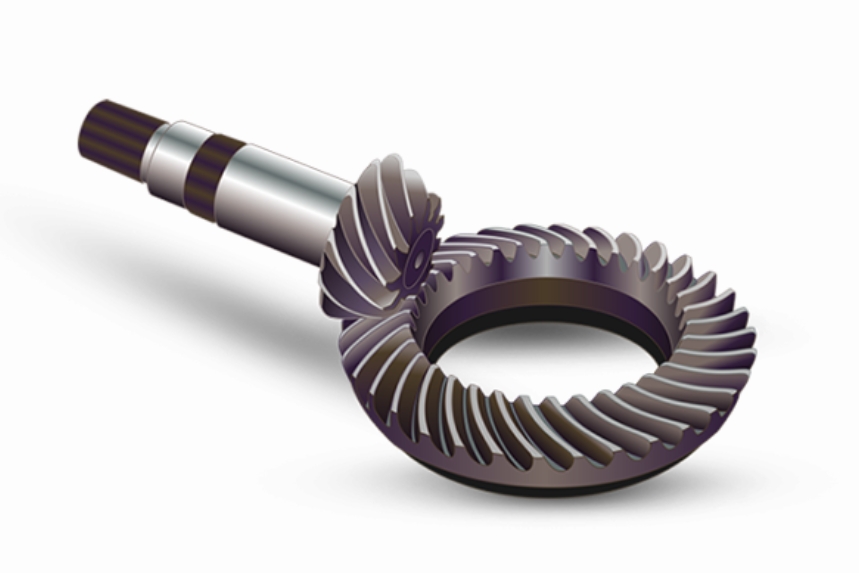
To begin, let’s explore the cutter head models for both gear systems. The spiral bevel gear typically employs intermittent indexing with a cutter head where blades are not grouped, and the angle between inner and outer blades does not affect tooth thickness. In contrast, the cycloid bevel gear uses continuous indexing, where blade grouping influences gear division, and the blade angle impacts tooth thickness. Moreover, spiral bevel gears are often machined using a hypothetical generating gear with a flat top, with parameters measured at the blade tip plane, while cycloid bevel gears use a hypothetical generating gear with a plane, with parameters measured at the blade node plane. Additionally, the cutting edge of a spiral bevel gear cutter is a generatrix of a cone, projecting through the cutter center, whereas for cycloid bevel gears, it projects tangent to an offset circle without passing through the center.
Based on these distinctions, a unified cutter head model is constructed, drawing from the cycloid bevel gear cutter head as a foundation. The coordinate system is established at the blade node plane. Let $r_0$ denote the nominal cutter radius, with points $P_A$ and $P_I$ representing the outer and inner blade nodes after radial correction. The tangential radius corrections are $\Delta r_{bA}$ and $\Delta r_{bI}$, and the blade direction angles are $\delta_{0A}$ and $\delta_{0I}$. The coordinate system $S_e (X_e, Y_e, Z_e)$ is fixed to the cutter head, rotating with it during machining. The cutting edge shape is defined in a plane $H$ perpendicular to the cutter end plane, with parameters $u_A$ and $u_I$ for outer and inner blades, respectively, and pressure angles $\alpha_A$ and $\alpha_I$.
The vector equation for the cutting edge in an auxiliary coordinate system $S_{e2}$ is given by:
$$ \mathbf{r}_{e2} = \begin{bmatrix} \Delta r_{bk} + u_k \sin \alpha_k \\ 0 \\ u_k \cos \alpha_k \end{bmatrix} $$
where $k = A, I$ for outer and inner blades. Transforming to the cutter head coordinate system $S_e$, we have:
$$ \mathbf{r}_e = \mathbf{M}_{AI} \mathbf{M}_{ee2} \mathbf{r}_{e2} $$
Here, $\mathbf{M}_{ee2}$ and $\mathbf{M}_{AI}$ are coordinate transformation matrices. For the spiral bevel gear cutter head model, we set $\delta_{0I} = \delta_{0A} = 0$, the blade angle $\tau_w = 0$, and convert the blade offset to the node plane, thus achieving a unified representation.
Next, the machining kinematics are analyzed. The generating gear for a spiral bevel gear is formed solely by cutter rotation, whereas for a cycloid bevel gear, it involves both rotation and revolution around the generating gear axis. A unified mathematical model for generating gear formation is developed. Let $\phi_1$ be the cutter rotation angle and $\phi_p$ be the revolution angle, with $\phi_p = i_{p0} \phi_1$, where $i_{p0}$ is the indexing ratio. The generating gear tooth flank equation in coordinate system $S_p$ is:
$$ \mathbf{r}_p = \mathbf{M}_{pp0} \mathbf{M}_{p0c} \mathbf{M}_{ce0} \mathbf{M}_{e0e} \mathbf{r}_e $$
For spiral bevel gears, $i_{p0} = 0$, so $\phi_p = 0$, simplifying to the spiral bevel gear model. The machining process involves enveloping the workpiece tooth flank by the generating gear. Using the relative motion between the generating gear and workpiece, the unified cutting model is established. In the machine coordinate system $S_m$, the generating gear rotates by $\phi_{g1}$, and the workpiece rotates by $\phi_1$, with $\phi_1 = m_{p1} \phi_{g1}$, where $m_{p1}$ is the cutting ratio. The gear tooth flank equation and unit normal vector are:
$$ \mathbf{r}_1(u_1, \phi_1, \phi_{g1}) = \mathbf{M}_{1a} \mathbf{M}_{an} \mathbf{M}_{nm} \mathbf{M}_{mp} \mathbf{r}_p(u_1, \phi_1) $$
$$ \mathbf{n}_1(u_1, \phi_1, \phi_{g1}) = \mathbf{L}_{1a} \mathbf{L}_{an} \mathbf{L}_{nm} \mathbf{L}_{mp} \mathbf{n}_p(u_1, \phi_1) $$
where $\mathbf{M}$ and $\mathbf{L}$ matrices represent coordinate transformations. This model applies to both gear types, enabling direct comparison of tooth flank geometry.
With the theoretical tooth flank solved, we can compare geometric parameters, focusing on tooth line spiral angle and tooth flank topography. For the tooth line spiral angle, since the expanded pitch cone of a spiral bevel gear aligns with the generating gear tooth line, the spiral angle on the tooth line equals that on the pitch line. Thus, we use the generating gear tooth line to compute spiral angles at various points. From the generating gear tooth flank equation $\mathbf{r}_p(u, \phi)$, setting $u = 0$ gives the tooth line equation $\mathbf{r}_p(\phi)$. The unit tangent vector at any point $P’$ is:
$$ \mathbf{T}_x = \frac{d\mathbf{r}_p(\phi)/d\phi}{|d\mathbf{r}_p(\phi)/d\phi|} $$
The unit radial vector is:
$$ \mathbf{R}_x = \frac{\mathbf{r}_p(\phi)}{|\mathbf{r}_p(\phi)|} $$
The spiral angle $\beta_x$ is then:
$$ \beta_x = \arccos(\mathbf{T}_x \cdot \mathbf{R}_x) $$
This calculation allows for comparing spiral angles at the small end, midpoint, and large end of the tooth flank for both gear types.
For tooth flank topography deviation, after numerically solving the tooth flank equations for both spiral bevel gear and cycloid bevel gear, we align them by rotating the spiral bevel gear tooth flank around the gear axis $X$ by an angle $\Delta \theta$ so that their midpoint $M$ coincides. Let the coordinates of point $M’$ on the spiral bevel gear be $(x’_m, y’_m, z’_m)$ and on the cycloid bevel gear be $(x_m, y_m, z_m)$. The rotation angle $\Delta \theta$ is determined from:
$$ \begin{bmatrix} x_m \\ y_m \\ z_m \\ 1 \end{bmatrix} = \begin{bmatrix} 1 & 0 & 0 & 0 \\ 0 & \cos \Delta \theta & -\sin \Delta \theta & 0 \\ 0 & \sin \Delta \theta & \cos \Delta \theta & 0 \\ 0 & 0 & 0 & 1 \end{bmatrix} \begin{bmatrix} x’_m \\ y’_m \\ z’_m \\ 1 \end{bmatrix} $$
After rotation, any point on the spiral bevel gear tooth flank with coordinates $(x’, y’, z’)$ transforms to $(x_1, y_1, z_1)$. For a point $M_2$ on the cycloid bevel gear tooth flank with coordinates $\mathbf{r}_2 = (x_2, y_2, z_2)$, we project it onto the spiral bevel gear tooth flank along the normal $\mathbf{n}_M$ at point $M_1$ with coordinates $\mathbf{r}_1 = (x_1, y_1, z_1)$. The deviation $\Delta \epsilon$ is:
$$ \Delta \epsilon = (\mathbf{r}_2 – \mathbf{r}_1) \cdot \mathbf{n}_M $$
This deviation represents the topological difference between the two tooth flanks, crucial for assessing machining allowances.
To illustrate, consider a practical example focusing on the large wheel of a cycloid bevel gear pair. The geometric parameters are summarized in Table 1, and the cutter and machining parameters for the cycloid bevel gear are in Table 2.
| Parameter | Value |
|---|---|
| Number of teeth | 37 |
| Hand of spiral | Right-hand |
| Midpoint module (mm) | 7.476 |
| Reference spiral angle (°) | 35 |
| Pressure angle (°) | 20 |
| Face width (mm) | 55 |
| Whole depth (mm) | 16.821 |
| Addendum (mm) | 7.476 |
| Large end pitch diameter (mm) | 390 |
| Pitch angle (°) | 72.031 |
| Parameter | Value |
|---|---|
| Nominal cutter radius (mm) | 99.7682 |
| Number of blade groups | 5 |
| Blade pressure angle (°) | 20 |
| Outer blade tangential radius (mm) | 98.8619 |
| Inner blade tangential radius (mm) | 97.1419 |
| Radial distance (mm) | 164.1332 |
| Angular position (°) | 33.6708 |
| Vertical work offset (mm) | 0 |
| Axial offset (mm) | 0 |
| Horizontal work offset (mm) | 0 |
| Workpiece installation angle (°) | 72.031 |
For rough cutting the cycloid bevel gear with a spiral bevel gear cutter, the cutter radius should match the curvature radius of the extended epicycloid tooth line at the reference point. The curvature is derived from the generating gear tooth flank. The unit normal vector $\mathbf{n}_p$ is:
$$ \mathbf{n}_p = \frac{d\mathbf{r}_p/du \times d\mathbf{r}_p/d\phi}{|d\mathbf{r}_p/du \times d\mathbf{r}_p/d\phi|} $$
The first fundamental quantities are:
$$ E = \left( \frac{d\mathbf{r}_p}{du} \right)^2, \quad F = \frac{d\mathbf{r}_p}{du} \cdot \frac{d\mathbf{r}_p}{d\phi}, \quad G = \left( \frac{d\mathbf{r}_p}{d\phi} \right)^2 $$
The second fundamental quantities are:
$$ L = \mathbf{n}_p \cdot \frac{d^2\mathbf{r}_p}{du^2}, \quad M = \mathbf{n}_p \cdot \frac{d^2\mathbf{r}_p}{du d\phi}, \quad N = \mathbf{n}_p \cdot \frac{d^2\mathbf{r}_p}{d\phi^2} $$
The normal curvature is:
$$ k_\phi = \frac{N}{G} $$
The curvature at any point on the tooth line is:
$$ k = \frac{k_\phi}{\cos \alpha} $$
where $\alpha$ is the blade pressure angle. At the reference point ($u=0, \phi=0$), the curvature $k_p = 0.0101$, so the curvature radius $r_0 = 1/k_p = 99$ mm. This radius is used as the nominal radius for the spiral bevel gear cutter. The machining parameters for the spiral bevel gear cutter are then calculated: radial distance = 145.4261 mm, angular position = 33.89°, and blade offset = 4.9 mm.
Now, comparing the tooth line spiral angles for both gear types, we compute values at the small end, midpoint, and large end, as shown in Table 3.
| Spiral Angle | Small End | Midpoint | Large End |
|---|---|---|---|
| Cycloid gear convex side | 20.8713° | 35.0115° | 48.0745° |
| Spiral bevel gear convex side | 21.0295° | 35.142° | 50.6973° |
| Cycloid gear concave side | 21.1485° | 34.991° | 47.8006° |
| Spiral bevel gear concave side | 23.1073° | 35.0025° | 47.8468° |
For the convex side, the spiral bevel gear exhibits a larger deviation at the large end, with a greater difference between small and large end spiral angles compared to the cycloid bevel gear. For the concave side, the deviation is more pronounced at the small end, with the spiral bevel gear having a smaller range of spiral angles. This indicates that the tooth line geometry differs significantly, affecting the overall tooth flank shape.
Regarding tooth flank topography, the deviation between the spiral bevel gear and cycloid bevel gear tooth flanks is computed. For the convex side, the maximum deviation is 0.5536 mm at the large end, while for the concave side, it is 0.5522 mm at the small end. These values imply that when using a spiral bevel gear cutter for rough cutting of cycloid bevel gears, the single-side allowance for finish cutting must exceed these maximum deviations to ensure complete tooth flank machining.
The implications of this analysis are profound. The unified mathematical model for spiral bevel gear and cycloid bevel gear not only clarifies their geometric relationships but also supports the development of integrated software for design and analysis. This model can inform the creation of machine tools capable of machining both gear types and measurement systems for quality control. Moreover, the comparison highlights practical considerations for manufacturing, such as tool selection and machining parameters, potentially reducing costs and improving efficiency in gear production.
In conclusion, this study establishes a comprehensive framework for understanding spiral bevel gear and cycloid bevel gear through a unified mathematical model. By comparing tooth line spiral angles and tooth flank topography, we identify key differences that impact manufacturing processes. The findings suggest that while spiral bevel gear cutters can be used for rough machining of cycloid bevel gears, careful attention must be paid to spiral angle variations and deviation allowances. This research contributes to the ongoing evolution of gear technology, offering insights that could enhance both theoretical knowledge and industrial applications. As the demand for efficient and cost-effective gear manufacturing grows, such comparative studies will play a crucial role in optimizing processes and advancing the field of spiral bevel gear and related systems.
To further elaborate, the mathematical models presented here involve complex coordinate transformations and vector calculations. For instance, the transformation matrices used in the cutter head and machining models can be detailed. Consider the matrix $\mathbf{M}_{ee2}$, which rotates coordinates from $S_{e2}$ to $S_e$. It can be expressed as a rotation about the Z-axis by an angle $\delta$, depending on the blade direction. Similarly, $\mathbf{M}_{AI}$ accounts for the offset between inner and outer blades. These matrices are essential for accurate tooth flank generation and are derived from spatial geometry principles.
Another aspect is the calculation of tooth flank deviation. The process involves iterative methods to find the perpendicular projection from a point on the cycloid bevel gear tooth flank to the spiral bevel gear tooth flank. This requires solving nonlinear equations based on the normal vector condition. Numerical techniques such as Newton-Raphson can be employed to compute $\Delta \epsilon$ efficiently. The deviation map can be visualized as a contour plot, showing regions of high and low mismatch, which aids in identifying critical areas for machining adjustments.
Additionally, the impact of machining parameters on tooth flank geometry is significant. For example, varying the radial distance or angular position can alter the spiral angle and tooth thickness. Table 4 summarizes key parameters and their effects on both gear types, based on sensitivity analysis.
| Parameter | Effect on Spiral Bevel Gear | Effect on Cycloid Bevel Gear |
|---|---|---|
| Radial distance | Modifies tooth depth and spiral angle | Influences tooth line curvature and contact pattern |
| Angular position | Adjusts tooth flank symmetry | Alters blade engagement and indexing |
| Blade offset | Controls tooth thickness and backlash | Determines tooth thickness and group spacing |
| Cutter radius | Affects tooth profile and strength | Impacts generating gear formation and noise |
This sensitivity analysis underscores the importance of precise parameter selection in gear manufacturing. For spiral bevel gears, parameters are often optimized for load distribution and noise reduction, while for cycloid bevel gears, efficiency and smooth operation are prioritized. The unified model allows for cross-comparison, enabling manufacturers to adapt processes for hybrid approaches, such as using spiral bevel gear cutters for initial roughing of cycloid bevel gears.
Furthermore, the mathematical framework can be extended to include thermal and dynamic effects during machining. For instance, cutting forces and heat generation may cause deformations that alter the tooth flank geometry. Incorporating these factors into the model would enhance its predictive accuracy. Equations for force calculation could be based on empirical data or finite element analysis, integrating with the kinematic model to simulate real-world conditions.
In terms of applications, the unified model supports advancements in digital twin technology for gear production. By simulating the entire machining process, manufacturers can virtualize tool paths, predict tooth flank errors, and optimize parameters before physical cutting. This reduces trial-and-error, saves material, and shortens lead times. For spiral bevel gears, this is particularly valuable due to their complex geometry and high precision requirements.
Another area of exploration is the integration of this model with machine learning algorithms. By training models on historical data from both spiral bevel gear and cycloid bevel gear production, predictive maintenance and quality control systems can be developed. These systems could anticipate tool wear, recommend parameter adjustments, and ensure consistent gear quality, further reducing costs and improving reliability.
From a theoretical perspective, the unified model highlights fundamental principles of gear geometry. The tooth flank equations derived here are based on differential geometry, involving concepts like curvature and torsion. For example, the spiral angle $\beta_x$ is related to the geodesic curvature of the tooth line on the generating gear surface. Understanding these relationships deepens insights into gear design and can inspire new gear types with optimized performance characteristics.
In summary, this extensive analysis of spiral bevel gear and cycloid bevel gear through a unified mathematical model provides a robust foundation for comparative studies and practical applications. By leveraging formulas, tables, and detailed explanations, we have explored key aspects of tooth flank geometry, machining parameters, and sensitivity effects. The findings emphasize the versatility of the spiral bevel gear framework and its potential for innovation in gear manufacturing. As technology progresses, such models will continue to drive efficiency, accuracy, and cost-effectiveness in the production of spiral bevel gears and beyond.