
In my recent investigation, I was presented with a critical and recurring failure involving the final drive spiral bevel gears supplied for a heavy-duty truck’s intermediate axle. These components, the driving and driven spiral bevel gears, are paramount for power transmission, and their premature fracture in field service demanded a rigorous, multi-faceted forensic analysis. The gears were manufactured from 20CrMnMo steel, following a standard sequence: forging, rough machining, normalizing, finish machining, carburizing and quenching with tempering, shot peening, final machining, and assembly. The reported failure involved severe tooth breakage on both gears, leading to catastrophic damage to the differential housing.
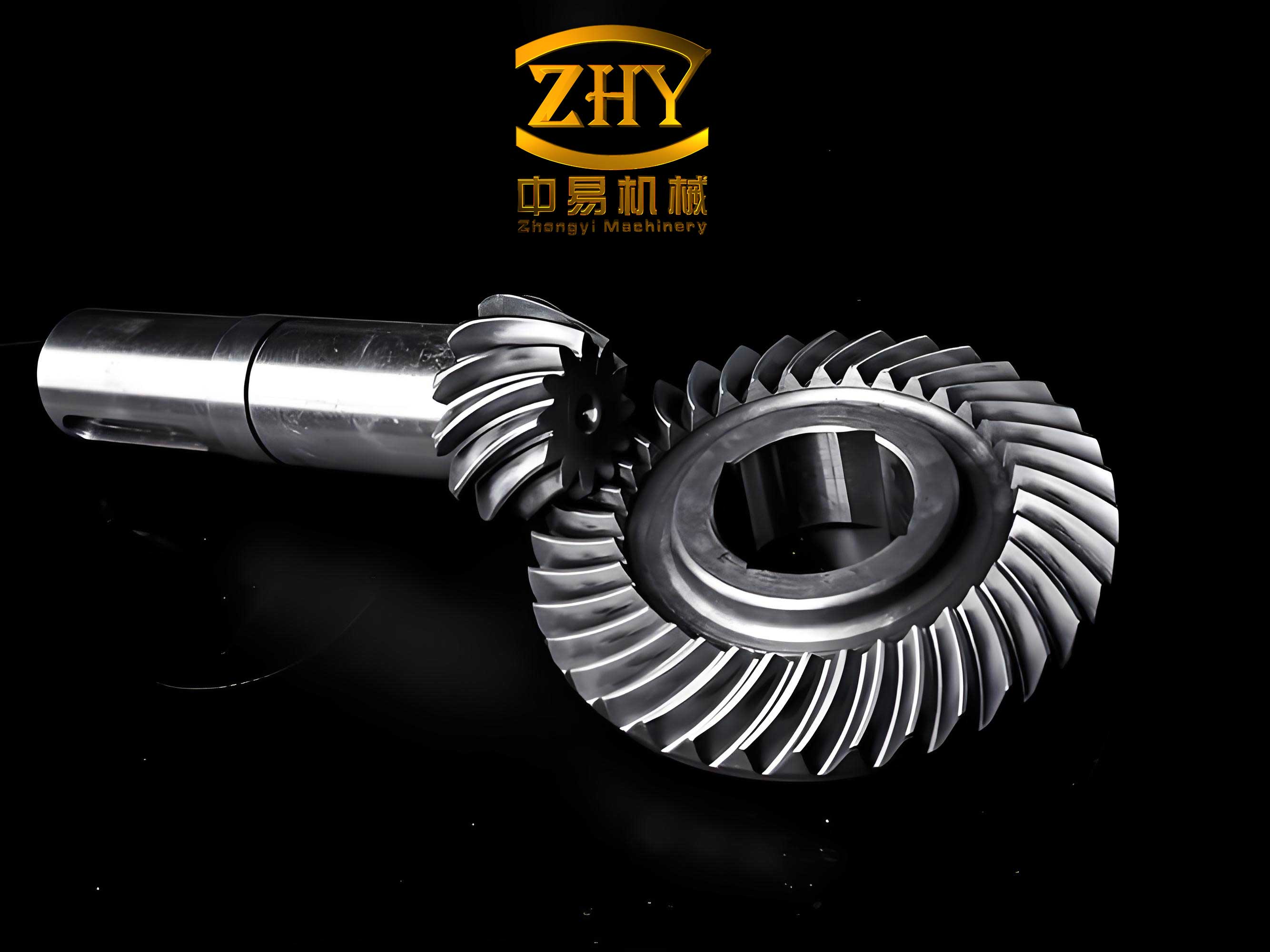
My initial step was a meticulous macro-examination of the failed spiral bevel gear set. The driving gear exhibited the most severe damage. The fracture predominantly initiated at the tooth root fillet region, with cracks propagating inward and connecting to the central hub area, resulting in complete, through-root fractures. Only a handful of teeth remained intact in their original form. The driven gear showed breakage primarily in the dedendum region, above the pitch line, which is a typical consequence of a high-impact overload event following the initial failure of its mating gear. This visual evidence strongly pointed towards insufficient bending strength at the root of the driving spiral bevel gear as the primary failure mode.
To quantify the material properties, I conducted thorough hardness testing across multiple points on both failed spiral bevel gears. The results are summarized in the table below.
| Component | Measurement Location | Hardness (HV) | Converted Hardness (HRC) | Technical Requirement (HRC) |
|---|---|---|---|---|
| Driving Spiral Bevel Gear | Surface (Average) | ~676 | 58.5 – 58.9 | Surface: 58-64 Core: 29-45 |
| Core | ~254 | 24 – 26 | ||
| Driven Spiral Bevel Gear | Surface (Average) | ~749 | 61.2 – 61.5 | Surface: 58-64 Core: 29-45 |
| Core | ~369 | 37.2 – 41 |
The data revealed a critical discrepancy. While the surface hardness of both gears met specifications, the core hardness of the driving spiral bevel gear was alarmingly low at approximately 25 HRC, falling significantly below the required range of 29-45 HRC. In contrast, the driven gear’s core hardness was within specification. The core hardness is a direct indicator of the material’s strength and its ability to support the hardened case. A soft core drastically compromises the overall load-bearing capacity and fatigue resistance of a gear tooth, particularly under bending stress. The bending stress at the root can be approximated by the fundamental Lewis formula, modified for modern standards:
$$\sigma_F = \frac{F_t}{b \cdot m_n} \cdot Y_F \cdot Y_S \cdot Y_\beta \cdot Y_K$$
Where $ \sigma_F $ is the nominal tooth root stress, $ F_t $ is the tangential load, $ b $ is the face width, $ m_n $ is the normal module, $ Y_F $ is the form factor, $ Y_S $ is the stress correction factor, $ Y_\beta $ is the helix/spiral angle factor, and $ Y_K $ is the rim factor. A low core hardness implies a lower permissible bending stress $ \sigma_{FP} $, making failure likely when $ \sigma_F > \sigma_{FP} $.
Subsequently, I performed metallographic analysis on transverse sections taken from the fractured teeth. The samples were prepared, etched with 4% nital, and examined under a microscope.
| Component | Case Depth (Tooth Flank) | Case Depth (Tooth Root Fillet) | Carbide Rating | Martensite & Retained Austenite Rating | Core Microstructure |
|---|---|---|---|---|---|
| Driving Spiral Bevel Gear | 1.3 mm | 0.78 mm | Grade 2 | Grade 2 | Lath martensite with patches of blocky ferrite |
| Driven Spiral Bevel Gear | 1.4 mm | 1.2 – 1.3 mm | Grade 2 | Grade 2 | Lath/basketweave martensite |
The microstructure of the case (carbides, martensite) was acceptable for both spiral bevel gears. However, a key finding was the shallow effective case depth at the critical tooth root fillet of the driving gear—only 0.78 mm compared to the 1.2-1.6 mm typical specification. The core microstructure of the driving gear revealed the presence of blocky ferrite, a soft, ductile phase that is undesirable in a hardened gear core as it significantly lowers strength. The driven gear’s core showed the expected stronger martensitic transformation product. The relationship between case depth and bending fatigue strength is often expressed empirically. A shallow case depth at the root, $ CHD_{root} $, can severely limit the bending fatigue limit $ \sigma_{FL} $:
$$\sigma_{FL} \propto \frac{CHD_{root}}{\sqrt{a_0}}$$
where $ a_0 $ is the characteristic size of an initial flaw or the critical process zone. A shallow case depth makes the gear more susceptible to crack initiation from subsurface inclusions or from the transition zone itself.
To trace the root cause of the poor hardenability evidenced by the soft core and shallow case, I conducted a full chemical compositional analysis using spectrometry. The results were compared against the standard for 20CrMnMo steel (GB/T 3077-1999 equivalent to international specifications).
| Element | Driving Spiral Bevel Gear Result | Driven Spiral Bevel Gear Result | Standard for 20CrMnMo (Typical Range) |
|---|---|---|---|
| C | 0.230 | 0.228 | 0.17 – 0.23 |
| Si | 0.321 | 0.324 | 0.17 – 0.37 |
| Mn | 0.972 | 0.985 | 0.90 – 1.20 |
| Cr | 0.758 | 1.125 | 1.10 – 1.40 |
| Mo | 0.150 | 0.252 | 0.20 – 0.30 |
The compositional analysis provided the definitive link to the observed material deficiencies. The driving spiral bevel gear’s content of chromium (Cr) and molybdenum (Mo) was substantially below the standard specification for 20CrMnMo steel. These elements are potent hardenability enhancers. Their deficiency directly explains the poor through-hardening characteristics. The Grossmann approach to hardenability defines an ideal critical diameter $ D_I $, which is a function of composition:
$$D_I = \sum (k_i \cdot [\%Element_i])$$
where $ k_i $ is the multiplying factor for each alloying element. Low $ k_{Cr} $ and $ k_{Mo} $ values due to sub-standard concentrations result in a lower $ D_I $. For a given section size (like the gear tooth), a lower $ D_I $ leads to a lower volume fraction of martensite in the core after quenching, resulting in lower hardness and the formation of softer transformation products like ferrite, exactly as observed. Consequently, the effective case depth achievable during carburizing is also limited by the material’s inherent hardenability, leading to the shallow root case.
My failure analysis synthesizes all findings into a coherent root-cause sequence. The primary failure initiated in the driving spiral bevel gear due to bending fatigue at the tooth root fillet. The crack initiation and propagation were overwhelmingly facilitated by two interdependent material-level factors stemming from the use of off-specification steel: 1) Severely deficient core hardness and strength, and 2) Inadequate effective case depth at the tooth root. The fundamental cause was the non-compliant chemical composition of the raw material used for the driving gear, specifically the critically low levels of chromium and molybdenum. This deficient chemistry led to poor hardenability. During the carburizing and quenching process, this poor hardenability prevented the gear’s core from transforming to the required high-strength martensitic structure, instead forming a soft ferrite-martensite mixture. Simultaneously, it limited the depth to which a fully hardened, high-carbon martensitic case could be formed, particularly in the geometrically challenging and critical stress-concentration zone of the tooth root fillet.
This compromised the gear’s ability to withstand the cyclic bending stresses ($ \sigma_F $) experienced during service. The driven spiral bevel gear, manufactured from compliant material with proper chemistry, exhibited acceptable core hardness, case depth, and microstructure. Its failure was secondary, resulting from the massive shock loads and misalignment caused by the catastrophic breakage of the mating driving spiral bevel gear.
Based on this comprehensive analysis, I propose the following corrective and preventive actions to prevent recurrence of such failures in spiral bevel gears. First, implement a stringent incoming material inspection protocol. Every batch of steel must undergo full spectroscopic chemical analysis to verify compliance with 20CrMnMo specifications, with special attention to Cr and Mo content. A hardenability test, such as the Jominy end-quench test, should be performed on a sampling basis to directly assess the material’s quenching response before production. The Jominy distance $ J_{1.5} $ (distance where hardness is 50 HRC) can be correlated to composition:
$$J_{1.5} = f(C, Cr, Mo, Mn, \ldots)$$
Second, enhance process control and validation. Establish strict Statistical Process Control (SPC) for the carburizing and quenching operations. Regularly perform destructive testing on production samples to validate core hardness and case depth profiles, especially at the tooth root of spiral bevel gears. Consider non-destructive techniques like Barkhausen noise analysis for 100% screening of core hardness on critical components.
Finally, review and potentially enhance design specifications. While the primary issue was material and process control, collaborating with design engineering to evaluate the nominal bending stress calculations and safety factors for the spiral bevel gear set is prudent. Specifying a minimum required case depth explicitly at the tooth root fillet, potentially deeper than the flank requirement, and defining a stringent minimum core hardness with a narrow tolerance band will further de-risk the design. The safety factor $ S_F $ for bending should be rigorously validated:
$$S_F = \frac{\sigma_{FP}}{\sigma_F} \geq S_{F\_min}$$
where $ \sigma_{FP} $ must be derived from material properties (core strength, case depth) that are assured through controlled manufacturing. By addressing the root cause at the material sourcing level and fortifying process and design controls, the reliability and service life of these critical spiral bevel gear transmissions can be assured.