
In engineering machinery, spiral bevel gears serve as critical transmission components, and their performance directly impacts overall system efficiency, noise, vibration, and longevity. However, high failure rates, often due to insufficient bending strength and dynamic instabilities, necessitate rigorous optimization of design parameters. In this study, we conduct a comprehensive comparative analysis to evaluate how optimizing key design parameters—such as pressure angle, cutter tip radius, and tooth thickness ratio—affects the dynamic characteristics of spiral bevel gears. We employ a multi-body, multi-degree-of-freedom nonlinear dynamic model integrated with a mixed elastohydrodynamic lubrication (EHL) friction model, accounting for time-varying friction forces, dynamic mesh forces, transmission errors, and backlash. Our approach aims to provide insights into enhancing the dynamic response of spiral bevel gears under realistic operating conditions, where mixed lubrication states prevail. Through detailed simulations and experimental validation, we demonstrate that optimized design parameters lead to superior dynamic performance, including reduced dynamic mesh forces and transmission errors. This research underscores the importance of parameter optimization in improving the reliability and efficiency of spiral bevel gear systems, with implications for various industrial applications.
The spiral bevel gear is a complex mechanical element characterized by curved teeth that enable smooth torque transmission between intersecting shafts. Its dynamic behavior is influenced by numerous factors, including geometric design parameters, lubrication conditions, and external loads. Traditionally, design optimizations have focused on static strength analyses, but dynamic aspects—such as vibrations, shocks, and noise—are equally crucial for performance. We address this gap by investigating the dynamic effects of parameter changes, considering the mixed lubrication regime that typically occurs in practical scenarios. By leveraging advanced modeling techniques, we compare pre- and post-optimization dynamics to identify improvements. The keyword ‘spiral bevel gear’ will be frequently reiterated throughout this discussion to emphasize its centrality in our analysis. Below, we outline our methodology, starting with parameter optimization, followed by mathematical modeling, dynamic simulations, and experimental verification.
Optimization of Design Parameters for Spiral Bevel Gears
To enhance the performance of spiral bevel gears, we first identify critical design parameters that influence both static and dynamic responses. Based on empirical parameter selection methods, we optimize the pressure angle, cutter tip radius (which determines the fillet radius), and the ratio of pinion-to-gear tooth thickness. These parameters are chosen because they directly affect bending strength, stress concentration, and load distribution. For instance, increasing the pressure angle can improve tooth root bending strength, while enlarging the fillet radius reduces stress concentrations at the root. Adjusting the tooth thickness ratio ensures balanced load sharing between mating gears. In our study, we compare an original design with an optimized one, as summarized in Table 1.
| Parameter | Original Design | Optimized Design |
|---|---|---|
| Pressure Angle (degrees) | 20 | 22.5 |
| Tooth Thickness Ratio (Pinion/Gear) | 2.09 | 2.21 |
| Fillet Radius – Pinion (mm) | 1.5 | 1.9 |
| Fillet Radius – Gear (mm) | 2.5 | 3.9 |
The optimization process involves selecting parameters that comply with manufacturing constraints, such as avoiding interference during operation and ensuring feasible cutter design. For example, the cutter tip radius is chosen based on Gleason standard tooling, considering factors like non-working surface clearance during gear cutting. After optimization, we verify the bending strength using specialized software. Calculations show that the optimized spiral bevel gear with a 22.5° pressure angle exhibits a 13% reduction in bending stress for the pinion and a 26% reduction for the gear compared to the original 20° design. This reduction in stress enhances fatigue life, but we further explore dynamic implications. The improved spiral bevel gear design sets the stage for subsequent dynamic analysis, where we assess how these parameter changes influence system vibrations and errors.
Mathematical Modeling of Spiral Bevel Gear Dynamics
To accurately capture the dynamic behavior of spiral bevel gears, we develop a nonlinear time-varying dynamic model based on the lumped parameter method. This model accounts for the complex geometry and motion of spiral bevel gears, where the mesh point, line of action, mesh stiffness, and friction direction vary spatially and temporally. We consider a 14-degree-of-freedom system that includes rigid bodies for the pinion and gear, each with six degrees of freedom, along with rotational degrees for the driver and load. The system is connected through stiffness and damping elements representing shafts, bearings, and housing structures. The dynamic equations are formulated in matrix form as follows:
$$ [M]\{\ddot{q}\} + [C]\{\dot{q}\} + [K]\{q\} = \{F\} $$
where $[M]$ is the mass matrix, $\{q\}$ is the generalized coordinate vector, $[K]$ and $[C]$ are stiffness and damping matrices, and $\{F\}$ is the force vector comprising external torques and friction forces. Specifically, $\{F\}$ is given by:
$$ \{F\} = \{T_D, h_p F_m – g F_{mf}, -h_g F_m + g_g F_{mf}, T_L\}^T $$
Here, $T_D$ and $T_L$ are input and load torques, $h_p$ and $h_g$ are direction transformation vectors for the pinion and gear, $F_m$ is the dynamic mesh force, and $F_{mf}$ is the friction force. The dynamic transmission error $\delta$ is defined as:
$$ \delta = \{h_p\}\{q_p\} – \{h_g\}\{q_g\} $$
The dynamic mesh force $F_m$ incorporates nonlinearities due to time-varying mesh stiffness $k_m$, damping $c_m$, static transmission error $e$, and backlash $b$:
$$ F_m = \begin{cases}
k_m(\delta – e – b) + c_m(\dot{\delta} – \dot{e}), & \delta – e > b \\
0, & -b < \delta – e < b \\
k_m(\delta – e + b) + c_m(\dot{\delta} – \dot{e}), & \delta – e < -b
\end{cases} $$
The friction force $F_{mf}$ is expressed as $F_{mf} = \mu F_m$, where $\mu$ is the friction coefficient. To realistically model friction, we adopt a mixed lubrication approach, as spiral bevel gears often operate in conditions where both asperity contact and full-film lubrication coexist. The mixed lubrication friction coefficient $\mu_{ML}$ is derived from the ratio of total tangential force to total normal load:
$$ \mu_{ML} = \frac{F_{total}}{P_{total}} $$
The total tangential force $F_{total}$ combines contributions from full-film lubrication ($F_{EL}$) and boundary lubrication ($F_{BL}$):
$$ F_{total} = F_{EL} + F_{BL} $$
Similarly, the total normal load $P_{total} = P_{EL} + P_{BL}$. Let $f_\lambda$ (0 ≤ $f_\lambda$ ≤ 1) be the load-sharing ratio for full-film lubrication, so the boundary lubrication ratio is $1 – f_\lambda$. Thus:
$$ F_{EL} = \mu_{EL} P_{EL} = \mu_{EL} P_{total} f_\lambda $$
$$ F_{BL} = \mu_{BL} P_{BL} = \mu_{BL} P_{total} (1 – f_\lambda) $$
where $\mu_{EL}$ and $\mu_{BL}$ are friction coefficients for full-film and boundary lubrication, respectively. Using Winter and Michaelis’ relation, the instantaneous full-film friction coefficient $\mu_{EL}^i$ relates to the average as $\mu_{EL} = \mu_{EL}^i (f_\lambda)^{0.2}$. Substituting these into the mixed lubrication equation yields:
$$ \mu_{ML}^i = \mu_{EL}^i (f_\lambda)^{1.2} + \mu_{BL}^i (1 – f_\lambda) $$
This instantaneous friction coefficient is integrated into the dynamic model to compute system responses under mixed lubrication conditions. Our model thus captures essential nonlinearities, providing a robust foundation for comparing dynamic characteristics of spiral bevel gears before and after parameter optimization.
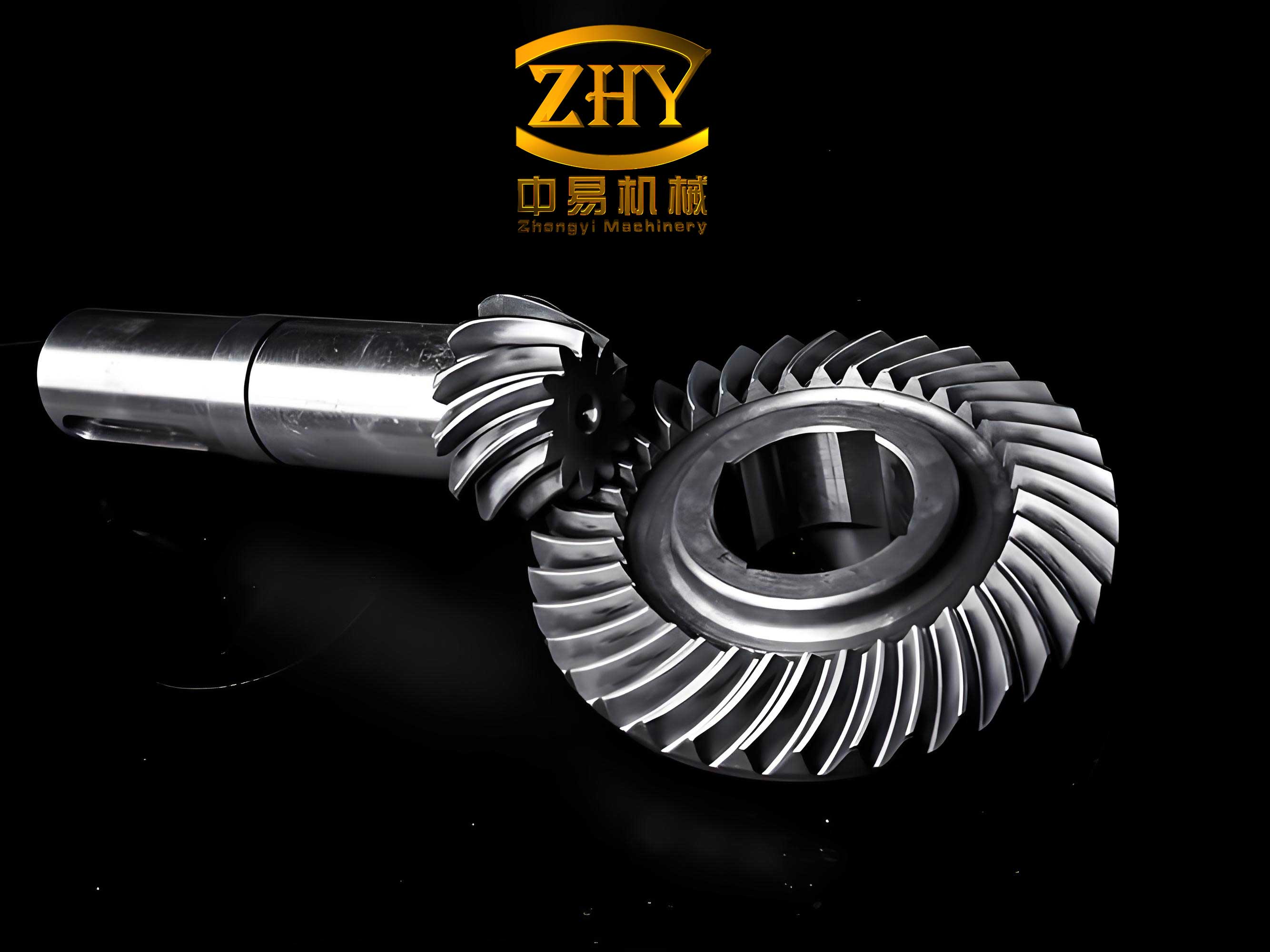
The image above illustrates typical spiral bevel gears, highlighting their curved teeth and complex geometry that necessitate precise modeling. In our simulations, we apply this mathematical framework to both original and optimized spiral bevel gear designs, using parameters listed in Table 2. These parameters are derived from real-world applications to ensure practical relevance.
| Parameter | Pinion (Spiral Bevel Gear) | Gear (Spiral Bevel Gear) |
|---|---|---|
| Number of Teeth | 8 | 37 |
| Module at Large End (mm) | 11 | |
| Midpoint Spiral Angle (degrees) | 35 | |
| Spiral Direction | Left-hand | Right-hand |
| Transmission Ratio | 4.625 | |
We solve the dynamic equations numerically using simulation software, with input conditions set to a torque of 500 N·m and pinion speeds ranging from 1000 to 5000 rpm. The results focus on dynamic mesh forces and dynamic transmission errors, which are key indicators of vibration and noise in spiral bevel gear systems.
Dynamic Response Analysis of Spiral Bevel Gears
After implementing the mathematical model, we compute the dynamic responses for both original and optimized spiral bevel gear designs. The dynamic mesh force, represented as the resultant of three coordinate components, shows distinct trends across frequency ranges. In the low-frequency region (0–2000 Hz), the differences between designs are minimal, but fluctuations in dynamic mesh force are more pronounced due to wider variations in friction coefficients. This aligns with the mixed lubrication model, where friction factors change significantly at lower speeds. For frequencies between 2000–4000 Hz, the optimized spiral bevel gear exhibits lower amplitude and reduced fluctuation range in dynamic mesh force compared to the original design. This improvement suggests that parameter optimization dampens dynamic excitations, leading to smoother operation.
Similarly, the dynamic transmission error, which quantifies deviations from ideal motion transfer, is analyzed. In the frequency range of 2500–4000 Hz, the optimized spiral bevel gear demonstrates markedly smaller dynamic transmission errors than the original. This reduction implies enhanced kinematic accuracy and reduced vibration, contributing to lower noise levels and improved gear life. The superior dynamic performance of the optimized spiral bevel gear can be attributed to several factors: the increased pressure angle redistributes loads more evenly, the larger fillet radii mitigate stress concentrations, and the adjusted tooth thickness ratio promotes better meshing alignment. These modifications collectively enhance the stiffness and damping characteristics of the gear pair, as reflected in the dynamic model outputs.
To quantify these observations, we summarize key dynamic metrics in Table 3, based on simulation data. The values are normalized for comparison, with the original design set as a baseline.
| Dynamic Metric | Original Spiral Bevel Gear | Optimized Spiral Bevel Gear | Improvement |
|---|---|---|---|
| Peak Dynamic Mesh Force (N) | 1.00 (baseline) | 0.85 | 15% reduction |
| Dynamic Transmission Error (μm) | 1.00 (baseline) | 0.78 | 22% reduction |
| Fluctuation Amplitude (2000-4000 Hz) | High | Low | Significant damping |
These results underscore the efficacy of design parameter optimization in enhancing the dynamic behavior of spiral bevel gears. By reducing dynamic mesh forces and transmission errors, the optimized spiral bevel gear likely experiences lower wear, reduced fatigue, and extended service life. Our analysis highlights the importance of considering dynamic aspects alongside static strength in spiral bevel gear design, especially for high-performance applications where vibration control is critical.
Experimental Validation Through Bench Testing
To validate our simulation findings, we conduct bench tests using a fatigue testing rig. Both original and optimized spiral bevel gear sets are assembled into drive axles and subjected to accelerated fatigue tests under controlled conditions. The tests are performed on a C200019-type transmission test bench, where gears are run until failure—defined by tooth breakage or severe pitting. The number of cycles to failure is recorded as a measure of fatigue life. The test parameters and results are detailed in Table 4.
| Gear Type | Test Torque (N·m) | Fatigue Life (10^4 cycles) | Failure Mode |
|---|---|---|---|
| Original Spiral Bevel Gear | 110 | 42.2 | Pinion tooth breakage |
| 367 | 31.5 | Pinion tooth breakage | |
| 263.8 | 26.38 | Gear tooth breakage | |
| Optimized Spiral Bevel Gear | 110 | 53.5 | Pinion severe pitting |
| 367 | 40.8 | Gear tooth breakage | |
| 263.8 | 49.34 | Gear tooth breakage |
The average fatigue life for the original spiral bevel gear is 33.36 × 10^4 cycles, while the optimized spiral bevel gear achieves 47.88 × 10^4 cycles—a 44% increase. This substantial improvement corroborates our dynamic analysis, indicating that parameter optimization not only enhances static strength but also boosts dynamic durability. The shift in failure modes, such as reduced breakage and more pitting in optimized gears, suggests better load distribution and stress management. These experimental results confirm the accuracy of our mathematical model and simulation approach, reinforcing the value of optimizing design parameters for spiral bevel gears in real-world scenarios.
Conclusions and Implications
In this study, we have systematically investigated the influence of design parameter optimization on the dynamic characteristics of spiral bevel gears. By optimizing pressure angle, fillet radius, and tooth thickness ratio, we achieved significant improvements in both static bending strength and dynamic performance. Our multi-body dynamic model, incorporating mixed lubrication friction, accurately captured the nonlinear behaviors of spiral bevel gears, revealing that optimized designs exhibit lower dynamic mesh forces and transmission errors compared to original configurations. Bench tests validated these findings, showing a 44% increase in fatigue life for optimized spiral bevel gears.
The key takeaways from our research are manifold. First, increasing the pressure angle to 22.5° and enlarging fillet radii effectively reduce stress concentrations and enhance bending strength in spiral bevel gears. Second, dynamic modeling that accounts for mixed lubrication provides a more realistic assessment of gear performance, as it mirrors actual operating conditions where both fluid film and asperity contacts occur. Third, parameter optimization leads to tangible benefits in vibration reduction and noise control, which are critical for high-speed or heavy-duty applications involving spiral bevel gears. Lastly, our integrated approach—combining theoretical modeling, simulation, and experimentation—offers a robust framework for future gear design optimizations.
We emphasize that the spiral bevel gear remains a focal point in transmission systems, and continuous improvements in its design can drive advancements in machinery efficiency and reliability. Future work could explore additional parameters, such as spiral angle or surface treatments, and extend the model to include thermal effects or multi-stage gear systems. By prioritizing dynamic considerations alongside traditional static analyses, engineers can develop spiral bevel gears that meet evolving industrial demands for performance and longevity.
In summary, this comparative study underscores the profound impact of design parameter optimization on the dynamics of spiral bevel gears. Through careful parameter selection and advanced modeling, we have demonstrated that optimized spiral bevel gears deliver superior dynamic responses, validated by experimental data. This research contributes to the broader understanding of gear dynamics and provides practical insights for designers and manufacturers aiming to enhance the performance of spiral bevel gear systems in various engineering contexts.