
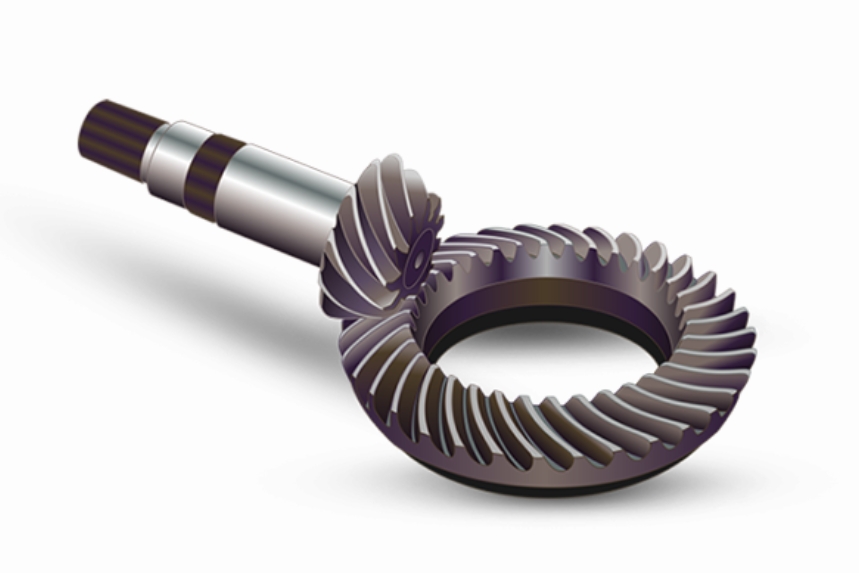
Spiral bevel gears are critical power transmission components, renowned for their high load-carrying capacity, smooth operation, and low noise generation. These attributes make them indispensable in demanding applications across the aerospace, automotive, and heavy machinery industries. In particular, helicopter transmissions, such as tail rotor gearboxes, heavily rely on spiral bevel gear sets for efficient and reliable power transfer. However, the very complexity that grants them superior performance also presents significant challenges in reverse engineering and maintenance. The tooth geometry is spatially curved, and numerous proprietary manufacturing systems exist, such as those developed by Gleason, Oerlikon, and Klingelnberg. Each system employs distinct machine tools and design philosophies, often shrouded in technical confidentiality. This diversity complicates the parameter identification process for legacy, damaged, or imported gear sets where original design documentation is unavailable. Traditional surveying and mapping techniques, while foundational, can be time-consuming and limited in accuracy, especially for intricate parameters like spiral angle and localized pressure angles. This necessitates the integration of advanced digital tools to enhance precision and efficiency.
The primary objective of this discourse is to outline a robust, integrated methodology for the surveying and mapping of spiral bevel gear parameters. We will combine established manual measurement techniques with the powerful capabilities of modern Computer-Aided Design (CAD) software, specifically leveraging Dassault Systèmes’ CATIA V5. This approach aims to accurately extract critical geometric data from physical gear specimens through imprint analysis and computational reconstruction, forming a reliable digital twin. The acquired parameters are not merely for replication; they serve as the essential foundation for subsequent engineering analyses, including load capacity calculations, stress verification, and the creation of accurate models for finite element analysis (FEA) or manufacturing. The general workflow for surveying a bevel gear pair is a systematic process, as illustrated in the following sequence: initial physical inspection and data collection, acquisition of tooth and face imprints, digital processing and analysis of imprints within CAD software, detailed parameter calculation and deduction, and final verification and documentation of results.
CATIA V5, an industry-standard CAD/CAE/CAM platform, offers modules particularly suited for this task. Its ‘Sketch Tracer’ module allows for the direct import and scaling of 2D imprint images, enabling precise digital tracing and measurement. This capability transforms qualitative imprint observations into quantitative, scalable data. We will demonstrate how this digital augmentation streamlines the determination of complex parameters, significantly improving upon traditional protractor and caliper-based methods for defining the spiral angle and tool profile angles of a spiral bevel gear.
Fundamental Principles and Gear Terminology
To effectively survey a spiral bevel gear, a firm understanding of its key geometric parameters is essential. These parameters define the gear’s size, shape, and meshing characteristics. Below is a summary of the primary parameters required for a complete definition, many of which are targets of our mapping process.
| Parameter Category | Key Variables | Symbol | Description |
|---|---|---|---|
| Basic Dimensions | Number of Teeth | z1, z2 | Count of teeth on the pinion and gear. |
| Shaft Angle | Σ | The angle between the axes of the two mating shafts. | |
| Outer Cone Distance | Re | Distance from the apex of the pitch cone to the outer edge of the tooth face. | |
| Face Width | b | Length of the tooth along the cone distance. | |
| Angular Parameters | Pitch Cone Angle | δ1, δ2 | Angle between the gear axis and the pitch cone element. |
| Spiral Angle | β | Angle between the tooth trace and a generatrix of the pitch cone at its midpoint. | |
| Tooth Proportions | Outer Module | mt | Module measured at the large end of the tooth. Key scaling factor. |
| Whole Depth | h | Total tooth height (sum of addendum and dedendum). | |
| Pressure/Tool Angle | αn, α0 | Normal pressure angle in mesh; related to the cutter’s generating profile angle. | |
| Design System | Tooth System | — | Identifies the manufacturing standard (e.g., Gleason, Oerlikon). |
The geometry of a spiral bevel gear is governed by specific trigonometric relationships. The fundamental equation linking module, cone distance, and pitch angle for a given gear is:
$$m_t = \frac{2R_e \sin \delta}{z}$$
This formula is crucial for calculating the outer module (\(m_t\)) from measured values of outer cone distance (\(R_e\)) and the derived pitch cone angle (\(\delta\)). Furthermore, the spiral angle (\(\beta\)) is a critical design feature distinguishing it from straight bevel gears. An approximate formula relating it to other manufacturing parameters is:
$$\beta = \tan^{-1}\left(\frac{\pi D \sin \phi}{P}\right)$$
where \(D\) is a reference diameter and \(\phi\) is a machine setting angle. For surveying, \(\beta\) is often approximated from the mean cone geometry.
Traditional Surveying and Mapping Techniques
Before introducing digital augmentation, it is vital to establish the core manual measurement procedures. These methods provide the primary dimensional inputs for any subsequent calculation. The process for a spiral bevel gear pair typically follows a structured sequence, beginning with direct measurement and culminating in parameter calculation.
- Direct Counts and Measurements:
- Tooth Count (z): The number of teeth on both the pinion (\(z_1\)) and the gear (\(z_2\)) is directly counted.
- Shaft Angle (Σ): This is measured using precision angle gauges or by inserting mandrels into the gear housing’s bearing bores and measuring the angle between them.
- Face Width (b): Measured directly using calipers along the tooth flank. For a pair, the smaller value is typically used as the effective face width.
- Whole Tooth Depth (h): Measured at the large end of the tooth using a vernier depth gauge or specialized gear tooth calipers.
- Derived Measurements:
- Outer Cone Distance (Re): This can be measured in situ if the gear pair is assembled or simulated in their nominal position using large calipers to measure the distance between opposite tooth faces, yielding approximately \(2R_e\). For a single gear, a method using two straight edges resting on the back cone can be employed to find the apex and thus \(R_e\). For standard tapered teeth (coniflex), \(R_e = R’_e\). For uniform depth teeth, a correction is needed:
$$R_e = R’_e – \frac{h}{2.15} \cot \delta$$ - Pitch Cone Angles (δ1, δ2): These are calculated trigonometrically from the shaft angle and the tooth ratio.
For shaft angles Σ ≤ 90°:
$$δ_1 = \arctan\left(\frac{\sinΣ}{\frac{z_2}{z_1} + \cosΣ}\right)$$
For shaft angles Σ > 90°:
$$δ_1 = \arctan\left(\frac{\sin(180° – Σ)}{\frac{z_2}{z_1} – \cos(180° – Σ)}\right)$$
The mating gear’s angle is \(δ_2 = Σ – δ_1\) (for Σ ≤ 90°) or \(δ_2 = Σ – δ_1\) for other configurations.
- Outer Cone Distance (Re): This can be measured in situ if the gear pair is assembled or simulated in their nominal position using large calipers to measure the distance between opposite tooth faces, yielding approximately \(2R_e\). For a single gear, a method using two straight edges resting on the back cone can be employed to find the apex and thus \(R_e\). For standard tapered teeth (coniflex), \(R_e = R’_e\). For uniform depth teeth, a correction is needed:
- Imprint Acquisition:
- Tooth Surface Imprint: A mixture of heavy grease or oil and a contrast agent (like red lead or Prussian blue) is applied to the tooth flanks. The gear is then carefully rolled against a stiff, clean white paper to transfer the curved trace of several teeth (at least 5-6). This imprint reveals the spiral pattern and tooth curvature.
- Face/Back Cone Imprint: Similarly, the gear’s back cone surface (the large-end profile) is inked and pressed onto paper to obtain a planar projection of the tooth profiles. This imprint is used for analyzing pressure angles and tooth thickness.
These traditional steps yield a foundational dataset. However, the interpretation of imprints and precise measurement of angles from them are subjective and prone to error. This is where CAD software like CATIA provides a significant advantage for analyzing spiral bevel gear geometry.
CATIA-Assisted Digital Analysis and Calculation
The integration of CATIA V5 transforms the surveying process by providing a precise, scalable, and reproducible digital canvas for analyzing physical imprints. We will focus on three critical applications: tooth system identification, spiral angle measurement, and tool profile angle determination.
Tooth System Identification via Imprint Analysis
Determining whether a spiral bevel gear follows a circular arc (Gleason) or an extended epicycloid (Oerlikon) trace is the first diagnostic step. Using the CATIA ‘Sketch Tracer’ workbench:
- The tooth surface imprint image is imported and scaled to 1:1 using a known reference dimension from the physical gear (e.g., a measured outer diameter or cone distance).
- On a clearly imprinted tooth flank (concave or convex), four or more points are digitally placed along the tooth trace, spaced approximately equally.
- Using the software’s circle-fitting tool, circles are constructed using successive triplets of these points (e.g., points 1,2,3 and points 2,3,4).
The key diagnostic is the coincidence of the circle centers:
- If the centers of the circles constructed from different point triplets are nearly coincident, the tooth trace is a circular arc, indicative of Gleason or similar circular arc systems.
- If the circle centers shift significantly as different point sets are used, the local curvature is not constant, pointing towards an extended epicycloid (Oerlikon) or other non-circular trace system.
This digital method provides a more objective and accurate classification than visual inspection alone.
Precise Spiral Angle (β) Measurement
For a spiral bevel gear identified with a circular arc tooth trace, the spiral angle at the mean cone can be accurately deduced. The process digitally replicates the graphical method within CATIA:
- Locate Apex (O): On the scaled tooth surface imprint, identify points A and C at the large end of two corresponding tooth traces. With O as the unknown apex, the distance OA = OC = Outer Cone Distance (\(R_e\)). Using \(R_e\) as the radius, construct two digital circles centered on A and C. Their intersection point is the apex O.
- Locate Midpoint (M): Calculate the mean cone distance: \(R_m = R_e – b/2\). With O as the center, draw a circle of radius \(R_m\). Its intersection with a tooth trace defines point M, the tooth trace midpoint.
- Determine Cutter Center (D): Select three points on a clear tooth trace: the large end (A), midpoint (M), and small end (B). Fit a circle through A, M, and B. Its center is the theoretical cutter center D’ for that flank. The radius MD’ is the approximate cutter radius (\(r_0\)). The true cutter center D lies on an arc centered at O with radius OD’ and is also at a distance \(r_0\) from point M.
- Calculate Spiral Angle: Construct lines OM and MD. The mean cone spiral angle \(\beta_m\) is the complement of angle \(\angle OMD\).
$$\beta_m = 90° – \angle OMD$$
This \(\beta_m\) is a highly accurate representation of the nominal spiral angle \(\beta\).
Determination of Normal Pressure Angle / Tool Profile Angle (αn, α0)
The tool profile angle, which closely relates to the normal pressure angle in mesh, is derived from the face/back cone imprint. This process involves measuring equivalent “base pitches” from the planar projection.
- Measure Span Wires (Virtual): Import and scale the back cone imprint to 1:1. Calculate the equivalent number of teeth for the back cone: \(z_v = z / \cos \delta\). Determine the span number \(k \approx 0.111z_v + 0.5\) (round to nearest integer).
- Construct Tangent Lines: Digitally, construct lines tangent to the convex and concave flanks of the teeth, spanning \(k\) and \(k-1\) teeth, mimicking caliper jaws.
- Calculate Base Pitches: Measure the perpendicular distance between these parallel tangents on the convex (\(W_{t(k)}\), \(W_{t(k-1)}\)) and concave (\(W_{a(k)}\), \(W_{a(k-1)}\)) sides. The differences give the apparent base pitches on the back cone projection:
$$pb_a = W_{a(k)} – W_{a(k-1)}$$
$$pb_t = W_{t(k)} – W_{t(k-1)}$$ - Compute Transverse Pressure Angles: The transverse pressure angles at the back cone (approximating the large end) are:
$$\alpha_t \approx \arccos\left(\frac{pb_t}{\pi m_t}\right)$$
$$\alpha_a \approx \arccos\left(\frac{pb_a}{\pi m_t}\right)$$ - Compute Normal Pressure Angle: For a spiral bevel gear with tapered tooth depth (coniflex), the normal pressure angle is calculated from the spiral angle and transverse angles:
$$\alpha_n \approx \arctan\left[ \cos\beta \cdot \frac{\tan\alpha_a + \tan\alpha_t}{1 – \tan\alpha_a \tan\alpha_t \cos^2\beta} \right]$$
For uniform depth teeth, the formula is:
$$\alpha_n \approx \arctan\left[ \frac{1}{2} (\tan\alpha_a + \tan\alpha_t) \cos\beta \right]$$
The calculated \(\alpha_n\) is then compared to standard cutter angles (e.g., 14.5°, 16°, 17.5°, 20°, 22.5°) to identify the most likely tool profile angle \(\alpha_0\).
| Analysis Step | CATIA Tool/Function Used | Input | Output/Determination |
|---|---|---|---|
| System ID | Sketch Tracer, Circle Fit | Tooth surface imprint | Circular Arc vs. Extended Epicycloid (Gleason vs. Oerlikon) |
| Spiral Angle | Sketcher, Constraint Solving | Scaled imprint, Measured Re, b | Precise mean cone spiral angle βm |
| Pressure Angle | Sketcher, Parallel/Distance Constraints | Scaled back cone imprint, mt, β | Normal pressure angle αn, Tool angle α0 |
Comprehensive Case Study: Helicopter Gearbox Spiral Bevel Gear Pair
To illustrate the integrated methodology, we present a detailed case study involving a spiral bevel gear pair from an intermediate helicopter gearbox. The goal was to fully define its parameters for potential refurbishment and performance analysis.
Phase 1: Initial Physical Measurement
Direct manual measurements were performed on the disassembled gear pair, yielding the initial dataset in Table 1.
| Table 1: Initial Physical Measurements | |||
|---|---|---|---|
| Parameter | Symbol | Pinion (Driver) | Gear (Driven) |
| Number of Teeth | z | 29 | 35 |
| Shaft Angle | Σ | 145° | |
| Outer Cone Distance | Re | 98.02 mm | |
| Face Width | b | 33.2 mm (smaller of the two) | |
| Whole Tooth Depth | h | 10.82 mm | |
Using the formulas for Σ > 90°, the pitch cone angles were calculated:
$$δ_1 = \arctan\left(\frac{\sin(180° – 145°)}{\frac{35}{29} – \cos(180° – 145°)}\right) = \arctan\left(\frac{\sin 35°}{1.2069 – \cos 35°}\right) ≈ 55.94°$$
$$δ_2 = Σ – δ_1 = 145° – 55.94° = 89.06°$$
The outer transverse module was then estimated:
$$m_t = \frac{2 R_e \sin δ_1}{z_1} = \frac{2 \times 98.02 \times \sin 55.94°}{29} ≈ 5.60 \text{ mm}$$
This value was cross-checked using the whole depth formula, assuming standard Gleason coefficients (addendum coefficient \(h_a^* = 0.85\), bottom clearance coefficient \(c^* = 0.188\)):
$$h = (2h_a^* + c^*) m_t = (2 \times 0.85 + 0.188) \times m_t = 1.888 m_t$$
$$m_t = h / 1.888 = 10.82 / 1.888 ≈ 5.73 \text{ mm}$$
The close agreement (5.60 vs. 5.73) suggested the initial measurements were consistent, and the module was confirmed as \(m_t = 5.65\) mm after standard rounding and final reconciliation.
Phase 2: Digital Analysis in CATIA
- Tooth System ID: The tooth surface imprints were imported. Circular fitting on multiple points of the tooth trace showed nearly coincident centers, conclusively identifying the pair as Gleason-style circular arc spiral bevel gears with tapered tooth depth.
- Spiral Angle Measurement: Following the digital graphical method:
- Apex O was located using \(R_e = 98.02\) mm.
- Mean point M was found using \(R_m = R_e – b/2 = 81.42\) mm.
- Cutter center D was determined via circle fitting through A, M, B.
- Angle \(\angle OMD\) was measured as 55.1°.
- Therefore, \(\beta_m = 90° – 55.1° = 34.9°\). The spiral angle was recorded as \(\beta ≈ 35°\).
- Tool Profile Angle Measurement: The back cone imprint was analyzed:
- Equivalent tooth count: \(z_v = 29 / \cos 55.94° ≈ 52\). Span number \(k = 0.111 \times 52 + 0.5 ≈ 6\).
- Digital “span measurements” on convex side: \(W_{t(6)} = 84.813 \text{ mm}\), \(W_{t(5)} = 69.137 \text{ mm}\) → \(pb_t = 15.676 \text{ mm}\).
- On concave side: \(W_{a(6)} = 84.868 \text{ mm}\), \(W_{a(5)} = 69.171 \text{ mm}\) → \(pb_a = 15.697 \text{ mm}\).
- Transverse pressure angles (using \(m_t=5.65\) mm):
$$\alpha_t = \arccos(15.676 / (\pi \times 5.65)) ≈ 26.99°$$
$$\alpha_a = \arccos(15.697 / (\pi \times 5.65)) ≈ 26.84°$$ - Normal pressure angle (coniflex formula, β=35°):
$$\alpha_n ≈ \arctan\left[ \cos 35° \cdot \frac{\tan 26.84° + \tan 26.99°}{1 – \tan 26.84° \tan 26.99° \cos^2 35°} \right] ≈ 22.58°$$ - This aligns perfectly with the standard cutter angle \(\alpha_0 = 22.5°\).
Phase 3: Final Parameter Synthesis
Combining all measurement and analysis streams, the complete parameter set for the helicopter spiral bevel gear pair was finalized as shown in Table 2. This comprehensive dataset, achieved through the integrated methodology, provides a reliable digital definition of the components.
| Table 2: Final Surveyed Parameters for Case Study Gear Pair | |||
|---|---|---|---|
| Parameter Category | Parameter | Pinion Value | Gear Value |
| Basic Geometry | Number of Teeth (z) | 29 | 35 |
| Shaft Angle (Σ) | 145° | ||
| Outer Cone Distance (Re) | 98.02 mm | ||
| Angular Geometry | Pitch Cone Angle (δ) | 55.94° | 89.06° |
| Mean Spiral Angle (β) | 35° | ||
| Tooth Form | Outer Transverse Module (mt) | 5.65 mm | |
| Face Width (b) | 33.2 mm | ||
| Tooth System | Gleason, Circular Arc, Tapered Depth | ||
| Nominal Tool Profile Angle (α0) | 22.5° | ||
Verification, Error Sources, and Advantages
The credibility of any surveying methodology depends on its consistency and accuracy. In our integrated approach, verification is built into the process through cross-checking. For instance, the outer module (\(m_t\)) derived from the cone distance and geometry must be consistent with the module implied by the whole tooth depth (\(h\)) and standard tooth proportion coefficients. Significant discrepancies indicate measurement errors in \(R_e\), \(h\), or \(\delta\), prompting re-measurement.
Potential sources of error must be acknowledged and minimized:
- Imprint Quality: Blurry, smudged, or incomplete imprints are the largest source of error for the CATIA-based steps. Careful application of the marking medium and controlled rolling/pressing are crucial.
- Scaling Accuracy: Incorrect scaling of the imported imprint images invalidates all subsequent digital measurements. Scaling must be done using a reliably measured feature visible in the imprint (e.g., a known outer diameter or a marked gauge length).
- Physical Measurement Errors: Inaccuracies in manual measurement of \(R_e\), \(h\), and \(Σ\) propagate through all calculations. Using high-precision instruments (e.g., coordinate measuring machines for \(R_e\) where possible) is recommended.
- Wear and Damage: Heavily worn or damaged tooth profiles will yield imprints that do not represent the original designed geometry. Critical judgment and potential profile reconstruction are needed in such cases.
The advantages of augmenting traditional spiral bevel gear surveying with CATIA are substantial:
- Enhanced Accuracy: Digital measurement on a scaled, high-resolution image eliminates parallax errors and allows for precise geometric constructions (circle fits, tangents) that are difficult to achieve manually on paper.
- Improved Objectivity & Reproducibility: The process is less dependent on operator skill in interpreting faint lines. The digital steps can be saved, reviewed, and repeated identically.
- Efficiency Gains: Once imprints are digitized and scaled, multiple parameters (spiral angle, pressure angles) can be extracted quickly from the same digital model, speeding up the overall analysis.
- Foundation for Digital Modeling: The accurately determined parameters can be directly used to create solid 3D models of the spiral bevel gear in CATIA or other CAD software, enabling advanced simulations, manufacturing planning, and performance analysis.
| Table 3: Methodology Comparison | ||
|---|---|---|
| Aspect | Traditional Manual Method | CATIA-Augmented Method |
| Spiral Angle (β) Determination | Graphical on paper, prone to drafting error. | Precise digital construction & angle measurement. |
| Pressure Angle (αn) Determination | Manual span measurement with gear calipers on physical gear or approximate graphical measurement on paper. | Accurate digital tangent construction and calculation on scaled back-cone imprint. |
| Tooth System ID | Visual inspection, less definitive. | Quantitative circle-fitting analysis on tooth trace. |
| Data Reproducibility | Low; dependent on individual’s drawing. | High; digital file can be reused and re-measured. |
| Output for Further Analysis | List of numbers, 2D drawings. | Digital parameters ready for 3D CAD modeling and CAE. |
Conclusion
Surveying and mapping the complex parameters of a spiral bevel gear is a demanding but essential engineering task for reverse engineering, maintenance, and legacy system support. The methodology presented herein demonstrates that a synergistic approach, combining the irreplaceable value of careful physical measurement with the analytical power of modern CAD software like CATIA, yields superior results. This integrated process efficiently and accurately determines all critical geometric parameters, including the often-troublesome spiral angle and tool profile angle, which are vital for defining the spiral bevel gear’s action. The resulting high-fidelity parameter set is not an end in itself; it forms the critical input for subsequent engineering stages, such as strength and durability calculations, noise and vibration analysis, and the generation of manufacturing data for potential replacement. By systematically applying this approach, engineers can significantly improve the accuracy, efficiency, and reliability of spiral bevel gear documentation, thereby supporting the continued operation, analysis, and reproduction of these sophisticated power transmission components across critical industries like aerospace.