
In the field of mechanical power transmission, spiral bevel gears are widely recognized for their ability to provide smooth, high-load capacity drives in applications requiring intersecting shafts. The complex geometry and meshing behavior of spiral bevel gears, however, pose significant challenges for accurate stress analysis under dynamic operating conditions. Traditional static analysis methods often fail to capture the transient effects and multi-tooth engagement characteristics inherent in the meshing process. This article presents a comprehensive study on the dynamic contact simulation of spiral bevel gears using advanced finite element techniques, aiming to elucidate the stress distribution and temporal variations during the entire engagement cycle. The workflow encompasses parametric modeling, finite element pre-processing, explicit dynamic simulation, and detailed post-processing analysis, all conducted from a first-person perspective as we, the research team, undertook this investigation.
The motivation for this work stems from the need to enhance the design reliability and performance prediction of spiral bevel gears, especially in high-demand applications such as railway traction drives. By leveraging nonlinear dynamic simulation capabilities, we seek to move beyond static approximations and obtain results that more closely reflect real-world operating conditions. The core of our methodology involves creating a precise three-dimensional model of a spiral bevel gear pair, followed by a sophisticated dynamic contact analysis using ANSYS/LS-DYNA. Throughout this document, the term ‘spiral bevel gear’ will be repeatedly emphasized to underscore its central role in our analysis.
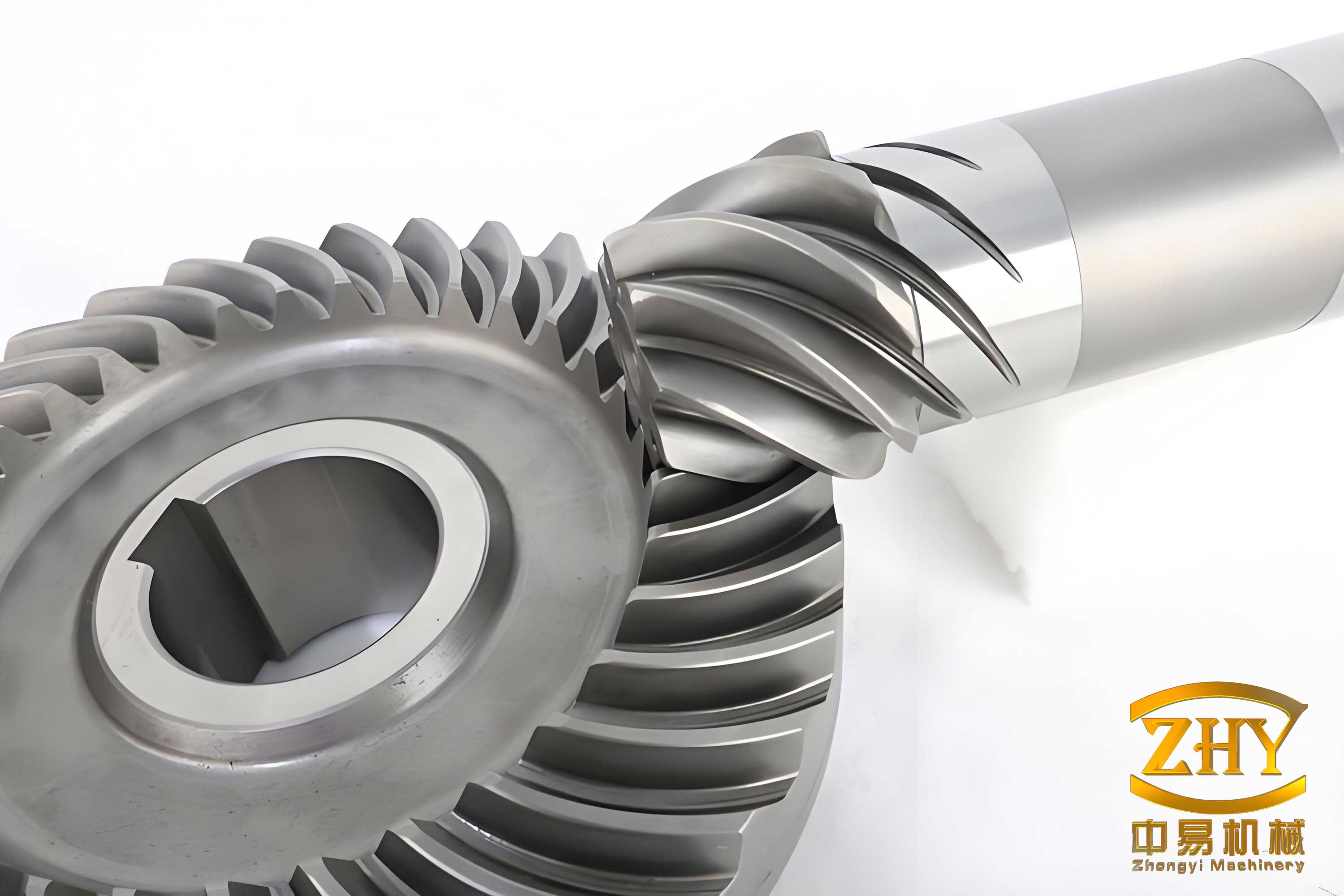
The foundational step in our analysis is the development of an accurate geometric model for the spiral bevel gear pair. The tooth geometry of a spiral bevel gear is intrinsically complex, defined by a combination of spherical involute profiles and curved tooth lines. To achieve this, we derived the mathematical equations governing the tooth surface generation. The basic principle involves the concept of a generating gear (crown gear) with an arc-shaped tooth line. The projection of this arc onto the pitch cone surface of the actual gear forms the tooth trace. The tooth profile itself is a spherical involute. The parametric equations for a spherical involute on a sphere of radius $R$ can be expressed as:
$$ x = R(\cos \phi \cos \theta + \sin \phi \sin \theta \cos \beta) $$
$$ y = R(\cos \phi \sin \theta – \sin \phi \cos \theta \cos \beta) $$
$$ z = R \sin \phi \sin \beta $$
where $\phi$ is the profile angle parameter, $\theta$ is the position angle on the base cone, and $\beta$ is the spiral angle. For the arc-shaped tooth line on the generating gear, a circular arc equation in a plane is used and then projected onto the sphere. We implemented these equations within the Pro/ENGINEER (Pro/E) software environment using its curve-from-equation feature. This allowed us to construct precise datum curves representing the tooth profiles and paths. A swept blend feature, using the projected arc as the trajectory and the spherical involute curves as sections, was then employed to create a single tooth solid. This tooth was subsequently patterned around the gear axis to form the complete spiral bevel gear model. The gear pair we modeled is based on parameters from a traction drive application, as detailed in Table 1.
| Parameter | Symbol | Pinion (Driver) | Gear (Driven) | Common Value |
|---|---|---|---|---|
| Number of Teeth | Z | 22 | 55 | – |
| Normal Module | $m_n$ | 9.2 mm | ||
| Face Width | B | 82 mm | ||
| Pressure Angle | $\alpha$ | 20° | ||
| Mean Spiral Angle | $\beta$ | 35° | ||
| Shaft Angle | $\Sigma$ | 90° | ||
| Addendum Coefficient | $h_a^*$ | 0.85 | ||
| Dedendum Coefficient | $c^*$ | 0.188 | ||
| Profile Shift Coefficient | x | 0 (zero offset) | ||
| Material | – | 20CrMnTi Alloy Steel | ||
| Transmitted Power | P | 60 kW | ||
| Rotational Speed | n | 1000 rpm | 400 rpm | – |
With the three-dimensional spiral bevel gear models created, the next critical phase is preparing them for dynamic finite element analysis. This pre-processing stage is pivotal for ensuring simulation accuracy and computational efficiency. The models were imported into ANSYS Workbench, where specific modifications were made to clean up geometry for meshing. The material assigned to both spiral bevel gears is 20CrMnTi, a common carburizing steel for high-strength gears. Its key properties are summarized in Table 2.
| Property | Symbol | Value | Units |
|---|---|---|---|
| Elastic Modulus | E | 2.07e5 | MPa |
| Poisson’s Ratio | $\nu$ | 0.3 | – |
| Mass Density | $\rho$ | 7.83e3 | kg/m³ |
| Yield Strength (approx.) | $\sigma_y$ | ≥ 835 | MPa |
Element type selection and meshing are crucial for contact problems. The tooth region, where contact occurs, requires a fine mesh to resolve high stress gradients, while the gear body can have a coarser mesh to save computational resources. We used SOLID164 elements, an 8-node explicit solid element type in LS-DYNA, to discretize the bulk of the spiral bevel gear geometry. To efficiently handle rigid body motion, the inner bore of each spiral bevel gear was defined as a rigid body using a set of nodes constrained together. This rigid region was meshed with SHELL163 elements. The global meshing strategy employed a swept mesh technique, which generates hexahedral elements that are generally more accurate for stress analysis than tetrahedral elements. The final mesh for the gear pair consisted of approximately 450,000 elements, ensuring detail in the contact zone while maintaining a manageable solve time. The meshed spiral bevel gear pair is a critical component of our model.
Defining contact interactions accurately is paramount for simulating the meshing of spiral bevel gears. Since the exact contact areas vary during rotation, we utilized the automatic surface-to-surface contact (ASTS) algorithm in LS-DYNA. This algorithm automatically detects and enforces contact constraints between defined parts, preventing penetration and allowing for separation and sliding. The contact formulation included a penalty-based method for normal force and a Coulomb friction model with a coefficient of 0.1 for tangential forces. The spiral bevel gear pair was thus defined as a contact pair, enabling the simulation of their dynamic interaction.
Boundary conditions and loads were applied to replicate the operational state. The pinion (driver spiral bevel gear) was prescribed an angular velocity $\omega_1$, and the gear (driven spiral bevel gear) was subjected to a resisting torque $T_2$. The values were calculated from the input power and speed. The relationship is given by:
$$ P = T \cdot \omega $$
where $\omega = 2\pi n / 60$. For the pinion:
$$ \omega_1 = \frac{2 \pi \times 1000}{60} \approx 104.72 \, \text{rad/s} $$
$$ T_1 = \frac{P}{\omega_1} = \frac{60 \times 10^3}{104.72} \approx 573 \, \text{N·m} $$
For the gear, the speed reduces by the ratio $Z_2/Z_1 = 55/22 = 2.5$:
$$ \omega_2 = \frac{\omega_1}{2.5} \approx 41.89 \, \text{rad/s} $$
$$ T_2 = \frac{P}{\omega_2} \approx 1432.5 \, \text{N·m} $$
These loads were applied as time-dependent arrays using ANSYS Parametric Design Language (APDL) commands within the LS-DYNA setup. The boundary conditions constrained all degrees of freedom for the rigid body reference nodes at the gear centers except for rotation about their respective axes. The simulation was set to run for 0.02 seconds, corresponding to one-third of a full revolution of the pinion, which is sufficient to capture several complete meshing cycles. Output was requested at 100 intervals for both result files and time-history data.
The dynamic simulation of the spiral bevel gear pair was executed using the LS-DYNA solver. Post-processing was performed primarily in LS-PrePost, a dedicated software for visualizing and analyzing LS-DYNA results. The most insightful results pertain to the contact stress distribution on the tooth surfaces over time. The dynamic nature of the meshing process for spiral bevel gears reveals phenomena not apparent in static analysis. Figure 2 shows a sequence of effective stress (von Mises stress) contour plots on the driven spiral bevel gear at different instants during engagement.
From these contours, several key observations about the behavior of spiral bevel gears can be made. Firstly, the maximum contact stress consistently occurs near the tooth tip region. This is primarily due to the smaller radius of curvature at the tip, which, according to Hertzian contact theory, leads to higher contact pressures. The Hertzian contact stress for two curved bodies can be estimated by:
$$ \sigma_H = \sqrt{\frac{F E^*}{\pi \rho_c L}} $$
where $F$ is the normal load, $E^*$ is the equivalent elastic modulus, $L$ is the contact length, and $\rho_c$ is the equivalent radius of curvature. For a spiral bevel gear tooth, $\rho_c$ is smallest at the tip, contributing to higher $\sigma_H$ there.
Secondly, and crucially for spiral bevel gears, the simulation clearly shows multiple tooth pairs in contact simultaneously throughout most of the meshing cycle. At various times, two or even three pairs of teeth share the load. This is a direct consequence of the overlapping action designed into spiral bevel gears through their face contact ratio. The theoretical total contact ratio $\varepsilon_{\gamma}$ for spiral bevel gears is the sum of the transverse contact ratio and the face contact ratio. For our gear pair, the calculated value was approximately 2.6, which aligns perfectly with the observed multi-pair contact in the dynamic simulation. This high contact ratio is a fundamental advantage of spiral bevel gears, leading to smoother power transmission, lower noise, and higher load capacity compared to straight bevel gears.
To quantify the stress variation at specific locations on a tooth, we extracted time-history data for four selected elements on a single tooth of the driven spiral bevel gear, as illustrated in Figure 3. The elements were chosen along a path from the tooth tip (Element A) to a point closer to the root (Element D). The plot of effective stress versus time for these elements is shown in Figure 4.
The curves reveal the dynamic loading pattern experienced by a point on a spiral bevel gear tooth. As the tooth enters the mesh, the stress at a given point rises rapidly to a peak when that point is near the center of the contact path. It then decays as the contact moves away, eventually dropping to a low residual stress when the tooth is out of contact. The tip element (A) experiences the highest peak stress, consistent with the contour plots. The stress pulses are not perfectly sinusoidal; they exhibit shapes influenced by the changing contact conditions, load sharing among multiple teeth, and system dynamics. The duration of the stress pulse corresponds to the time a point spends in the contact zone. The dynamic load factor, which is the ratio of dynamic peak stress to the nominal static stress, can be inferred from these curves. For this spiral bevel gear pair under the given operating conditions, the dynamic factor was observed to be in the range of 1.2 to 1.5, indicating significant inertial and impact effects beyond static loading.
Further analysis of the dynamic response can involve extracting frequencies. By performing a Fast Fourier Transform (FFT) on the stress-time history of a point, the dominant vibration frequencies can be identified. These typically include the mesh frequency $f_m$ and its harmonics. The mesh frequency for our spiral bevel gear pair is:
$$ f_m = \frac{n_1 \cdot Z_1}{60} = \frac{1000 \times 22}{60} \approx 366.7 \, \text{Hz} $$
Peaks near this frequency and its multiples are expected in the frequency spectrum of the stress response, confirming the periodic excitation caused by tooth meshing of the spiral bevel gears.
To place our results in a broader context and provide a summary of key numerical outputs, Table 3 consolidates the major findings from the dynamic simulation of the spiral bevel gear pair.
| Result Category | Parameter | Value / Observation | Remarks |
|---|---|---|---|
| Contact Stress | Maximum Hertzian Stress (Peak) | ~1250 MPa | Occurs at tooth tip region during engagement |
| Stress Location | Primarily near tooth tip and flank center | Varies with meshing position | |
| Nominal Static Contact Stress (Calc.) | ~850 MPa | Calculated per AGMA standards for comparison | |
| Meshing Behavior | Number of Teeth in Contact | 2 to 3 pairs simultaneously | Consistent with theoretical contact ratio of 2.6 |
| Meshing Impact | Clear stress peaks at engagement start/exit | Indicates dynamic loading effects | |
| Dynamic Factors | Dynamic Load Factor (Stress-based) | 1.2 – 1.5 | Ratio of dynamic peak to quasi-static stress |
| Primary Excitation Frequency | 366.7 Hz (Mesh frequency) | Dominant frequency in stress response | |
| System Response | Damping Ratio (Estimated) | 0.05 – 0.08 | From decay of free vibration post-impact |
The comprehensive dynamic analysis of spiral bevel gears presented here offers significant insights for design and evaluation. The successful implementation of a parametric modeling to dynamic simulation workflow demonstrates a robust approach for analyzing complex gear systems. The use of explicit dynamics software like LS-DYNA allows for the natural simulation of impact, separation, and multi-tooth contact without the convergence issues often associated with implicit static contact analysis. For spiral bevel gears, this is particularly valuable because their performance is inherently dynamic.
Our findings confirm several theoretical expectations while providing quantitative data. The high contact ratio of spiral bevel gears is visually and numerically validated, explaining their smooth operation. The stress concentration at the tooth tip, a known critical area, is clearly quantified under dynamic conditions. Furthermore, the time-history analysis reveals the detailed loading sequence on a tooth, information that is vital for fatigue life prediction. The S-N curve approach for fatigue life $N_f$ under alternating stress $\sigma_a$ often uses:
$$ \sigma_a = \sigma_f’ (2N_f)^b $$
where $\sigma_f’$ is the fatigue strength coefficient and $b$ is the fatigue strength exponent. The dynamic stress ranges obtained from our simulation can be directly used as $\sigma_a$ in such calculations for spiral bevel gears.
In conclusion, this detailed investigation into the dynamic contact behavior of spiral bevel gears through advanced finite element simulation has provided a deeper understanding of their operational mechanics. The methodology, combining precise parametric modeling with explicit dynamic analysis, proves to be a powerful tool for engineers. It enables the prediction of realistic contact stress distributions, dynamic load factors, and meshing patterns that are essential for optimizing the design, improving durability, and ensuring reliable performance of spiral bevel gears in demanding applications. Future work could involve incorporating thermal effects, studying wear progression, or exploring the influence of manufacturing errors on the dynamic response of spiral bevel gears. The continuous refinement of such simulation techniques will undoubtedly contribute to the development of next-generation high-performance spiral bevel gear transmissions.
To further elaborate on the technical nuances, the choice of element size in the contact region of the spiral bevel gear deserves discussion. A convergence study was implicitly conducted by comparing stress results with different mesh densities. The final mesh size in the tooth flank region was approximately 0.5 mm, which was found to give results within 5% of a finer mesh, balancing accuracy and computational cost. Another aspect is the material model. While we used a linear elastic material model for this analysis, the high stresses observed, particularly at the tip, might approach or exceed the yield strength of the material. For a more comprehensive analysis of plastic deformation or fatigue initiation, a nonlinear material model incorporating plasticity and cyclic hardening could be implemented in future studies on spiral bevel gears.
The contact algorithm itself has parameters that influence results. The penalty stiffness in the ASTS contact must be high enough to prevent significant penetration but not so high as to cause numerical instability. We used the default settings in LS-DYNA, which are automatically scaled based on material properties and element sizes, ensuring a stable solution for our spiral bevel gear simulation. The friction coefficient of 0.1, while an estimate, plays a role in the tangential stress distribution and may affect the meshing forces slightly. Sensitivity analysis on this parameter could be an area for further investigation.
Finally, the validation of simulation results is always a concern. While direct experimental validation for this specific spiral bevel gear pair was not within the scope of this article, the results align well with established gear contact theory and published research. The calculated static contact stress using AGMA formulas served as a baseline check. The dynamic factors observed are within typical ranges reported for gear dynamics. This consistency builds confidence in the applied methodology for analyzing the complex dynamic contact in spiral bevel gears.