
Spiral bevel gears are pivotal components in power transmission systems, particularly in demanding applications like helicopter drivetrains, due to their ability to transmit motion and power smoothly between intersecting axes with high load capacity and low noise. A key metric influencing their performance, including load distribution, bending strength, and dynamic behavior, is the contact ratio. Traditional designs, where the contact path is approximately perpendicular to the root cone, inherently limit this ratio. This work presents a novel methodology for designing spiral bevel gears with a significantly increased contact ratio by deliberately presetting the contact path to run along the direction of the tooth length.
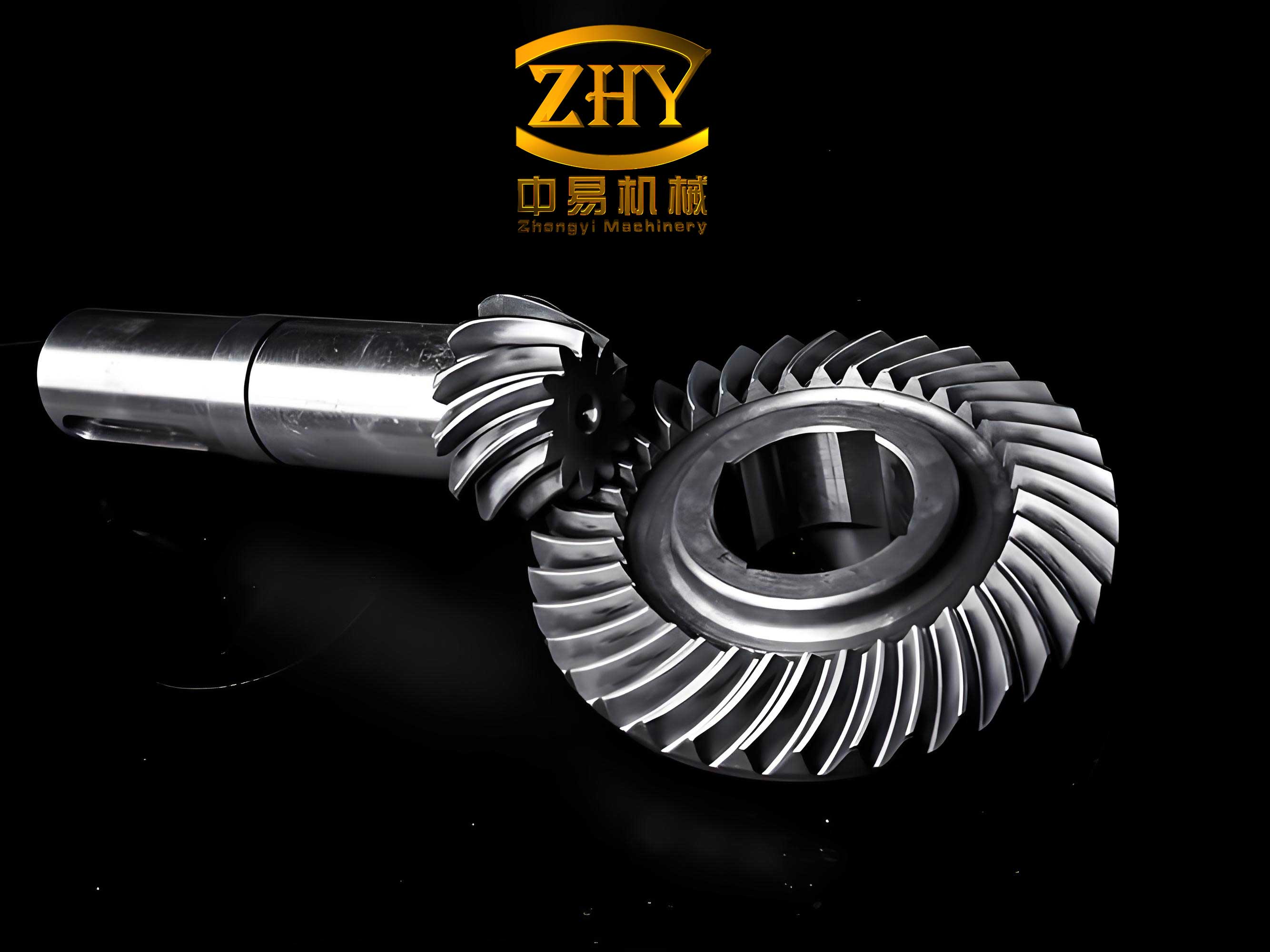
The core principle involves generating a pinion tooth surface that is conjugate to the gear member under a predefined parabolic function of transmission error. The desired localized point contact with a controlled path is then achieved through a systematic modification process applied to this conjugate surface. The corresponding machine-tool settings for manufacturing the designed pinion are solved via an optimization algorithm, making the design practically realizable.
Fundamental Theory and Pinion Generation
Preset Parabolic Transmission Error
Transmission error (TE) is defined as the deviation of the actual angular position of the driven gear from its theoretical position for a given rotation of the driving pinion. A symmetric parabolic function is preset to ensure smooth meshing and low vibration. Let $T_z = 2\pi / z_1$ be the meshing cycle, where $z_1$ is the pinion tooth number. The TE, $\Delta \phi_2$, as a function of pinion rotation angle $\phi_1$, is given by:
$$ \Delta \phi_2 = -\Delta_{TE} \frac{z_1^2}{\pi^2} (\phi_1 – \phi_1^{(0)})^2 $$
where $\Delta_{TE}$ is the peak-to-peak transmission error at the pitch point, and $\phi_1^{(0)}$ is the initial pinion angle. From the definition of TE, the functional relationship between the gear rotation angle $\phi_2$ and the pinion rotation angle $\phi_1$ is derived:
$$ \phi_2 = \phi_2^{(0)} + m_{21}(\phi_1 – \phi_1^{(0)}) – \Delta_{TE} \frac{z_1^2}{\pi^2} (\phi_1 – \phi_1^{(0)})^2 $$
where $m_{21} = z_1 / z_2$ is the inverse gear ratio, and $z_2$ is the gear tooth number.
Generation of Auxiliary Pinion Tooth Surface
The gear tooth surface $\Sigma_2$, generated with known cutter geometry and machine settings, serves as a imaginary generating tool. A conjugate pinion surface $\Sigma_1’$, which is in line contact with $\Sigma_2$ under the prescribed kinematic law from Eq. (2), is generated. This surface is termed the auxiliary pinion tooth surface. Using homogeneous coordinate transformations, the position vector $\mathbf{r}_1’$ and unit normal vector $\mathbf{n}_1’$ of a point on $\Sigma_1’$ in the pinion coordinate system are:
$$
\mathbf{r}_1′ = \mathbf{M}_{1h}(\phi_1) \mathbf{M}_{h2}(\phi_2) \mathbf{r}_2, \quad \mathbf{n}_1′ = \mathbf{L}_{1h}(\phi_1) \mathbf{L}_{h2}(\phi_2) \mathbf{n}_2
$$
subject to the equation of meshing $f_{12}(\theta_g, \psi_g, \phi_1)=0$. Here, $\mathbf{M}_{ij}$ and $\mathbf{L}_{ij}$ are the coordinate transformation matrices and their $3\times3$ rotational sub-matrices, respectively, $\theta_g$ is the cutter rotation angle, and $\psi_g$ is the cradle angle.
Design of Target Pinion Tooth Surface
Contact Path Along Tooth Length
The primary innovation is designing the contact path $\Gamma$ as a straight line oriented along the tooth length direction. This orientation directly maximizes the potential contact ratio, which becomes primarily a function of face width rather than tooth height. The path can be aligned along the pitch line or, preferably, offset to the middle of the tooth flank to optimize load distribution and avoid edge contact under light loads. The path is defined in the plane of the gear back-cone development.
Let $R_i$ and $R_e$ be the inner and outer cone distances of the pinion, $\delta_1$ the pinion pitch angle, and $\Delta y$ the offset from the pitch line. The coordinates of the start (A) and end (B) points of the contact path are $(R_i \cos\delta_1 + \Delta y \sin\delta_1, \quad R_i \sin\delta_1 + \Delta y \cos\delta_1)$ and $(R_e \cos\delta_1 + \Delta y \sin\delta_1, \quad R_e \sin\delta_1 + \Delta y \cos\delta_1)$, respectively. By solving the system of equations that positions a contact point from the auxiliary surface at these coordinates, the corresponding pinion roll angles $\phi_{1A}$ and $\phi_{1B}$ are determined. The theoretical design contact ratio $\varepsilon_r$ is then:
$$ \varepsilon_r = \frac{|\phi_{1B} – \phi_{1A}|}{T_z} $$
Tooth Surface Modification for Localized Contact
The auxiliary surface $\Sigma_1’$ provides line contact. To achieve a controlled elliptical contact pattern (point contact) under load, a modification is applied. For a given instant of meshing (fixed $\phi_1^i$), the instantaneous contact line $L_i$ on $\Sigma_1’$ intersects the preset path $\Gamma$ at point $P$. In the tangent plane at $P$, points $P_1, P_2$ on $L_i$ are projected onto the plane. The modification $\zeta_i$ at these points follows a parabolic function based on the distance $d$ from the projection to $P$:
$$ \zeta_i = \frac{\delta}{a^2} d^2 $$
where $a$ is the semi-major axis of the desired contact ellipse, and $\delta$ is the total normal approach (elastic deformation) of the contacting surfaces under a light load, typically taken as an empirical value (e.g., 0.00635 mm).
The auxiliary pinion surface is discretized into a grid of $m \times n$ points. For each grid point $i$ with position vector $\mathbf{p}_i’$ and unit normal $\mathbf{n}_i’$, the modification $\zeta_i$ is calculated and superimposed to obtain the target pinion tooth surface $\Sigma_1^*$:
$$ \mathbf{p}_i^* = \mathbf{p}_i’ + \zeta_i \mathbf{n}_i’, \quad i=1,2,…,k $$
Inverse Calculation of Machine-Tool Settings
Given an initial set of pinion machine settings (cutter geometry and kinematic parameters), the theoretical manufactured pinion surface $\Sigma_1$ can be calculated. The objective is to find the set of machine settings $\mathbf{d}$ that minimize the deviation between $\Sigma_1$ and the designed target surface $\Sigma_1^*$.
Let $\mathbf{p}_i$ and $\mathbf{n}_i$ be the position and unit normal of a point on $\Sigma_1$ corresponding to the $i$-th grid point of the target surface. The normal deviation $h_i$ is:
$$ h_i(\mathbf{d}) = (\mathbf{p}_i^* – \mathbf{p}_i) \cdot \mathbf{n}_i $$
The optimization problem is formulated as a nonlinear least-squares minimization:
$$
\min f(\mathbf{d}) = \sum_{i=1}^{k} [h_i(\mathbf{d})]^2, \quad \text{subject to} \quad \mathbf{d} \in [\boldsymbol{\chi}_1, \boldsymbol{\chi}_2]
$$
where $\boldsymbol{\chi}_1$ and $\boldsymbol{\chi}_2$ define the feasible bounds for the machine settings $\mathbf{d}$ (e.g., cutter profile angle $\alpha_1$, cutter radius $R_c$, radial setting $S_{r1}$, machine root angle $\gamma_m$, and higher-order correction coefficients). Due to the high nonlinearity and multi-modal nature of this problem, a genetic algorithm (GA) is employed to robustly search for the optimal solution, ensuring the manufacturability of the designed spiral bevel gear.
Numerical Example and Performance Analysis
A spiral bevel gear pair is designed using the proposed method. Key geometric parameters are listed below.
| Parameter | Pinion | Gear |
|---|---|---|
| Number of Teeth | 23 | 65 |
| Module (mm) | 3.9 | 3.9 |
| Normal Pressure Angle (°) | 25 | 25 |
| Mean Spiral Angle (°) | 35 | 35 |
| Hand of Spiral | Right | Left |
| Shaft Angle (°) | 90.0 | 90.0 |
| Face Width (mm) | 37 | 37 |
The preset parabolic transmission error has a peak-to-peak value $\Delta_{TE} = 0.00278^\circ$. The contact path is set along the mid-line of the tooth flank ($\Delta y \neq 0$). The optimized machine settings for the pinion concave side are determined via the GA. The design contact ratio achieved is $\varepsilon_r = 2.8242$, a significant increase from a traditional design which yielded $\varepsilon_r = 2.3159$ for the same basic geometry.
Tooth Contact Analysis (TCA) Results
Tooth Contact Analysis is performed to simulate the meshing of the gear pair under no-load conditions. The results for two design philosophies are compared: 1) Contact path along the pitch line, and 2) Contact path along the tooth flank mid-line.
The analysis confirms that the contact pattern is successfully oriented along the tooth length. The transmission error curve matches the preset symmetric parabolic function. The design with the path along the mid-line positions the contact ellipse centrally on the flank, which is advantageous for avoiding edge contact under load and for tolerating assembly errors. The surface deviation map shows the intentional modification applied to the fully conjugate auxiliary surface to obtain the prescribed point contact.
Relative Sliding Velocity
The relative sliding velocity between meshing tooth surfaces is a critical factor influencing friction, wear, and scuffing resistance. For a contact path along the pitch line, the sliding velocity is theoretically minimal but may change direction. For the path along the tooth flank mid-line, the sliding velocity is higher but remains unidirectional across the entire meshing cycle, which can be beneficial for establishing a consistent lubrication film. The velocity magnitude is influenced by the spiral angle and the amount of profile modification.
Influence of Mean Spiral Angle
The mean spiral angle $\beta_m$ profoundly affects the performance of this design. TCA was conducted for gear pairs with $\beta_m$ values of 25°, 30°, 35°, and 40°.
| Mean Spiral Angle $\beta_m$ (°) | Design Contact Ratio $\varepsilon_r$ | Contact Pattern Orientation | Relative Sliding Trend |
|---|---|---|---|
| 25 | 1.8684 | More diagonal may be needed | Lower |
| 30 | 2.3273 | Feasible along length | Moderate |
| 35 | 2.8242 | Well-suited along length | Moderate |
| 40 | 3.2261 | Strongly along length | Higher |
The results indicate that for spiral angles above approximately 30°, the along-length contact path design is highly effective, yielding a large contact ratio. For smaller spiral angles, a slight diagonal orientation of the contact path ($\Delta \neq 0$) might be necessary to achieve a sufficient contact ratio and avoid a narrow, highly stressed contact pattern, though this increases sliding velocity at the tooth tips and roots.
Sensitivity to Assembly Errors
The sensitivity of the contact pattern to typical assembly errors—axial misalignments of pinion ($\Delta A_1$) and gear ($\Delta A_2$), offset error ($\Delta E$), and shaft angle error ($\Delta \Sigma$)—was investigated. A key advantage of the along-length contact path design is its predictable behavior under misalignment: the contact pattern primarily shifts along the tooth height direction (towards the toe or heel) rather than developing a severe diagonal (edge-to-edge) orientation. This characteristic helps prevent premature edge contact under moderate errors. The sensitivity ranking, from highest to lowest, is typically: shaft angle error $\Delta \Sigma$, offset error $\Delta E$, gear axial error $\Delta A_2$, and pinion axial error $\Delta A_1$.
Conclusion
A comprehensive methodology for the design and analysis of high-contact-ratio spiral bevel gears has been developed. By presetting a symmetric parabolic transmission error and strategically designing the contact path to follow the tooth length direction, a substantial increase in the contact ratio is achieved, which is primarily governed by the face width. The auxiliary pinion tooth surface, conjugate to the gear under the prescribed motion, is subsequently modified to obtain a localized contact pattern with desired dimensions.
Key findings from the analysis include:
- Aligning the contact path along the tooth flank mid-line, rather than the pitch line, provides better load distribution and margin against edge contact, especially under light loads or with assembly errors.
- The along-length design inherently avoids the pronounced “inner diagonal” contact, leading to more favorable and unidirectional sliding velocities, which can benefit lubrication and reduce the risk of scoring.
- The spiral bevel gear’s mean spiral angle is a critical design parameter. For angles greater than about 30°, the along-path design is ideal. For lower angles, a controlled diagonal path may be used to boost the contact ratio, albeit with increased sliding at the tooth extremities.
- The proposed design exhibits manageable sensitivity to assembly errors, with the contact pattern shifting predominantly along the tooth height, maintaining a robust and non-edge-contacting condition within specified tolerance ranges.
This methodology, integrating preset kinematics, controlled surface modification, and inverse optimization for manufacturing, provides a powerful tool for designing advanced spiral bevel gears that meet the demands for high strength, low noise, and smooth operation in modern power transmission systems.