
In the field of mechanical transmission, spiral bevel gears play a critical role due to their ability to transmit power efficiently between intersecting shafts at various angles. These components are extensively utilized in demanding applications such as automotive differentials, aerospace systems, marine propulsion, and precision machine tools. To enhance durability and performance, spiral bevel gears typically undergo heat treatment processes like carburizing or induction hardening, which achieve surface hardness levels of HRC 57–63. However, heat treatment inevitably introduces distortions and deformations in the gear tooth surfaces, leading to deviations from the originally machined geometry and compromising accuracy. Consequently, finishing processes are essential to rectify these distortions, improve surface integrity, reduce noise, and ensure optimal meshing characteristics. This review comprehensively analyzes the principles, characteristics, and applications of various finishing methods for spiral bevel gears, emphasizing advancements in technology and emerging trends. We will explore traditional techniques like honing, hard skiving, grinding, and lapping, as well as innovative approaches such as dry cutting and roll forming, while incorporating mathematical models and comparative tables to summarize key aspects.
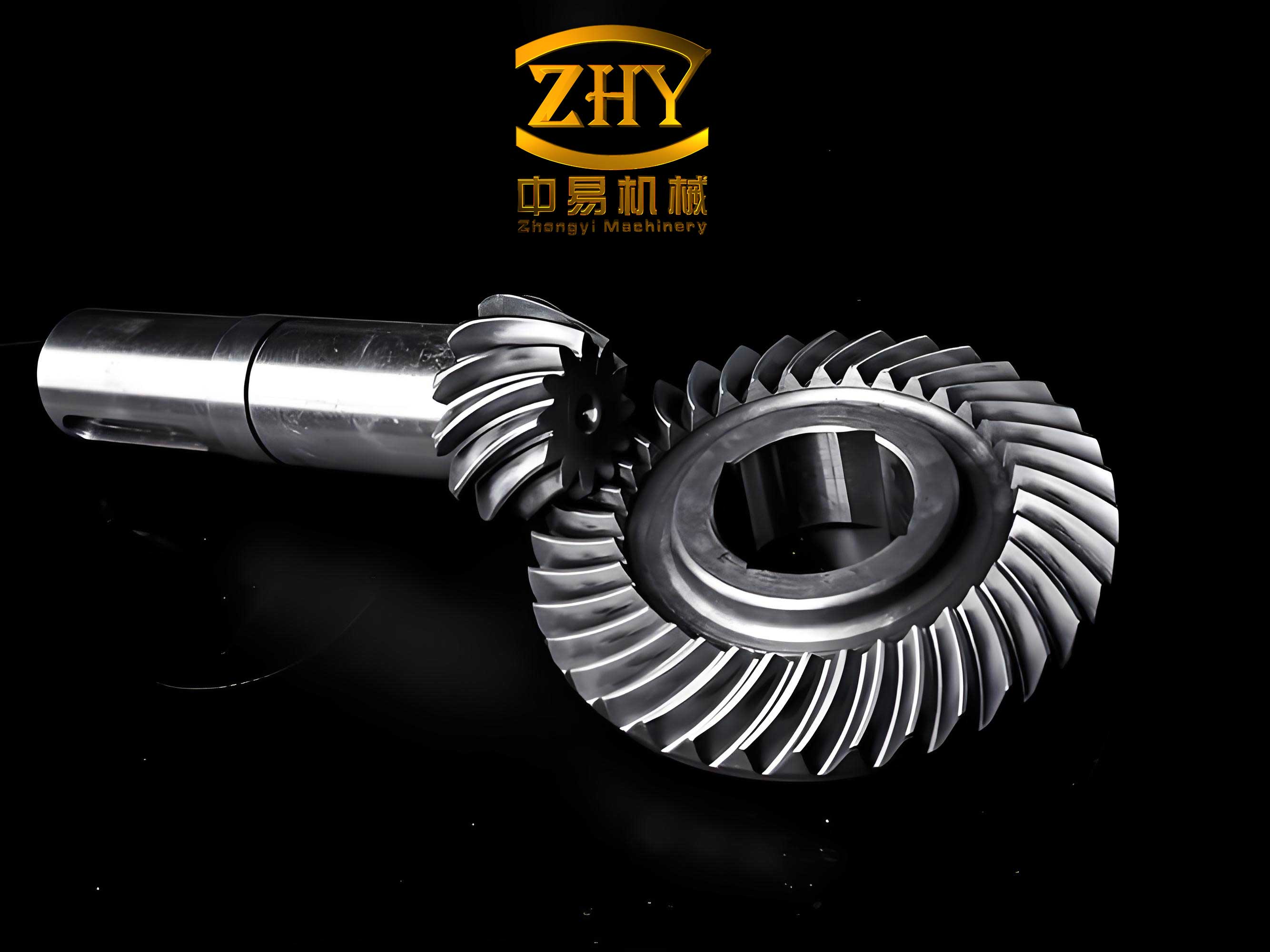
The necessity for finishing spiral bevel gears stems from the inherent challenges posed by post-heat-treatment deformation. During thermal cycles, residual stresses and microstructural changes cause tooth profile errors, pitch deviations, and surface roughness alterations, which can lead to increased vibration, noise, and premature failure in service. Therefore, implementing precise finishing operations is crucial to restore geometric accuracy and enhance functional performance. Over the years, numerous methods have been developed, each with distinct mechanisms and suitability for specific gear types, sizes, and production volumes. In this review, we delve into these processes from a first-person perspective, drawing on industrial and research experiences to provide a detailed exposition. We will also highlight the integration of numerical control (NC) technology and ultrasonic assistance, which have revolutionized the efficiency and quality of spiral bevel gear finishing.
Fundamentals of Spiral Bevel Gear Finishing
Before exploring individual methods, it is essential to understand the basic geometry and kinematics of spiral bevel gears. These gears have curved teeth that are oblique to the gear axis, allowing for smooth and gradual engagement. The tooth surface is typically generated using a hypoid or bevel gear generator, where a cutting tool mimics the motion of a virtual generating gear (often referred to as the “crown gear” or “planar gear”). The mathematical representation of the tooth surface can be derived from conjugate action principles. For instance, the equation of meshing between the tool and gear workpiece can be expressed as:
$$ \mathbf{n} \cdot \mathbf{v} = 0 $$
where \(\mathbf{n}\) is the normal vector to the tool surface at the contact point, and \(\mathbf{v}\) is the relative velocity vector between the tool and workpiece. This equation ensures continuous tangency during generation. After heat treatment, deviations from this ideal surface necessitate finishing. The total distortion \(\Delta S\) can be modeled as a function of material properties and thermal parameters:
$$ \Delta S = f(\alpha, \Delta T, E, \sigma_y) $$
Here, \(\alpha\) is the coefficient of thermal expansion, \(\Delta T\) is the temperature gradient, \(E\) is Young’s modulus, and \(\sigma_y\) is the yield strength. Finishing processes aim to remove a thin layer of material \(\delta\) to correct \(\Delta S\), typically in the range of 0.01–0.1 mm, depending on the method.
Honing of Spiral Bevel Gears
Gear honing is a abrasive-based finishing process used to refine the tooth surfaces of spiral bevel gears after heat treatment. The principle involves using a honing wheel, which is essentially a gear-shaped tool coated with abrasive particles (e.g., cubic boron nitride or diamond), meshing with the workpiece gear in a crossed-axis configuration. As shown in the schematic, the honing wheel axis \(a_H\) and the gear axis \(a_G\) are positioned at a slight angle, creating a hypoid relationship that generates sliding motion at the tooth contact. This sliding action, combined with applied honing pressure, enables the abrasive grains to micro-cut the surface, removing distortion and improving roughness.
The effectiveness of honing spiral bevel gears depends on several parameters, including honing speed, pressure, abrasive grit size, and lubrication. The material removal rate \(MRR_h\) can be approximated by:
$$ MRR_h = K_h \cdot v_s \cdot F_n \cdot t $$
where \(K_h\) is a honing constant dependent on abrasive and material, \(v_s\) is the sliding velocity, \(F_n\) is the normal force, and \(t\) is the time. Honing is particularly beneficial for reducing noise and enhancing surface finish, often achieving roughness values as low as \(R_a = 0.4 \mu m\). However, challenges include the difficulty in manufacturing and dressing the honing wheel, as well as limited corrective capability for large errors. Table 1 summarizes the key characteristics of honing for spiral bevel gears.
| Parameter | Typical Range | Influence on Process |
|---|---|---|
| Abrasive Type | CBN, Diamond | Determines cutting efficiency and wear resistance |
| Grit Size | 80–400 mesh | Affects surface roughness and material removal rate |
| Sliding Velocity | 1–5 m/s | Higher speeds increase MRR but may cause heating |
| Honing Pressure | 0.5–2 MPa | Directly impacts stock removal and surface integrity |
| Application Scope | Medium-precision gears, noise reduction | Suitable for batch production with moderate distortions |
Hard Skiving of Spiral Bevel Gears
Hard skiving, also known as hard gear cutting or precision hard turning, is a machining process that employs a rigid cutting tool to remove small amounts of material from hardened spiral bevel gears. Unlike honing, which uses abrasives, skiving utilizes a defined cutting edge on a skiving tool, often made of polycrystalline cubic boron nitride (PCBN) or advanced ceramics. The tool geometry mimics that of a generating gear, and the process is performed on specialized machines that control the relative motion between tool and workpiece.
The skiving process for spiral bevel gears is analogous to the generating principle used in soft cutting, but with adaptations for hard materials. The tool follows a path that replicates the virtual generating gear, ensuring conjugate action. The depth of cut \(\delta_s\) is typically very small, ranging from 0.02 to 0.1 mm, to minimize tool forces and maintain accuracy. The cutting force \(F_c\) can be estimated using:
$$ F_c = K_s \cdot a_p \cdot f \cdot v_c^{-m} $$
where \(K_s\) is a material-specific constant, \(a_p\) is the depth of cut, \(f\) is the feed rate, \(v_c\) is the cutting speed, and \(m\) is an exponent (usually around 0.2–0.3). Hard skiving offers advantages such as excellent surface finish (down to \(R_a = 0.8 \mu m\)), improved dimensional accuracy, and favorable residual stress profiles. However, it requires high-stiffness machine tools and precise tool alignment, making it more suitable for high-value applications like aerospace spiral bevel gears.
Grinding of Spiral Bevel Gears
Grinding is a predominant finishing method for high-precision spiral bevel gears, especially those requiring tight tolerances after heat treatment. It involves using an abrasive wheel to remove material through a combination of cutting and rubbing actions. Various grinding techniques have been developed, each tailored to specific gear geometries and production needs. The primary goal is to eliminate distortions while achieving superior surface quality and gear accuracy.
Cup Wheel Grinding
Traditional cup wheel grinding employs a grinding wheel shaped like a cup, with its working surface corresponding to the profile of the virtual generating gear teeth. The wheel rotates about its axis \(o_1o_2\) and moves relative to the gear workpiece in a generating motion. This method is effective for spiral bevel gears with pitch cone angles less than 50°. The grinding process can be modeled using the equation of meshing, with the wheel surface represented parametrically. For instance, the wheel surface \(\mathbf{S}_w(u,v)\) in coordinate system \(O_w\) is given by:
$$ \mathbf{S}_w(u,v) = \begin{bmatrix} x_w(u,v) \\ y_w(u,v) \\ z_w(u,v) \end{bmatrix} $$
where \(u\) and \(v\) are parameters. The contact condition with the gear tooth surface \(\mathbf{S}_g\) ensures precise material removal. However, cup wheel grinding may lead to thermal damage (burning) due to poor coolant access, especially in deep tooth spaces.
Flared Cup Wheel Grinding
To address limitations in cooling, flared cup wheel grinding uses a wheel with a 30° conical flared edge. This design creates a gap between the wheel and tooth surface along most of the contact line, allowing coolant to penetrate effectively and reduce thermal loads. The wheel rotates about axis \(o_1o_3\) while oscillating about \(o_1o_2\) to sweep the entire tooth slot. This technique is suitable for spiral bevel gears with pitch cone angles greater than 50°, such as those used in heavy-duty vehicles. The material removal rate \(MRR_g\) in flared grinding can be expressed as:
$$ MRR_g = \frac{\pi D_w b_w v_f a_e}{1000} $$
where \(D_w\) is the wheel diameter, \(b_w\) is the wheel width, \(v_f\) is the feed rate, and \(a_e\) is the radial depth of cut. Flared grinding enhances productivity and surface integrity, but the specialized wheels are costly.
Waguri Mechanism Grinding
The Waguri mechanism incorporates an eccentric spindle that imparts a slight orbital motion to the grinding wheel. As the wheel feeds axially into the tooth space, it alternately grinds the convex and concave flanks along the tooth length. The eccentricity, typically around 0.1 mm, provides clearance for coolant and chip evacuation, preventing burning and enabling high metal removal rates. The motion trajectory can be described by:
$$ \Delta x = e \cos(\omega t), \quad \Delta y = e \sin(\omega t) $$
with \(e\) as eccentricity and \(\omega\) as angular speed. Waguri grinding is advantageous for its ability to use standard cup wheels, but it requires complex machine kinematics. Table 2 compares these grinding methods for spiral bevel gears.
| Method | Wheel Type | Applicable Pitch Cone Angle | Advantages | Limitations |
|---|---|---|---|---|
| Cup Wheel Grinding | Standard cup wheel | < 50° | Simple setup, good accuracy | Risk of thermal damage, poor coolant access |
| Flared Cup Wheel Grinding | Flared cup wheel | > 50° | Effective cooling, high productivity | Expensive wheels, complex dressing |
| Waguri Grinding | Standard cup wheel | All angles | No burning, high MRR, uses standard wheels | Complex machine structure, higher cost |
Lapping of Spiral Bevel Gears
Lapping is a finishing process that involves running a pair of spiral bevel gears in mesh with an abrasive compound (lapping paste) applied between the teeth. The relative motion causes fine abrasive particles to micro-cut the surfaces, improving contact pattern and reducing noise. Traditional lapping is a slow process due to the pure rolling near the pitch line, which limits abrasive action, and excessive sliding at the tip and root, which can lead to uneven wear.
To enhance lapping efficiency, ultrasonic-assisted lapping has been introduced. In this method, ultrasonic vibrations are applied to one gear (typically the pinion) using a transducer and booster, inducing high-frequency oscillations in the tangential and normal directions. This vibratory motion energizes the abrasive particles, increasing the material removal rate. The ultrasonic lapping setup can be modeled with a forced vibration equation:
$$ m \ddot{x} + c \dot{x} + k x = F_0 \sin(2\pi f t) $$
where \(m\) is the effective mass, \(c\) is damping, \(k\) is stiffness, \(F_0\) is the excitation force, and \(f\) is the ultrasonic frequency (usually 20–40 kHz). Experiments show that ultrasonic lapping can triple the material removal rate compared to conventional lapping and achieve surface roughness as low as \(R_a = 0.2 \mu m\). Additionally, a braking torque applied to the mating gear ensures proper contact pressure. This advancement makes lapping more viable for high-precision spiral bevel gears in applications like wind turbines and robotics.
UMC and UMG Grinding Technologies
The Universal Motion Concept (UMC) and its extension, Universal Motion Grinding (UMG), represent state-of-the-art CNC-based grinding technologies developed by companies like Gleason for spiral bevel gears. These systems integrate multi-axis numerical control to manipulate the grinding wheel and workpiece with high flexibility, enabling precise correction of tooth geometry errors. The UMC approach involves four primary motions: vertical, radial, spiral, and ratio roll, each controlled by NC axes (typically 6-axis systems) that allow dynamic adjustments from zeroth- to fourth-order parameters.
Mathematically, the machine kinematics can be described by a transformation matrix that relates the wheel coordinates to the gear coordinates. For a 6-axis machine, the position and orientation of the wheel \(\mathbf{T}_w\) relative to the gear \(\mathbf{T}_g\) are given by:
$$ \mathbf{T}_g = \mathbf{T}_{base} \cdot \mathbf{R}_x(\theta_1) \cdot \mathbf{R}_y(\theta_2) \cdot \mathbf{R}_z(\theta_3) \cdot \mathbf{T}_{trans}(x,y,z) \cdot \mathbf{T}_w $$
where \(\mathbf{R}\) are rotation matrices and \(\mathbf{T}_{trans}\) is a translation matrix. This allows for real-time modifications to compensate for distortions and optimize tooth contact. UMG technology further enhances this by integrating adaptive grinding parameters, such as variable wheel speed and feed, based on in-process measurements. The benefits include elimination of post-grinding lapping, reduced assembly errors, and improved economic efficiency for mass production of spiral bevel gears. For instance, cycle times for grinding spiral bevel gears with UMG can be comparable to cutting times, making it attractive for automotive transmissions.
New Processing Methods for Spiral Bevel Gears
In response to trends toward sustainability and efficiency, novel finishing methods for spiral bevel gears have emerged. These approaches aim to reduce environmental impact, increase productivity, or enable new design possibilities.
Dry Cutting of Spiral Bevel Gars
Dry cutting eliminates the use of cutting fluids, aligning with green manufacturing initiatives. For spiral bevel gears, dry cutting is particularly advantageous in generating processes where high speeds and efficient chip evacuation are possible. The implementation requires specialized machine tools with high-speed spindles, effective thermal management, and quick chip removal systems. Tool materials must exhibit high hot hardness, thermal toughness, wear resistance, and anti-adhesion properties, such as coated carbides or ceramics.
The cutting parameters in dry machining of spiral bevel gears need careful optimization to avoid excessive heat and tool wear. A model for tool life \(T\) in dry cutting can be expressed as:
$$ T = C \cdot v_c^{-p} \cdot f^{-q} \cdot a_p^{-r} $$
where \(C\) is a constant, \(v_c\), \(f\), and \(a_p\) are cutting speed, feed, and depth of cut, and \(p, q, r\) are exponents determined experimentally. Dry cutting reduces waste disposal costs and health hazards, but it demands rigorous control of workpiece hardness and process stability. It is gaining attention for finishing spiral bevel gears in electric vehicles and aerospace applications.
Roll Forming of Spiral Bevel Gears
Roll forming, or gear rolling, is a chipless finishing process where a hardened roll die (with the inverse tooth profile) is pressed against a pre-formed gear blank to plastically deform the surface and achieve final dimensions. For spiral bevel gears, this method is suitable for small modules (e.g., below 2 mm) where the gear teeth can be directly rolled. For larger modules, a two-step approach is used: pre-forging near-net shape followed by precision rolling.
The roll forming process for spiral bevel gears involves complex three-dimensional material flow. The effective strain \(\bar{\epsilon}\) can be estimated using:
$$ \bar{\epsilon} = \ln\left(\frac{h_0}{h_f}\right) $$
where \(h_0\) and \(h_f\) are initial and final tooth thicknesses. Roll forming offers benefits like improved surface finish, work hardening, and high production rates, but it requires precise die design and is limited to ductile materials. It holds potential for mass-produced spiral bevel gears in consumer electronics and light machinery.
Conclusion
In this comprehensive review, we have examined the various finishing processes for spiral bevel gears, focusing on their principles, applications, and advancements. Starting with the need to correct post-heat-treatment distortions, we discussed traditional methods like honing, hard skiving, grinding, and lapping, each offering unique advantages in terms of accuracy, surface quality, and efficiency. The integration of technologies such as ultrasonic vibration and multi-axis CNC grinding (e.g., UMC/UMG) has significantly enhanced the capabilities of these processes, enabling higher precision and productivity. Furthermore, emerging methods like dry cutting and roll forming present promising directions for sustainable and cost-effective manufacturing of spiral bevel gears.
The future of spiral bevel gear finishing lies in the continued development of adaptive, intelligent systems that combine real-time monitoring, artificial intelligence, and advanced materials. For instance, machine learning algorithms could optimize grinding parameters based on distortion patterns, while novel abrasive composites might extend tool life in dry environments. As demand grows for high-performance gears in electric vehicles, renewable energy, and robotics, these innovations will be crucial. Ultimately, selecting the appropriate finishing method depends on factors such as gear geometry, material, production volume, and required tolerances. By understanding the characteristics summarized in this review, engineers can make informed decisions to achieve optimal performance and reliability for spiral bevel gears in diverse applications.