
In my experience designing and analyzing power transmission systems, the spiral bevel gear stands out as a critical component for applications demanding high torque and smooth motion transfer under heavy loads, such as in mining, aerospace, and automotive differentials. The superior performance of the spiral bevel gear compared to straight bevel or parallel axis gears stems from its gradual tooth engagement and increased contact ratio. However, this performance is heavily contingent upon the quality of the tooth contact pattern, which is the localized area of physical contact between the mating tooth flanks under load. Achieving the ideal contact pattern is the central challenge in manufacturing spiral bevel gears, especially when employing the widely used face-hobbing or face-milling processes based on the *flat crown gear* or *plane crown gear* principle. This method simplifies machine-tool kinematics but inherently introduces deviations in the generated tooth surfaces, leading to contact pattern errors that directly impact noise, load capacity, and longevity. This article delves into a first-principle analysis of these errors, their root causes in the manufacturing setup, and the systematic correction methodologies necessary for optimal spiral bevel gear performance.
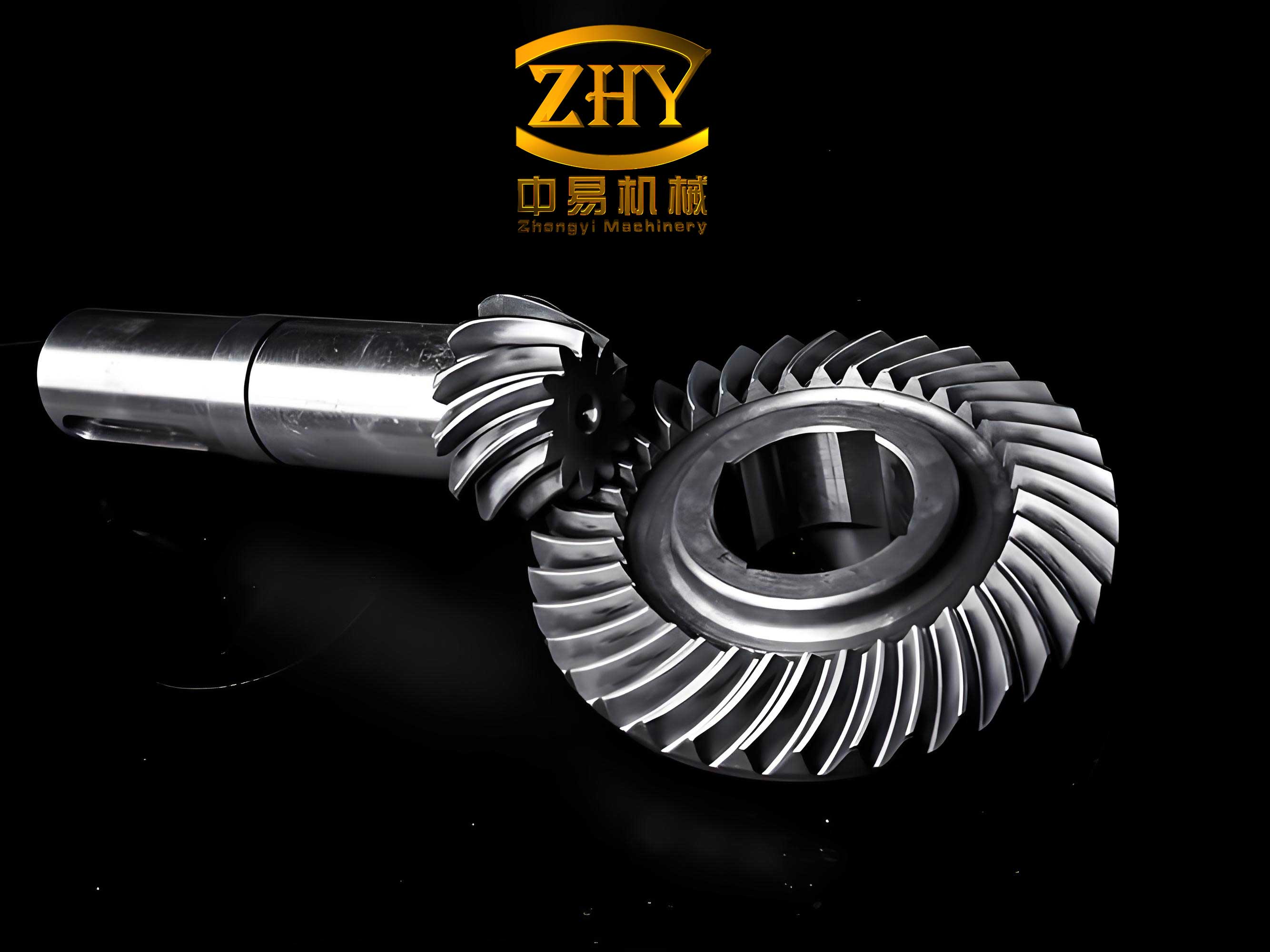
The fundamental goal in spiral bevel gear design is to achieve a controlled and favorable localization of contact. The ideal tooth contact pattern is elliptical or oval-shaped, located centrally on the tooth flank but slightly biased towards the toe (inner end) under no-load or light test conditions. This positioning accounts for predictable deflections and thermal expansion during operation, allowing the pattern to shift towards the center under full load. The ideal dimensions are typically defined as a percentage of the face width and tooth depth.
| Parameter | Ideal Specification (Light/Medium Load) | Ideal Specification (Heavy Load) |
|---|---|---|
| Contact Length | 50-70% of face width | 40-60% of face width |
| Contact Height | 50-70% of tooth depth | 50-70% of tooth depth |
| Location (Lengthwise) | Centered to slightly towards toe | Centered to slightly towards toe |
| Location (Profilewise) | Centered on active profile | Centered on active profile |
Deviations from this ideal pattern are symptoms of mismatched tooth surface geometries. When machining a spiral bevel gear pair using the flat crown gear method, the cradle-type machine simulates the rolling of the work gear with a theoretical generating gear. The cutting tool (a circular cutter head with multiple inserted blades) represents the teeth of this generating gear. The primary source of error arises because the root cone of the work gear is set parallel to the cutter head plane, not the pitch cone. This misalignment, equal to the root angle, causes the cutter head’s generating surface to deviate from the true conjugate surface, leading to systematic errors in tooth geometry. These errors manifest distinctly in the contact pattern.
The first major category is Error in the Profile (Tooth Depth) Direction. This error appears as a contact band that is too high (near the tip) or too low (near the root) on the tooth flank. The root cause is a mismatch between the working pressure angles of the mating pinion and gear flanks. The local pressure angle on the tooth profile is a function of the cutter blade profile and the machine setup. If the actual pressure angle on the pinion convex flank ($\alpha_{convex}^{act}$) is greater than the theoretical design pressure angle ($\alpha_0$), and the pressure angle on the gear concave flank ($\alpha_{concave}^{act}$) is correspondingly less than $\alpha_0$, the contact will shift towards the pinion root and gear tip. The governing relationship can be visualized as a deviation from the theoretical conjugate contact line.
| Contact Pattern Symptom | Pressure Angle Condition | Correction Principle |
|---|---|---|
| Contact on Pinion Root / Gear Tip | $\alpha_{convex}^{act} > \alpha_0$; $\alpha_{concave}^{act} < \alpha_0$ | Decrease pinion convex pressure angle. Increase gear concave pressure angle. |
| Contact on Pinion Tip / Gear Root | $\alpha_{convex}^{act} < \alpha_0$; $\alpha_{concave}^{act} > \alpha_0$ | Increase pinion convex pressure angle. Decrease gear concave pressure angle. |
In practice, this is corrected by adjusting the machine settings known as “cutter tilt” or “swivel” for fixed-setting methods, or by modifying the blade profile geometry in higher-end CNC methods. The adjustment alters the effective generating surface, bringing the local pressure angles into equality and centering the contact pattern in the profile direction.
The second critical error concerns the Length and Longitudinal Curvature of the Contact Pattern. A pattern that is too short or too long indicates an improper mismatch in the longitudinal curvature (lengthwise curvature) of the two mating tooth surfaces. The spiral bevel gear tooth is characterized by a curved lengthwise trace, often a circular arc. The radii of curvature of the pinion and gear tooth traces must have a specific, controlled difference (the “mismatch”) to produce an elliptical contact patch of desired size under load. If the mismatch is too large, the contact ellipse shrinks, resulting in a short, highly concentrated pattern prone to high contact stress. If the mismatch is too small or negative, the contact area becomes excessively long, potentially spanning the entire face width, which can lead to edge loading and sensitivity to misalignment.
The length of the semi-major axis of the contact ellipse ($a$) is governed by the relative curvature. A simplified expression relating it to the normal load ($F_n$), the effective modulus of elasticity ($E’$), the sum of curvatures ($\sum \rho$), and the mismatch in curvatures ($\Delta \rho_{long}$) is derived from Hertzian contact theory:
$$ a \propto \left( \frac{F_n}{E’ \cdot \Delta \rho_{long}} \right)^{1/3} $$
where a larger $\Delta \rho_{long}$ yields a smaller contact ellipse. Correcting this involves adjusting the machine setting that controls the “spiral angle” or the “tilt” of the cutter head relative to the root cone, which directly modifies the longitudinal curvature of the generated tooth surface of the spiral bevel gear.
The third fundamental error is Bias Along the Face Width (Toe-Heel Error). This is observed as a contact pattern consistently biased towards the toe (small end) or the heel (large end) on both members. The primary cause is a discrepancy between the mean spiral angles of the pinion ($\beta_{m1}$) and the gear ($\beta_{m2}$). The spiral angle at the mean point of the tooth trace is a critical design parameter. If $\beta_{m2} < \beta_{m1}$, the contact on the drive side (typically pinion convex/gear concave) will shift towards the toe. Conversely, if $\beta_{m2} > \beta_{m1}$, the contact shifts towards the heel.
The relationship can be understood through the kinematics of engagement: equal spiral angles ensure the velocity vectors align correctly at the mean point for pure rolling. A difference causes a sliding velocity component that displaces the zone of contact. The correction is achieved by adjusting the “machine root angle” or the “cradle angle” setting, which effectively rotates the tooth trace about its center, altering the mean spiral angle of the spiral bevel gear being cut until equality ($\beta_{m1} = \beta_{m2}$) is achieved.
The most complex and common error in spiral bevel gears is Diagonal Contact Pattern. This manifests as an elliptical contact band that runs diagonally across the tooth face, for example, from the heel-tip corner to the toe-root corner. This error is a torsional distortion of the contact pattern and indicates that the mismatch between the mating surfaces is not uniform across the face width. It arises because the condition of conjugate action is violated not just at the mean point, but in a graduated manner along the tooth. The root cause is often an incorrect combination of machine settings—specifically, an improper interaction between the parameters controlling profile curvature (pressure angle) and longitudinal curvature (spiral angle). The diagonal is quantified by its direction and slope.
| Diagonal Type | Direction (Pinion Convex Flank) | Typical Cause (Machine Setting Interaction) |
|---|---|---|
| Heel to Toe | From Heel/Tip to Toe/Root | Excessive mismatch between cutter head radius and mean spiral angle. |
| Toe to Heel | From Toe/Tip to Heel/Root | Insufficient mismatch between cutter head radius and mean spiral angle. |
Correcting a diagonal pattern requires a compound adjustment, often a simultaneous change to the cutter head tilt (swivel) and the horizontal machine setting (e.g., Modified Roll ratio). Modern CNC spiral bevel gear generators use sophisticated software to calculate these compensating adjustments automatically based on trial cut results.
Beyond the intrinsic manufacturing errors, the final assembly and operational conditions profoundly affect the contact pattern of a spiral bevel gear set. Two critical external factors are:
- Mounting Distance (Axial Positioning): Variation in the axial installation distance of either the pinion or the gear from the theoretical design point acts similarly to a change in effective pressure angle. Moving the pinion closer to the gear center typically shifts the pattern towards the root on the pinion and the tip on the gear (and vice versa). This is a crucial adjustment during final assembly.
- Axis Misalignment (Offset & Shaft Angle Error): Non-intersecting axes or a deviation from the designed shaft angle introduces a bias along the face width and can create a diagonal pattern. This is a mounting error, not a manufacturing one, but it produces identical symptoms in the contact pattern check.
Therefore, a robust process for qualifying a spiral bevel gear pair involves a two-stage approach: first, verifying and correcting the pattern under a precise, repeatable test fixture (no-load or light load) to eliminate manufacturing errors; second, validating the pattern under simulated or actual mounting conditions to account for housing and bearing deflections.
A critical phenomenon in spiral bevel gear operation is load-induced pattern shift and saturation. The initial no-load contact pattern is designed to be somewhat “unfavorable” (e.g., slightly toe-biased) so that under the influence of load-induced deflections (shaft windup, bearing clearance take-up, tooth bending), the pattern migrates to its optimal central position. Furthermore, a mild diagonal contact or edge contact often “wears in” or “runs in” during initial operation under moderate load. The localized high contact stress induces mild plastic flow or wear, gradually conforming the surfaces to each other and improving the pattern. However, severe errors will not self-correct and will lead to rapid failure.
The design and calculation process for a spiral bevel gear set must be iterative and focused on contact pattern prediction. Modern design software does not merely calculate geometric dimensions but performs tooth contact analysis (TCA) and loaded tooth contact analysis (LTCA). TCA simulates the kinematic engagement of the theoretically designed or manufactured tooth surfaces to predict the no-load contact pattern path and its sensitivity to misalignments. LTCA adds the effects of elastic deformations to predict the contact ellipse size, transmission errors, and stresses under load. The designer’s goal is to synthesize a tooth surface geometry—through machine setting selection—that yields a forgiving, stable, and correctly located contact pattern across the expected range of operational loads and misalignments.
In conclusion, mastering the tooth contact pattern is synonymous with mastering the manufacture and application of spiral bevel gears. The errors—profile bias, length偏差, longitudinal bias, and diagonal contact—are systematic fingerprints of specific discrepancies between the machine tool’s generative motion and the ideal conjugate geometry. Each error points to a particular axis of adjustment in the complex web of machine settings: cutter head geometry, tilt, radial, angular, and axial positions. Successful production relies on a disciplined, analytical approach: accurately measuring the pattern from a trial cut, diagnosing the root error type (often a combination), and applying the precise corrective adjustment. This empirical know-how, now greatly augmented by predictive computer simulation, transforms the intricate spiral bevel gear from a challenging component into a reliable and efficient cornerstone of high-performance mechanical power transmission systems. The relentless pursuit of the ideal contact pattern remains the central theme in advancing the quality and capability of these remarkable gears.