
In the development of non-contact detection systems for spiral bevel gears, the morphology of contact dots serves as a critical indicator of meshing quality. Image matching of these contact dots is a fundamental step towards three-dimensional reconstruction, posing significant challenges in digital image processing due to the complexity of algorithms and their direct impact on matching efficacy. From my perspective, the exploration of robust matching techniques is essential for advancing spiral bevel gear inspection. Image matching algorithms can be broadly categorized into intensity-based correlation, feature-based methods, model-based approaches, and transform-domain techniques. Specifically, in spiral bevel gear rolling detection systems, feature-based wide-baseline digital image matching remains a persistent难点, necessitating in-depth analysis and innovative solutions.
Wide-baseline matching under conditions of substantial geometric deformation between images—such as those captured from different viewpoints in spiral bevel gear inspections—requires the extraction of stable features followed by their correspondence. The process typically involves: (1) detecting keypoints as local extrema of intensity variations, which encapsulate structural information invariant to certain transformations; (2) describing these keypoints by constructing feature vectors that remain invariant to scaling, rotation, and illumination changes; (3) performing feature matching using similarity measures like Euclidean distance; and (4) eliminating mismatches through geometric constraints, such as the RANSAC algorithm or epipolar geometry. Traditional keypoint detectors often lack scale and rotation invariance, complicating matching in wide-baseline scenarios. However, the Scale-Invariant Feature Transform (SIFT) algorithm has emerged as a powerful tool, leveraging descriptor-based matching to handle significant deformations effectively.
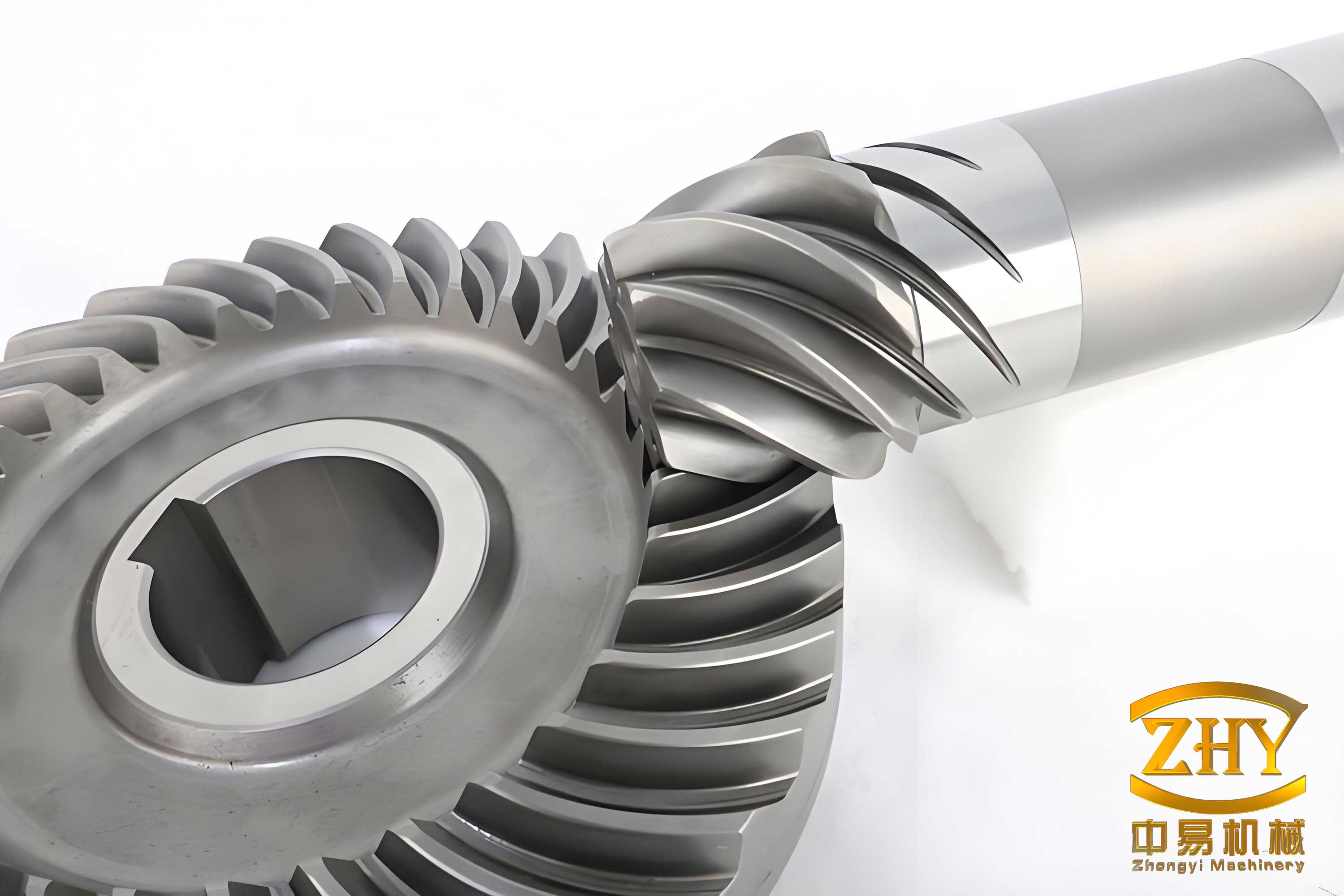
The SIFT algorithm, introduced by David Lowe, is renowned for its invariance to scale, rotation, and partial affine illumination changes, making it highly suitable for matching spiral bevel gear contact dot images. Its characteristics include local feature extraction, distinctiveness, abundance of feature vectors, and strong extensibility. The algorithm operates in two stages: SIFT feature generation and feature vector matching. Feature extraction begins with scale-space extremum detection using the Difference of Gaussian (DoG) function to identify potential keypoints across scales. The scale-space representation is defined as:
$$ L(x,y,\sigma) = G(x,y,\sigma) * I(x,y) $$
where $$ G(x,y,\sigma) = \frac{1}{2\pi\sigma^2} e^{-\frac{x^2+y^2}{2\sigma^2}} $$ is the Gaussian kernel, $$ I(x,y) $$ denotes image intensity, and $$ * $$ represents convolution. The DoG is computed as:
$$ D(x,y,\sigma) = (G(x,y,k\sigma) – G(x,y,\sigma)) * I(x,y) $$
which approximates the scale-normalized Laplacian of Gaussian. Keypoints are localized by finding extrema in $$ D(x,y,\sigma) $$ across scales and spaces. To refine keypoint location and scale, a Taylor expansion is employed:
$$ D(\mathbf{x}) = D + \frac{\partial D^T}{\partial \mathbf{x}} \mathbf{x} + \frac{1}{2} \mathbf{x}^T \frac{\partial^2 D}{\partial \mathbf{x}^2} \mathbf{x} $$
where $$ \mathbf{x} = (x, y, \sigma)^T $$. Low-contrast points and edge responses are eliminated to enhance stability. Orientation assignment follows, using gradient magnitude and direction computed as:
$$ m(x,y) = \sqrt{(L(x+1,y)-L(x-1,y))^2 + (L(x,y+1)-L(x,y-1))^2} $$
$$ \theta(x,y) = \tan^{-1}\left( \frac{L(x,y+1)-L(x,y-1)}{L(x+1,y)-L(x-1,y)} \right) $$
This ensures rotation invariance. Finally, a descriptor is generated by partitioning the keypoint neighborhood into sub-regions, computing orientation histograms, and forming a 128-dimensional feature vector (e.g., from 4×4 sub-regions with 8 bins each). This descriptor captures local gradient information, providing robustness to noise and minor geometric distortions.
In practical applications for spiral bevel gear analysis, I implemented the SIFT algorithm using MATLAB to evaluate its performance on wide-baseline image pairs. The matching process involves: inputting two images, extracting SIFT features to obtain candidate point sets, measuring similarity via Euclidean distance, and applying a threshold to filter mismatches. The algorithm steps are summarized in Table 1, highlighting the workflow for spiral bevel gear contact dot matching.
| Step | Description | Key Operations |
|---|---|---|
| 1 | Feature Extraction | Compute scale-space extrema, refine keypoints, assign orientations, generate descriptors. |
| 2 | Similarity Measurement | Calculate Euclidean distance between feature vectors of keypoints from both images. |
| 3 | Matching | Apply nearest-neighbor ratio test (e.g., threshold of 0.6) to identify candidate matches. |
| 4 | Mismatch Removal | Use RANSAC or geometric constraints to eliminate outliers. |
| 5 | Output | Return final set of matched point pairs for further analysis. |
For instance, when processing images from left and right cameras in a spiral bevel gear setup, the algorithm extracted 167 keypoints from the left image and 134 from the right. With a ratio threshold of 0.6, 48 matched pairs were identified, demonstrating SIFT’s ability to handle wide-baseline conditions. The matching results showed accurate alignment of features in terms of position, orientation, and scale, consistent with visual assessment. Table 2 presents a quantitative summary of the matching performance for spiral bevel gear images under varying thresholds.
| Ratio Threshold | Keypoints in Left Image | Keypoints in Right Image | Candidate Matches | Valid Matches | Matching Efficiency (%) |
|---|---|---|---|---|---|
| 0.4 | 167 | 134 | 52 | 35 | 67.3 |
| 0.5 | 167 | 134 | 50 | 40 | 80.0 |
| 0.6 | 167 | 134 | 48 | 36 | 75.0 |
The matching efficiency, defined as the percentage of valid matches among candidates, hovers around 36–40% in typical wide-baseline scenarios for spiral bevel gears, underscoring SIFT’s reliability. The algorithm’s invariance properties allow it to compensate for geometric deformations common in spiral bevel gear imaging, such as those arising from different camera angles or gear rotations. However, from my experience, SIFT has limitations: its computational speed is relatively slow, making it less suitable for high-resolution images or real-time systems in spiral bevel gear inspections. Additionally, the number of generated matches may be limited, necessitating optimization for higher effectiveness.
To delve deeper, the scale-space construction in SIFT involves convolving the image with Gaussian kernels at multiple scales, represented by:
$$ \sigma_n = \sigma_0 \cdot k^n, \quad n = 0, 1, \dots, s $$
where $$ \sigma_0 $$ is the base scale and $$ k $$ is a multiplicative factor. The DoG function is then:
$$ D(x,y,\sigma_n) = L(x,y,\sigma_{n+1}) – L(x,y,\sigma_n) $$
Keypoint detection involves comparing each pixel in $$ D(x,y,\sigma_n) $$ to its 26 neighbors in scale-space. For descriptor generation, the region around a keypoint is rotated to its dominant orientation, and gradients are weighted by a Gaussian window to reduce emphasis on distant pixels. The descriptor vector $$ \mathbf{f} $$ is normalized to unit length to enhance invariance to illumination changes:
$$ \mathbf{f} = \frac{\mathbf{v}}{|\mathbf{v}|}, \quad \mathbf{v} \in \mathbb{R}^{128} $$
In matching, the Euclidean distance between descriptors $$ \mathbf{f}_1 $$ and $$ \mathbf{f}_2 $$ is computed as:
$$ d(\mathbf{f}_1, \mathbf{f}_2) = \sqrt{\sum_{i=1}^{128} (f_{1,i} – f_{2,i})^2} $$
A match is accepted if $$ d(\mathbf{f}_1, \mathbf{f}_2) < t \cdot d(\mathbf{f}_1, \mathbf{f}_2′) $$, where $$ t $$ is the ratio threshold (e.g., 0.6) and $$ d(\mathbf{f}_1, \mathbf{f}_2′) $$ is the distance to the second-nearest neighbor. This approach reduces false matches in spiral bevel gear images.
In conclusion, the SIFT algorithm proves highly effective for wide-baseline image matching in spiral bevel gear contact dot analysis, offering robustness to scale, rotation, and illumination variations. Its feature-based methodology aligns well with the structural intricacies of spiral bevel gears, enabling accurate correspondence even under significant geometric deformations. However, computational demands and match quantity limitations suggest areas for future improvement, such as algorithmic optimizations or hybrid approaches. As non-contact detection systems for spiral bevel gears evolve, SIFT remains a cornerstone technique, paving the way for enhanced 3D reconstruction and quality assessment in gear manufacturing and maintenance.