
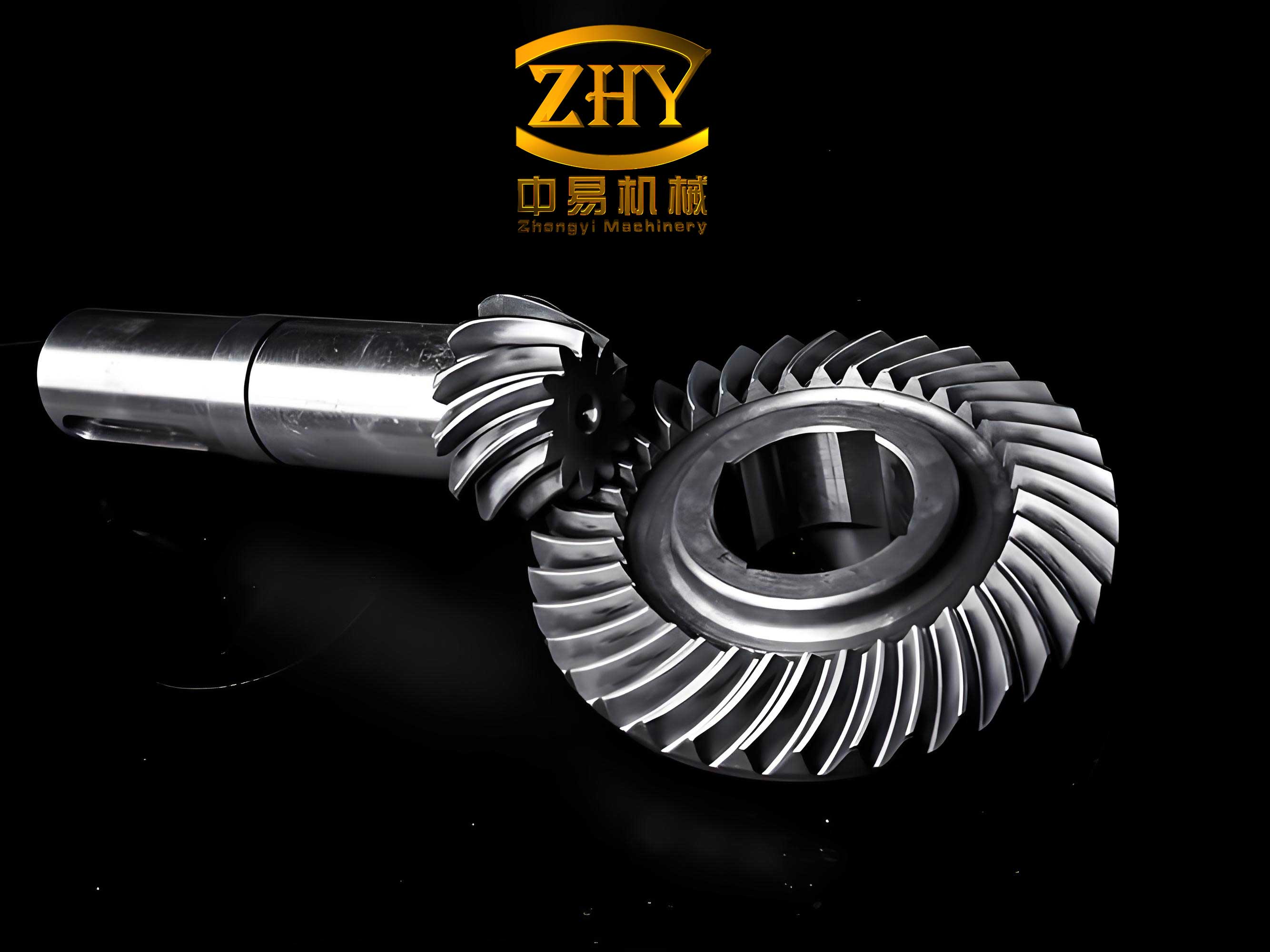
The design of spiral bevel gears represents a pinnacle of complexity in mechanical power transmission engineering. These components are critical for transmitting high torque and rotational motion between intersecting axes in demanding applications such as aerospace propulsion systems, heavy-duty vehicle transmissions, and precision industrial machinery. The geometry of a spiral bevel gear is intrinsically three-dimensional and non-linear, characterized by its curved teeth which provide smoother engagement and higher load capacity compared to straight bevel gears. This complexity gives rise to a design process fraught with challenges, involving the calculation and optimization of hundreds of interrelated parameters. These parameters range from fundamental geometric dimensions to sophisticated empirical coefficients—like dynamic load factors, size factors, and surface condition factors—whose accurate selection is not derived from pure theory but is deeply rooted in expert experience, historical design data, and lessons learned from past failures and successes.
Traditionally, this expertise resides in the minds of senior engineers, documented in fragmented notes, proprietary company standards, and vast, often cumbersome, reference manuals. This leads to significant inefficiencies: knowledge is poorly shared and reused, junior engineers face steep learning curves, and excessive time is spent searching for information rather than innovating. Furthermore, the risk of critical experiential knowledge being lost as experts retire is a persistent threat to organizational capability. To address these systemic issues, we have turned to Knowledge-Based Engineering (KBE) as a foundational methodology. KBE is not merely a type of software but a comprehensive paradigm that focuses on the capture, formalization, reuse, and management of engineering knowledge to automate and enhance design processes. By integrating KBE principles into a dedicated computational system, we aim to transform the design of spiral bevel gears from a heavily manual, experience-dependent task into a more systematic, knowledge-driven, and efficient engineering activity.
Core Tenets of Knowledge-Based Engineering (KBE)
KBE transcends conventional computer-aided design (CAD) by embedding intelligence and rationale into the design system itself. While CAD tools excel at geometry creation and manipulation, they typically lack an understanding of *why* a particular dimension or feature exists. KBE systems seek to encode this “why” – the constraints, rules, heuristics, and best practices that constitute expert knowledge. The effective implementation of KBE hinges on three interdependent key technologies:
- Knowledge Representation: This involves structuring human knowledge into formats that a computer can process and reason with. The choice of representation schema is crucial and varies with the nature of the knowledge (e.g., declarative facts, procedural rules, numerical correlations).
- Knowledge Utilization: This refers to the mechanisms by which the system accesses, processes, and applies the stored knowledge to solve specific design problems, such as performing calculations or making recommendations.
- Knowledge Acquisition: This is the often challenging process of extracting, validating, and formalizing knowledge from human experts, legacy designs, and other sources to populate and maintain the knowledge base.
The successful application of these technologies to the domain of spiral bevel gear design requires a deep understanding of both the KBE methodology and the intricate technical specifics of gear engineering.
Architecting the Spiral Bevel Gear Design Calculation System
Our developed system is engineered to be more than a calculation script; it is a structured environment for managing the entire lifecycle of design knowledge for spiral bevel gears. The system architecture, developed on the Microsoft Visual Studio platform using C++ for core algorithms and MFC for the user interface, is built around several integrated modules.
System Framework and Data Flow
The core structure facilitates a logical flow from user input to final validated output, with persistent knowledge and data storage at its heart. The process begins with the user defining initial requirements. The system then engages the knowledge base—a repository of rules, formulas, and empirical relationships—to guide the selection of algorithms and parameters. A dedicated calculation engine executes the complex, multi-step procedures for geometric design and strength rating (e.g., following AGMA or Gleason standards). All inputs, intermediate results, final outputs, and crucially, the contextual knowledge or “design rationale” behind key choices, are managed within a secure database. This database allows for the retrieval, comparison, and reuse of past designs, effectively creating a corporate memory for spiral bevel gear engineering.
Representing the Knowledge of Spiral Bevel Gear Design
The diversity of knowledge required for spiral bevel gear design necessitates a multi-modal representation approach. No single method is sufficient. Our system employs a hybrid strategy to capture different knowledge types effectively.
1. Production Rules for Heuristics and Constraints:
This method is ideal for encoding “if-then” conditional logic commonly found in design handbooks and expert judgment. It is used to enforce design constraints and provide recommendations.
$$ \text{IF (Condition) THEN (Action/Conclusion)} $$
For example, knowledge about pinion tooth count selection to avoid interference and manufacturing issues can be represented as:
IF (Pinion_Teeth < 17) THEN
    Signal_Error("Undercut will occur! Pinion teeth must be >= 17.");
IF (Pinion_Teeth > 50) THEN
    Issue_Warning("Manufacturing difficulties may arise with pinion teeth > 50.");
Another rule might guide the choice of spiral angle:
IF (Application == "High-Speed, Low-Noise") THEN
    Recommended_Spiral_Angle = 35°;
ELSE IF (Application == "High-Torque, Heavy-Duty") THEN
    Recommended_Spiral_Angle = 25°;
2. Procedural and Functional Knowledge for Calculations:
The core mathematical formulas governing spiral bevel gear geometry and strength are best represented as executable functions or procedures.
$$ d = m_t \cdot z $$
Where \( d \) is the pitch diameter, \( m_t \) is the transverse module, and \( z \) is the number of teeth. This is implemented directly in code:
double calculatePitchDiameter(double transverseModule, double toothCount) {
    return transverseModule * toothCount;
}
More complex relationships, like the formula for the dynamic factor \( K_v \), are also encoded procedurally based on established standards, ensuring consistent and accurate computation every time.
3. Structured Data for Empirical Data and Tables:
Much of gear design relies on tabulated data, graphs, and empirical coefficients that are functions of several parameters. We represent these using structured data objects, such as interpolated tables or multi-dimensional arrays. For instance, the geometry factor \( J \) for pitting resistance is a function of the number of teeth on the gear and pinion and the spiral angle. This is stored as a 3D lookup table. The system can perform multi-linear interpolation to find the precise value for any given combination.
$$
J = f(z_p, z_g, \psi)
$$
This table is stored in a structured format, allowing the calculation engine to query it efficiently. Similarly, material grade selection charts or lubrication factor graphs are digitized and represented in an interpolatable form within the knowledge base.
| Knowledge Type | Description | Representation Method | Example in Spiral Bevel Gear Context |
|---|---|---|---|
| Heuristic Rules | Experience-based “rules of thumb” and constraints. | Production Rules (If-Then) | Rules for minimum teeth to avoid undercut, spiral angle selection based on application. |
| Theoretical Formulas | Mathematical relationships from gear theory. | Procedural Functions | Calculation of pitch diameter, bending stress formula (Lewis/AGMA), contact stress formula. |
| Empirical Coefficients | Tabulated values from testing (e.g., AGMA standards). | Interpolation Tables / Structured Data | Geometry factors (I, J), Elastic coefficient (Cp), Life factors (ZN, YN). |
| Design Standards & Processes | The sequence of steps and checks in a design process. | Process Maps / Flow Control | Mandatory sequence: Geometry Calc -> Stress Analysis -> Safety Factor Check -> Refinement. |
Utilizing Knowledge: Secure and Efficient Access
Building a rich knowledge base is futile without robust mechanisms for its utilization. Our system manages knowledge and data (calculation results) as external, human-readable text files for transparency and ease of maintenance. The core challenge is to provide fast, reliable, and safe access to potentially thousands of rules and data files.
The Twin-Index File Mechanism for Data Integrity:
A central innovation is the use of a twin-index file system to prevent data corruption, a critical risk if the system terminates unexpectedly during a save operation. The process works as follows:
- An index file (`Index1`) contains pointers to all active data files and a “status flag.”
- When saving new data, the system first creates a backup by copying `Index1` to `Index2`.
- It then sets the status flag in `Index1` to “SAVING.”
- The new data file is written, and `Index1` is updated with its pointer.
- Finally, the status flag is set back to “STABLE.”
On system startup or before any read operation, it checks the status flag. If the flag is “SAVING,” it indicates a previous crash during save. The system then automatically recovers by restoring `Index1` from the backup `Index2`, ensuring database consistency. This mechanism guarantees that a failed write operation never leaves the knowledge or results database in a corrupted or partially updated state, which is essential for maintaining trust in the system’s output for critical spiral bevel gear designs.
Intelligent Querying and Knowledge Retrieval:
The index file is not just for integrity; it also enables efficient searching. Users can query the results database using ranges for key output parameters. For example, an engineer can search for all past designs of a spiral bevel gear where the calculated contact safety factor is between 1.3 and 1.5 and the spiral angle is 35 degrees. The system quickly filters the index and retrieves the relevant result sets, allowing for easy benchmarking and design precedent analysis.
Acquiring and Evolving Knowledge in the Spiral Bevel Gear Domain
A static KBE system quickly becomes obsolete. The true power lies in its ability to grow and refine its knowledge base over time. Our system facilitates knowledge acquisition from multiple sources and carefully controls its integration to maintain quality.
Sources of Knowledge:
- Static Knowledge: This is well-established, non-controversial knowledge from international standards (AGMA, ISO), foundational textbooks, and validated company design manuals. It forms the immutable core of the system’s reasoning.
- Dynamic Knowledge: This is the living, evolving knowledge from expert experience, post-analysis of field failures, results from new research and development projects, and insights gained from advanced simulation (FEA, CFD). This knowledge is the system’s competitive advantage.
A Role-Based Governance Model:
To manage the inflow of dynamic knowledge responsibly, we implement a strict role-based user permission system. This prevents the knowledge base from being polluted by unverified or erroneous information.
| User Role | Primary Function | Permissions |
|---|---|---|
| Novice Engineer | Learning and basic calculation. | Can run calculations using existing knowledge. Cannot save results or modify knowledge. |
| Project Engineer | Executing design projects. | Can run calculations and save results to the database with descriptive tags. Cannot edit core knowledge rules. |
| Senior Expert/Lead | Curating and enhancing knowledge. | Full calculation access. Can author new rules, modify coefficients, and validate/delete results submitted by project engineers. Can manage empirical data tables. |
| System Administrator | Maintaining system integrity. | Manages user accounts and roles. Maintains system infrastructure. Does not engage in gear design knowledge editing. |
This model ensures a virtuous cycle: Project Engineers contribute valuable result cases (successful and failed) which are tagged with context. Senior Experts review these cases, extract new patterns or rules, and formally encode them into the knowledge base. For example, if multiple successful designs for a high-performance vehicle transmission consistently use a specific case depth profile that differs from the standard recommendation, an expert can formalize this as a new heuristic rule for that application context.
Practical Application: A Walkthrough of the System in Action
Consider the task of designing a spiral bevel gear set for a new all-terrain vehicle differential. The engineer, acting as a Project Engineer, logs into the system.
Step 1: Knowledge Consultation and Algorithm Selection
The engineer navigates to the design calculation module. The first step is not inputting numbers, but selecting the calculation “path.” The system presents options for key algorithms based on the knowledge base. For instance, it may offer a choice between the classic Gleason “Duplex” helical spread blade method and a more modern “Formate” or “Full” cycle method for generating gear geometry. Each option is linked to a detailed knowledge snippet explaining its applicability, advantages, and limitations, helping the engineer make an informed choice consistent with manufacturing capabilities and performance goals.
Step 2: Guided Parameter Input
The engineer inputs basic requirements: power (P=200 kW), input speed (n=4000 rpm), gear ratio (i=3.5), desired life, etc. As they input parameters like tooth numbers, the system’s embedded rules provide immediate feedback. For example, if they enter a pinion tooth count of 15, the system immediately flags an error based on the rule `IF (z_p < 17) THEN Error…`, preventing a fundamental mistake early in the process.
Step 3: Automated Calculation and Knowledge Application
Upon execution, the system sequences through hundreds of calculations. It retrieves material properties from databases, looks up geometry factors (I, J) from its interpolation tables based on the chosen tooth numbers and spiral angle, calculates dynamic loads using the specified procedural formula, and determines bending and contact stresses.
$$
\sigma_H = Z_E \cdot \sqrt{ \frac{F_t}{b \cdot d_1} \cdot \frac{u+1}{u} \cdot K_A \cdot K_V \cdot K_{H\beta} \cdot K_{H\alpha} }
$$
$$
\sigma_F = \frac{F_t}{b \cdot m_n} \cdot K_A \cdot K_V \cdot K_{F\beta} \cdot K_{F\alpha} \cdot Y_J
$$
It then calculates safety factors and presents a comprehensive report. Crucially, next to each key output (e.g., a safety factor of 1.8), the system can display a note sourced from the knowledge base: “For off-road vehicle final drives, a contact safety factor > 1.6 is recommended for high shock load conditions,” providing immediate design context.
Step 4: Result Management and Knowledge Evolution
Satisfied with the design, the engineer saves the results. The system prompts for “tags” – descriptive metadata like “Project_X_Differential_Prototype_1,” “High-Shock_Load_Condition,” “Material_20MnCr5_Case_Hardened.” This saved case enriches the database. Later, a Senior Expert reviewing successful projects might notice that all durable off-road spiral bevel gear designs used a face width factor above a certain threshold. This observation can be distilled into a new production rule and added to the knowledge base, making this tacit knowledge explicit and available to all future designers.
Conclusion and Future Trajectory
The implementation of a KBE framework for spiral bevel gear design calculation marks a significant shift from a document-centric to a knowledge-centric paradigm. The developed system successfully addresses the core challenges of knowledge preservation, reuse, and systematic application. By employing a hybrid knowledge representation strategy, it captures the multifaceted nature of gear design expertise—from rigid formulas to flexible heuristics. The robust data management and role-based governance model ensure the system’s integrity and its capacity for controlled evolution, turning it into a living repository of corporate engineering intelligence.
The benefits are manifold: drastic reduction in routine calculation time and errors, accelerated onboarding of new engineers, and the invaluable preservation of expert knowledge. The system provides a solid knowledge-backed foundation for downstream activities such as parametric CAD modeling, automatic generation of finite element analysis inputs, and computer-aided process planning for manufacturing.
The future development of this KBE system for spiral bevel gear design lies in several promising directions. Deeper integration with multi-physics simulation tools (e.g., linking calculated loads directly to FEA software for detailed stress and thermal analysis) will create a closed-loop design-validation-optimization cycle. The incorporation of machine learning algorithms could analyze the growing database of design cases to uncover hidden correlations and suggest novel optimization paths beyond traditional rules, potentially leading to more lightweight and efficient spiral bevel gear geometries. Furthermore, extending the knowledge framework to encompass manufacturing knowledge—such as cutter selection, machine settings, and anticipated tolerances for spiral bevel gears—would bridge the critical gap between design intent and producibility, realizing a true end-to-end knowledge-driven engineering process for these complex and vital mechanical components.