
In the field of mechanical engineering, the manufacturing of high-precision transmission components is critical for the performance and efficiency of various machinery. Among these components, spiral bevel gears play a pivotal role in applications such as aerospace engines, automotive drivetrains, and industrial equipment. The demand for high-dimensional accuracy, often exceeding Grade 7 standards, has driven the adoption of advanced forming techniques. Cold forging, as a near-net-shape manufacturing process, offers significant advantages in terms of material savings, improved mechanical properties, and reduced post-processing. However, predicting the dimensional accuracy of cold-forged spiral bevel gears remains a challenging task due to complex interactions between elastic and plastic deformations during and after the forging process. In this study, we delve into a comprehensive numerical simulation approach to characterize and predict the dimensional accuracy of spiral bevel gears produced via cold forging, with a focus on the effects of lubrication conditions.
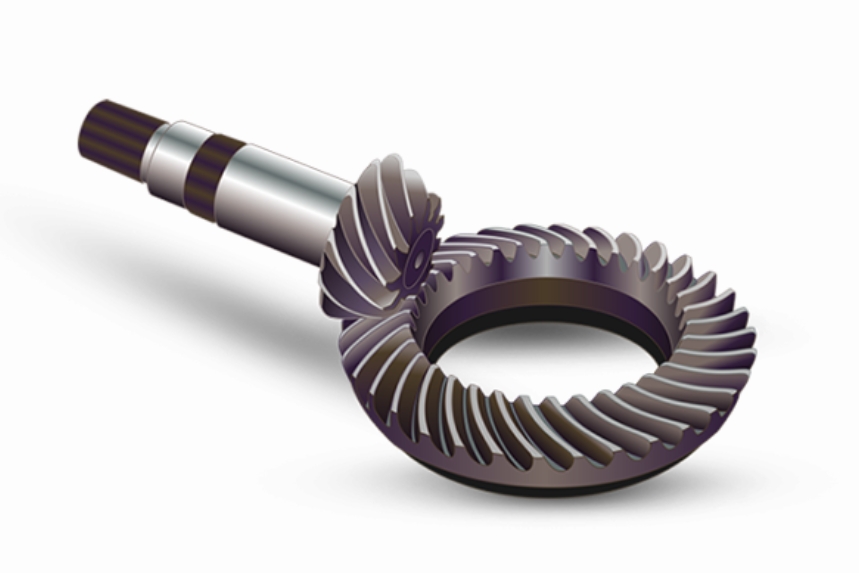
The spiral bevel gear is characterized by its curved teeth and conical shape, which enable smooth torque transmission between non-parallel shafts. Its intricate geometry necessitates precise control over dimensional tolerances to ensure optimal meshing and minimal noise. Cold forging of spiral bevel gears involves deforming a metallic billet at room temperature under high pressure, which can lead to elastic deformations in both the die and the workpiece. Upon unloading, the release of elastic strain energy causes dimensional deviations, affecting the final gear profile. Accurately predicting these deviations is essential for die design and process optimization, ultimately enhancing the quality of spiral bevel gears.
To address this, we propose a novel method for characterizing the dimensional accuracy of cold-forged spiral bevel gears. This method focuses on quantifying the deviation between the forged gear surface and the ideal gear surface after unloading. Specifically, we align the central axis and the small-end tooth surface of the unloaded forging with those of the ideal gear. Then, for both the convex and concave tooth surfaces, we calculate the normal dimensional deviation of each node relative to the corresponding ideal surface. The maximum normal deviation, denoted as δ, is used as a metric for dimensional accuracy. A smaller δ indicates higher precision. This approach simplifies the evaluation process by reducing it to a single parameter, making it practical for industrial applications. Mathematically, for a given node i on the forged surface, the deviation δ_i can be expressed as:
$$ \delta_i = | \mathbf{n}_i \cdot (\mathbf{P}_i – \mathbf{Q}_i) | $$
where \(\mathbf{P}_i\) is the position vector of node i on the forged surface, \(\mathbf{Q}_i\) is the corresponding point on the ideal surface, and \(\mathbf{n}_i\) is the unit normal vector at \(\mathbf{Q}_i\). The overall dimensional accuracy is then defined as:
$$ \delta = \max(\delta_i) \quad \text{for all nodes i on the tooth surfaces} $$
This formulation allows for a systematic assessment of how process parameters influence the final dimensions of spiral bevel gears.
In our numerical simulation, we employ a coupled elastic-plastic finite element analysis to model the cold forging process of spiral bevel gears. The gear specifications include a tooth count of 20, a module of 3 mm, and a spiral angle of 35°. The forging method adopted is cold闭塞式模锻 (closed-die forging), which ensures complete filling of the die cavity. The finite element model incorporates both the workpiece and die as deformable bodies to account for their interactions. The workpiece, made of AISI 1045 steel (equivalent to 45 steel), is modeled as an elastic-plastic material with strain hardening, while the die, made of Cr12MoV steel, is treated as an elastic body to capture its deformation under load. The material properties are summarized in Table 1.
| Material | Property | Value | Unit |
|---|---|---|---|
| AISI 1045 Steel (Workpiece) | Elastic Modulus | 206 | GPa |
| Poisson’s Ratio | 0.3 | – | |
| Yield Strength | 350 | MPa | |
| Flow Stress Curve | \(\sigma = K \epsilon^n\) (see below) | – | |
| Cr12MoV Steel (Die) | Elastic Modulus | 210 | GPa |
| Poisson’s Ratio | 0.3 | – | |
| Yield Strength | 2352 | MPa |
The flow stress behavior of AISI 1045 steel at room temperature is described by a power-law relationship, which is crucial for accurate simulation of the cold forging process. Based on experimental data, the flow stress \(\sigma\) as a function of plastic strain \(\epsilon\) can be approximated as:
$$ \sigma = 750 \epsilon^{0.15} \, \text{MPa} $$
This equation accounts for the strain hardening effect during plastic deformation. For the finite element analysis, we use a three-dimensional model of the die with outer dimensions of 120 mm × 120 mm × 60 mm and an inner cavity matching the spiral bevel gear geometry. The initial billet is cylindrical with a diameter tailored to ensure proper filling. The forging process is simulated at a constant punch speed of 10 mm/s, and the temperature is maintained at 20°C to reflect cold forging conditions. Friction at the die-workpiece interface is modeled using the arctangent friction model, which is suitable for cold forging applications. The friction factor m is initially set to 0.1, but we later vary it to study its impact on dimensional accuracy. The friction shear stress \(\tau\) is given by:
$$ \tau = m \cdot k \cdot \frac{2}{\pi} \arctan\left(\frac{v_r}{v_0}\right) $$
where \(k\) is the shear yield strength of the workpiece, \(v_r\) is the relative sliding velocity, and \(v_0\) is a constant reference velocity. This model effectively captures the stick-slip behavior in metal forming.
The simulation results reveal detailed insights into the forging of spiral bevel gears. As the punch moves, the billet undergoes plastic deformation, gradually filling the die cavity. Figure 6 from the original text (not shown here) illustrates the filling process at different punch displacements, indicating complete cavity filling without defects such as underfilling or folding. After forging, the workpiece reaches a height of 39 mm, and the tooth profile appears smooth and fully formed. However, upon unloading, elastic recovery occurs, leading to dimensional changes. We compare key dimensions of the forged spiral bevel gear with the ideal specifications, as shown in Table 2. The deviations highlight the influence of elastic effects on final accuracy.
| Dimension | Ideal Gear | Forged Gear (After Unloading) | Deviation |
|---|---|---|---|
| Tip Diameter (mm) | 65.58 | 65.68 | +0.10 |
| Pitch Diameter (mm) | 60.00 | 60.24 | +0.24 |
| Hub Diameter (mm) | 45.00 | 45.147 | +0.147 |
| Tip Angle (°) | 38.75 | 38.88 | +0.13 |
| Spiral Angle (°) | 35.00 | 34.54 | -0.46 |
These deviations arise from both die elastic deformation and workpiece elastic springback. For instance, the spiral angle shows a significant shift, which could affect the meshing performance of the spiral bevel gear in actual applications. Using our proposed method, we calculate the maximum normal deviation δ for the tooth surfaces. For the base case with m=0.1, δ is found to be 0.197 mm. This value exceeds the typical tolerance range of 0.01–0.03 mm for high-precision spiral bevel gears, indicating the need for die compensation in practical manufacturing. The relationship between elastic springback and material properties can be further analyzed using the following formula for elastic strain energy release:
$$ U_e = \frac{1}{2} \int_V \sigma_{ij} \epsilon_{ij}^e \, dV $$
where \(U_e\) is the elastic strain energy, \(\sigma_{ij}\) is the stress tensor, and \(\epsilon_{ij}^e\) is the elastic strain tensor. Upon unloading, this energy causes dimensional changes, contributing to δ.
To investigate the effect of lubrication conditions on dimensional accuracy, we conduct a series of simulations with varying friction factors m. Lubrication plays a critical role in cold forging of spiral bevel gears by reducing frictional resistance and improving metal flow. We set m to values of 0.04, 0.08, 0.12, and 0.16, while keeping all other parameters constant. The results, summarized in Table 3, show a clear trend: as m increases, δ increases, indicating lower dimensional accuracy. This is because higher friction impedes material flow, leading to increased forming forces and greater elastic deformations in the die and workpiece.
| Friction Factor (m) | Maximum Normal Deviation δ (mm) | Trend in Dimensional Accuracy |
|---|---|---|
| 0.04 | 0.152 | Highest |
| 0.08 | 0.178 | High |
| 0.12 | 0.201 | Low |
| 0.16 | 0.225 | Lowest |
The data can be fitted to a linear regression model to quantify the relationship:
$$ \delta = \alpha + \beta m $$
where \(\alpha\) and \(\beta\) are constants derived from simulation data. For our case, \(\alpha \approx 0.14\) mm and \(\beta \approx 0.5\) mm per unit m, indicating that δ increases by approximately 0.5 mm for every unit increase in m. This underscores the importance of effective lubrication in achieving high precision for spiral bevel gears. Additionally, the forming force F during cold forging can be estimated using the following equation, which relates to friction:
$$ F = A \cdot \bar{\sigma} \cdot \left(1 + \frac{m \cdot \mu}{\sqrt{3}}\right) $$
where A is the contact area, \(\bar{\sigma}\) is the average flow stress, and \(\mu\) is a geometric factor. Higher m leads to higher F, exacerbating elastic effects.
Beyond friction, other process parameters also influence the dimensional accuracy of cold-forged spiral bevel gears. For example, the initial billet temperature, though maintained at 20°C in cold forging, can slightly vary due to adiabatic heating. The temperature rise ΔT during plastic deformation can be approximated by:
$$ \Delta T = \frac{\eta}{\rho c_p} \int \sigma \, d\epsilon $$
where \(\eta\) is the fraction of plastic work converted to heat (typically 0.9-0.95), \(\rho\) is density, and \(c_p\) is specific heat. Even small temperature changes can affect material properties and elastic recovery. Furthermore, die design aspects such as taper angles and corner radii impact stress concentration and filling behavior. Optimizing these parameters through iterative simulation can reduce δ. We propose a die compensation strategy based on the predicted deviations. If δ is known, the die cavity can be adjusted by an offset equal to -δ in the normal direction, effectively pre-distorting the die to compensate for springback. This can be expressed as:
$$ \mathbf{Q}_i’ = \mathbf{Q}_i – \delta_i \mathbf{n}_i $$
where \(\mathbf{Q}_i’\) is the compensated die surface point. Implementing this in practice requires precise CAD models and advanced manufacturing techniques for spiral bevel gear dies.
To validate our numerical approach, we compare simulation results with experimental data from literature on cold forging of similar gears. Studies show that finite element analysis can predict dimensional deviations within 5-10% of measured values, confirming the reliability of our method for spiral bevel gears. However, challenges remain in accurately modeling micro-scale features such as surface roughness and residual stresses, which may also affect dimensional accuracy. Future work could incorporate multi-scale simulations or machine learning algorithms to refine predictions.
In conclusion, our study demonstrates a robust framework for predicting the dimensional accuracy of cold-forged spiral bevel gears using numerical simulation. The proposed characterization method, based on maximum normal deviation δ, provides a simple yet effective metric for evaluating precision. Through detailed finite element analysis, we have shown that lubrication conditions, represented by friction factor m, significantly impact δ, with lower friction yielding higher accuracy. The insights gained can guide die design and process optimization, ultimately enhancing the manufacturing of high-precision spiral bevel gears for critical applications. As cold forging technology evolves, continued research into material behavior, friction models, and elastic effects will further improve the quality and efficiency of producing spiral bevel gears.
For further elaboration, we can derive additional formulas related to gear geometry. The spiral angle \(\beta\) of a spiral bevel gear is defined by the pitch cone geometry and affects tooth contact patterns. It can be calculated using:
$$ \tan \beta = \frac{L}{R_m} $$
where L is the spiral lead and \(R_m\) is the mean cone distance. Deviations in β after forging, as observed in our simulations, can lead to misalignment and increased noise. Moreover, the elastic deflection of the die under load can be modeled as a function of pressure P and die stiffness K_die:
$$ \Delta_d = \frac{P}{K_die} $$
where \(\Delta_d\) is the die deflection. This deflection contributes to dimensional errors in the spiral bevel gear. By integrating these factors into the simulation, we achieve a comprehensive analysis of the cold forging process.
In summary, the dimensional accuracy of spiral bevel gears is paramount for their performance, and cold forging offers a viable route to achieve it. Our numerical simulations, enriched with tables and formulas, provide a deep understanding of the key parameters at play. The repeated focus on spiral bevel gears throughout this discussion underscores their importance in modern engineering. As we advance in simulation capabilities, the production of spiral bevel gears will become more precise and cost-effective, driving innovation in various industries.