
In modern engineering applications, spiral bevel gears are critical components in power transmission systems, especially for intersecting axes in heavy-duty machinery, automotive differentials, aerospace systems, and industrial equipment. These gears offer advantages such as high load capacity, smooth operation, and increased contact ratio due to their curved teeth. However, traditional manufacturing methods for spiral bevel gears rely on specialized gear-cutting machines, like Gleason-type gear generators or CNC spiral bevel gear milling machines. These machines are expensive, have limited flexibility, and are often inefficient for small-batch or single-piece production. Moreover, for gears with non-standard parameters or incomplete teeth, dedicated machines may not be suitable. This study explores an alternative approach: machining spiral bevel gears on a five-axis CNC machining center. By leveraging advanced CAD/CAM software, such as UG for modeling and PowerMill for toolpath generation, along with simulation tools like VERICUT, I aim to demonstrate that high-precision spiral bevel gears can be produced cost-effectively on standard five-axis CNC platforms. This method not only reduces dependency on specialized equipment but also enhances manufacturing agility for prototyping and low-volume production.
The core challenge in machining spiral bevel gears lies in their complex geometry. The tooth profile is based on a spherical involute, and the tooth length follows a circular arc generated by a virtual crown gear. Achieving accurate tooth surfaces requires precise modeling, optimal toolpath strategies, and careful consideration of machining dynamics. In this research, I address several key problems: First, the accuracy of digital modeling—any errors in the geometric representation of the spiral bevel gear can lead to poor meshing, increased noise, and reduced strength. Second, workpiece fixturing must ensure stability and avoid interference with the cutting tool and machine components. Third, the machining sequence, including roughing, semi-finishing, and finishing operations, must be planned to maintain surface quality and dimensional tolerance. Fourth, five-axis NC programming and pre-machining simulation are essential to prevent collisions, overcuts, and other runtime errors. Finally, post-machining inspection is crucial to validate gear performance against design specifications. By integrating these aspects, I present a comprehensive methodology for spiral bevel gear production on five-axis CNC machines.
To begin, let’s analyze the geometric and kinematic fundamentals of spiral bevel gears. The tooth surface of a Gleason spiral bevel gear is defined by two primary elements: the profile in the tooth depth direction (spherical involute) and the longitudinal curve (circular arc). The mathematical model involves spherical coordinates and transformation matrices. For a spiral bevel gear with pitch cone angle $\delta$, mean cone distance $R_m$, spiral angle $\beta$, and pressure angle $\alpha$, the coordinates of points on the tooth surface can be derived. The spherical involute profile can be expressed using parametric equations. For instance, in a coordinate system with origin at the cone apex, the position vector $\vec{r}$ for a point on the involute is:
$$ \vec{r} = R \left( \sin\theta \cos\phi, \sin\theta \sin\phi, \cos\theta \right) $$
where $R$ is the radial distance, $\theta$ is the polar angle, and $\phi$ is the azimuthal angle. For a spiral bevel gear, these parameters are functions of the gear geometry and manufacturing settings. The spiral curve along the tooth length is typically a circular arc with radius equal to the cutter radius of the virtual generating gear. The exact equations depend on the gear design system (e.g., Gleason, Klingelnberg). In this study, I used UG NX software to create a parametric model of the spiral bevel gear. The modeling process starts with defining basic parameters: number of teeth $z$, module $m$, pressure angle $\alpha$, spiral angle $\beta$, face width $F$, and shaft angle $\Sigma$. For the example gear in this research, the driving pinion has $z_1 = 15$ teeth, and the driven gear has $z_2 = 36$ teeth, with a shaft angle of 90°. The table below summarizes the key geometric parameters of the spiral bevel gear pair.
| Parameter | Symbol | Pinion (Driving) | Gear (Driven) |
|---|---|---|---|
| Number of Teeth | $z$ | 15 | 36 |
| Module (mm) | $m$ | 5 | 5 |
| Pressure Angle (°) | $\alpha$ | 20 | 20 |
| Spiral Angle (°) | $\beta$ | 35 | 35 |
| Face Width (mm) | $F$ | 28 | 28 |
| Shaft Angle (°) | $\Sigma$ | 90 | 90 |
| Pitch Cone Angle (°) | $\delta$ | 22.62 | 67.38 |
| Cone Distance (mm) | $R$ | 75.62 | 75.62 |
Using these parameters, I developed a script in MATLAB to compute the spherical involute coordinates, which were then imported into UG NX to generate curves and surfaces. The solid model of the spiral bevel gear pinion was constructed with precise tooth flanks, root fillets, and mounting features. This digital model serves as the basis for all subsequent CAM operations. The accuracy of the model was verified through virtual assembly and motion simulation in UG, ensuring that the gear pair meshes correctly without interference.
After modeling, the next step is machining process planning. The spiral bevel gear blank is made of 45 steel, with a hardness of HB250 after heat treatment. The blank is first turned on a CNC lathe to create the conical shape and bore, followed by keyway broaching. The critical operation is five-axis milling of the tooth spaces. The table below outlines the overall process plan for the spiral bevel gear.
| Step | Operation | Machine | Key Details |
|---|---|---|---|
| 1 | Forging & Heat Treatment | – | Isothermal normalizing |
| 2 | Rough Turning | CNC Lathe | Face, OD, bore, leave 2 mm stock |
| 3 | Finish Turning | CNC Lathe | Final dimensions and tolerances |
| 4 | Keyway Broaching | Broaching Machine | 10 mm wide keyway |
| 5 | Five-Axis Milling | DMG DMU50V | Tooth slots and flanks |
| 6 | Heat Treatment | – | Surface hardening |
| 7 | Gear Grinding | Gear Grinder | Final tooth surface finish |
For five-axis machining, workpiece fixturing is crucial. I designed a custom fixture that locates the gear blank using a plane and short cylinder, with a key to prevent rotation. The fixture is bolted to the machine table, and the blank is clamped using a bolt circle. This setup minimizes deflection and allows full access to the tooth surfaces without tool interference. The fixture design was validated in simulation to ensure clearance during multi-axis movements.
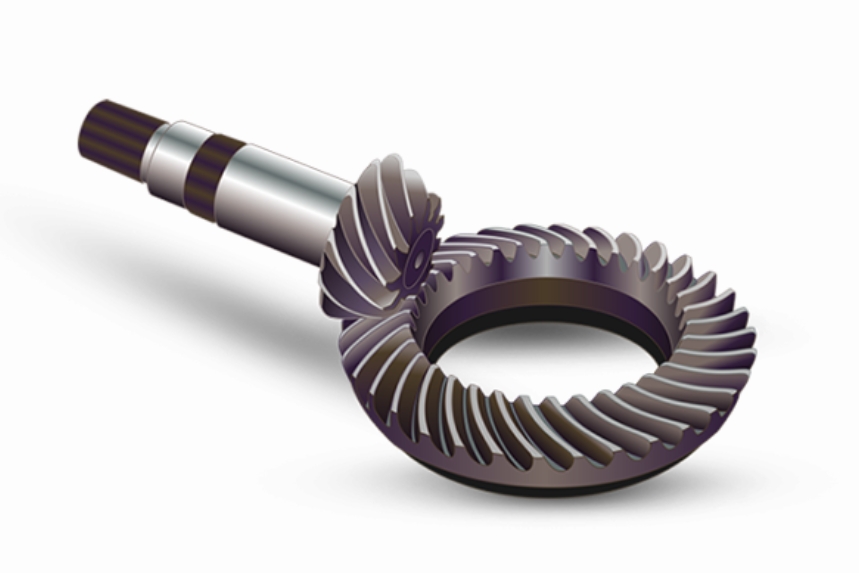
The heart of this research is the generation of efficient and accurate toolpaths for the spiral bevel gear using Autodesk PowerMill. PowerMill is a high-performance CAM system known for its robust multi-axis strategies and fast computation. The process starts by importing the UG model of the spiral bevel gear pinion. I then define user coordinate systems (UCS) aligned with the gear axis and machine kinematics. For roughing, I use the Model Area Clearance strategy to remove bulk material from the tooth slots. This strategy employs a tapered ball-nose end mill (Ø10 mm with R1 corner radius) to plunge into the slot and follow a spiral pattern from the large end to the small end of the gear. The cutting parameters are optimized to balance material removal rate and tool life. The table below details the tooling and cutting parameters for each machining stage.
| Operation | Tool Type | Diameter (mm) | Spindle Speed (rpm) | Feed Rate (mm/min) | Depth of Cut (mm) | Remarks |
|---|---|---|---|---|---|---|
| Rough Milling | Tapered Ball End Mill | 10 (R1) | 4000 | 2500 | 2.0 | Layer milling, 2.5 mm stock left |
| Semi-Finish Milling | Ball End Mill | 8 | 5000 | 3000 | 0.6 | 1.5 mm stock left |
| Concave Flank Roughing | Ball End Mill | 6 | 6000 | 3000 | 0.5 | 1.0 mm stock left, surface tolerance 0.03 mm |
| Convex Flank Roughing | Ball End Mill | 6 | 6000 | 3000 | 0.5 | 1.0 mm stock left, surface tolerance 0.03 mm |
| Root Fillet Clearing | Ball End Mill | 3 | 8000 | 4000 | 0.5 | 0.5 mm stock left, min root clearance 3.95 mm |
| Finish Milling | Ball End Mill | 3 | 10000 | 5000 | 0.1 | 0.5 mm stock left for grinding, surface tolerance 0.01 mm |
In PowerMill, I create separate toolpaths for each operation. For roughing, the toolpath is generated in a UCS that aligns with the gear axis, ensuring that the tool approaches from a safe direction. The toolpath pattern is optimized to maintain constant chip load and avoid sharp directional changes. For semi-finishing and finishing, I use swarf machining and surface projection strategies to achieve smooth tooth flanks. The tool axis is controlled using lead and tilt angles to match the local surface normals, which is critical for five-axis machining of spiral bevel gears. The lead angle $\lambda$ and tilt angle $\tau$ are computed based on the gear geometry:
$$ \lambda = \arctan\left(\frac{\tan\beta}{\sin\delta}\right) $$
$$ \tau = \arcsin\left(\cos\beta \cdot \sin\delta\right) $$
where $\beta$ is the spiral angle and $\delta$ is the pitch cone angle. These angles ensure that the cutting tool remains tangent to the tooth surface, minimizing gouging and improving surface finish. After generating the toolpaths, I use PowerMill’s simulation module to verify material removal and detect any potential collisions. Once satisfied, I post-process the toolpaths to generate NC code for the specific five-axis CNC machine—a DMG DMU50V with a Siemens 840D control system. The postprocessor converts the toolpath data into G-code with rotary axis commands (B and C axes). The NC program includes tool changes, spindle commands, and coordinate transformations. A snippet of the roughing NC code is shown below (simplified for illustration):
N10 G54 G90 G94
N20 T1 M6 (Tool 1: Ø10 tapered ball end mill)
N30 S4000 M3
N40 G0 X0 Y0 Z50
N50 B0 C0
N60 G43 Z10 H1
N70 G1 Z-2 F2500
... (toolpath motions)
N1000 M30
Before actual machining, it is imperative to simulate the entire process in a virtual environment. I use VERICUT software to build a digital twin of the DMG DMU50V five-axis CNC machine. The machine model includes the kinematics: X, Y, Z linear axes and B, C rotary axes. I then import the fixture, blank, and cutting tools into VERICUT. The NC program is loaded and executed in the simulation. VERICUT performs material removal analysis and collision detection. This step is vital for identifying errors such as tool-holder collisions, workpiece-fixture interference, or axis limit violations. For the spiral bevel gear job, the simulation revealed that the custom fixture provided adequate clearance, and the toolpaths were collision-free. The simulation also helped optimize the tool approach and retract motions, reducing non-cutting time.
After successful simulation, I proceed to actual machining on the DMG DMU50V five-axis machining center. The machine is equipped with a high-speed spindle (up to 12,000 rpm) and a Siemens 840D control, capable of simultaneous five-axis interpolation. The workpiece is mounted on the custom fixture, and the tools are loaded into the magazine. The NC programs are transferred via DNC or USB. During machining, I monitor cutting forces and vibrations to ensure stability. The roughing operation removes most material efficiently, while semi-finishing and finishing operations achieve the desired tooth form. The use of coated carbide tools (TiAlN coating) allows for higher cutting speeds and longer tool life. Coolant is applied to control heat and evacuate chips. The total machining time for the spiral bevel gear pinion is approximately 4.5 hours, which is acceptable for single-piece production. The final gear tooth surfaces have a uniform stock allowance of 0.5 mm for subsequent grinding.
Post-machining heat treatment involves surface hardening to improve wear resistance. Then, the gear undergoes grinding on a dedicated spiral bevel gear grinder to achieve final dimensions and surface finish. The grinding process removes the 0.5 mm stock left from milling, ensuring high geometric accuracy and low surface roughness. After grinding, the spiral bevel gear is assembled with its mating gear for inspection. Gear inspection is performed on a Gleason-type gear tester, such as the YK95100 bevel gear checking machine. The primary metrics are tooth contact pattern and transmission error. The contact pattern should be centered on the tooth flank, with adequate length and height. For this spiral bevel gear pair, the contact pattern covers about 61% of the tooth length and 67% of the tooth height, which is better than typical values (50% length, 60% height). This indicates excellent meshing characteristics. The table below summarizes the inspection results.
| Inspection Item | Specification | Measured Value | Evaluation |
|---|---|---|---|
| Contact Pattern Length | >50% | 61% | Pass |
| Contact Pattern Height | >60% | 67% | Pass |
| Tooth Profile Error | < 0.02 mm | 0.015 mm | Pass |
| Tooth Lead Error | < 0.03 mm | 0.022 mm | Pass |
| Backlash | 0.05–0.10 mm | 0.08 mm | Pass |
| Noise Level | Quiet, no abnormal sound | Normal | Pass |
The successful inspection confirms that the spiral bevel gear machined on the five-axis CNC meets all functional requirements. The gear pair operates smoothly with minimal noise and vibration, making it suitable for the intended application in tobacco machinery. This outcome validates the effectiveness of the proposed methodology.
In conclusion, this research demonstrates that spiral bevel gears can be accurately and efficiently manufactured on a standard five-axis CNC machining center using advanced CAD/CAM techniques. The process involves precise parametric modeling of the spiral bevel gear, optimal toolpath generation with PowerMill, thorough simulation with VERICUT, and careful machining on a five-axis machine. The key advantages of this approach are flexibility, cost-effectiveness for small batches, and the ability to produce non-standard gears. The spiral bevel gear produced exhibited superior meshing performance, as verified by gear inspection. Future work could explore the use of alternative tool geometries, adaptive machining strategies, and in-process monitoring to further improve quality and reduce cycle time. Additionally, integrating machine learning for toolpath optimization could enhance the automation of spiral bevel gear production. Overall, this study contributes to the broader adoption of multi-axis CNC technology for complex gear manufacturing, reducing reliance on specialized gear-cutting machines and promoting agile manufacturing practices.
From a technical perspective, the mathematical modeling of spiral bevel gears is foundational. The spherical involute surface can be described more rigorously using differential geometry. The position vector $\vec{r}(u,v)$ of a point on the tooth surface is given by:
$$ \vec{r}(u,v) = \begin{bmatrix} x(u,v) \\ y(u,v) \\ z(u,v) \end{bmatrix} = \begin{bmatrix} R(u) \sin\theta(u) \cos\phi(v) \\ R(u) \sin\theta(u) \sin\phi(v) \\ R(u) \cos\theta(u) \end{bmatrix} $$
where $u$ is the parameter along the tooth depth (related to the involute), and $v$ is the parameter along the tooth length (related to the spiral). The functions $R(u)$, $\theta(u)$, and $\phi(v)$ are derived from gear design equations. For a Gleason spiral bevel gear with circular arc teeth, the spiral function $\phi(v)$ is:
$$ \phi(v) = \phi_0 + \frac{v}{R_c} $$
where $R_c$ is the cutter radius, and $\phi_0$ is the initial angle. The involute function $\theta(u)$ is:
$$ \theta(u) = \delta + \arctan\left( \frac{\tan\alpha}{\cos\beta} \right) – \text{inv}(u) $$
where $\text{inv}(u)$ is the involute function of parameter $u$. These equations enable accurate digital representation of the spiral bevel gear. In practice, CAD software like UG NX implements these relations through parametric sketches and surface sweeping operations.
Regarding toolpath generation, PowerMill offers several strategies suitable for spiral bevel gear milling. The “Swarf Machining” strategy is particularly effective for finishing tooth flanks because it aligns the tool side with the surface, providing better surface finish and longer tool life. The tool axis vector $\vec{A}$ is computed as:
$$ \vec{A} = \frac{\vec{n} \times \vec{t}}{\|\vec{n} \times \vec{t}\|} $$
where $\vec{n}$ is the surface normal, and $\vec{t}$ is the feed direction. For five-axis machining, this vector is decomposed into rotary axis angles (B and C) using inverse kinematics. The machine tool’s inverse kinematics for a table-tilting five-axis CNC (like DMU50V) are given by:
$$ B = \arcsin(A_z) $$
$$ C = \arctan2(A_y, A_x) $$
where $A_x, A_y, A_z$ are components of the tool axis vector in the workpiece coordinate system. These calculations are embedded in the postprocessor to generate correct G-code.
In terms of machining economics, the cost comparison between dedicated gear cutting and five-axis CNC milling is noteworthy. For small batches, the five-axis approach reduces capital investment and setup time. The table below compares key factors for producing a single spiral bevel gear pinion.
| Factor | Dedicated Gear Machine | Five-Axis CNC |
|---|---|---|
| Machine Cost | High ($500,000+) | Moderate ($200,000+) |
| Setup Time | Long (hours) | Short (minutes) |
| Tooling Cost | Special cutters ($5,000+) | Standard end mills ($500) |
| Flexibility | Low (gear-specific) | High (multi-purpose) |
| Lead Time | Weeks (if outsourced) | Days (in-house) |
Thus, for prototyping or low-volume production, five-axis CNC machining of spiral bevel gears is economically viable. Moreover, the ability to quickly iterate designs supports product development cycles.
In summary, this research provides a comprehensive framework for machining spiral bevel gears on five-axis CNC centers. The integration of accurate modeling, advanced CAM, and virtual simulation ensures high-quality gears that meet industrial standards. The spiral bevel gear produced in this study performed excellently in testing, validating the methodology. As five-axis CNC technology becomes more accessible, this approach will enable manufacturers to produce complex gears like spiral bevel gears efficiently and flexibly, driving innovation in power transmission systems.