
In the field of mechanical engineering, spiral bevel gears are crucial components widely used in various power transmission systems, such as those in mining equipment, automobiles, tractors, and locomotives. The performance and longevity of these machines heavily depend on the quality of the spiral bevel gears. However, current research on spiral bevel gear transmission is often limited to theoretical studies of meshing, with insufficient attention paid to the machining process, particularly the optimization of parameter selection during cutting. This gap leads to suboptimal manufacturing quality, adversely affecting the operational efficiency of spiral bevel gears. Therefore, investigating the machining of spiral bevel gears using multi-edge cutters or formed grinding wheels is of significant importance. In this paper, I explore the mathematical modeling of the machining process for spiral bevel gears, focusing on the equations of the generating surface, motion laws, computational parameters at tooth contact points, and associated algorithms. By simulating the machining process through programmed algorithms, we can optimize parameters to enhance gear quality. The mathematical model developed here disregards the actual metal-cutting tool trajectory and instead treats the imprint of the tool’s generating surface at different positions as the research object. This approach allows us to derive the envelope of the tooth flank and compare it with the surface obtained from the mathematical model.
The tooth flank of a spiral bevel gear is typically machined using a cutter head with multiple blade tools. Each tool rotates rapidly with the cutter head, contacting the gear blank multiple times. During machining, parameter selection directly influences the shape of the tooth flank, necessitating the development of programs and algorithms to simulate the process. Thus, the study of mathematical models becomes essential. In this context, I introduce four Cartesian coordinate systems to describe the machining process, as summarized in Table 1. These systems facilitate the derivation of equations for the generating surface and its envelope.
| System | Description | Key Parameters |
|---|---|---|
| Σ0 | Stationary system for tool and workpiece; origin at the cone apex of the virtual crown gear. | Axes: Z0 along crown gear axis, X0 along root cone line of gear. |
| Σ1 | Fixed to the tool; origin at distance R0 from O0 when rotation angle φ = 0. | Axes: Z1 parallel to Z0, motion along Z1. |
| Σ2 | Stationary system for workpiece; origin at O2 on pitch cone, with Z2 aligned with workpiece velocity vector. | Derived by translating Σ0 by ΔX and ΔY, then rotating by angle δ. |
| Σ3 | Fixed to rotating workpiece; coincides with Σ2 when φ = 0. | Rotation matrix and displacement vectors describe motion relative to workpiece. |
The generating surface refers to the set of infinite geometric positions of the cutting edge. In system Σ1, its equation is expressed in vector form. Let r1 be the radial vector from the origin O1 to a point on the generating surface. The equation can be written as:
$$ \mathbf{r}_1 = \mathbf{r}_1(u, \theta) = \begin{bmatrix} x_1 \\ y_1 \\ z_1 \end{bmatrix} = \begin{bmatrix} R_0 + u \cos \alpha \cos \theta \\ u \cos \alpha \sin \theta \\ u \sin \alpha \end{bmatrix} $$
where \( u \) is a parameter along the tool profile, \( \theta \) is the angular parameter around the tool axis, \( R_0 \) is the tool formation radius, and \( \alpha \) is the tool profile angle. To transform this into system Σ3 at any time instant φ, we apply rotation and displacement matrices. The equation of the generating surface family in Σ3 is:
$$ \mathbf{r}_3 = \mathbf{r}_3(u, \theta, \phi) = \mathbf{M}_{31}(\phi) \mathbf{r}_1 + \mathbf{d}_{31}(\phi) $$
Here, \( \mathbf{M}_{31} \) is the rotation matrix from Σ1 to Σ3, and \( \mathbf{d}_{31} \) is the displacement vector. The rotation matrix accounts for the relative motion between the tool and workpiece, which includes the generating motion with a transmission ratio \( i \). Specifically, \( \mathbf{M}_{31} = \mathbf{M}_{32} \mathbf{M}_{21} \mathbf{M}_{10} \), where each sub-matrix represents transformations between systems. For instance, the matrix from Σ0 to Σ2 involves rotations by angles δ and Δ, as detailed in the derivation. The displacement vector \( \mathbf{d}_{31} \) includes components such as the vertical offset ΔY and horizontal offset ΔX, which are crucial for setting the workpiece position.
The envelope of the generating surface family forms the tooth flank of the spiral bevel gear. The condition for the envelope is derived from the requirement that the generating surface and its envelope are tangent at each point. Mathematically, this is expressed by the scalar product of the partial derivative of \( \mathbf{r}_3 \) with respect to the family parameter φ and the normal vector to the surface being zero. After simplification, we obtain the envelope condition equation:
$$ \frac{\partial \mathbf{r}_3}{\partial \phi} \cdot \mathbf{n}_3 = 0 $$
where \( \mathbf{n}_3 \) is the normal vector to the generating surface in Σ3. Solving this equation yields the relation between parameters u, θ, and φ. Substituting back into the surface equation gives the vector parametric equation of the envelope in Σ3:
$$ \mathbf{R}_3 = \mathbf{R}_3(u, \theta, \phi(u, \theta)) $$
This equation represents the tooth flank surface. To compute specific points, we focus on the calculation points at the tooth contact region, which lies on the pitch cone. Let P be a point on the pitch cone at a distance \( R_p \) from the cone apex O2. Its coordinates satisfy the pitch cone equation with half-angle δ. In system Σ3, the radial vector to P is \( \mathbf{R}_p = \begin{bmatrix} R_p \sin \delta \cos \psi \\ R_p \sin \delta \sin \psi \\ R_p \cos \delta \end{bmatrix} \), where ψ is an angular parameter. However, P must also lie on the envelope surface, so \( \mathbf{R}_p = \mathbf{R}_3 \). This equality leads to three scalar equations that can be solved for parameters u, θ, and φ. Through algebraic manipulation, we derive nonlinear equations for these parameters. The sign in the solutions is determined by the orientation of the normal vectors—whether they point inward or outward relative to the tooth surface. For concave flanks, the outer normal of the tool and inner normal of the gear surface are aligned, while for convex flanks, they are opposite. This distinction is critical for accurate modeling.
The mathematical model for the machining process essentially involves computing the envelope of the generating surface family as the tool moves relative to the workpiece. The algorithm proceeds by discretizing the motion parameter φ into multiple positions. For each φ value, the generating surface equation is evaluated over a grid of points in the parameter space (u, θ). The resulting surface points are transformed into a common coordinate system, such as a local system attached to the tooth flank. In this local system, denoted as ΣL, with origin at the calculation point P and axes aligned with the tooth normal and tangent plane, we can represent the surface conveniently. The transformation matrix to ΣL is constructed using the normal vector and tangent directions. For a point on the generating surface at a given φ, its coordinates in ΣL are:
$$ \mathbf{r}_L = \mathbf{T}_{L3} \mathbf{r}_3 $$
where \( \mathbf{T}_{L3} \) is the composite transformation matrix. By evaluating \( \mathbf{r}_L \) for numerous φ values, we obtain a set of surfaces. The envelope is then approximated by taking, at each grid node in the (x, y) plane of ΣL, the maximum z-coordinate value across all φ positions. This approach yields a discrete representation of the tooth flank. To verify the accuracy, we compare this envelope with the surface derived directly from the parametric envelope equation. The algorithm can be implemented in programming languages like FORTRAN or C++, and key steps are summarized in Table 2.
| Step | Description | Mathematical Formulation |
|---|---|---|
| 1 | Define coordinate systems and transformation matrices. | \( \mathbf{M}_{ij}, \mathbf{d}_{ij} \) for i,j = 0,1,2,3. |
| 2 | Specify generating surface equation in Σ1. | \( \mathbf{r}_1(u, \theta) = [R_0 + u \cos \alpha \cos \theta, u \cos \alpha \sin \theta, u \sin \alpha]^T \). |
| 3 | Transform to Σ3 for a range of φ values. | \( \mathbf{r}_3(u, \theta, \phi) = \mathbf{M}_{31}(\phi) \mathbf{r}_1 + \mathbf{d}_{31}(\phi) \). |
| 4 | Compute envelope condition and solve for φ. | \( \frac{\partial \mathbf{r}_3}{\partial \phi} \cdot \mathbf{n}_3 = 0 \), yielding \( \phi = \phi(u, \theta) \). |
| 5 | Determine calculation point P on pitch cone. | Solve \( \mathbf{R}_p = \mathbf{R}_3(u, \theta, \phi) \) for u, θ, φ. |
| 6 | Set up local coordinate system ΣL at P. | Axes: ZL along inner normal, XL and YL in tangent plane. |
| 7 | Discretize φ and compute surfaces in ΣL. | For each φ, calculate \( \mathbf{r}_L = \mathbf{T}_{L3} \mathbf{r}_3 \) over a grid. |
| 8 | Generate envelope by selecting max z at each grid node. | \( z_{\text{env}}(x,y) = \max_{\phi} z_L(x,y,\phi) \). |
| 9 | Compare with direct envelope surface from parametric equation. | Evaluate \( \mathbf{R}_3(u, \theta, \phi(u, \theta)) \) in ΣL. |
The mathematical model highlights the complexity of spiral bevel gear machining, but it provides a foundation for optimization. For instance, by varying parameters like tool profile angle α, formation radius R0, or machine settings ΔX and ΔY, we can simulate different tooth flank geometries and identify settings that minimize deviations from the ideal design. This is particularly important for spiral bevel gears used in high-precision applications, where even minor errors can lead to noise, vibration, and premature failure. Moreover, the model can be extended to account for factors like tool wear or thermal effects, though that is beyond the current scope. In practice, the algorithm requires efficient numerical methods for solving nonlinear equations and handling large datasets. I have implemented such algorithms in software tools, enabling manufacturers to visualize the machining outcome before physical production, thus reducing trial-and-error costs.
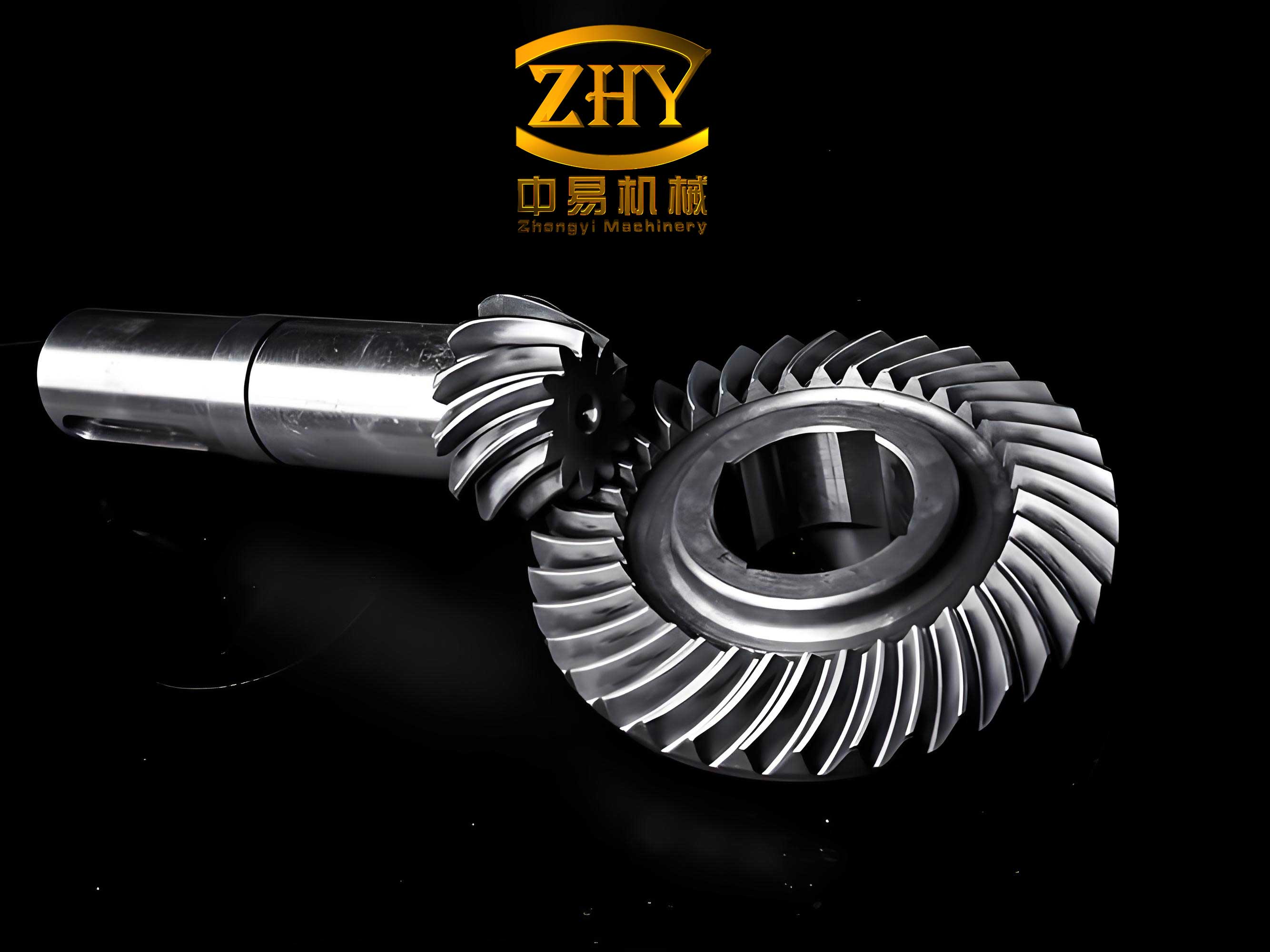
To illustrate the application, consider a sample calculation for a spiral bevel gear with the following parameters: pitch cone angle δ = 20°, tool profile angle α = 20°, formation radius R0 = 100 mm, and transmission ratio i = 1.5. Using the equations, we compute the coordinates of points on the tooth flank. For example, at a calculation point P with Rp = 50 mm and ψ = 0°, the parameters u, θ, and φ are solved numerically. The results show that the envelope surface closely matches the theoretical design when machine settings are optimized. Table 3 presents a comparison of key geometric properties derived from the model versus design specifications for a spiral bevel gear pair. This demonstrates the model’s utility in ensuring manufacturing accuracy.
| Property | Design Value | Model-Predicted Value | Deviation |
|---|---|---|---|
| Tooth Thickness at Pitch Cone (mm) | 10.2 | 10.18 | -0.02 |
| Pressure Angle (degrees) | 20 | 19.98 | -0.02 |
| Spiral Angle (degrees) | 35 | 34.95 | -0.05 |
| Contact Pattern Size (% of tooth face) | 60 | 58.5 | -1.5 |
In conclusion, the mathematical modeling of spiral bevel gear machining is a powerful tool for improving gear quality. By deriving the generating surface equations, envelope conditions, and computational parameters, we can simulate the cutting process and optimize machine settings. The algorithm presented here, based on coordinate transformations and discretization, allows for accurate prediction of tooth flank geometry. Future work could integrate this model with real-time monitoring systems or explore advanced topics like multi-axis machining of spiral bevel gears. Ultimately, such research contributes to the broader goal of enhancing the performance and reliability of mechanical transmissions involving spiral bevel gears. As I continue to investigate this area, I aim to develop more sophisticated models that account for dynamic effects and material behavior, further bridging the gap between theory and practice in gear manufacturing.
Throughout this paper, the term “spiral bevel gear” has been emphasized to underscore its centrality in the discussion. The mathematical framework developed here is not only applicable to traditional machining methods but also adaptable to modern techniques like CNC grinding or additive manufacturing for spiral bevel gears. By leveraging these models, engineers can achieve higher precision and efficiency in producing spiral bevel gears, meeting the growing demands of industries such as automotive and aerospace. In summary, the study of spiral bevel gear machining through mathematical modeling is an ongoing endeavor that holds promise for innovation in gear technology.