
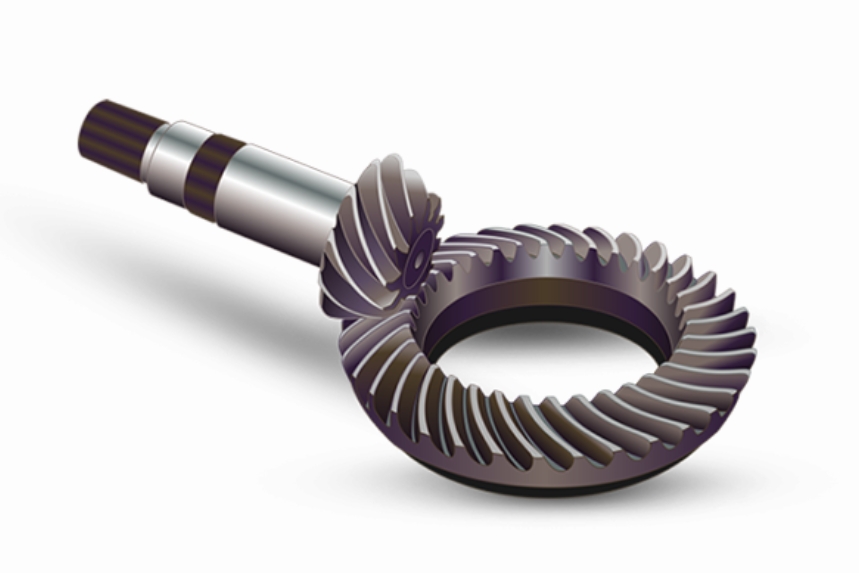
The reliable and efficient transmission of power and motion between intersecting, non-parallel shafts is a fundamental requirement in countless mechanical systems, from automotive differentials to aerospace rotorcraft drives and heavy industrial machinery. Among the various gear types capable of fulfilling this role, the spiral bevel gear stands out due to its superior performance characteristics. The curved, oblique teeth of a spiral bevel gear engage gradually, leading to smoother operation, higher load-carrying capacity, reduced vibration, and lower acoustic noise compared to straight bevel gears. This makes them the preferred choice for demanding applications where performance, durability, and quiet operation are paramount. However, the high-performance potential of spiral bevel gears is critically dependent on precise manufacturing and, equally importantly, accurate installation within the final assembly.
In practical engineering scenarios, perfect installation alignment is unattainable. Tolerances in housing bores, bearing fits, thermal expansions, and assembly practices inevitably introduce small but consequential misalignments between the gear and pinion axes. These installation errors disrupt the theoretically perfect meshing geometry meticulously designed into the spiral bevel gear pair. The consequences are multifaceted and detrimental: localized increases in contact stress leading to accelerated surface fatigue (pitting), uneven load distribution across the tooth face, shifts in the contact pattern towards sensitive edges, alterations in the transmission error spectrum (a key excitation source for noise and vibration), and ultimately, a reduction in the system’s overall efficiency, reliability, and service life. Therefore, a deep and quantitative understanding of how specific installation errors influence meshing performance is essential for robust design, tolerance allocation, and system diagnostics.
Traditional analytical methods for studying gear meshing, such as Tooth Contact Analysis (TCA) and its extension to include errors (ETCA), have provided invaluable insights. These numerical techniques solve the geometric conditions of contact between two idealized tooth surfaces, allowing for the prediction of contact path, transmission error, and sensitivity to misalignments. However, these methods are inherently limited to geometric and kinematic analysis. They treat the gear teeth as perfectly rigid bodies, neglecting the crucial physical phenomena that occur under real operating conditions: elastic deformation of the teeth, housing, and shafts; the redistribution of load among multiple tooth pairs in simultaneous contact; and the true, non-Hertzian pressure distribution within the contact ellipse. As spiral bevel gear applications push towards higher loads, higher speeds, and lighter structures, these deformation-related effects become increasingly significant and cannot be ignored for accurate performance prediction.
The advent of powerful computational mechanics and sophisticated finite element analysis (FEA) software has revolutionized the engineering analysis of complex systems like spiral bevel gears. FEA provides a comprehensive framework to transcend the limitations of pure geometric analysis. By discretizing the physical gear bodies into a mesh of finite elements, it becomes possible to simulate the coupled mechanical behavior—incorporating material elasticity, complex boundary conditions, realistic load application, and sophisticated surface-to-surface contact algorithms. This allows for the direct computation of stresses, strains, and deformations under load, offering a virtual prototype that closely mirrors physical reality. While previous studies have successfully applied FEA to analyze static and dynamic stresses, stiffness, and transmission error of spiral bevel gears, and others have used it to study installation errors in simpler gear types like spur gears, a focused and detailed FEA-based investigation into the specific effects of various installation errors on the loaded contact performance of spiral bevel gears represents a critical advancement. This approach bridges the gap, combining the error-sensitivity knowledge from TCA with the physical fidelity of FEA.
The primary objective of this analysis is to employ a rigorous finite element methodology to investigate and quantify the influence of key installation errors on the operational performance of a spiral bevel gear pair. We will move beyond geometric predictions to assess real mechanical responses under load. Specifically, the study will focus on four fundamental types of installation error: pinion axial offset (ΔA1), gear axial offset (ΔA2), axial offset or mounting distance error (often related to the hypoid offset E), and shaft angle error (ΔΣ). The response metrics will include the evolution of maximum contact stress during meshing, the fluctuation of the normal contact force, and the trajectory of the contact path across the tooth flank. The process involves generating an accurate, error-inclusive geometric model based on gear theory, converting it into a high-fidelity finite element model, executing nonlinear contact simulations, and post-processing the results to extract clear, comparative performance data. This integrated approach provides design and reliability engineers with a powerful tool to understand tolerance sensitivities, optimize gear geometry for robustness, and predict in-service behavior under realistic, imperfect assembly conditions.
Theoretical Foundation and Geometric Modeling
The starting point for any accurate mechanical analysis of spiral bevel gears is a precise digital representation of the tooth surfaces. These surfaces are not simple geometric primitives but are complex, spatially curved geometries generated via a specific machining process, typically using a face-mill or face-hob cutter. The mathematical model of the tooth surface is derived from the theory of gearing and the principles of the generating process. The surface coordinates are obtained by considering the envelope of the family of cutter surfaces as they move relative to the gear blank according to the prescribed machine tool settings.
The basic equation for a point on the manufactured tooth surface in the workpiece coordinate system can be expressed through the coordinate transformation from the cutter to the gear. Let us define a vector function \( \mathbf{r}_0(\mu, \theta) \) that describes the surface of the cutting tool (e.g., the surface of a blade or the grinding wheel), where \( \mu \) and \( \( \theta \) \) are the surface parameters. The transformation from the cutter coordinate system \( S_c \) to the gear coordinate system \( S_g \) involves a series of rotations and translations defined by the machine settings (cradle angle, sliding base, machine root angle, etc.), collectively represented by a homogeneous transformation matrix \( \mathbf{M}_{gc} \). The family of cutter surfaces in \( S_g \) is then given by:
$$
\mathbf{r}_g(\mu, \theta, \phi_c) = \mathbf{M}_{gc}(\phi_c) \cdot \mathbf{r}_c(\mu, \theta)
$$
where \( \phi_c \) is the generating motion parameter (often related to the cradle rotation).
The actual tooth surface is the envelope of this family. According to the theory of gearing, a point on the envelope satisfies the equation of meshing, which states that the common normal vector at the contact point must be perpendicular to the relative velocity between the tool and the workpiece:
$$
\mathbf{n}_g \cdot \mathbf{v}_g^{(c)} = f(\mu, \theta, \phi_c) = 0
$$
Here, \( \mathbf{n}_g \) is the unit normal vector to the surface in \( S_g \), and \( \mathbf{v}_g^{(c)} \) is the relative velocity vector. By simultaneously solving the locus equation \( \mathbf{r}_g(\mu, \theta, \phi_c) \) and the equation of meshing \( f(\mu, \theta, \phi_c)=0 \) for a discrete set of parameters, we obtain a point cloud \( \{\mathbf{r}_g^{(i)}\} \) that accurately represents the theoretical spiral bevel gear tooth surface. This procedure is applied independently to generate the pinion and gear tooth surfaces based on their respective machine settings.
The critical step for analyzing installation errors is to position these two independently generated tooth surfaces into their operational assembly configuration, which includes the specified misalignments. Instead of creating separate solid models and manually assembling them in CAD software—a process prone to introducing its own inaccuracies—a more robust method is used. The pinion and gear point clouds are transformed directly into a common, fixed “assembly” or “housing” coordinate system \( S_h \), with the transformations explicitly incorporating the installation errors.
For the pinion, the transformation from its own coordinate system \( S_1 \) to \( S_h \) involves its rotational position \( \phi_1 \) and its installation errors (e.g., axial offset ΔA1, and contributions to ΔΣ and ΔE). This is represented by matrix \( \mathbf{M}_{h1}(\phi_1, \Delta A_1, …) \). For the gear, a similar transformation \( \mathbf{M}_{h2}(\phi_2, \Delta A_2, …) \) is applied. The points and normals in the housing system are:
$$
\mathbf{r}_h^{(1)}(\mu_p, \theta_p, \phi_1) = \mathbf{M}_{h1} \cdot \mathbf{r}_1(\mu_p, \theta_p), \quad \mathbf{n}_h^{(1)} = \mathbf{L}_{h1} \cdot \mathbf{n}_1
$$
$$
\mathbf{r}_h^{(2)}(\mu_g, \theta_g, \phi_2) = \mathbf{M}_{h2} \cdot \mathbf{r}_2(\mu_g, \theta_g), \quad \mathbf{n}_h^{(2)} = \mathbf{L}_{h2} \cdot \mathbf{n}_2
$$
where \( \mathbf{L} \) matrices are the rotational parts (3×3) of the corresponding \( \mathbf{M} \) matrices.
To achieve a meshing position for a given pinion rotation \( \phi_1 \), we solve the system of equations known as Tooth Contact Analysis (TCA). The conditions for contact at a point are that the position vectors and the unit normals of both surfaces coincide in the fixed space:
$$
\mathbf{r}_h^{(1)}(\mu_p, \theta_p, \phi_1) = \mathbf{r}_h^{(2)}(\mu_g, \theta_g, \phi_2)
$$
$$
\mathbf{n}_h^{(1)}(\mu_p, \theta_p, \phi_1) = \mathbf{n}_h^{(2)}(\mu_g, \theta_g, \phi_2)
$$
This system is solved numerically for the unknowns \( \mu_p, \theta_p, \mu_g, \theta_g, \phi_2 \). The solution provides the conjugate contact point on the gear for the given pinion position and the specific installation errors embedded in the transformation matrices. By calculating this for a sequence of \( \phi_1 \) values, the complete meshing cycle is simulated geometrically. More importantly for model creation, using a specific \( \phi_1 \) and its solved \( \phi_2 \) to transform the point clouds ensures the two gear solids are generated in their correct, assembled orientation relative to each other, including all specified errors. This point cloud data is then imported into solid modeling software to generate surfaces and, subsequently, three-dimensional volumetric solids that are perfectly positioned, eliminating manual assembly error.
Finite Element Model Development
With accurately assembled solid models of the spiral bevel gear pair, the next phase involves constructing a finite element model suitable for nonlinear contact analysis. The goal is to capture the stress and deformation fields under load while maintaining computational efficiency. A full 360-degree model, while ideal, is often computationally prohibitive for dynamic or detailed static analysis due to the large number of elements and contact pairs required. Therefore, a sector modeling approach is adopted.
A representative segment containing multiple tooth pairs is extracted. Typically, a segment containing five teeth from both the pinion and the gear provides a good balance, as it is wide enough to capture the transfer of load from one tooth pair to the next (the load sharing effect) but not so large as to make the model unwieldy. The basic geometrical parameters for the example spiral bevel gear pair used in this study are summarized in the table below. These parameters are used with the local synthesis method to determine the detailed machine tool settings required to generate the tooth surfaces with desired contact properties.
| Basic Parameter | Value |
|---|---|
| Module (mm) | 3.85 |
| Number of Gear Teeth | 68 |
| Number of Pinion Teeth | 24 |
| Hand of Gear | Right |
| Hand of Pinion | Left |
| Mean Spiral Angle (°) | 25 |
| Pressure Angle (°) | 20 |
| Face Width (mm) | 40 |
The solid models are imported into a commercial FEA software package such as ABAQUS or ANSYS. To achieve a high-quality, structured mesh which improves solution accuracy and convergence, each single tooth is partitioned into several logical volumetric blocks. A common strategy involves dividing the tooth into the following regions: the root fillet area, the active flank region (often subdivided into heel, midpoint, and toe sections), the top land, and the web/body of the gear. This partitioning allows the application of mapped meshing or sweeping techniques, generating predominantly hexahedral elements. Hexahedral elements (e.g., C3D8R, reduced-integration brick elements) are generally preferred over tetrahedral elements for contact problems involving large stress gradients, as they provide better accuracy and convergence behavior for a given number of degrees of freedom.
The mesh density is highest in the potential contact region on the tooth flank and in the root fillet area where bending stresses peak. A coarser mesh can be used in the gear body far from these critical regions to reduce model size. The single-tooth mesh is then replicated in a circular pattern to create the meshed sector model. The nodes on the circumferential faces of the sector are constrained with appropriate periodic boundary conditions to simulate the behavior of the full ring. The material is defined as linear elastic steel with standard properties: Young’s Modulus \( E = 206,000 \) MPa, Poisson’s ratio \( \nu = 0.29 \), and density \( \rho = 7.8 \times 10^{-9} \) tonne/mm³.
The interaction between the pinion and gear teeth is the core of the analysis. Surface-to-surface contact pairs are defined between the potential contact zones on all five pinion teeth and their corresponding gear teeth. A “master-slave” algorithm is employed, with the finer-meshed surface typically designated as the slave. The contact normal behavior is defined as “hard” contact, which enforces the impenetrability constraint. The tangential behavior is often modeled as frictionless for initial studies to simplify convergence, though a Coulomb friction model (with a coefficient ~0.05-0.1) can be incorporated for more detailed analysis. The finite sliding formulation is used to accommodate the large relative motion between the teeth.
Boundary conditions and loads are applied to simulate a quasi-static loading condition. A reference point (RP) is created at the theoretical center of each gear segment and coupled to the inner bore surface of the model using a kinematic coupling constraint (or rigid body elements). This RP represents the shaft connection. All degrees of freedom at the pinion’s RP are fixed except for rotation about its axis. A small, smooth rotational velocity (e.g., 0.25 rad/s) is applied to the pinion RP to drive the meshing cycle slowly, making the problem quasi-static and mitigating dynamic inertia effects. At the gear’s RP, all degrees of freedom are fixed except for rotation about its axis, and a constant resistive torque (e.g., \( T = 1000 \) Nm) is applied. The analysis is performed using an explicit dynamics solver (ideal for complex contact problems) with mass scaling to achieve a reasonable solution time, or a static solver with stabilization if the misalignments are small. The output requests include the contact pressure (CPRESS), contact forces (CFN), and the stress field (e.g., Mises stress) throughout the analysis time.
Analysis of Installation Error Effects
To systematically study the impact of installation errors, a baseline model with perfect alignment is first analyzed. Subsequently, a series of models are created and analyzed, each incorporating one specific installation error of a defined magnitude. The error magnitudes chosen for this study are representative of realistic assembly tolerances in precision systems: axial displacements (ΔA1 and ΔA2) of +0.05 mm, an offset error (ΔE) of +0.05 mm, and a shaft angle error (ΔΣ) of +0.05°. The positive direction is defined such that each error tends to shift the contact pattern towards the toe (thin end) of the gear tooth, facilitating comparison. The following sections detail the post-processing methodology and the comparative results for contact stress, normal force, and contact path.
Contact Stress Analysis
Contact stress, or more precisely the contact pressure distribution, is the primary indicator of surface durability. Excessive or poorly distributed contact stress leads to premature pitting and wear. From the FEA results, the contact pressure (CPRESS) is output for all slave nodes in the contact pairs at each solution increment. A Python script is employed to automate the post-processing: it extracts, for every output frame, the contact pressure value for every node on the active flank. The maximum contact pressure value among all contacting nodes at that instant is identified and stored. Plotting this maximum contact pressure against the pinion rotation angle (or a normalized meshing position) yields the contact stress history for one complete mesh cycle involving multiple tooth pairs.
The results reveal distinct trends. The baseline model (perfect alignment) shows a relatively smooth and consistent peak contact stress curve as load is transferred from one tooth pair to the next. When installation errors are introduced, significant deviations occur. The model with a pinion axial offset (ΔA1 = +0.05 mm) exhibits the most severe effect, showing a substantial increase in the peak contact stress throughout the meshing cycle. The model with a gear axial offset (ΔA2 = +0.05 mm) also shows a clear increase in peak stress, though generally slightly lower than that caused by the pinion error. This asymmetry is common in spiral bevel gears due to the different curvatures and pressure angles of the convex (pinion) and concave (gear) flanks.
In contrast, the models with offset error (ΔE = +0.05 mm) and shaft angle error (ΔΣ = +0.05°) show peak contact stress curves that are much closer to the baseline. Their magnitudes fluctuate around the baseline value, with no consistent, significant increase. However, it is important to note that while the peak magnitude may not drastically change, the distribution and location of the stress can be altered, which is assessed through the contact path. The sequence and angular position of the stress peaks also shift slightly between different error cases, reflecting changes in the loaded tooth contact pattern and the precise timing of the load sharing between adjacent tooth pairs.
Normal Contact Force Analysis
The total normal contact force transmitted between a single mating tooth pair is a direct measure of the load carried by that pair. In a multi-tooth FEA model, this force can be extracted as a history output (CFN) for each contact pair. Plotting the normal force for a representative contact pair over the meshing cycle provides insight into load sharing and the effect of errors on the force magnitude.
The trends in normal force closely mirror those of contact stress, confirming the consistency of the analysis. The pinion axial offset model produces the highest peak normal force, calculated to be approximately 10-11% higher than the baseline force. The gear axial offset model follows, with an increase of about 9-10%. These increases occur because the axial misalignment disrupts the optimal conjugate contact, leading to a loss of load distribution breadth (the contact ellipse may become narrower or more concentrated) and potentially engaging the teeth in a slightly mismatched geometry that is less efficient at bearing load, effectively increasing the force density. The force curve for the offset error (ΔE) model is virtually indistinguishable from the baseline, indicating negligible impact on the force magnitude for this small error.
The shaft angle error (ΔΣ) model presents an interesting case: the peak normal force is actually slightly lower than the baseline. This might initially seem counterintuitive. However, this reduction is often accompanied by a more abrupt rise and fall of the force curve, indicating a shorter contact duration. This suggests a reduction in the effective contact ratio or a shift of contact towards the very edge of the tooth, where the local compliance is different. The lower integrated force could be a result of load being shed to other pairs differently or a sign of impending edge contact, which is highly undesirable. Thus, while the force magnitude might not increase, the shaft angle error can degrade performance by promoting unstable contact conditions and noise.
Contact Path and Pattern Analysis
The contact path—the locus of the center of the contact ellipse as it travels across the tooth flank from heel to toe (or vice versa)—is a critical visual indicator of meshing quality. An ideal path is centered on the tooth flank, runs diagonally, and has an appropriate length. Errors cause this path to shift, shorten, or become irregular. To extract this from FEA results, the Python script identifies all nodes in contact (CPRESS > 0) at each time increment. The geometric center of these contacting nodes is calculated in the local tooth coordinate system. Connecting these center points across successive time steps plots the contact path trajectory.
As designed, all four error cases cause a shift of the contact path towards the toe compared to the centered baseline path. However, the degree of shift varies markedly. The pinion axial offset induces the most pronounced toe-ward shift, significantly altering the path location. The gear axial offset also causes a clear and substantial shift. These large shifts correlate directly with the significant increases in contact stress and force, as moving the contact zone away from the optimally designed center reduces the effective contact area and leverages unfavorable tooth geometry. The paths for the offset error (ΔE) and shaft angle error (ΔΣ) models show only minor deviations from the baseline path. Their trajectories are very close to the nominal, explaining why the contact stress and force magnitudes were less affected. However, even a small shift can be important if it moves the path closer to the tooth edge, increasing the risk of stress concentrations at the tip or toe.
The following table summarizes the comparative effects of the four installation errors studied on the key performance metrics of the spiral bevel gear pair:
| Error Type | Symbol | Magnitude | Primary Effect | Relative Severity |
|---|---|---|---|---|
| Pinion Axial Offset | ΔA1 | +0.05 mm | Major increase in contact pressure & force; significant toe-ward shift. | Highest |
| Gear Axial Offset | ΔA2 | +0.05 mm | Substantial increase in contact pressure & force; noticeable toe-ward shift. | High |
| Axis Offset (E) | ΔE | +0.05 mm | Minimal change in contact metrics; minor path shift. | Low |
| Shaft Angle (Σ) | ΔΣ | +0.05° | Reduced contact force with potential for edge contact; minor path shift. | Low (but risk of edge contact) |
Discussion and Engineering Implications
The finite element analysis clearly demonstrates a hierarchy of sensitivity for the spiral bevel gear pair with respect to the installation errors studied. Axial positioning errors (ΔA1 and ΔA2) are the most critical. They directly alter the working distance of the gears, which has a first-order effect on the local curvature match between the pinion and gear tooth surfaces. This mismatch concentrates the load on a smaller area, leading to the observed sharp rise in contact pressure and normal force. The contact path is forcibly relocated, potentially into regions not designed for high load. In practice, this means that special attention must be paid during assembly to the shimming and axial positioning of both the pinion and the gear. Tolerances for axial location should be the tightest among the installation parameters.
The lower sensitivity to offset error (ΔE) and shaft angle error (ΔΣ), for the small magnitudes studied, is an important finding. It suggests that for this specific gear design, minor deviations in these parameters may be accommodated without catastrophic increases in contact stress. This provides valuable leeway for manufacturing tolerances in housing bore locations and bearing seat alignments. However, this conclusion should not be generalized without caution. The sensitivity is highly dependent on the specific gear geometry, especially the spiral angle and the degree of curvature. Furthermore, while peak stress may not spike, shaft angle error can degrade the meshing smoothness by altering the transmission error curve and, as indicated by the sharper force transition, potentially reducing contact ratio, which excites vibrations. It also increases the risk of edge contact under heavier loads or larger error magnitudes, a failure mode not fully captured in a linear-elastic analysis.
The methodology itself highlights the power of modern FEA. By integrating the geometric generation theory (TCA) directly into the pre-processing stage, we ensure the finite element model is physically accurate from the outset, incorporating the exact tooth geometry with errors. The FEA then adds the indispensable layer of mechanical realism: deformation, multi-tooth contact, and true load distribution. The automated post-processing via scripting is crucial for efficiently extracting and comparing quantitative data like stress curves and path coordinates from multiple complex simulations.
For the design engineer, this analysis approach is a potent tool. It enables:
- Tolerance Analysis: Quantifying the performance degradation for given error magnitudes allows for the establishment of science-based, functional assembly tolerances rather than relying solely on general standards.
- Robust Design: The gear macro-geometry (pressure angle, spiral angle) and micro-geometry (modifications like flank crowning, bias) can be iteratively optimized in the virtual environment to make the spiral bevel gear pair more tolerant to expected ranges of installation errors, thereby improving real-world reliability.
- Diagnostics: The characteristic changes in contact path and stress pattern predicted by FEA for specific errors can serve as a fingerprint to diagnose root causes of problems observed in physical testing or field failures.
Conclusion
This investigation employed an integrated finite element methodology to rigorously analyze the influence of key installation errors on the operational performance of a spiral bevel gear pair. The process began with the mathematical generation of precise tooth surfaces incorporating specified misalignments, ensuring an accurately assembled digital twin. A detailed, multi-tooth sector finite element model was then developed and subjected to nonlinear contact analysis under load, simulating real operating conditions including elastic deformation and load sharing.
The results provide clear, quantitative insights. Axial installation errors—specifically, deviations in the pinion and gear axial positions—were identified as the most detrimental to the meshing performance of the spiral bevel gear system. These errors caused significant increases in maximum contact stress (over 10% in the studied case) and normal contact force, coupled with a substantial and undesirable shift of the contact path towards the toe end of the tooth. Such effects directly compromise the surface durability, load capacity, and potentially the bending strength of the gear teeth.
In contrast, small errors in the shaft offset (ΔE) and the shaft intersection angle (ΔΣ) were found to have a comparatively minor impact on the magnitude of contact stress and force for the specific gear geometry analyzed. Their primary influence was a slight shift in the contact path. However, the shaft angle error indicated a potential to reduce contact smoothness, warranting attention for noise and vibration-critical applications.
The study conclusively demonstrates that finite element analysis, when properly integrated with gear geometric theory, is a superior tool for assessing the real-world performance of spiral bevel gears. It moves beyond purely kinematic predictions to deliver a comprehensive mechanical response that includes the critical effects of deformation and multi-pair contact. This capability is essential for advancing the design, manufacturing, and application of high-performance spiral bevel gear drives across aerospace, automotive, and industrial sectors, enabling more reliable, efficient, and quiet power transmission systems. Future work could extend this approach to dynamic analysis, the study of combined errors, thermal effects, and the inclusion of advanced material models to capture plastic deformation or fatigue damage initiation.