
Spiral bevel gears are integral components in modern power transmission systems, prized for their high load-bearing capacity, smooth operation, and low noise characteristics. Their application spans critical industries such as aerospace, maritime, and automotive engineering, where reliability and performance under demanding conditions are paramount. As technological progress pushes these gears towards higher speeds, greater loads, and lighter weight designs, understanding the stress state within the gear teeth under actual operating conditions becomes crucial for predicting service life and ensuring structural safety. Traditional gear strength calculations, often based on empirical formulas, possess inherent limitations and uncertainties when dealing with the complex three-dimensional contact and bending stresses in spiral bevel gears. This article details a comprehensive methodology for conducting a high-fidelity stress analysis of a spiral bevel gear pair. The process begins with the precise mathematical modeling of the tooth surfaces based on generation principles, proceeds through the construction of a solid model and a high-quality finite element mesh, and culminates in a multi-tooth contact analysis using the ABAQUS solver. The results provide clear visualization and quantitative data on contact and bending stress distribution, offering valuable insights for the design and application of spiral bevel gears.
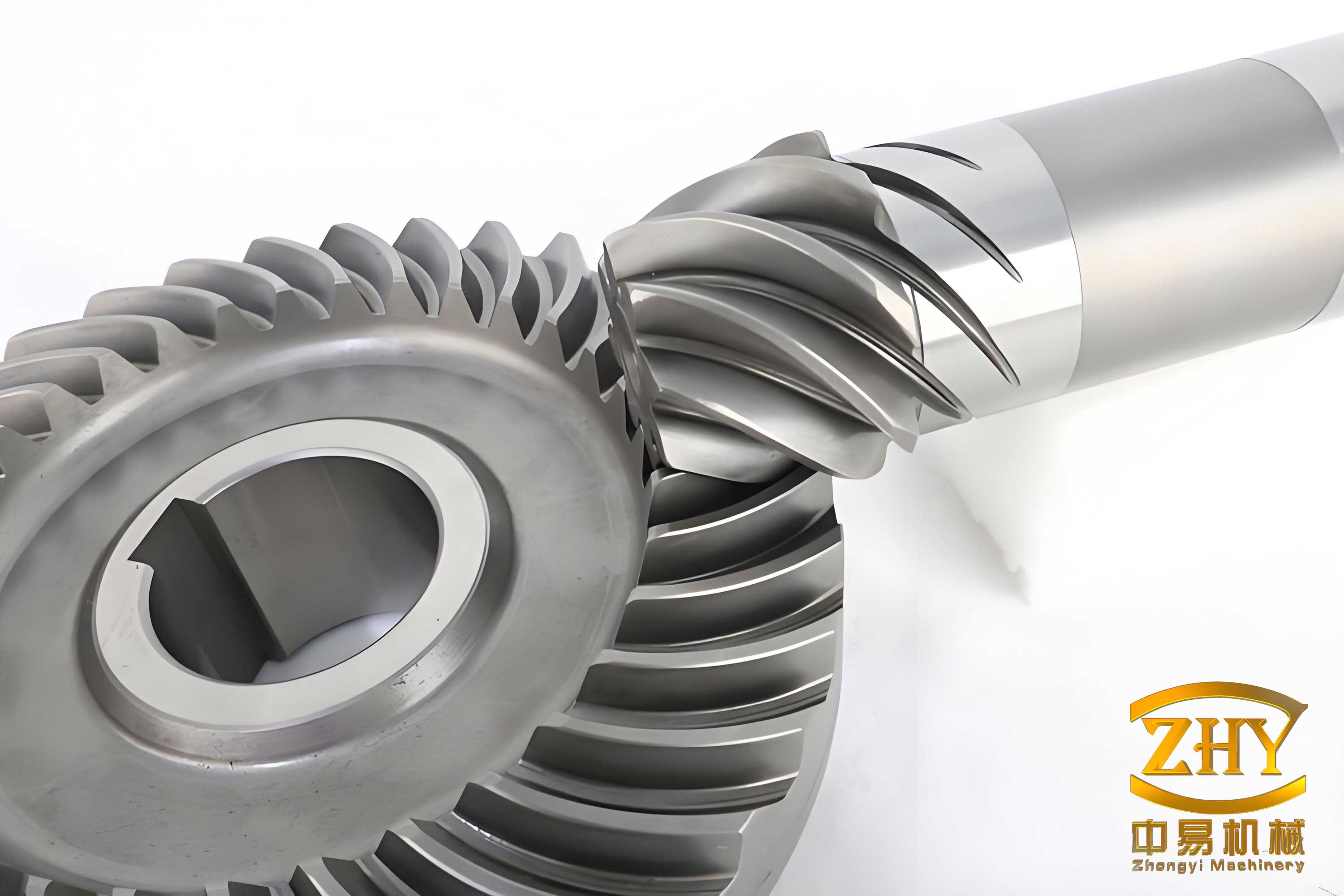
The geometry of a spiral bevel gear tooth is intrinsically complex, arising from a simulated generation process between a imaginary crown gear (or generating gear) and the workpiece. To establish an accurate digital model, we first define the fundamental parameters of the gear pair under study, as summarized in the table below.
| Parameter | Pinion (Driver) | Gear (Driven) |
|---|---|---|
| Number of Teeth (Z) | 11 | 45 |
| Module (mm) | 6 | 6 |
| Face Width (mm) | 45 | 45 |
| Mean Spiral Angle (°) | 35 (Left Hand) | 35 (Right Hand) |
| Pressure Angle (°) | 20 | 20 |
| Shaft Angle (°) | 90 | |
The mathematical foundation for the tooth surface coordinates is derived from the theory of gearing and the kinematic relationship of the cutting process. The surface of the imaginary generating gear is known. Through the coordinate transformation that describes the relative rolling motion between the generator and the workpiece gear blank, the family of generator surfaces is enveloped in the coordinate system fixed to the workpiece. The meshing condition equation provides the constraint needed to identify the unique contact line at each instant. The locus of these contact lines forms the theoretical tooth surface of the spiral bevel gear.
The coordinate transformation chain is essential. Typically, we define a machine coordinate system \( S_m(X_m, Y_m, Z_m) \), a generator coordinate system \( S_g(X_g, Y_g, Z_g) \), and a workpiece coordinate system \( S_w(X_w, Y_w, Z_w) \). The surface of the cutter blade in \( S_g \) is given by a vector function \( \vec{r_g}(u, \theta) \), where \( u \) and \( \theta \) are surface parameters. The transformation from \( S_g \) to \( S_w \) involves rotations related to the machine root angle, cradle angle \( \phi_g \), and workpiece rotation angle \( \phi_w \). The relationship between \( \phi_g \) and \( \phi_w \) is defined by the ratio of roll, \( R_{roll} \), which is fundamental to generating the desired tooth curvature:
$$ \phi_w = \frac{\phi_g}{R_{roll}} $$
The meshing condition states that the common normal vector at the point of contact must be perpendicular to the relative velocity vector between the two bodies. This can be expressed using the scalar product:
$$ \vec{n} \cdot \vec{v}^{(gw)} = 0 $$
where \( \vec{n} \) is the unit normal to the generator surface and \( \vec{v}^{(gw)} \) is the relative velocity of the generator with respect to the workpiece, both represented in a common coordinate system. Solving this equation simultaneously with the coordinate transformation \( \vec{r_w}(u, \theta, \phi_g) \) yields the coordinates of discrete points on the tooth surface for a given generator setting and workpiece position. By programming this algorithm in MATLAB, we can systematically compute a dense point cloud representing the entire active flank of both the pinion and gear. The coordinate output for a sample point ‘i’ on the pinion concave side can be structured as follows:
| Point ID | X_w (mm) | Y_w (mm) | Z_w (mm) | Surface Flag |
|---|---|---|---|---|
| Pinion_Concave_i | x_i | y_i | z_i | Concave |
These discrete points, grouped by tooth and flank (concave/convex), are then imported into SolidWorks. Using the gear blank dimensions (pitch cone angle, root cone angle, back angle, etc.), a solid model is constructed. The point cloud serves as a guide for creating spline-based surfaces, which are then stitched together and joined with the gear body to form a complete, watertight solid model of the spiral bevel gear pair. This model serves as the precise geometry for subsequent finite element analysis.
The transition from a solid CAD model to a finite element model is a critical step that dictates the accuracy and computational cost of the simulation. The highly curved and twisted geometry of a spiral bevel gear tooth presents a significant challenge for automated mesh generation, especially when seeking a structured hexahedral mesh, which is generally preferred for contact analysis due to its superior accuracy and lower element count compared to tetrahedral meshes. While ABAQUS has robust meshing capabilities, the complexity of the spiral bevel gear geometry often necessitates a more specialized preprocessor for generating high-quality hexahedral elements. Therefore, HyperMesh, with its advanced solid meshing modules, was employed for this task.
To improve meshing efficiency and focus computational resources on the contact region, the gear model is often partitioned. Sections of the body far from the teeth (e.g., part of the hub or shaft) that do not significantly influence the local stress state can be removed or meshed with coarser elements. In HyperMesh, the Solid Map function is utilized. This tool allows for the semi-automatic decomposition of the volume into mappable sub-volumes, which are then filled with a structured grid of hexahedral elements. Key parameters for the mesh include element size and growth rate. A finer mesh is applied in the fillet region and along the potential contact paths on the flank to capture high stress gradients accurately. A summary of the mesh statistics is presented below:
| Component | Element Type | Number of Elements | Approx. Size in Contact Zone |
|---|---|---|---|
| Pinion (Active Teeth) | C3D8R (8-node linear hex, reduced integration) | ~150,000 | 0.5 mm |
| Gear (Active Teeth) | C3D8R | ~180,000 | 0.5 mm |
The completed finite element mesh is exported from HyperMesh in a format compatible with ABAQUS (.inp file) and imported for the setup of the analysis. The subsequent pre-processing within ABAQUS involves several key steps:
- Material Property Definition: The gear material is modeled as linear elastic, isotropic steel. The properties are defined as:
- Young’s Modulus, \( E = 210,000 \) MPa
- Poisson’s Ratio, \( \nu = 0.3 \)
- Density, \( \rho = 7800 \) kg/m³ (relevant for dynamic analyses, though this is a static study)
- Interaction Definition: The contact between the pinion and gear tooth flanks is the core of the analysis. A surface-to-surface contact pair is defined.
- Sliding Formulation: Finite sliding. This is the most general and accurate formulation for problems where surfaces may undergo large relative motion.
- Contact Pressure-overclosure: “Hard” Contact. This prevents nodes on the slave surface from penetrating the master surface but allows separation.
- Tangential Behavior: Penalty friction formulation with a coefficient of \( \mu = 0.1 \).
- Analysis Step Creation: A quasi-static analysis is performed. To ensure robust convergence, the loading is applied in three distinct general static steps:
Step Name Purpose Key Actions Step-1: Initial Contact Establish stable contact between gear pairs from an initially slightly separated or just-touching state without inducing large stresses. Apply a tiny rotational displacement (e.g., 0.001 rad) to the pinion reference point. Fully constrain the gear reference point. Step-2: Load Application Apply the full operational torque to the system. Keep pinion rotation fixed from Step-1. Apply a torque load, \( T = 500 \) N·m, to the gear reference point. The torque ramps up from 0 to T over this step. Step-3: Stabilization Allow the system to reach a steady-state stress distribution under full load. Hold all loads and boundary conditions constant. This step is often short and allows any transient effects from load application to settle. The step controls are vital for convergence. The automatic incrementation scheme is used with the following settings: Initial increment size = 0.0001, Minimum increment size = 1e-8, Maximum increment size = 0.01, Maximum number of increments = 1000. These conservative settings help the solver navigate the non-linearities introduced by contact.
- Boundary Conditions and Coupling: Since solid (continuum) elements have only translational degrees of freedom at their nodes, torque or rotation cannot be applied directly. A reference point (RP) is created coincident with the axis of each gear. A Kinematic Coupling constraint is then defined, tying all the degrees of freedom of the nodes on the gear’s bore surface to the reference point. This causes the gear to behave as a rigid body connected to the RP, allowing boundary conditions (rotation, torque) to be applied at the RP which are then transmitted to the entire gear body.
- Pinion RP: Coupled to the pinion bore.
- Gear RP: Coupled to the gear bore.
Upon successful completion of the analysis, the results are visualized and interrogated within ABAQUS/Viewer. The primary outputs of interest are the von Mises equivalent stress (a good predictor of yield for ductile materials) and the contact pressure. The analysis clearly shows the progression of contact through the mesh cycle.
For the specified load of 500 N·m, the stress distributions are as follows. On the convex side of the gear tooth and the concave side of the pinion tooth, which form one of the primary contact pairs, the contact pressure forms a distinct elliptical patch. This is a classic signature of Hertzian-type contact, albeit modified by the complex geometry of the spiral bevel gear. The maximum contact stress values observed are:
| Component & Flank | Max. Equivalent Contact Stress (MPa) | Location |
|---|---|---|
| Gear Convex Side | 318.3 | Center of elliptical contact patch |
| Pinion Concave Side | 325.0 | Center of elliptical contact patch |
The bending stress, critical for tooth root integrity, is highest at the root fillet region on the loaded side of the tooth. The maximum values extracted from the analysis are:
| Component & Flank | Max. Equivalent Bending Stress (MPa) | Location |
|---|---|---|
| Gear Convex Side (Root) | 225.4 | Root fillet, beneath contact zone |
| Pinion Concave Side (Root) | 157.5 | Root fillet, beneath contact zone |
By animating the results through the mesh cycle, the dynamic behavior of the spiral bevel gear pair is revealed. The contact ellipse traverses the tooth surface from the inner end (toe) towards the outer end (heel), and also shifts along the profile from near the root towards the tip, depending on the specific conjugate point of contact. This path of contact is a fundamental characteristic of spiral bevel gears, contributing to their smooth and gradual load transfer. The stress plots show the corresponding variation in both contact and root bending stress magnitudes as different pairs of teeth come into and out of engagement. The peak stresses occur when the contact is near the center of the face width.
In conclusion, the integrated methodology employing mathematical generation modeling via MATLAB, solid modeling in CAD, advanced hex-dominant meshing in HyperMesh, and nonlinear finite element analysis in ABAQUS provides a powerful and accurate framework for analyzing spiral bevel gears. This approach moves beyond the limitations of traditional handbook formulas by directly simulating the complex three-dimensional contact mechanics. The results successfully demonstrate the elliptical contact pattern and its traversal across the tooth flank, validating the model against established theoretical expectations. The detailed stress contours for both contact and bending offer designers precise data for evaluating factor of safety, optimizing tooth geometry, and predicting fatigue life. The finite element method, as demonstrated, is an indispensable tool in the modern design and validation process for high-performance spiral bevel gears, enabling more reliable, efficient, and compact gearbox designs.