
The spiral bevel gear is a critical component in countless power transmission systems, renowned for its high load capacity, smooth operation, and efficiency, especially in applications involving intersecting shafts. Its complex, spatially curved tooth geometry, however, presents significant manufacturing challenges. Traditional methods predominantly rely on dedicated gear cutting machines using face-milling or face-hobbing processes. While effective, these methods can be material-wasteful, energy-intensive, and may impose certain limitations on the final gear strength due to the cutting process interrupting the material grain flow.
This article explores a transformative manufacturing approach: the precision forging of the driven (larger) spiral bevel gear. For a substantial subset of spiral bevel gear pairs—specifically those with high transmission ratios where the driven gear’s pitch cone angle exceeds 60 degrees—precision forging emerges as a viable and highly advantageous alternative to machining. This process involves forming the gear teeth directly into a metal blank through plastic deformation within a precision die, potentially eliminating the need for subsequent tooth cutting. The corresponding pinion (smaller gear) is then machined conventionally to mesh correctly with the forged gear. This hybrid strategy leverages the efficiency of forging for the large, slow-to-machine component while retaining the flexibility of cutting for the more complex pinion.
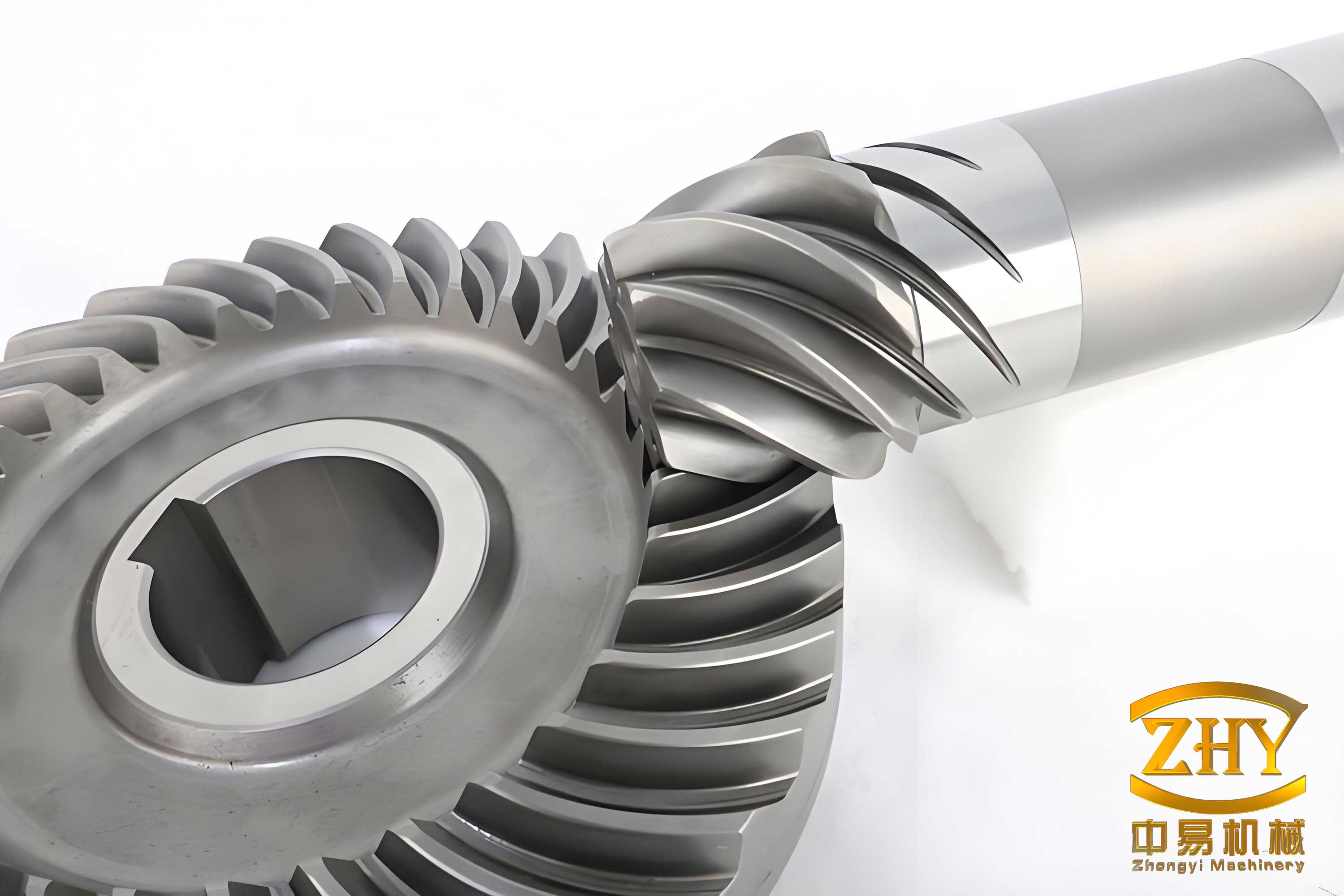
The fundamental advantage of precision forging for a spiral bevel gear lies in its potential for near-net-shape production. This leads to superior material utilization, reduced energy consumption per part, shorter cycle times suitable for high-volume production, and most importantly, enhanced mechanical properties. The forging process aligns the metal’s grain structure along the tooth profile, creating continuous fiber lines that significantly improve fatigue resistance, bending strength, and impact toughness compared to a cut tooth where the fibers are severed. The successful implementation of this technology for complex geometries like the spiral bevel gear represents a significant leap towards green, energy-efficient, and high-performance manufacturing within the gear industry.
1. Core Principles and Prerequisites for Precision Forging
The journey to a precision-forged spiral bevel gear begins long before the forging press is activated. It is fundamentally rooted in meticulous digital design and process planning. The entire chain—from the theoretical tooth flanks to the forging die cavity—depends on a single, accurate source of truth: the digital gear model defined by its machine settings.
1.1 Theoretical Foundation: Local Synthesis and Flank Modification
Unlike simple gears, spiral bevel gears are designed for localized contact (point contact under load, spreading to an elliptical area) to accommodate misalignments and deflections. This is achieved through deliberate flank modifications introduced during the cutting process. When transitioning to forging, these modifications must be precisely “baked into” the die. The design process employs local synthesis methodology and Tooth Contact Analysis (TCA) to calculate the machining parameters that will yield the desired meshing behavior—optimal contact pattern location, size, and motion direction under load.
The conjugate condition at a reference point \( M \) on the tooth flank requires that the normals to both gear surfaces coincide and that the relative velocity at that point lies in the common tangent plane. This can be expressed using the equation of meshing:
$$ \mathbf{n}^{(1)} \cdot \mathbf{v}^{(12)} = 0 $$
where \( \mathbf{n}^{(1)} \) is the unit normal to the pinion tooth surface and \( \mathbf{v}^{(12)} \) is the relative velocity vector of the pinion with respect to the gear at point \( M \). Local synthesis uses higher-order derivatives of this basic condition to control the transmission error curve and contact path direction.
1.2 3D Geometric Modeling: From Parameters to Digital Twin
Given a validated set of machining parameters (like those in Table 2), the exact tooth flank geometry of the spiral bevel gear can be mathematically reconstructed. This involves modeling the generating process. The surface of the imaginary generating gear (cutter head) is defined, and through a series of coordinate transformations representing the machine tool kinematics, the family of surfaces swept by the cutter is determined. The envelope of this family defines the theoretical gear tooth surface.
A point \( \mathbf{r}_c \) on the cutter blade surface is transformed to the gear coordinate system \( S_g \) via a series of homogeneous transformations involving machine settings like radial distance \( S_r \), machine root angle \( \gamma_m \), and cradle angle \( \psi_c \):
$$ \mathbf{r}_g = \mathbf{M}_{g,c}(\psi_c, S_r, \gamma_m, \ldots) \cdot \mathbf{r}_c $$
By calculating this for a dense point cloud over the complete generating motion, the coordinates of points on the finished tooth flank are obtained. These points are then imported into CAD software (e.g., UG NX, CATIA) to generate a precise, watertight 3D solid model. This model serves as the “digital twin” of the final forged spiral bevel gear and is the direct input for die cavity machining.
Critical considerations for the forging-specific model include:
- Draft Angles & Undercuts: The spiral bevel gear model must be analyzed for forgeability. The combination of spiral angle and face cone angle may create undercuts that prevent the part from being ejected from a simple straight-draw die. Sophisticated die design, potentially involving segmented dies or special ejection schemes, may be required.
- Back Cone Adaptation: The true back cone (perpendicular to the pitch cone) often creates an undercut in the forging direction. A practical solution is to replace this conical surface with a simple cylindrical surface, ensuring a positive draft for part ejection.
1.3 Process Chain Definition
The typical process sequence for producing a precision-forged spiral bevel gear is outlined below. Each step is inter-dependent, and quality assurance is paramount throughout.
| Stage | Process | Key Objective / Outcome |
|---|---|---|
| 1. Design & Digital Validation | Local Synthesis, TCA, 3D Modeling | Creation of a verified 3D gear model with optimal meshing performance. |
| 2. Master Gear Fabrication | 5-Axis CNC Milling of a “Master Gear” | Physical validation of the digital model. Used for initial inspection and pinion matching trials. |
| 3. Die Manufacturing | 5-Axis CNC Machining of Forging Die Cavity (Hardened Steel) | Translation of the gear geometry into the negative impression in the forging tool. Requires ultra-high precision and post-hardening finishing. |
| 4. Forging Process | Billet Heating → Hot Forging → Cleaning → Cold Sizing (Coining) | Plastic deformation to form the near-net-shape gear teeth. The cold sizing step is critical for achieving final dimensional accuracy and surface finish. |
| 5. Post-Forging Machining | Turning, Drilling, etc., using tooth flanks for location | Machining of non-forged features (bore, mounting face, bolt holes) with precise reference to the forged tooth geometry. |
| 6. Heat Treatment | Carburizing, Hardening, Tempering | Achieving the required surface hardness and core toughness. This step introduces distortion. |
| 7. Final Inspection & Pinion Matching | Gear Measurement, Final Pinion Cutting/Adjustment | Verification of the forged gear’s quality and final machining of the mating pinion to compensate for any heat treatment distortion in the gear. |
2. Critical Manufacturing Phases: From Die to Finished Gear
2.1 Die Manufacturing: The Heart of Precision
The forging die is the inverse of the final spiral bevel gear part. Creating its cavity with micron-level accuracy is the most technologically demanding step. The process typically involves machining the cavity into a block of high-grade hot-work tool steel (e.g., H13) using a 5-axis machining center. The tool paths are generated directly from the 3D gear model. After roughing and semi-finishing, the die block is heat-treated to high hardness (45-50 HRC) to withstand forging loads and wear.
Post-hardening, the cavity must be finished to its final dimensions and surface quality. This is done with fine-grain carbide or CBN (Cubic Boron Nitride) ball-nose end mills. To combat tool deflection (“tool push-off”) during this final cut, a two-step strategy is essential: a semi-finishing pass leaving a minimal, uniform stock (e.g., 0.05-0.1mm), followed by a light finishing pass. For large dies, tool wear becomes significant, necessitating mid-process tool changes with the aid of a high-precision touch probe to ensure seamless continuation of accuracy.
2.2 The Forging Process: Hot Forging and Cold Sizing
The forging process itself is a carefully choreographed sequence of deformation stages. A typical flow for a medium-sized spiral bevel gear made from low-alloy steel (e.g., 20MnCr5) is:
- Billet Preparation & Heating: A cylindrical billet is sheared to weight and heated uniformly to the forging temperature (typically 1150-1250°C for steels).
- Hot Forging: The hot billet is transferred to the forging press and formed in the pre-heated die cavity. The goal is rapid, single-stroke formation to minimize die contact time and reduce die thermal fatigue. The part, known as a “forge,” has all the tooth geometry but with added material for a subsequent sizing operation and a rough external shape.
- Cleaning & Preparation for Sizing: The hot-forged part is cleaned (e.g., by shot blasting) to remove scale. It then undergoes phosphating and soaping, which deposits a lubricant layer essential for the cold sizing operation.
- Cold Sizing (Coining): This is the precision-defining step. The forged part is placed in a separate, ultra-precision die and struck with a high force at room temperature. This operation:
- Refines the tooth profile to the final dimensions.
- Improves surface finish through controlled metal flow.
- Increases dimensional accuracy and reduces scatter.
- Induces beneficial compressive residual stresses in the tooth root.
The sizing allowance (extra material left from hot forging) is critical. If too small, the die doesn’t fill completely; if too large, excessive pressure causes high elastic die deflection and part springback, degrading accuracy. An intermediate “pre-sizing” step is often beneficial. The sizing force \( F_s \) can be estimated from the flow stress of the material \( \sigma_f \) and the projected area of the teeth being sized \( A \), considering a constraint factor \( K \):
$$ F_s \approx K \cdot \sigma_f \cdot A $$
2.3 Post-Forging Machining and Heat Treatment
After cold sizing, the spiral bevel gear blank has precise teeth but lacks other functional features. These are machined using the forged teeth as the primary datum. A dedicated fixture, whose locating surface is a negative of the gear teeth (machined with the same precision as the forging die), is used to hold the part. This ensures that the bore, front face, and bolt holes are machined concentrically and perpendicular to the theoretical axis of the forged tooth geometry.
Subsequent carburizing and hardening impart the necessary wear resistance. However, heat treatment causes distortion. The established practice is to measure the hardened forged gear and then use these results to make final, compensatory adjustments to the machining parameters of the mating pinion. This final pairing step ensures excellent meshing performance despite the inevitable heat treatment distortions in the forged spiral bevel gear.
3. Technical Analysis: Expected Performance and Verification
The transition from cutting to forging for a spiral bevel gear has profound implications for its performance characteristics. A comparative analysis highlights the key benefits.
| Aspect | Traditional Cut Spiral Bevel Gear | Precision Forged Spiral Bevel Gear |
|---|---|---|
| Material Utilization | Low. Significant chip generation from the tooth spaces. | High. Near-net-shape forming minimizes waste. |
| Grain Flow | Interrupted. Cutting severs the natural grain lines. | Continuous. Grain lines follow the tooth contour, enhancing strength. |
| Tooth Root Strength | Standard. Subject to the machined surface condition. | Enhanced. Superior fatigue resistance due to favorable grain flow and possible compressive stresses from cold sizing. |
| Surface Integrity | Machined surface with possible micro-tears. | Forged surface with a work-hardened, dense layer. |
| Production Rate | Moderate. Limited by cutting feed rates. | High. Forming is a rapid process, suitable for mass production. |
| Dimensional Accuracy (Tooth-to-Tooth) | High (Grinding) to Medium (Cutting). Dependent on machine tool. | Potentially High (ISO 7-8 grade achievable). Governed by die accuracy and process control. |
3.1 Modeling the Forging Outcome
The final geometry of the forged spiral bevel gear is not a perfect replica of the die cavity due to elastic deflections during sizing and springback after ejection. Sophisticated Finite Element Method (FEM) simulation is used to predict and compensate for these effects. The simulation models the elastic-plastic deformation during cold sizing and the subsequent stress release. By iteratively adjusting the die geometry in the virtual model, a die can be designed that produces a part that springs back to the desired final shape. The springback \( \delta \) can be conceptually related to the sizing stress \( \sigma_s \) and the material’s elastic modulus \( E \) over a characteristic dimension \( L \):
$$ \delta \propto \frac{\sigma_s \cdot L}{E} $$
Minimizing \( \sigma_s \) through optimal pre-form design and sizing allowance control is key to minimizing springback error in the forged spiral bevel gear.
3.2 Quality Assurance and Inspection
Verifying the quality of a precision-forged spiral bevel gear requires specialized gear metrology. A coordinate measuring machine (CMM) or dedicated gear measuring center is used. The gear is mounted on a precision mandrel, and a probe scans the tooth flanks. The software reconstructs the actual geometry and compares it to the theoretical model, reporting deviations such as:
- Profile Deviation: Difference between actual and theoretical tooth profile.
- Lead Deviation: Error in the tooth trace direction (spiral).
- Pitch Deviation: Single pitch error and cumulative pitch error over the entire circumference.
The cumulative pitch error is a critical indicator of overall forging quality and gear accuracy grade. With refined processes, achieving ISO 7-8 grade tolerance on the forged spiral bevel gear is a realistic target, which is sufficient for many high-performance applications without subsequent grinding.
The ultimate test is a rolling test with its mating pinion. The contact pattern (obtained using marking compound) and the transmission error (measured with encoders) provide a functional assessment of the gear pair’s meshing quality, validating the entire design and manufacturing chain from the initial local synthesis to the final forged component.
4. Conclusion and Future Outlook
The precision forging of driven spiral bevel gears represents a paradigm shift in the manufacturing of these complex components. It moves production from a subtractive, material-removal philosophy to an additive, form-giving one. The technical pathway—encompassing advanced digital design via local synthesis, ultra-precision die manufacturing, and a controlled hybrid process of hot forging and cold sizing—is now clearly defined and demonstrably feasible.
The benefits are compelling: drastic reductions in material waste and energy consumption per part, substantial increases in production rate for high-volume applications, and a fundamental improvement in the mechanical strength and fatigue life of the gear teeth. While the initial investment in tooling and process development is significant, the long-term economic and performance advantages for suitable applications are profound.
The future of this technology lies in further integration and refinement. The integration of process simulation (FEM for forging, FEA for loaded tooth contact) directly into the initial design loop will enable first-time-right die development. Advances in die materials and coatings will extend tool life. Furthermore, the exploration of warm forging or isothermal forging could expand the range of forgeable alloys and improve dimensional precision. The success of this hybrid manufacturing model—forging the robust, large spiral bevel gear and precision-cutting its agile mating pinion—establishes a powerful new standard for efficient, high-strength gear production, perfectly aligning with the global industrial trends towards sustainable and high-performance manufacturing.