
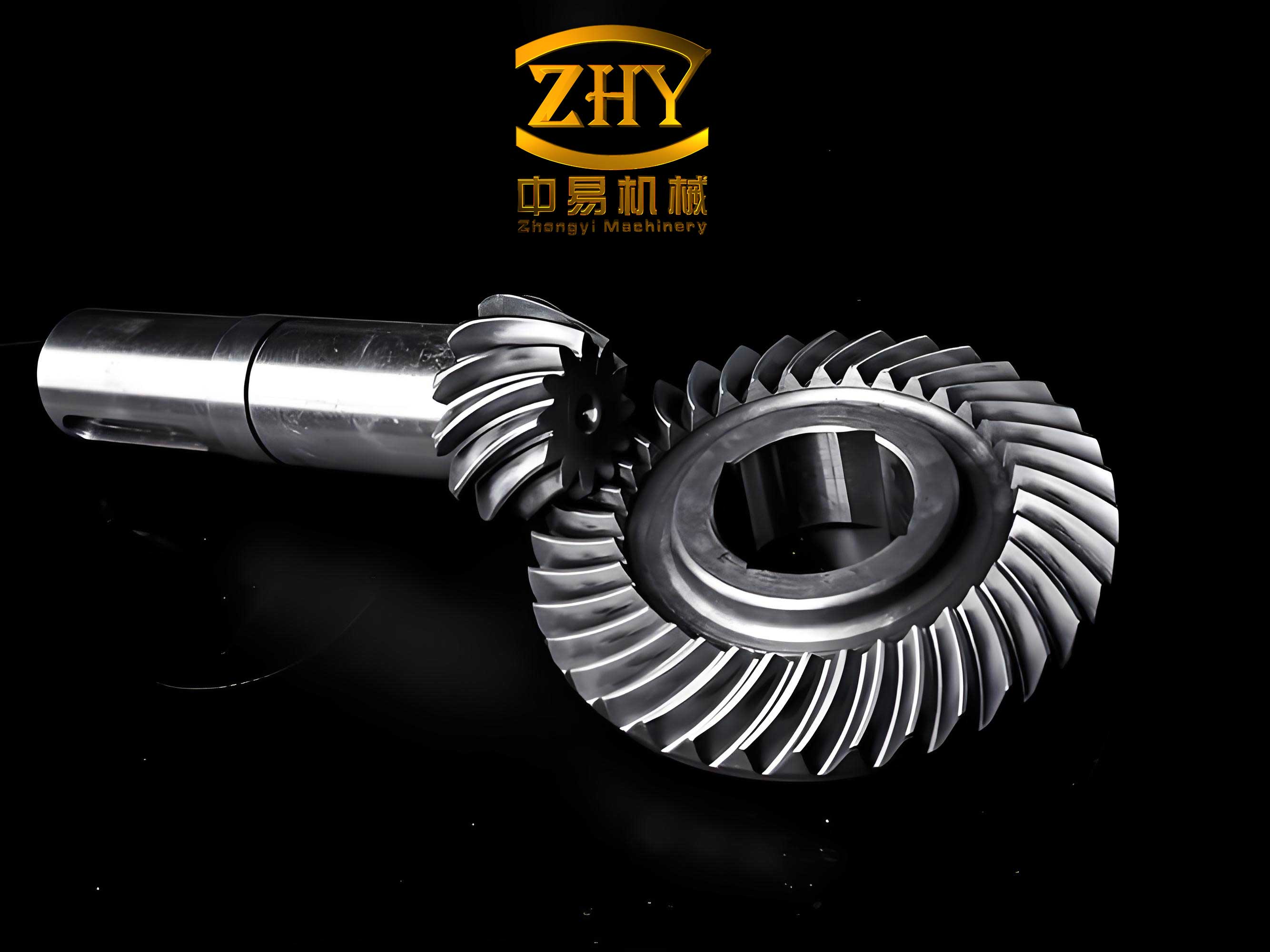
The relentless pursuit of higher power density and rotational speeds in modern aviation propulsion and transmission systems has placed increasing demands on gearbox components. Among these, the spiral bevel gear stands out as a critical power transmission element in main gearboxes and accessory drives, prized for its high load-carrying capacity, smooth operation, and low noise characteristics. However, these same operational conditions exacerbate vibration and noise issues, making the dynamic analysis and vibration suppression of spiral bevel gear transmissions (SBGD) a paramount research focus.
To mitigate these challenges, damping technologies are frequently integrated into rotor-dynamic systems. The Squeeze Film Damper (SFD) is a well-established solution, providing external damping to suppress vibration amplitudes as rotors traverse critical speeds. While effective, traditional SFDs introduce strong nonlinear forces that can, under certain conditions, lead to undesirable non-synchronous vibrations and chaotic motion, ultimately limiting their effectiveness. A significant advancement in this field is the Elastic Ring Squeeze Film Damper (ERSFD). By incorporating an elastic ring with inner and outer bosses into the oil film cavity, the ERSFD retains the beneficial damping characteristics of the SFD while demonstrably suppressing the nonlinearity inherent in the oil film forces. This article presents a comprehensive nonlinear dynamic analysis of an aviation spiral bevel gear transmission system supported by ERSFDs, establishing a bidirectional fluid-structure interaction model and investigating the influence of key design parameters on system stability.
The core of the ERSFD’s functionality lies in its unique structure and the coupled interaction between the oil films and the elastic ring. The primary components include the housing, the elastic ring, the rolling element bearing (whose outer race acts as the journal), the gear shaft, and the lubricating oil. The elastic ring, featuring alternating inner and outer bosses, segments the continuous oil film into independent chambers. The inner oil film is formed between the journal and the elastic ring’s inner surface, while the outer oil film exists between the elastic ring’s outer surface and the housing. This configuration allows the elastic ring to deform under the action of the journal’s motion, dynamically adjusting the oil film thickness and pressure in both cavities, thereby modifying the damping and stiffness characteristics.
The mathematical modeling of the ERSFD begins with the generalized Reynolds equation, which governs the hydrodynamic pressure generation in thin fluid films. For an incompressible, isoviscous, Newtonian fluid under laminar flow conditions neglecting fluid inertia, the equation in polar coordinates is expressed as:
$$\frac{\partial}{R^2 \partial \theta} \left( h^3 \frac{\partial p}{\partial \theta} \right) + \frac{\partial}{\partial z} \left( h^3 \frac{\partial p}{\partial z} \right) = \frac{6\mu}{R} (u_0 – u_h) \frac{\partial h}{\partial \theta} + \frac{6\mu}{R} (w_0 – w_h) \frac{\partial h}{\partial z} + 12\mu(v_h – v_0)$$
Here, \(R\) is the radius, \(h\) is the local film thickness, \(p\) is the pressure, \(\mu\) is the dynamic viscosity, and \((u, v, w)\) are the surface velocity components in the circumferential (\(\theta\)), radial, and axial (\(z\)) directions, respectively, with subscripts \(0\) and \(h\) denoting the lower and upper surfaces.
For the inner oil film of the ERSFD, the journal (bearing outer race) translates with velocities \(\dot{x}\) and \(\dot{y}\), while the elastic ring’s inner surface has a radial deformation velocity \(\partial r / \partial t\). The corresponding surface velocities are:
$$u_0 = -\dot{x}\sin\theta + \dot{y}\cos\theta, \quad v_0 = \dot{x}\cos\theta + \dot{y}\sin\theta, \quad w_0 = 0$$
$$u_h = 0, \quad v_h = \frac{\partial r}{\partial t}, \quad w_h = 0$$
The film thickness is approximately \(h_1 = c_1 (1 + \varepsilon \cos(\pi – (\beta – \theta))) + r\), where \(c_1\) is the radial clearance, \(\varepsilon\) is the eccentricity ratio, and \(\beta\) is the attitude angle. Substituting these into the Reynolds equation yields the governing equation for the inner film pressure \(p_1\).
For the outer oil film, the housing is stationary, and only the elastic ring’s outer surface has radial deformation velocity. The surface velocities are:
$$u_0 = 0, \quad v_0 = \frac{\partial r}{\partial t}, \quad w_0 = 0$$
$$u_h = 0, \quad v_h = 0, \quad w_h = 0$$
The film thickness is \(h_2 = c_2 – r\), leading to the governing equation for the outer film pressure \(p_2\).
The deformation of the elastic ring \(r(\alpha)\) under the displacement \(\delta_i\) of the \(i\)-th inner boss is calculated using a semi-analytical method based on circular arc deformation. Assuming the ring segment deforms into another circular arc between two fixed points (the boss and the midpoint between bosses), the radial deflection at any angle \(\alpha\) from the boss is derived as:
$$r(\alpha) = b \cos \alpha + \sqrt{(R + \delta_i – b)^2 – (b \sin \alpha)^2} – R$$
where \(b = (2R\delta_i + \delta_i^2) / [2(R + \delta_i – R \cos \gamma)]\), \(R\) is the original outer radius, and \(2\gamma\) is the angular span of the ring segment between bosses. The deformation velocity is then approximated using a forward finite difference: \(\partial r / \partial t \approx [r(t+\Delta t) – r(t)] / \Delta t\).
To solve the transient pressure fields, the governing equations are normalized and discretized using the central finite difference method over the fluid domain defined by each oil cavity. The discrete form for a node \((i, j)\) is:
$$D_{i,j} P_{i,j} – A_{i,j} P_{i,j+1} – B_{i,j} P_{i,j-1} – C_{i,j} P_{i+1,j} – C_{i,j} P_{i-1,j} = -F_{i,j}$$
The coefficients \(A, B, C, D, F\) are functions of the local film thickness \(H\) and structural parameters. Boundary conditions assume ambient pressure at the axial ends (\(z=0, L\)) and at the circumferential edges of each cavity (boss locations). The resulting linear system of equations for each film at each time step is solved efficiently using matrix algebraic techniques (like the QR algorithm). Once the pressure field is obtained, the nonlinear oil film forces along the x and y axes are computed by numerical integration:
$$F_x = -\int_{\theta_1}^{\theta_2} \left( \int_{-L/2}^{L/2} p(\theta,z) \, dz \right) R \cos\theta \, d\theta, \quad F_y = -\int_{\theta_1}^{\theta_2} \left( \int_{-L/2}^{L/2} p(\theta,z) \, dz \right) R \sin\theta \, d\theta$$
Given the computational expense of solving the full ERSFD model at every time step of a dynamic simulation, a Radial Basis Function (RBF) neural network surrogate model is constructed. It maps the journal’s attitude angle \(\beta\) and eccentricity ratio \(\varepsilon\) to the oil film force components \(F_x\) and \(F_y\), significantly accelerating the calculation while maintaining high accuracy, as validated against direct numerical solutions.
| Parameter | Value |
|---|---|
| Number of Bosses | 8 |
| Angular Extent per Boss | \(\pi/4\) rad |
| Elastic Ring Length (\(L\)) | 20 mm |
| Number of Oil Feed Holes | 8 |
| Oil Dynamic Viscosity (\(\mu\)) | 0.01844 Pa·s |
| Inner Film Radial Clearance (\(c_1\)) | 0.2 mm |
| Outer Film Radial Clearance (\(c_2\)) | 0.2 mm |
The dynamic behavior of the spiral bevel gear pair is modeled using an 8-degree-of-freedom (DOF) lumped parameter system. Each gear (pinion \(p\) and gear \(g\)) has three translational (\(x, y, z\)) and one rotational (\(\theta\)) degree of freedom about its own axis. The generalized coordinate vector is \(\{q\} = \{x_p, y_p, z_p, \theta_p, x_g, y_g, z_g, \theta_g\}^T\). The gear mesh is modeled by a time-varying stiffness \(k_h(t)\), a constant damping \(\xi_h\) along the line of action (LOA), and includes backlash nonlinearity \(f(\lambda_n)\) and static transmission error excitation \(e_n(t)\). The equations of motion are derived using D’Alembert’s principle:
$$
\begin{aligned}
m_p \ddot{x}_p + \xi_{px} \dot{x}_p + k_{px} x_p &= F_{px} – n_{px} F_n + m_p e_p \omega_p^2 \cos(\omega_p t) \\
m_p \ddot{y}_p + \xi_{py} \dot{y}_p + k_{py} y_p &= F_{py} – n_{py} F_n + m_p g + m_p e_p \omega_p^2 \sin(\omega_p t) \\
m_p \ddot{z}_p + \xi_{pz} \dot{z}_p + k_{pz} z_p &= – n_{pz} F_n \\
I_p \ddot{\theta}_p &= T_p – \lambda_p F_n \\
m_g \ddot{x}_g + \xi_{gx} \dot{x}_g + k_{gx} x_g &= F_{gx} – n_{gx} F_n + m_g e_g \omega_g^2 \cos(\omega_g t) \\
m_g \ddot{y}_g + \xi_{gy} \dot{y}_g + k_{gy} y_g &= F_{gy} – n_{gy} F_n – m_g g + m_g e_g \omega_g^2 \sin(\omega_g t) \\
m_g \ddot{z}_g + \xi_{gz} \dot{z}_g + k_{gz} z_g &= – n_{gz} F_n \\
I_g \ddot{\theta}_g &= T_g – \lambda_g F_n
\end{aligned}
$$
Here, \(m_l, I_l\) are mass and moment of inertia; \(k_{lj}, \xi_{lj}\) are support stiffness and damping; \(F_{lx}, F_{ly}\) are the ERSFD oil film forces; \(T_l\) is the torque; \(e_l\) is the mass eccentricity; \(\omega_l\) is the rotational speed; \(n_l = [n_{lx}, n_{ly}, n_{lz}]^T\) is the unit vector of the LOA at the mesh point; \(\lambda_l = n_l \cdot (j_l \times r_l)\) is the directional rotation radius, with \(j_l\) as the axial unit vector and \(r_l\) as the position vector of the mesh point. The dynamic transmission error (DTE) along the LOA is \(\delta_e = n_p \cdot [x_p, y_p, z_p]^T + \lambda_p \theta_p + n_g \cdot [x_g, y_g, z_g]^T + \lambda_g \theta_g\). The relative displacement considering backlash \(2b_c\) is \(\lambda_n = \delta_e – e_n(t)\). The mesh force \(F_n\) is:
$$F_n = k_h(t) f(\lambda_n) + \xi_h \dot{\lambda}_n, \quad \text{where} \quad f(\lambda_n) =
\begin{cases}
\lambda_n – b_c, & \lambda_n > b_c \\
0, & |\lambda_n| \le b_c \\
\lambda_n + b_c, & \lambda_n < -b_c
\end{cases}
$$
The equations are normalized using the characteristic length \(b_c\) (half of backlash) and the natural frequency \(\omega_n = \sqrt{k_m / m_e}\), where \(k_m\) is the average mesh stiffness and \(m_e\) is the equivalent mass. The dimensionless time is \(\tau = \omega_n t\). This results in a set of normalized differential equations suitable for numerical integration.
| Parameter | Pinion | Gear |
|---|---|---|
| Number of Teeth | 47 | 53 |
| Mass, \(m\) (kg) | 0.8 | 1.5 |
| Moment of Inertia, \(I\) (kg·mm²) | 1040 | 3120 |
| Mass Eccentricity, \(e\) (µm) | 0.5 | |
| Average Mesh Stiffness, \(k_m\) (N/m) | 3.0 × 10⁸ | |
| Mesh Damping, \(\xi_h\) (N·s/m) | 1000 | |
| Radial Bearing Stiffness (N/m) | 3.0 × 10⁸ | |
The coupled spiral bevel gear-ERSFD system constitutes a challenging bidirectional fluid-structure interaction problem. The oil film forces depend nonlinearly on the journal’s instantaneous position and velocity (attitude angle \(\beta\) and eccentricity ratio \(\varepsilon\)), which are themselves determined by the dynamic response of the gear system. A segregated, time-marching (block-iteration) scheme is employed to solve this coupled system. Within each time step \(t_n\):
- The current journal displacement (from the gear system solution at \(t_{n-1}\)) is used to calculate the elastic ring deformation \(r\) and its velocity \(\partial r/\partial t\).
- These, along with the journal velocities, are fed into the ERSFD model (or its RBF surrogate) to compute the nonlinear oil film forces \(F_x, F_y\).
- These oil film forces are applied as inputs to the 8-DOF spiral bevel gear dynamic equations.
- The gear system equations are integrated using the 4th-order Runge-Kutta method to obtain the new journal positions and velocities at time \(t_n\).
- The process iterates until convergence within the time step is achieved for both fluid (oil film force) and solid (gear displacement) domains, before proceeding to \(t_{n+1}\).
This approach captures the essential bidirectional coupling, where the solid motion deforms the fluid domain (changing film thickness), and the resulting fluid forces (pressure) act back on the solid.
Analysis of the ERSFD’s steady-state pressure field reveals distinct characteristics. The inner oil film pressure distribution is segmented circumferentially due to the presence of the elastic ring bosses. Pressure peaks occur in cavities not directly aligned with the journal’s offset line. Crucially, the pressure distribution along the offset line itself is asymmetric, differing from the symmetric profile often seen in plain SFDs with circular centered orbits. This asymmetry is a direct consequence of the elastic ring’s deformation. A key advantage of the ERSFD is evident when comparing its force-eccentricity relationship to that of a Finite Length SFD (FLSFD). While both show increasing force with eccentricity ratio \(\varepsilon\), the ERSFD’s growth is more linear and subdued, especially beyond \(\varepsilon > 0.7\). The FLSFD force exhibits a strongly nonlinear, near-exponential rise as \(\varepsilon\) approaches 1, whereas the ERSFD’s force increases steadily. This is because the elastic ring’s deformation counteracts the reduction in film thickness, effectively weakening the strong nonlinear coupling between eccentricity and oil film force, leading to more predictable and stable damping behavior. This property is fundamentally beneficial for the stability of the coupled spiral bevel gear system.
The influence of the elastic ring’s boss thickness (\(h_{boss}\)) on the nonlinear dynamic response of the spiral bevel gear transmission system is profound. Bifurcation diagrams, plotting the lateral vibration displacement amplitude of the pinion against its rotational speed, are used to analyze this effect. Three cases are compared: \(h_{boss} = 0.15\) mm, \(0.20\) mm (baseline), and \(0.25\) mm, under a constant input torque \(T_p = 500\) N·m. The system exhibits rich nonlinear phenomena including periodic, quasi-periodic, and chaotic motions.
For the baseline thickness (\(0.20\) mm), the system response is primarily period-1, except near the first two critical speeds (approximately 2200 and 4200 rpm). A bifurcation to quasi-period-2 motion occurs around 5600 rpm, which later transitions back to quasi-period-1. Crucially, within the speed range of 7100 to 8200 rpm, the system undergoes a quasi-periodic route to chaos, indicated by a broad band of displacements in the bifurcation diagram and a fractal-like structure in the Poincaré map. Beyond 8200 rpm, the motion returns to period-1.
Reducing the boss thickness to \(0.15\) mm destabilizes the system. The chaotic regime significantly expands, now spanning from 5200 to 8200 rpm. Furthermore, the overall vibration amplitudes increase across the entire speed range, and a sudden “jump” phenomenon is observed near 5000 rpm. The thinner, more compliant ring provides less effective modulation of the oil film forces, allowing the nonlinearities to dominate the system dynamics more readily.
Conversely, increasing the boss thickness to \(0.25\) mm has a markedly beneficial effect. The chaotic regime is entirely suppressed. Within the problematic 7300-8200 rpm range, the system exhibits quasi-periodic motion but does not descend into chaos. The vibration amplitudes are the lowest among the three cases. The stiffer ring provides more controlled deformation, leading to oil film forces that better linearize the system’s response and enhance stability. This demonstrates that the boss thickness is a critical design parameter for tuning the dynamic performance of an ERSFD-supported spiral bevel gear drive.
Detailed time-domain responses and Fast Fourier Transform (FFT) spectra at specific speeds further illustrate these states. At the first critical speed (2200 rpm), for \(h_{boss}=0.20\) mm and \(0.25\) mm, the response is quasi-period-1, with dominant spectral components at sub-multiples of the mesh frequency. For \(h_{boss}=0.15\) mm, the response at this speed becomes unstable. At 5800 rpm (within the chaotic zone for the thin ring), the thick ring (\(0.25\) mm) maintains a clean period-1 spectrum, the baseline ring shows quasi-period-2 motion (two incommensurate frequencies), and the thin ring exhibits a broadband spectrum characteristic of chaos. At 7600 rpm, both the thin and baseline rings show chaotic spectra, while the thick ring maintains a quasi-periodic response with discrete frequency components. The peak-to-peak vibration displacement values quantitatively confirm the amplitude reduction: for example, at 7600 rpm, the displacements are approximately 0.1951 µm, 0.0870 µm, and 0.0603 µm for boss thicknesses of 0.15 mm, 0.20 mm, and 0.25 mm, respectively.
This investigation presents a comprehensive framework for modeling and analyzing the nonlinear dynamics of an aviation spiral bevel gear transmission system integrated with Elastic Ring Squeeze Film Dampers. The proposed bidirectional fluid-structure interaction model, coupling a semi-analytical ERSFD formulation with an 8-DOF gear dynamic model via an efficient RBF network surrogate, successfully captures the complex interactions within the system. The primary conclusions are:
- The ERSFD fundamentally alters the oil film pressure distribution, creating a segmented, asymmetric profile that effectively weakens the strong nonlinear relationship between oil film force and journal eccentricity compared to conventional SFDs.
- The boss thickness of the elastic ring is a pivotal design parameter. Increasing it enhances the damping linearity and system stability.
- A thicker boss significantly suppresses chaotic behavior, as evidenced by the elimination of the chaotic regime observed with thinner bosses in the 5200-8200 rpm range, replacing it with quasi-periodic motion.
- Increased boss thickness consistently reduces the amplitude of vibration response across the operational speed range, thereby improving the overall dynamic characteristics of the spiral bevel gear transmission system.
These findings provide valuable guidance for the design and optimization of ERSFDs in high-performance aviation gearboxes, offering a pathway to achieve superior vibration control and operational stability for spiral bevel gear drives.