
This article details a comprehensive study on the optimization of preform geometry for the cold extrusion manufacturing of a spiral bevel gear, a critical component in power transmission systems. The research focuses on overcoming the inherent challenges of forming the complex, curved tooth profile of a spiral bevel gear through precision cold forging. By employing three-dimensional rigid-plastic finite element method (FEM) simulations, the influence of preform shape, conical angle, and diameter on the forming load and the quality of the final extruded spiral bevel gear is systematically investigated. The goal is to establish design principles that ensure complete die fill, minimize forming forces, and produce a net-shape or near-net-shape spiral bevel gear preform suitable for minimal final machining.
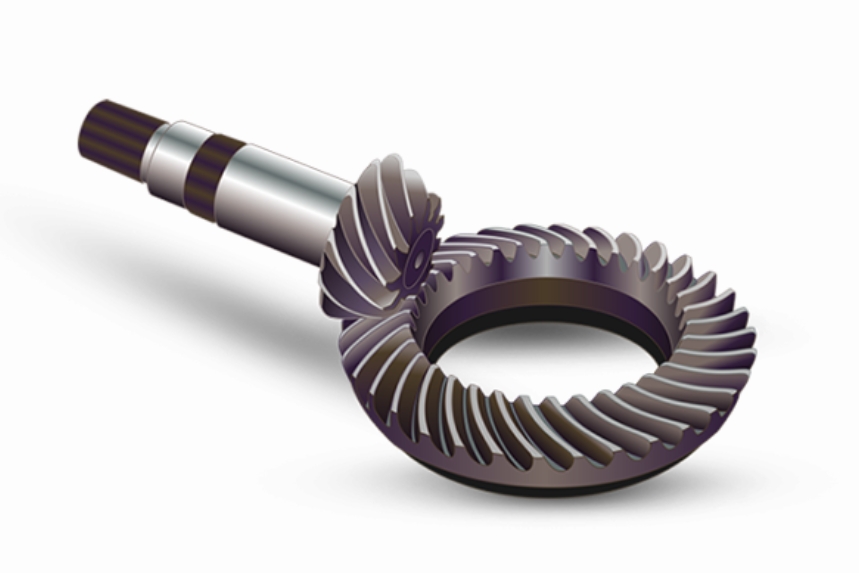
The manufacturing of spiral bevel gears via precision plastic forming represents a significant advancement over traditional machining methods, offering substantial benefits in material efficiency, production rate, and enhanced mechanical properties due to continuous grain flow. However, the curvilinear geometry of the spiral bevel gear tooth presents a formidable challenge for metal forming. The intricate, three-dimensional flow of material required to completely fill the die cavity, especially at the small end and tooth tips, often leads to defects such as underfill, excessive forming loads, and premature die wear. To mitigate these issues, the design of the initial billet, or preform, is paramount. An optimally designed preform for the spiral bevel gear guides the metal flow, reduces resistance, and ensures uniform pressure distribution within the die cavity, ultimately leading to a successful and economical forming process.
Design of the Cold Extrusion Component
The subject of this study is a driven spiral bevel gear used in a three-wheeled motorcycle reverse gear mechanism. The original machined part features a mounting boss, a central hole, and peripheral slots, which are undesirable for a direct cold extrusion process due to complexity and precision requirements on non-tooth features. Therefore, a dedicated cold extrusion component was designed, focusing solely on forming the geometrically demanding spiral bevel gear teeth to net-shape. Non-critical surfaces, such as the back cone, were allocated a machining allowance of approximately 1 mm. This approach simplifies the die cavity, concentrates forming energy on the critical tooth profile, and isolates the challenges of forming the spiral bevel gear teeth. The key parameters of the target spiral bevel gear are summarized in Table 1.
| Parameter | Symbol | Value |
|---|---|---|
| Module | m | 3.5 mm |
| Number of Teeth | Z | 13 |
| Pressure Angle | α | 20° |
| Spiral Angle | β | 10° (Right Hand) |
Forming Process and Preform Design Strategy
The selected forming process is a divided-flow (or relief-hole) cold extrusion. In this setup, a relief hole is machined at the bottom center of the die cavity. This hole provides an escape path for a controlled volume of material, effectively acting as a pressure relief mechanism. The primary advantages for forming a spiral bevel gear include a significant reduction in the maximum forming load and a more favorable hydrostatic pressure state in the deformation zone, which promotes better die filling, especially at the challenging small-end regions of the spiral bevel gear. The finite element model for the simulation of this process is constructed based on this principle.
The fundamental equation governing the volume constancy in plastic deformation is:
$$ V_{preform} = V_{gear} + V_{flash} + V_{relief} $$
where $V_{preform}$ is the volume of the initial billet, $V_{gear}$ is the volume of the fully formed spiral bevel gear teeth and body, $V_{flash}$ is the volume of the excess material forming the flash, and $V_{relief}$ is the volume of material extruded through the relief hole. Optimal preform design aims to minimize $V_{flash}$ and $V_{relief}$ while ensuring $V_{gear}$ is perfectly filled.
Determination of Preform Shape
Given the conical nature of the spiral bevel gear blank, a simple cylindrical billet is suboptimal. It leads to uneven metal flow, with excessive radial flow at the large end and insufficient flow at the small end. Therefore, a cylindrical billet with a conical tip (hereafter referred to as a conical-cylindrical preform) is adopted. This shape better conforms to the general envelope of the final spiral bevel gear, facilitating axial flow, improving stability during the initial stages of extrusion, and ensuring more centered positioning within the die cavity for the spiral bevel gear formation.
Optimization of Preform Cone Angle
The cone angle ($\phi$) of the preform is a critical parameter influencing the metal flow trajectory and the forming load for the spiral bevel gear. If $\phi$ is too large (approaching the gear blank cone angle), the preform contacts the die wall early, causing severe shearing and frictional resistance. This leads to premature flash formation at the large end of the spiral bevel gear, a sharp increase in load, and potential underfill at the small end. Conversely, if $\phi$ is too small, the preform becomes slender, risking buckling instability during the initial compression phase. Furthermore, a small $\phi$ can cause the metal at the small-end region to reach the relief hole too early, starving the tooth tips of material.
Finite element simulations were conducted with a constant preform volume while varying $\phi$. The relationship between the maximum forming force ($F_{max}$) and the preform cone angle was quantified. The results indicate an optimal range. Let $\theta$ be the cone angle of the final spiral bevel gear blank (approximately 102° in this case). The simulation data shows that the forming force is minimized when the preform cone angle is 7° to 12° less than $\theta$.
$$ \phi_{optimal} = \theta – (7° \text{ to } 12°) $$
Thus, for our spiral bevel gear with $\theta \approx 102°$, the optimal preform cone angle $\phi$ is between 90° and 95°. At $\phi = 90°$, the simulated forming force reached a minimum of approximately 6500 kN. The force increases sharply for angles outside this optimal window. This relationship can be conceptually expressed as:
$$ F_{max} \propto f(\phi, \theta, \mu) $$
where a significant deviation of $\phi$ from $(\theta – \Delta)$, with $\Delta$ in the optimal range, causes a non-linear increase in $F_{max}$, and $\mu$ is the friction coefficient.
Optimization of Preform Diameter
With the preform shape and cone angle established, the specific diameters—the large cylinder diameter ($D$) and the small conical tip diameter ($d$)—must be determined, keeping the total volume constant. The goal is to synchronize the metal flow: the large-end teeth should be nearly filled just as the small-end material begins to enter the relief hole. This synchronized flow minimizes flash and relief material while ensuring complete die fill for the spiral bevel gear.
Simulations revealed three distinct regimes based on the diameter ratio $d/D$:
- Small $d$ (Excessively slender cone tip): The tip contacts the die bottom/relief hole area too early. A large volume of metal flows out through the relief hole ($V_{relief}$ increases) before the large-end teeth are fully formed. This “short-circuits” the pressure needed to force metal into the complex spiral bevel gear tooth cavities at the large end, leading to underfill. More starting material would be required to compensate, violating the net-shape principle.
- Large $D$ (Excessively large cylindrical body): The large-end of the preform engages the tooth cavities immediately. Flash forms prematurely at the large end of the spiral bevel gear ($V_{flash}$ increases early), causing a rapid rise in forming force. Meanwhile, the small-end material is still far from the die wall, primarily flowing axially with little radial movement to fill the small-end teeth, resulting in underfill at the small end of the spiral bevel gear.
- Optimal $D$ and $d$: A balanced state is achieved. The metal flows progressively from the center towards both ends. As the large-end teeth become nearly complete and a thin flash begins to form, the small-end material simultaneously starts to flow into the relief hole. This optimal flow pattern ensures complete filling of both ends of the spiral bevel gear with minimal wasted material. For the specific geometry studied, the optimal dimensions were found to be $D = 50$ mm and $d = 45$ mm (with $\phi = 90°$).
The design logic can be summarized by a geometric compatibility and flow synchronization condition. The preform should be designed so that the time (or stroke) for the large-end material to fill the teeth and initiate flash ($t_{flash}$) is approximately equal to the time for the small-end material to travel to the entrance of the relief hole ($t_{relief}$).
$$ t_{flash}(D, \phi, \mu) \approx t_{relief}(d, \phi, \mu) $$
Achieving this equality for the spiral bevel gear forming process requires iterative FEM analysis, as done here.
| Parameter | Too Small / Incorrect | Optimal Range / Value | Too Large / Incorrect | Primary Effect on Spiral Bevel Gear |
|---|---|---|---|---|
| Cone Angle ($\phi$) | < (θ – 12°) | θ – (7° to 12°) | > (θ – 7°) | Minimizes forming force; prevents buckling & premature relief flow. |
| Small Tip Diameter ($d$) | Too Small | Balanced with D (e.g., 45mm) | N/A (constrained by cone angle) | Prevents premature relief flow causing large-end underfill. |
| Large Cylinder Diameter ($D$) | N/A (constrained by volume) | Balanced with d (e.g., 50mm) | Too Large | Prevents premature flash causing small-end underfill and high load. |
Process Experiment and Validation
To validate the simulation-based optimization for the spiral bevel gear, a physical process experiment was conducted. The tooling, including a precision-fabricated die cavity for the spiral bevel gear teeth, was manufactured from Cr12MoV tool steel and heat-treated. The preform was machined from 20CrMo low-carbon alloy steel according to the optimized dimensions: $D=50$ mm, $d=45$ mm, $\phi=90°$. A 3mm high chamfer matching the final gear blank angle was added to the conical tip for precise initial positioning in the die.
The extrusion was performed on an 800-ton hydraulic press. The experimental results closely matched the simulations. The measured maximum forming force was 6122 kN, which is slightly lower than but consistent with the simulated force of approximately 6500 kN (differences attributable to simplified friction models and material properties in simulation). Most importantly, the extruded spiral bevel gear preform was successfully produced. The tooth profile was fully formed, with sharp corners, a smooth tooth surface, and minimal flash. The spiral bevel gear preform required only the planned back-cone machining, confirming the net-shape capability of the process with the optimized preform design.
Conclusion
This investigation successfully demonstrates a methodology for the optimal design of preforms for the cold extrusion of spiral bevel gears. The key findings are systematically derived from numerical simulation and confirmed by experiment:
- The conical-cylindrical preform is the most suitable shape for the cold extrusion of a spiral bevel gear, promoting stable and directed metal flow.
- The cone angle of the preform is a decisive factor for the forming load. An optimal reduction of 7° to 12° from the final spiral bevel gear blank cone angle ($\phi_{optimal} = \theta – (7° \text{ to } 12°)$) minimizes the required extrusion force.
- The diameters of the preform must be carefully balanced to synchronize metal flow. An incorrectly small tip diameter ($d$) causes premature flow into the relief hole and large-end underfill of the spiral bevel gear, while an incorrectly large body diameter ($D$) causes premature flash formation and small-end underfill. The optimal diameters ensure that large-end filling and small-end relief flow commence simultaneously.
- The finite element simulation serves as a powerful and reliable tool for designing and optimizing the cold extrusion process for complex components like the spiral bevel gear. The close correlation between simulated and experimental results in terms of forming force and final part quality validates the model and the derived design principles.
Therefore, by applying the outlined preform optimization strategy—selecting a conical-cylindrical shape, calculating the cone angle per the specified rule, and fine-tuning the diameters via simulation to achieve flow synchronization—a high-quality, net-shape spiral bevel gear preform can be consistently produced via cold extrusion. This approach offers a viable and efficient manufacturing route for spiral bevel gears, yielding significant benefits in material utilization, production efficiency, and part strength.