
In modern mechanical engineering, the spiral bevel gear stands out as a critical component due to its unique design and performance characteristics. As a specialized type of hypoid gear, the spiral bevel gear offers numerous advantages over straight bevel gears, making it indispensable in high-speed, high-precision applications. From my perspective as a researcher in this field, I have dedicated significant effort to exploring the CNC machining processes for spiral bevel gears, aiming to enhance manufacturing efficiency and quality. This article delves into the principles, mathematical modeling, simulation, and experimental validation of CNC machining for spiral bevel gears, with an emphasis on leveraging advanced software and techniques to optimize production, especially for small batch sizes.
The spiral bevel gear is renowned for its superior performance attributes. Compared to straight bevel gears, it exhibits a larger contact ratio, which translates to multiple tooth engagements during transmission. This feature significantly reduces impact, minimizes noise, and ensures smoother operation. Additionally, spiral bevel gears boast higher load-carrying capacity, reduced wear, longer service life, and a lower susceptibility to undercutting. Their ability to achieve high transmission ratios in compact volumes makes them ideal for demanding sectors such as aerospace, automotive, and marine engineering. In these applications, the reliability and efficiency of spiral bevel gears are paramount, driving the need for advanced manufacturing methods like CNC machining.
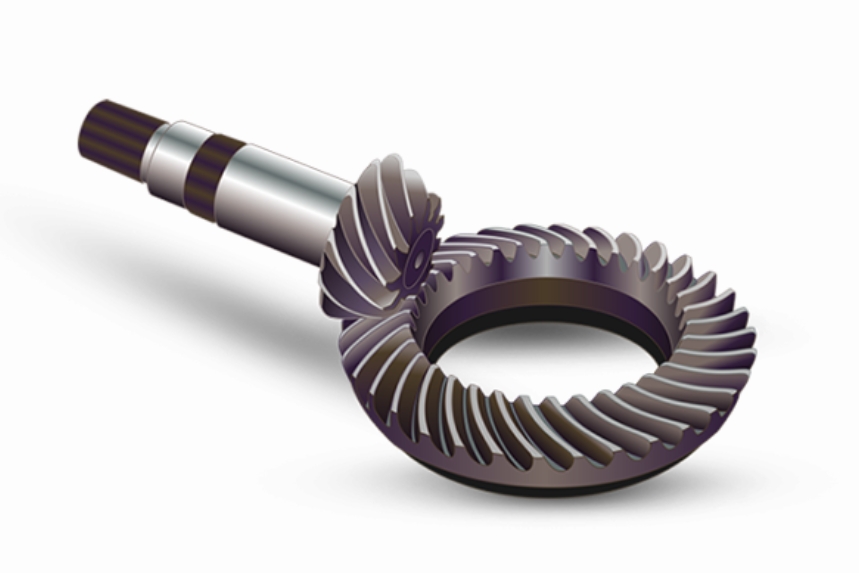
To understand the CNC machining of spiral bevel gears, it is essential to first grasp the fundamental principles governing their production. The machining process typically involves a multi-axis CNC machine tool equipped with linear and rotational axes. In a standard setup, the machine features three linear axes (X, Y, Z) and three rotational axes (A, B, C), where the A-axis controls the rotation of the workpiece. The cutting tool’s motion is orchestrated through coordinated movements along the X and Y axes within the machine coordinate system. This configuration allows for precise control over the gear tooth geometry, enabling the generation of the complex curvilinear profiles characteristic of spiral bevel gears. The integration of these axes facilitates the simulation of a virtual crown gear, which serves as the generating tool for machining the spiral bevel gear blank.
The mathematical modeling of the CNC machining process for spiral bevel gears is a cornerstone of this research. By establishing a comprehensive coordinate system, we can accurately describe the kinematic relationships between the machine, tool, and workpiece. The global coordinate system \( S_{m1} \) is fixed to the machine frame, with its origin \( O_{m1} \) at the machine center. A cradle coordinate system \( S_{c1} \) is attached to the machine cradle, sharing its origin \( O_{c1} \) with \( O_{m1} \) and rotating about the \( Z_{m1} \)-axis. The tool coordinate system \( S_{F1} \) is fixed to the cutter head, centered at \( O_{F1} \). Key parameters include the cradle angular velocity vector \( \mathbf{w}^{(F)} \), the gear blank angular velocity vector \( \mathbf{w}^{(1)} \), the machine center to back offset \( E_{m1} \), the blank axial position \( X_{g1} \), the cutter radial setting \( S_{r1} \), the cutter angular position \( q_1 \), and the machine root angle \( \gamma_{m1} \). The local coordinate systems are derived through sequential transformations: translating along the negative \( Y_{m1} \)-axis by \( E_{m1} \), along the positive \( Z_{m1} \)-axis by \( X_{b1} + X_{g1} \sin \gamma_{m1} \), and along the positive \( X_{m1} \)-axis by \( X_{g1} \cos \gamma_{m1} \). The gear blank coordinate system \( S_1 \) rotates with the workpiece, enabling the representation of tooth surfaces as envelopes of the cutter motions.
The cutting edge geometry of the tool plays a pivotal role in shaping the spiral bevel gear teeth. Typically, the cutter head features a conical profile with inner and outer edges defined by pressure angles. For a point \( P \) on the cutting edge, its position vector in the tool coordinate system can be expressed as follows, where \( r_{kp} \) is the cutter point radius, \( \alpha_i \) and \( \alpha_a \) are the inner and outer pressure angles, \( s_{kn} \) is the radial distance, and \( \theta_k \) is the phase angle. The equations for the inner and outer edges are given by:
$$ \mathbf{r}_{kp}^{(n)}(\theta_k) = \begin{bmatrix} r_{kpn} \pm s_{kn} \sin \alpha_n \cos \theta_k \\ r_{kpn} \pm s_{kn} \sin \alpha_n \sin \theta_k \\ -s_{kn} \cos \alpha_n \end{bmatrix}, \quad n = a, i $$
Here, the plus sign corresponds to the outer edge, and the minus sign to the inner edge. The unit normal vector at any point on the cutting edge is crucial for determining the gear tooth surface and is derived as:
$$ \mathbf{n}_{k}^{(n)}(\theta_k) = \begin{bmatrix} \pm \cos \alpha_n \cos \theta_k \\ \pm \cos \alpha_n \sin \theta_k \\ -\sin \alpha_n \end{bmatrix} $$
These equations form the basis for simulating the tooth generation process, allowing us to compute the exact tool-workpiece interactions during CNC machining of spiral bevel gears.
To validate the mathematical models and optimize the machining parameters, virtual simulation using software like VERICUT is indispensable. The simulation process begins with constructing a detailed virtual model of the CNC machine tool, incorporating its kinematic chain and motion limits. Concurrently, the geometric parameters of the spiral bevel gear are calculated based on design specifications, such as tooth count, spiral angle, pressure angle, and face width. These parameters are used to create 3D models of the workpiece, cutter head, and fixture. The machine settings, including axis offsets and angular positions, are adjusted according to the computed gear geometry. Subsequently, NC code is generated to drive the virtual machining process. By integrating the machine model, part model, tool model, and NC code within the simulation environment, we can visualize the entire machining sequence, detect potential collisions, and assess the accuracy of the generated tooth surfaces. The simulation outputs various forms of results, such as tool path plots, material removal animations, and deviation analyses, providing insights into the manufacturability of the spiral bevel gear design.
The experimental phase of this research involved actual CNC machining of spiral bevel gears to corroborate the simulation findings. The experiments were conducted on a YK21300 CNC machine tool, equipped with a milling cutter head made of tool steel. The workpiece material was 20CrMo, a commonly used alloy steel for gear applications. Key process parameters included an interpolation cycle of 1 ms, a feed rate of 100 mm/min, and an interpolation accuracy of 1 μm. The spiral bevel gear pair had the following specifications, which are summarized in Table 1 for clarity:
| Parameter | Pinion (Small Gear) | Gear (Large Gear) |
|---|---|---|
| Number of Teeth | 21 | 28 |
| Spiral Angle | 35° | 35° |
| Pressure Angle | 20° | 20° |
| Face Width | 19.058 mm | 19.058 mm |
| Pitch Cone Angle | 5.75° | 5.75° |
| Root Cone Angle | 33.267° | 48.883° |
| Face Cone Angle | 36.87° | 53.13° |
| Whole Depth | 2.14 mm | 2.14 mm |
The machining process was monitored in real-time, and the finished spiral bevel gears were inspected using coordinate measuring machines (CMM) to evaluate dimensional accuracy and surface quality. The results indicated that the CNC machining approach successfully produced spiral bevel gears with tight tolerances and excellent tooth contact patterns. Notably, the integration of virtual simulation prior to actual machining reduced setup times and minimized trial-and-error adjustments, underscoring the efficiency gains achievable with this methodology.
From a broader perspective, the advantages of CNC machining for spiral bevel gears extend beyond precision. The flexibility of CNC systems allows for rapid reconfiguration for different gear designs, making it particularly suitable for small batch production or prototyping. Moreover, the ability to simulate and optimize processes digitally leads to significant reductions in material waste and energy consumption. To further elucidate the kinematic relationships, we can express the relative velocity between the cutter and gear blank using the derived coordinate systems. For instance, the velocity of a point on the cutter edge relative to the gear blank can be computed as:
$$ \mathbf{v}^{(1F)} = \mathbf{v}^{(F)} – \mathbf{v}^{(1)} + \boldsymbol{\omega}^{(1)} \times \mathbf{r}^{(1F)} $$
where \( \mathbf{v}^{(F)} \) and \( \mathbf{v}^{(1)} \) are the translational velocities of the cutter and gear blank origins, \( \boldsymbol{\omega}^{(1)} \) is the angular velocity of the gear blank, and \( \mathbf{r}^{(1F)} \) is the position vector from the gear blank origin to the cutter point. This equation is fundamental for ensuring proper tooth surface generation and avoiding gouging during the machining of spiral bevel gears.
In addition to the core mathematical models, several auxiliary formulas are essential for comprehensive analysis. For example, the tooth thickness of a spiral bevel gear can be approximated using the following relation based on the pitch cone geometry:
$$ t = \frac{\pi m}{2} + 2x m \tan \alpha $$
where \( t \) is the tooth thickness, \( m \) is the module, \( x \) is the profile shift coefficient, and \( \alpha \) is the pressure angle. Such formulas aid in the initial design phase and ensure compatibility with the CNC machining constraints. Furthermore, the contact ratio \( \epsilon \) of a spiral bevel gear pair, which contributes to its smooth operation, can be estimated as:
$$ \epsilon = \frac{\sqrt{R_{a1}^2 – R_{b1}^2} + \sqrt{R_{a2}^2 – R_{b2}^2} – a \sin \alpha}{p_b} $$
Here, \( R_a \) and \( R_b \) are the addendum and base circle radii, \( a \) is the center distance, and \( p_b \) is the base pitch. A higher contact ratio, often achieved with spiral bevel gears, directly correlates with reduced noise and improved load distribution.
The simulation and experimental work also highlighted the importance of tool path optimization for spiral bevel gear machining. By employing algorithms that adjust feed rates and cutter orientations based on real-time feedback, we can enhance surface finish and tool life. Table 2 summarizes key optimization parameters and their effects on the machining outcome for spiral bevel gears:
| Optimization Parameter | Typical Range | Impact on Spiral Bevel Gear Quality |
|---|---|---|
| Feed Rate | 50-200 mm/min | Higher rates reduce time but may increase surface roughness; optimal balance required. |
| Spindle Speed | 1000-5000 rpm | Affects tool wear and chip formation; influences tooth profile accuracy. |
| Stepover Distance | 0.1-0.5 mm | Smaller stepover improves surface finish but extends machining time. |
| Cutter Radius Compensation | 0-10 mm | Critical for achieving correct tooth flank geometry; must be calibrated precisely. |
| Coolant Flow Rate | 5-20 L/min | Reduces thermal deformation and tool wear, ensuring dimensional stability. |
These parameters were fine-tuned during the virtual simulations, leading to a robust NC code that produced high-quality spiral bevel gears in the actual experiments. The iterative process between simulation and physical machining underscores the synergy between digital twins and traditional manufacturing, particularly for complex components like spiral bevel gears.
Looking ahead, the integration of artificial intelligence and machine learning into CNC machining for spiral bevel gears holds promise for further advancements. Predictive models could analyze simulation data to preemptively identify potential errors or optimize tool paths dynamically. Additionally, the adoption of additive manufacturing for producing near-net-shape gear blanks could complement CNC machining, reducing material usage and lead times. However, the core principles elucidated in this research—rigorous mathematical modeling, comprehensive simulation, and empirical validation—remain foundational for any such innovations.
In conclusion, the CNC machining of spiral bevel gears represents a sophisticated intersection of mechanical design, kinematics, and manufacturing technology. Through detailed mathematical modeling, virtual simulation with VERICUT, and practical experiments, we have demonstrated that CNC methods are highly effective for producing spiral bevel gears with superior quality and efficiency. The ability to simulate the entire process digitally not only accelerates production but also ensures consistency, especially in small batch scenarios where traditional methods may be less economical. The spiral bevel gear, with its exceptional performance characteristics, is thus well-suited to modern CNC machining techniques, paving the way for broader applications in high-performance industries. Future work will focus on refining the models for even greater accuracy and exploring hybrid manufacturing approaches to push the boundaries of spiral bevel gear production.