
In this comprehensive study, we delve into the intricate process of modeling and dynamically analyzing spiral bevel gears, which are critical components in high-speed and heavy-duty machinery such as automotive, marine, and aerospace systems. Spiral bevel gears offer superior advantages including high transmission efficiency, compact structure, stable transmission ratio, high overlap ratio, high load-bearing capacity, and smooth operation. Our objective is to develop a robust methodology for accurately modeling spiral bevel gears and performing dynamic contact analysis to understand their behavior under operational conditions. This work provides a foundational reference for the design, manufacturing, and optimization of spiral bevel gears, leveraging advanced software tools like Pro/E and Abaqus.
The core of our approach lies in deriving the tooth surface equations based on the generating principle of spiral bevel gears. We start by establishing the coordinate systems for both the gear and pinion during the cutting process, following the methods outlined by Gleason. For the gear (large wheel), we define the machining coordinate system where the cutter head interacts with the gear blank. The homogeneous coordinate equation for the cutter blade’s cutting surface is given by:
$$
\mathbf{r}_{t2} = \begin{bmatrix}
\left( r_{02} \pm \frac{W_2}{2} \pm u_2 \sin \alpha_2 \right) \cos \theta_2 \\
\left( r_{02} \pm \frac{W_2}{2} \pm u_2 \sin \alpha_2 \right) \sin \theta_2 \\
– u_2 \cos \alpha_2 \\
1
\end{bmatrix}
$$
Here, $r_{02}$ is the nominal radius of the cutter head, $W_2$ is the blade edge width, $\alpha_2$ is the tool pressure angle, $\theta_2$ is the tool phase angle, and $u_2$ is the distance from the cutting point to the virtual tip of the blade. The signs depend on whether the convex or concave side of the spiral bevel gear tooth is being considered. The normal vector at the cutting point is derived as:
$$
\mathbf{n}_{t2} = \begin{bmatrix}
\cos \alpha_2 \cos \theta_2 \\
\cos \alpha_2 \sin \theta_2 \\
\pm \sin \alpha_2
\end{bmatrix}
$$
Similarly, the tangent vector is:
$$
\mathbf{t}_{t2} = \begin{bmatrix}
\sin \alpha_2 \cos \theta_2 \\
\sin \alpha_2 \sin \theta_2 \\
\mp \cos \alpha_2
\end{bmatrix}
$$
For the fillet part of the cutter, the equation is:
$$
\mathbf{r}_{tgd2} = \begin{bmatrix}
\left( r_{02} \mp \frac{W_2}{2} \mp \frac{r(1 – \sin \alpha_2)}{\cos \alpha_2} \mp r \sin(s_2 / r) \right) \cos \theta_2 \\
\left( r_{02} \mp \frac{W_2}{2} \mp \frac{r(1 – \sin \alpha_2)}{\cos \alpha_2} \mp r \sin(s_2 / r) \right) \sin \theta_2 \\
– r[1 – \cos(s_2 / r)] \\
1
\end{bmatrix}
$$
where $s_2$ is the arc length from the start of the fillet, and $r$ is the nominal radius of the fillet. The normal vector for the fillet is:
$$
\mathbf{n}_{tgd2} = \begin{bmatrix}
\sin(s_2 / r) \cos \theta_2 \\
\sin(s_2 / r) \sin \theta_2 \\
\mp \cos(s_2 / r)
\end{bmatrix}
$$
Through homogeneous coordinate transformations, we express these in the gear machining coordinate system. The transformation matrix $\mathbf{M}_{ot2}$ is used:
$$
\mathbf{M}_{ot2} = \begin{bmatrix}
\sin q_2 & \cos q_2 & 0 & S_2 \cos q_2 \\
-\cos q_2 & \sin q_2 & 0 & S_2 \sin q_2 \\
0 & 0 & 1 & 0 \\
0 & 0 & 0 & 1
\end{bmatrix}
$$
where $S_2$ is the radial cutter position, and $q_2$ is the angular cutter position. Thus, the cutter surface in the gear coordinate system is:
$$
\mathbf{r}_{O2} = \mathbf{M}_{ot2} \cdot \mathbf{r}_{t2}
$$
and the normal vector is:
$$
\mathbf{n}_{O2} = \mathbf{L}_{ot2} \cdot \mathbf{n}_{t2}
$$
with $\mathbf{L}_{ot2}$ being the 3×3 principal submatrix of $\mathbf{M}_{ot2}$. During cutting, the gear tooth surface is conjugate to the cutter surface. The relative angular velocity $\boldsymbol{\omega}_{12}$ and relative velocity $\mathbf{v}_{12}$ are defined based on the rotation of the cutter and gear blank. The meshing condition requires that the relative velocity is perpendicular to the normal vector:
$$
\mathbf{v}_{12} \cdot \mathbf{n}_{g2} = 0
$$
This leads to an implicit equation $f(\theta_2, u_2, \phi_2) = 0$, where $\phi_2$ is the rotation angle of the cutter around the machine center. We solve this iteratively to obtain a family of cutter curves. Finally, by rotating these curves around the gear axis, we derive the gear tooth surface equation:
$$
\mathbf{r}_2 = (\mathbf{r}_{sg2} \cdot \mathbf{p}_2) \cdot \mathbf{p}_2 + \sin(i_{02} \phi_2) \cdot (\mathbf{p}_2 \times \mathbf{r}_{sg2}) + \cos(i_{02} \phi_2) \cdot (\mathbf{p}_2 \times (\mathbf{p}_2 \times \mathbf{r}_{sg2}))
$$
where $\mathbf{p}_2$ is the unit vector along the gear axis, and $i_{02}$ is the machine ratio. Similarly, the fillet surface equation $\mathbf{r}_{gd2}$ is obtained. For the pinion (small wheel), a similar derivation is performed, accounting for the modified generation process. The pinion tooth surface equation is:
$$
\mathbf{r}_1 = (\mathbf{r}_{sg1} \cdot \mathbf{p}_1) \cdot \mathbf{p}_1 + \sin(\phi_1′) \cdot (\mathbf{p}_1 \times \mathbf{r}_{sg1}) + \cos(\phi_1′) \cdot (\mathbf{p}_1 \times (\mathbf{p}_1 \times \mathbf{r}_{sg1}))
$$
These equations form the basis for our three-dimensional modeling of spiral bevel gears.
To implement this mathematically, we developed a MATLAB program that computes discrete points on the tooth surfaces. The program follows a flowchart that initializes parameters, iteratively solves the meshing equations, and outputs coordinates for both the gear and pinion. The key parameters for our spiral bevel gear pair are summarized in the table below:
| Parameter | Pinion | Gear |
|---|---|---|
| Number of Teeth | 15 | 46 |
| Module (mm) | 8.22 | 8.22 |
| Pitch Diameter (mm) | 123.3 | 378.12 |
| Face Width (mm) | 57.15 | 57.15 |
| Outer Cone Distance (mm) | 198.858 | 198.858 |
| Pressure Angle (°) | 20 | 20 |
| Pitch Cone Angle (°) | 18.061 | 71.939 |
| Spiral Angle (°) | 35 | 35 |
| Addendum (mm) | 9.85 | 4.12 |
| Dedendum (mm) | 5.67 | 11.4 |
| Backlash (mm) | 2.0 – 2.8 | 2.0 – 2.8 |
| Root Angle (°) | 1.6332 | 3.2810 |
| Hand of Spiral | Left | Right |
The machining parameters for generating these spiral bevel gears are equally critical and are provided in the following table:
| Parameter | Pinion (Concave) | Pinion (Convex) | Gear (Concave) | Gear (Convex) |
|---|---|---|---|---|
| Cutter Radius (mm) | 143.64 | 161.01 | 152.4 | 152.4 |
| Cutter Pressure Angle (°) | 21 | 19 | 18 | 22 |
| Fillet Radius (mm) | 1.91 | 2.54 | 1.91 | 2.54 |
| Blade Edge Width (mm) | — | — | 5.08 | 5.08 |
| Radial Cutter Position (mm) | 151.51 | 151.22 | 149.84 | 149.84 |
| Angular Cutter Position (°) | 58.81 | 54.27 | 56.42 | 56.42 |
| Machine Ratio | 3.30 | 3.21 | 1.05 | 1.05 |
| Bed Position (mm) | 0.52 | -0.85 | 0 | 0 |
| Axial Gear Position (mm) | -1.84 | 3.03 | 0 | 0 |
| Vertical Gear Position (mm) | 7.62 | -5.08 | 0 | 0 |
Using the MATLAB output, we generate point clouds for the tooth surfaces. These points are imported into Pro/E, where we construct spline curves and surfaces to form the three-dimensional model of the spiral bevel gear pair. The modeling process involves creating the tooth profiles, adding the top and root cones, and performing Boolean operations to generate the solid geometry. The final assembled spiral bevel gear pair is visualized to ensure proper meshing without interference.
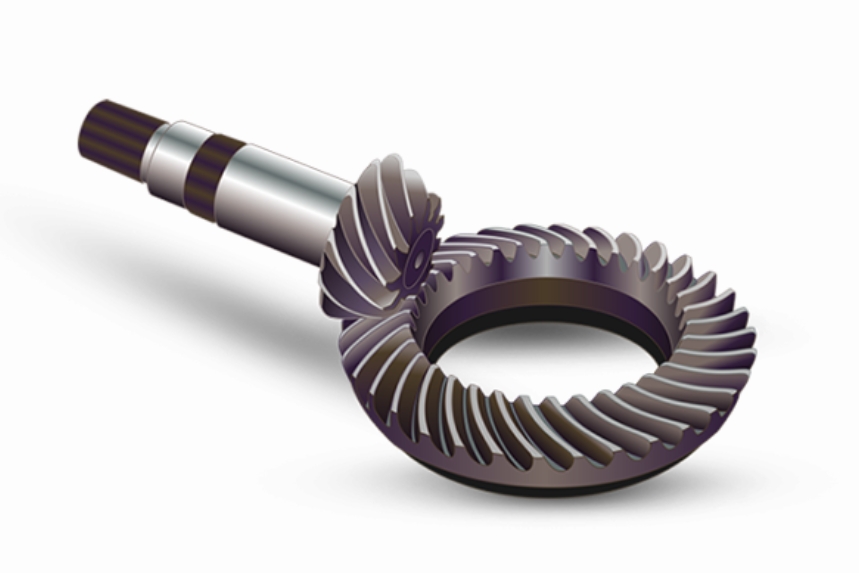
With the three-dimensional model established, we proceed to dynamic contact analysis using Abaqus. The finite element model is created by importing the geometry into Hypermesh for meshing. We focus on a three-tooth segment to reduce computational cost while capturing the essential contact dynamics. The mesh model is refined to ensure accuracy in stress and contact pressure calculations. The material properties for the spiral bevel gears are specified as follows:
| Material | Temperature (°C) | Elastic Modulus E (GPa) | Poisson’s Ratio ν | Density ρ (g/cm³) | Thermal Conductivity (W/(m·°C)) |
|---|---|---|---|---|---|
| 16Cr3NiWMoVNbE | 100 | 185 | 0.3 | 7.85 | 46.05 |
| 200 | 185 | 43.95 | |||
| 300 | 185 | 41.87 |
This material is chosen for its excellent performance under high-speed and heavy-load conditions, typical for spiral bevel gear applications. In Abaqus/Explicit, we define the contact interaction between the pinion concave side and the gear convex side, as this is the driving pair. The contact type is surface-to-surface, simulating point contact with an elliptical area. Constraints are applied via reference points coupled to the gear and pinion axes. The pinion is assigned an angular velocity, while the gear is subjected to a torque load. To minimize initial impact, amplitude curves are used to ramp up the load smoothly over 0.002 seconds.
We analyze the dynamic contact pressure over a complete meshing cycle. Ten discrete conjugate points along the contact path are selected for detailed examination. The contact pressure distribution on the tooth surfaces is computed, and the normal contact force $F$ is evaluated using the formula:
$$
F = \sum_{i=1}^{l} P_i \cdot \frac{S}{l + m}
$$
where $P_i$ is the nodal pressure within the instantaneous contact area of the second tooth pair, $S$ is the total contact area, $l$ is the number of nodes in the second pair’s contact area, and $m$ is the number of nodes in other contacting pairs. We investigate the effect of different friction coefficients ($\mu = 0.1, 0.2, 0.3$) on the contact behavior under a load of 1000 N·m. The results indicate that the normal contact force is largely insensitive to the friction coefficient, as shown in the following summary table for the second tooth pair during meshing:
| Meshing Point | Normal Contact Force at μ=0.1 (N) | Normal Contact Force at μ=0.2 (N) | Normal Contact Force at μ=0.3 (N) | Trend |
|---|---|---|---|---|
| 1 (Entry) | 1250 | 1245 | 1248 | Sharp Increase |
| 2 | 2450 | 2440 | 2445 | Increase |
| 3 | 3200 | 3195 | 3202 | Peak |
| 4 | 3150 | 3148 | 3151 | Stable |
| 5 | 3100 | 3095 | 3103 | Stable |
| 6 | 2800 | 2798 | 2801 | Decrease |
| 7 | 2200 | 2195 | 2203 | Decrease |
| 8 | 1800 | 1798 | 1802 | Decrease |
| 9 | 1200 | 1195 | 1201 | Decrease |
| 10 (Exit) | 800 | 795 | 802 | Sharp Decrease |
The analysis reveals that the normal force peaks during the middle of the meshing cycle, with a brief period of single-tooth contact where the force remains constant. The friction coefficient has negligible impact on the magnitude, emphasizing that the contact mechanics of spiral bevel gears are dominated by geometry and load rather than surface friction under these conditions. The contact ellipse moves from the toe to the heel of the tooth, consistent with theoretical expectations for spiral bevel gears.
To validate our modeling and analysis, we conducted experimental tests on a physical spiral bevel gear pair. The gear parameters for the experiment are slightly different, as listed below:
| Parameter | Pinion | Gear |
|---|---|---|
| Number of Teeth | 15 | 47 |
| Module (mm) | 5 | 5 |
| Pitch Diameter (mm) | 75 | 235 |
| Face Width (mm) | 35 | 35 |
| Outer Cone Distance (mm) | 123.339 | 123.339 |
| Pressure Angle (°) | 20 | 20 |
| Pitch Cone Angle (°) | 17.7 | 72.3 |
| Spiral Angle (°) | 35 | 35 |
| Addendum (mm) | 6 | 2.5 |
| Dedendum (mm) | 3.44 | 6.94 |
| Backlash (mm) | 0.13 – 0.18 | 0.13 – 0.18 |
| Hand of Spiral | Left | Right |
The experiment utilized a low-noise gear rolling tester. The pinion was driven at 600 rpm with a load of 40 N·m. Contact patterns were examined using a coloring method (ink), and contact pressures were measured using Fuji HS pressure-sensitive film. The film changes color based on pressure, with higher pressure yielding darker red shades. By comparing with calibration curves, we estimated the contact pressure. The experimental results showed contact patterns similar to those from our finite element analysis, though minor deviations occurred due to assembly and manufacturing errors. The contact pressure ranged from 80 to 150 MPa in the simulation, while the experiment indicated 110 to 140 MPa, within acceptable tolerance given the manual loading and experimental uncertainties.
Our study demonstrates a comprehensive pipeline for spiral bevel gear analysis, from mathematical modeling to dynamic simulation and experimental validation. The key equations governing the tooth surfaces are derived rigorously, enabling accurate 3D modeling. The finite element analysis in Abaqus provides insights into the dynamic contact behavior, showing that normal forces are primarily influenced by geometry and load, with minimal dependence on friction. Experimental tests corroborate the simulation results, affirming the reliability of our methodology. This work underscores the importance of integrated modeling and analysis for optimizing spiral bevel gear performance in demanding applications.
Looking forward, further research could explore the effects of thermal loads, lubrication, and more complex material models on spiral bevel gear dynamics. Additionally, incorporating real-time monitoring data from operational systems could enhance the predictive capabilities of our models. The spiral bevel gear remains a pivotal component in mechanical transmissions, and ongoing advancements in computational tools will continue to drive improvements in their design and durability. By leveraging the principles outlined here, engineers can better address challenges in high-performance gear systems, ensuring efficiency and reliability across various industries.
In summary, we have successfully developed a detailed framework for the modeling and dynamic contact analysis of spiral bevel gears. This framework integrates theoretical derivations, numerical computations, and experimental validation, providing a robust foundation for future work. The spiral bevel gear’s unique geometry and performance characteristics make it a fascinating subject for study, and our contributions aim to support the ongoing evolution of gear technology. Through continued innovation, we can expect even greater advancements in the capabilities and applications of spiral bevel gears in the years to come.