
The automotive differential is a critical assembly, and its core component, the spiral gear (specifically the driven spiral gear), is both vital and subject to wear. Its market demand correlates directly with the vehicle population. For decades, the manufacturing of these high-strength gears relied on conventional, resource-intensive methods. This article details a first-person perspective on the research, development, and implementation of a novel forming and ring rolling technology that has fundamentally improved the production economics for these essential automotive parts.
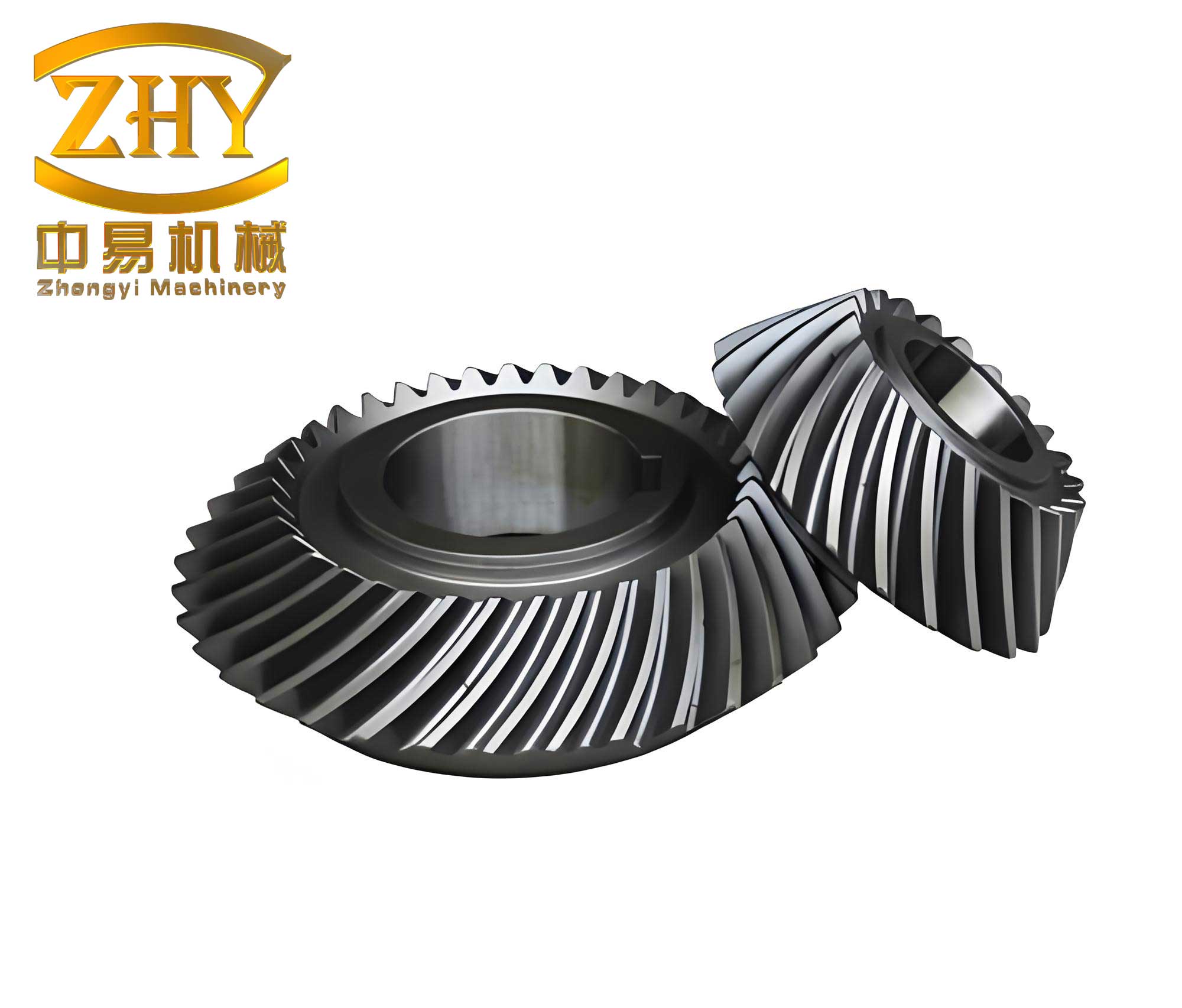
Traditionally, the production of a driven spiral gear followed a well-established but costly path: cutting stock, heating, die forging, machining, heat treatment, grinding, and final inspection. Taking a common automotive spiral gear as an example, the finished product weight might be over 7 kg, requiring a forging blank of nearly 12 kg. This scale necessitates massive equipment like a 16-ton forging hammer or a 12,000-ton hot die forging press. The capital investment and energy consumption are substantial. Furthermore, the die forging process inherently generates significant flash and web, which must be trimmed off, leading to material utilization often below 50%. The high cost of dies and the massive press upkeep make this process challenging, especially for medium and small-scale automotive forging and gear manufacturing plants.
Motivated by the need to drastically reduce equipment tonnage, lower investment costs, and enhance the technical and economic benefits of forging production, our research focused on developing an alternative: the Forming Ring Rolling (FRR) process for automotive differential spiral gear blanks. After years of experimentation and optimization, this technology matured, passed technical appraisals, and has been successfully adopted for batch production.
1. The Forming Ring Rolling (FRR) Process Route
The new process route is markedly simpler and more efficient:
Stock Cutting → Heating → Preforming → Forming Ring Rolling
This sequence replaces the massive die forging press with a combination of a smaller hammer and a ring rolling mill (expander). Stock is cut using a sawing machine. Heating can be accomplished in various furnaces (coal, oil, gas, or electric). Preforming is conducted on a 750kg air hammer, and the final shaping is achieved on a D51-350 universal radial-axial ring rolling mill. This process occupies less floor space, integrates fewer but more efficient steps, offers high stability, and is particularly well-suited for the operational context of many automotive component manufacturers.
| Parameter | Traditional Die Forging | Forming Ring Rolling (FRR) |
|---|---|---|
| Key Equipment | 16T Hammer / 12,000T Press | 750kg Hammer + D51-350 Rolling Mill |
| Process Steps | Cutting, Heat, Forge, Trim, Machine, HT, Grind | Cutting, Heat, Preform, Roll |
| Material Utilization | ~50% (High flash/web) | >80% (Near-net-shape) |
| Energy Consumption | Very High | Significantly Lower |
| Production Rhythm | Slower (complex die handling) | Faster (continuous rolling) |
| Suitability | Large-scale, high-volume | Medium/Small-scale, flexible batches |
2. Technical Core and Design Principles
The success of the FRR process hinges on several interlinked technical elements, each requiring meticulous design based on the principles of local incremental plastic deformation and the theory of profiled ring rolling.
2.1 Design of the Rolling Preform (Blank)
The preform is not a simple billet; its geometry dictates the success of the rolling stage. The goal is to design a shape that ensures smooth metal flow, complete die filling, and avoids defects like folding or underfilling. For the spiral gear blank, which has a complex cross-section with a web, hub, and rim, the preform design is critical. The volume distribution must satisfy the filling requirements of both the radial and axial passes during rolling. Using the principle of volume constancy, the preform dimensions are derived from the final forged part dimensions, accounting for thermal contraction and minimal finishing allowance.
The initial blank volume \( V_{blank} \) is calculated from the final part volume \( V_{part} \), scaling for material loss \( \eta \) (scale, minimal flash):
$$ V_{blank} = \frac{V_{part}}{\eta} $$
where \( \eta \) typically ranges from 0.95 to 0.98 for FRR. The preform is then designed as a nearly flat ring with a specific inner/outer diameter ratio and height to ensure proper engagement with the rolling mill rolls and stable deformation.
2.2 Design of Preforming Tools (Open-Die)
On the 750kg air hammer, specialized open-die tools (swage blocks and punches) are used to transform the heated stock into the designed rolling preform. This step prepares the correct initial shape and ensures optimal mass distribution. The tool design focuses on:
- Creating the preliminary hub and web protrusions.
- Establishing the approximate inner hole diameter.
- Achieving a symmetrical shape to prevent imbalance during rolling.
The tool geometry is optimized through finite element simulation and practical trials to minimize forming steps and prevent internal flaws.
2.3 Design of the Forming Ring Rolling Pass
This is the heart of the technology. The D51-350 mill uses a pair of contoured rolls: a driven main roll and a mandrel (idler roll). The design of these roll profiles is complex. They are not cylindrical but have the inverse profile of the final spiral gear blank’s cross-section. The design must ensure:
- Progressive Bite and Penetration: The rolls must gradually draw the preform in and reduce its wall thickness while expanding its diameter. The bite condition must be satisfied:
$$ \Delta h \leq \mu^2 R’ $$
where \( \Delta h \) is the feed amount per revolution, \( \mu \) is the coefficient of friction, and \( R’ \) is the equivalent roll radius. - Controlled Metal Flow: The contours guide metal axially to form the gear’s hub and rim features. We employ a semi-closed pass design, where the axial rolls constrain the side surfaces to control width spread and improve dimensional accuracy.
- Defect Prevention: The pass sequence and roll contours are optimized to eliminate common ring rolling defects like fishtailing, concave surfaces, folding, ovality, and dishing.
The radial rolling process can be modeled by the relationship between wall thickness reduction, diameter expansion, and roll geometry. The instantaneous growth of the ring’s mean radius \( R \) is related to the feed rate of the mandrel \( v \):
$$ \frac{dR}{dt} \approx \frac{R}{h} \cdot v \cdot \left( \frac{1}{R_m} + \frac{1}{R_s} \right) $$
where \( h \) is the instantaneous wall thickness, \( R_m \) is the mandrel radius, and \( R_s \) is the main roll radius.
2.4 Process Parameter Design
Stable and high-quality production requires precise operational procedures for both preforming and rolling.
- Preforming Procedure: Specifies the number of blows, orientation of the workpiece between blows, and tool sequence to achieve the target preform shape consistently within approximately 30 seconds per piece.
- Ring Rolling Procedure: Defines the initial mill setup (roll gap, axial con closure), the rotational speed of the main roll, the feed rate curve of the mandrel (often a two-stage curve: rapid approach followed by a slower forming feed), and the final sizing stage. For the example spiral gear, the rolling cycle is completed in about 20 seconds.
The combined cycle time of ~50 seconds enables a single-shift annual production capacity reaching 100,000 pieces, demonstrating high efficiency.
| Process Stage | Parameter | Typical Value / Description |
|---|---|---|
| Preforming | Equipment | 750kg Air Hammer |
| Operation Time | ~30 seconds | |
| Key Action | Upsetting, piercing, and preliminary shaping using custom swages. | |
| Forming Rolling | Equipment | D51-350 Radial-Axial Ring Mill |
| Main Roll Speed | ~1.2 rad/s | |
| Mandrel Feed Rate | 0.5-2.0 mm/s (Variable curve) | |
| Rolling Time | ~20 seconds | |
| Final Diameter Control | Automated gauge or manual measurement for stop. | |
| Overall | Total Cycle Time | ~50 seconds |
3. Equipment Investment and Economic Analysis
A significant advantage of the FRR process is the dramatic reduction in required capital investment compared to traditional die forging. The entire production line consists of standard, smaller-capacity equipment.
| Equipment | Model / Type | Approximate Investment (Currency Units) |
|---|---|---|
| Band Saw / Cutting | CNC Band Saw | 5 |
| Heating Furnace | Medium Frequency or Gas Furnace | 12 |
| Preforming Hammer | 750kg Air Hammer | 30 |
| Forming Rolling Mill | D51-350 Universal Ring Expander | 50 |
| Total Investment | 97 |
This total investment of approximately 97 units is a fraction of the cost of a single large die forging press line. The economic benefits extend far beyond lower capex.
3.1 Material and Energy Savings
The near-net-shape capability of ring rolling is its primary material-saving advantage. By minimizing flash and using a preform closer to the final shape, material utilization increases from around 50% in die forging to over 80% in FRR. For a 12kg forging blank, this translates to a saving of over 3.5kg of raw material per spiral gear.
The energy saving is twofold: first, heating less mass of material; second, using smaller, more efficient deformation equipment. The rolling process itself is a continuous incremental deformation, which is more energy-efficient than the single massive blow of a hammer. Verified production data shows average savings of 30% in material and 60% in energy consumption per part.
The material saving per part \( \Delta M \) is:
$$ \Delta M = M_{forging} – M_{FRR} = M_{forging} \cdot \left(1 – \frac{\eta_{FRR}}{\eta_{forging}}\right) $$
where \( \eta_{FRR} \) and \( \eta_{forging} \) are the material utilization ratios for the two processes.
3.2 Production Cost and ROI
Lower capital depreciation, reduced material cost, and decreased energy consumption directly lower the manufacturing cost per piece. Assuming a market price of 80 currency units per spiral gear forging and an annual production volume of 100,000 pieces, the annual output value is 8 million units. With a significantly reduced cost structure, the profit margin expands substantially. The investment payback period can be remarkably short, often within one to two years of full operation, yielding an excellent return on investment (ROI).
4. Metallurgical and Quality Considerations
Beyond economics, the FRR process imparts superior metallurgical characteristics to the spiral gear blank, enhancing its performance in service.
4.1 Grain Flow and Mechanical Properties
The rolling process produces a continuous, favorable grain flow that follows the contour of the gear. This is in contrast to die forging, where grain flow can be disrupted, especially in complex geometries with webs. The continuous circumferential grain structure improves fatigue resistance, fracture toughness, and gear tooth strength under cyclic loading—a critical factor for durable spiral gear performance in the differential.
4.2 Dimensional Accuracy and Consistency
The incremental forming and the use of sizing passes at the end of the rolling cycle result in excellent dimensional consistency from part to part. Wall thickness variation, concentricity, and flatness are superior to typical open-die forgings and rival closed-die forgings. This reduces the required machining allowance on subsequent operations, yielding further cost savings in the gear manufacturing chain.
4.3 Defect Control and Process Stability
Through the optimization of preform design, roll contours, and process parameters, the common defects in ring rolling have been systematically eliminated. A stable process window has been established, ensuring high yield rates in production.
| Defect | Cause | Mitigation Strategy in FRR Process |
|---|---|---|
| Folding / Lap | Excessive feed per revolution; improper preform shape. | Optimized mandrel feed curve; redesigned preform with smoother transitions. |
| Concavity / Dishing | Improper axial roll force or timing. | Precise control of axial roll closure sequence and force in the semi-closed pass. |
| Ovality | Insufficient rounding/sizing passes; uneven temperature. | Guaranteed final sizing revolution count; improved furnace temperature uniformity. |
| Fishtailing (Axial) | Unconstrained free spread at ring ends. | Use of contoured axial rolls in a semi-closed pass design to control spread. |
| Underfill | Insufficient volume in preform; low temperature. | Accurate preform volume calculation; strict temperature monitoring. |
5. Future Developments and Scalability
The success of the FRR process for the automotive differential spiral gear opens pathways for broader application and further technological refinement.
5.1 Application to Other Components
The principles are directly applicable to other annular components with complex profiles, such as bearing races, flanged rings, gear rims for transmissions, and other structural rings in automotive and aerospace industries. The process is scalable; larger ring rolling mills can produce larger diameter components using the same fundamental approach.
5.2 Integration with Advanced Technologies
The future lies in deeper integration:
- Simulation-Driven Design: Advanced Finite Element Method (FEM) software can be used to virtually simulate the entire preforming and rolling sequence, optimizing tool designs and process parameters before physical trials, reducing development time and cost for new spiral gear variants.
- Automation and Industry 4.0: The process is highly amenable to automation. Robots can handle loading/unloading between the furnace, hammer, and rolling mill. Real-time monitoring of rolling forces, temperatures, and dimensions can feed into a closed-loop control system, ensuring consistent quality and enabling predictive maintenance.
- Hybrid Processes: Combining FRR with subsequent precision forging or calibrating operations could achieve even closer-to-final net shapes, potentially reducing machining to a bare minimum.
6. Conclusion
The Forming Ring Rolling technology for automotive differential spiral gear blanks represents a paradigm shift in manufacturing philosophy. By replacing high-tonnage, batch-oriented die forging with a sequential process centered on incremental ring rolling, it delivers profound benefits:
- Drastically Reduced Capital Investment: Replacing mega-presses with a hammer and rolling mill lowers the barrier to entry for quality forging production.
- Superior Resource Efficiency: Material savings of ~30% and energy savings of ~60% contribute directly to sustainable manufacturing goals and cost reduction.
- Enhanced Product Quality: Improved grain flow and dimensional consistency yield a more reliable and performant spiral gear forging for the demanding automotive environment.
- Operational Flexibility: The process is well-suited for medium-volume production runs, offering manufacturers agility and economic viability.
The technology, having moved from research through validation to successful industrial implementation, proves that innovation in metal forming processes can simultaneously achieve economic advantage and technical excellence. It provides a compelling, sustainable production model for critical powertrain components like the spiral gear, aligning with the automotive industry’s continuous drive for efficiency, quality, and cost-effectiveness. The future development of this process, through digitalization and automation, promises to further solidify its role in advanced manufacturing.