
The study and application of gear transmissions with non-parallel and non-intersecting axes are pivotal in advanced mechanical design, particularly where complex spatial arrangements are required. Among these, the crossed-axis involute spiral gear pair stands out for its versatility. These spiral gears can transmit motion and power between shafts positioned at any arbitrary angle, with the added flexibility that the two mating spiral gears can have different helix angles and even opposite hand of helices. This geometry, while offering significant design freedom and relatively simple manufacturing, introduces a characteristic point contact condition. This concentrated contact leads to high contact stresses and makes the transmission susceptible to dynamic shocks, vibration, and ultimately, contact fatigue failure. Therefore, a comprehensive understanding of their dynamic contact behavior, fatigue life, and the impact of profile modifications is essential for optimizing their performance, enhancing durability, and ensuring operational safety in demanding applications such as aerospace, robotics, and specialized machinery.
This article presents an in-depth analysis, from theoretical modeling to dynamic simulation and life prediction, of a crossed-axis involute spiral gear pair. The core of the methodology is rooted in spatial gear meshing theory, which allows for the precise mathematical description of the gear tooth surfaces and their interaction.
Mathematical Foundation and Meshing Theory
The tooth surface of an involute spiral gear is generated by a transverse involute profile undergoing a helical motion along its axis. To derive the equations governing the meshing of two such spiral gears on crossed axes, we establish a set of coordinate systems. Let \( S_1(O_1; x_1, y_1, z_1) \) and \( S_2(O_2; x_2, y_2, z_2) \) be coordinate systems rigidly connected to gear 1 and gear 2, respectively. A fixed coordinate system \( S(O; x, y, z) \) and an auxiliary system \( S_p(O_p; x_p, y_p, z_p) \) are also defined. The shaft angle is denoted by \(\Sigma\). The transformation matrices between these systems are fundamental.
The transformation from \( S_1 \) to \( S \) involves a rotation \(\phi_1\) about the z-axis:
$$ M_{o1} = \begin{bmatrix} \cos\phi_1 & -\sin\phi_1 & 0 \\ \sin\phi_1 & \cos\phi_1 & 0 \\ 0 & 0 & 1 \end{bmatrix} $$
The auxiliary system \( S_p \) is related to \( S \) by the shaft angle \(\Sigma\):
$$ M_{op} = \begin{bmatrix} 1 & 0 & 0 \\ 0 & \cos\Sigma & -\sin\Sigma \\ 0 & \sin\Sigma & \cos\Sigma \end{bmatrix} $$
Finally, \( S_2 \) is related to \( S_p \) by a rotation \(\phi_2\):
$$ M_{p2} = \begin{bmatrix} \cos\phi_2 & -\sin\phi_2 & 0 \\ \sin\phi_2 & \cos\phi_2 & 0 \\ 0 & 0 & 1 \end{bmatrix} $$
The transverse involute profile in its own plane can be parameterized. When this profile undergoes a screw motion to form the spiral gear tooth surface, the coordinates of a point on the surface of gear \( i \) (\(i=1,2\)) in its local system \( S_i \) are given by:
$$ x_i^i = r_{bi} \cos(\theta_i + u_i) + r_{bi}u_i \sin(\theta_i + u_i) $$
$$ y_i^i = r_{bi} \sin(\theta_i + u_i) – r_{bi}u_i \cos(\theta_i + u_i) $$
$$ z_i^i = p_i \theta_i $$
where \( r_{bi} \) is the base radius, \( u_i \) is the involute roll angle, \( \theta_i \) is the helical motion parameter, and \( p_i \) is the screw parameter, defined as \( p_i = r_{bi} \tan\left[ \frac{\pi}{2} – \arctan(\tan\beta_i \cos\alpha_{ti}) \right] \), with \( \beta_i \) being the helix angle and \( \alpha_{ti} \) the transverse pressure angle.
Using the transformation matrices, the surface \( \Sigma_1 \) of the first spiral gear can be expressed in the fixed system \( S \):
$$ \mathbf{r}_1^o(u_1, \theta_1, \phi_1) = \begin{bmatrix} r_{b1} \cos(\theta_1 + u_1 + \phi_1) + r_{b1}u_1 \sin(\theta_1 + u_1 + \phi_1) \\ r_{b1} \sin(\theta_1 + u_1 + \phi_1) – r_{b1}u_1 \cos(\theta_1 + u_1 + \phi_1) \\ p_1 \theta_1 \end{bmatrix} $$
Similarly, the surface \( \Sigma_2 \) of the second spiral gear is brought into \( S \) via \( S_p \):
$$ \mathbf{r}_2^o(u_2, \theta_2, \phi_2) = \begin{bmatrix} r_{b2} \cos(\theta_2 + u_2 + \phi_2) + r_{b2}u_2 \sin(\theta_2 + u_2 + \phi_2) \\ \left[ r_{b2} \sin(\theta_2 + u_2 + \phi_2) – r_{b2}u_2 \cos(\theta_2 + u_2 + \phi_2) \right] \cos\Sigma – p_2 \theta_2 \sin\Sigma \\ \left[ r_{b2} \sin(\theta_2 + u_2 + \phi_2) – r_{b2}u_2 \cos(\theta_2 + u_2 + \phi_2) \right] \sin\Sigma + p_2 \theta_2 \cos\Sigma \end{bmatrix} $$
The unit normal vectors to these spiral gear surfaces are crucial for contact analysis. In \( S_1 \), the normal to \( \Sigma_1 \) is:
$$ \mathbf{n}_1^1 = \frac{1}{\sqrt{p_1^2 + r_{b1}^2}} \left[ p_1 \sin(u_1 + \theta_1) \mathbf{i}_1 – p_1 \cos(u_1 + \theta_1) \mathbf{j}_1 + r_{b1} \mathbf{k}_1 \right] $$
Transformed to the fixed system \( S \), it becomes:
$$ \mathbf{n}_1^o = \frac{1}{\sqrt{p_1^2 + r_{b1}^2}} \left[ p_1 \sin(u_1 + \theta_1 + \phi_1) \mathbf{i} – p_1 \cos(u_1 + \theta_1 + \phi_1) \mathbf{j} + r_{b1} \mathbf{k} \right] $$
The normal for the mating spiral gear surface \( \Sigma_2 \) in \( S \) is:
$$ \mathbf{n}_2^o = \frac{1}{\sqrt{p_2^2 + r_{b2}^2}} \left\{ p_2 \sin(u_2 + \theta_2 + \phi_2) \mathbf{i} – \left[ p_2 \cos(u_2 + \theta_2 + \phi_2) \cos\Sigma + r_{b2} \sin\Sigma \right] \mathbf{j} + \left[ r_{b2} \cos\Sigma – p_2 \cos(u_2 + \theta_2 + \phi_2) \sin\Sigma \right] \mathbf{k} \right\} $$
The fundamental condition for conjugate meshing of the spiral gears is that the relative velocity at the contact point must lie in the common tangent plane, i.e., it must be perpendicular to the common normal. This is expressed by the equation of meshing:
$$ \mathbf{n} \cdot \mathbf{v}^{(12)} = 0 $$
where \( \mathbf{v}^{(12)} \) is the relative velocity of surface \( \Sigma_1 \) with respect to \( \Sigma_2 \) in the fixed coordinate system. Solving this equation yields a specific relationship between the helical motion parameter \( \theta_1 \) and the involute roll angle \( u_1 \) for gear 1, which is essential for defining the true contact line on the spiral gear tooth surface:
$$ \theta_1 = \tan^2 \beta_{b1} (u_1 + \tan \alpha_{t1}) $$
Here, \( \beta_{b1} \) is the base helix angle.
Solid Model Generation and Finite Element Analysis
With the mathematical framework established, a specific crossed-axis spiral gear pair is modeled. The primary geometric parameters are summarized in the table below.
| Parameter | Symbol | Value |
|---|---|---|
| Normal Module | \( m_n \) | 3 mm |
| Normal Pressure Angle | \( \alpha_n \) | 20° |
| Number of Teeth (Gear 1) | \( z_1 \) | 25 |
| Number of Teeth (Gear 2) | \( z_2 \) | 48 |
| Helix Angle (Gear 1), Left Hand | \( \beta_1 \) | 40° |
| Helix Angle (Gear 2), Left Hand | \( \beta_2 \) | 50° |
| Face Width | \( B \) | 20 mm |
| Shaft Angle | \( \Sigma \) | 90° |
Using the derived surface equations, a MATLAB program is written to generate dense point clouds representing the tooth flank of each spiral gear. These point clouds are then imported into reverse engineering software to create smooth surface patches, which are subsequently solidified, patterned, and assembled into a complete three-dimensional model of the spiral gear pair in a CAD environment.
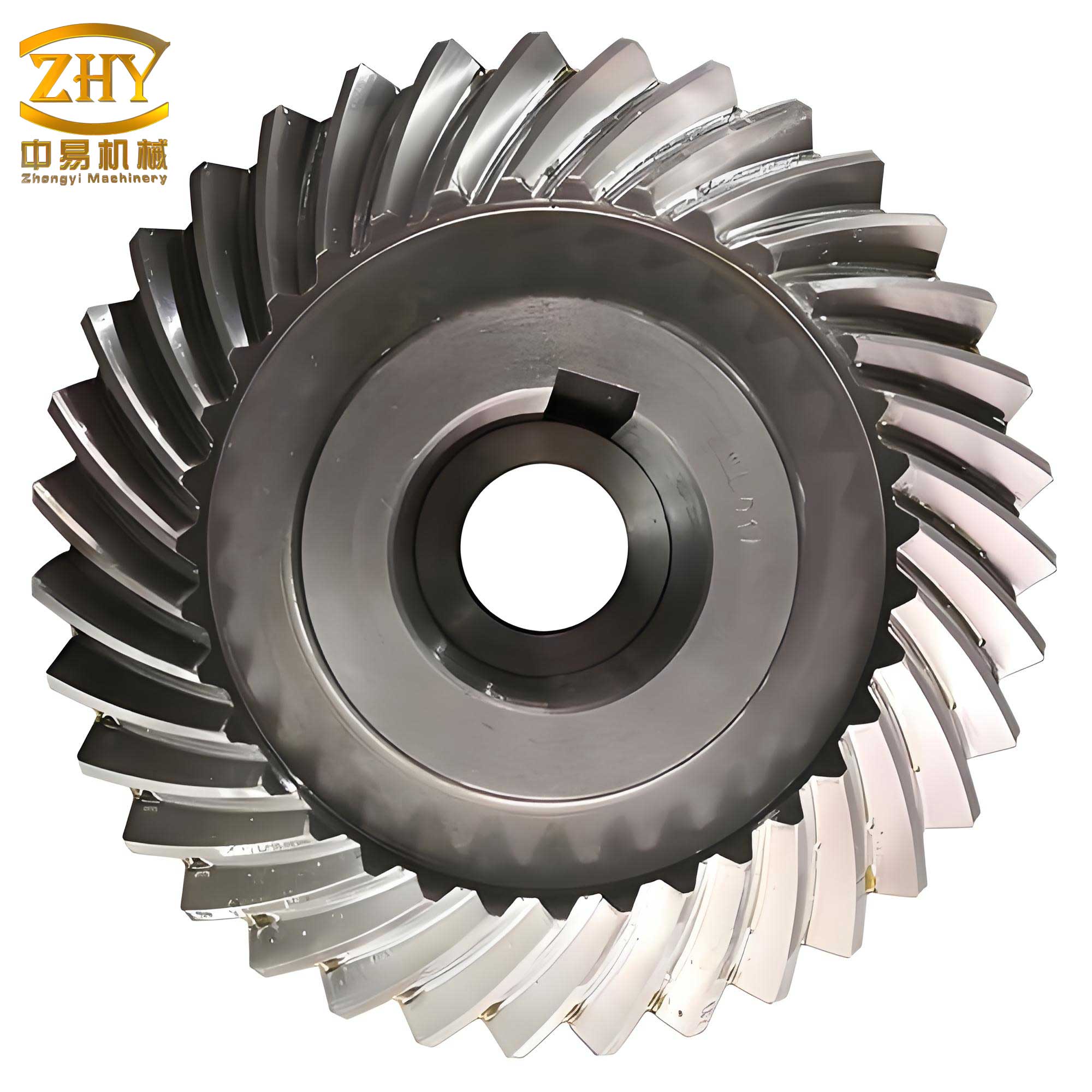
This accurate solid model is the foundation for high-fidelity dynamic analysis. The model is transferred to an explicit dynamics solver (LS-DYNA) for transient contact simulation. The finite element model is constructed with solid elements for the gear bodies. The rotational degrees of freedom about their respective axes are freed for both spiral gears. A constant input speed of 300 rpm is applied to the pinion (Gear 1), and a resisting torque of 525 N·m is applied to the wheel (Gear 2). A surface-to-surface contact algorithm is defined between all potential contacting teeth of the spiral gear pair to model the impact and sliding interactions accurately.
Dynamic Contact and Fatigue Life Analysis
The explicit dynamic simulation provides time-history data for the spiral gear pair’s behavior. The contact force between individual tooth pairs and the total meshing force are extracted. The results show that as a pair of spiral gear teeth engages and disengages, the contact force on that pair rises and falls cyclically. The total force fluctuates around a mean value of approximately 14,140 N.
A critical output is the transient contact stress. For the unmodified spiral gear pair, the maximum equivalent (von Mises) contact stress peaks at around 1,302 MPa. This peak consistently occurs at the tip region of the driving spiral gear tooth during initial engagement, highlighting a significant stress concentration area inherent to the unmodified point contact geometry.
The dynamic simulation also reveals output speed fluctuations. The steady-state output speed corresponds correctly to the theoretical gear ratio. However, the instantaneous speed varies. The variance of the output speed over a stable operating period serves as a quantitative measure of transmission smoothness, calculated to be 88.09 for the baseline unmodified spiral gears, indicating notable fluctuation.
Fatigue life prediction requires static stress results as input. A static contact analysis of a single tooth pair engagement position is performed in ANSYS to obtain the detailed sub-surface stress field. The analysis confirms the elliptical contact patch characteristic of point contact spiral gears, with a maximum static equivalent stress of 465 MPa.
The fatigue life calculation is performed using the FE-SAFE software, following a standard strain-life approach. The material’s S-N curve is defined based on relevant material standards. The dynamic contact force history from the explicit analysis is converted into a load spectrum, defining the amplitude and cycles for each load level experienced by the spiral gear teeth. The minimum predicted fatigue life, expressed as the logarithm of life in years, was found to be 0.854, corresponding to a life of approximately 7.15 years under the assumed operating conditions (16 hours/day). This minimum life location correlates with the high-stress region at the tooth tip.
Influence of Profile Modification on Spiral Gear Performance
To mitigate the high contact stress, shock, and vibration, profile modification is a widely used technique. For practical reasons, modification is typically applied only to the pinion spiral gear. A linear tip relief is adopted, defined by two parameters: the relief height (h) (the length from the tip where modification is applied) and the relief amount (Δ) (the total thickness removed at the very tip). Based on gear design handbooks, the study explores a range: \( h = 0.4m_n \pm 0.05m_n \) (i.e., 1.05 mm to 1.35 mm) and \( Δ = 0.015 \) mm to 0.025 mm.
The impact of these modifications on the dynamic performance and fatigue life of the spiral gear pair is systematically evaluated.
Effect on Dynamic Contact Stress
Profile modification effectively reduces the dynamic maximum contact stress in the spiral gear pair by alleviating the edge contact at the tooth tip. The results are summarized in the table below.
| Relief Height \( h \) (mm) | Max. Contact Stress (GPa) for Relief Amount \( Δ \) (mm) | |||
|---|---|---|---|---|
| 0.015 | 0.018 | 0.021 | 0.025 | |
| 1.05 | 1.112 | 1.100 | 1.081 | 1.063 |
| 1.15 | 1.135 | 1.120 | 1.092 | 1.072 |
| 1.25 | 1.196 | 1.166 | 1.103 | 1.086 |
| 1.35 | 1.205 | 1.195 | 1.154 | 1.095 |
The data shows that within the studied range, increasing the relief amount (\(Δ\)) consistently reduces the maximum contact stress for a given relief height. Conversely, increasing the relief height (\(h\)) generally increases the stress, unless accompanied by a sufficiently large relief amount. An optimal combination appears to be a lower relief height with a larger relief amount for minimizing dynamic contact stress in this spiral gear pair.
Effect on Meshing Force and Output Fluctuation
The modification has a negligible effect on the average total meshing force, causing only minor variations (within 0.2%) from the unmodified case. However, its effect on transmission smoothness is significant, as measured by the variance of the output speed.
| Relief Height \( h \) (mm) | Output Speed Variance for Relief Amount \( Δ \) (mm) | |||
|---|---|---|---|---|
| 0.015 | 0.018 | 0.021 | 0.025 | |
| 1.05 | 78.04 | 79.02 | 80.54 | 80.90 |
| 1.15 | 79.59 | 79.74 | 80.23 | 81.71 |
| 1.25 | 80.65 | 80.92 | 81.09 | 82.11 |
| 1.35 | 82.43 | 82.44 | 82.56 | 82.80 |
All modified cases show lower variance (improved smoothness) than the unmodified spiral gear pair (variance = 88.09). The table indicates that to minimize output fluctuation, a smaller relief height paired with a smaller relief amount is beneficial. Increasing either parameter tends to increase the speed variance, though it remains better than the unmodified baseline.
Effect on Contact Fatigue Life
The most critical impact of profile modification is on the predicted fatigue life of the spiral gear pair. The logarithm of the fatigue life for different modification parameters is shown below.
| Relief Height \( h \) (mm) | Log(Fatigue Life) for Relief Amount \( Δ \) (mm) | |||
|---|---|---|---|---|
| 0.015 | 0.018 | 0.021 | 0.025 | |
| 1.05 | 1.164 | 1.301 | 1.385 | 1.470 |
| 1.15 | 1.142 | 1.269 | 1.368 | 1.446 |
| 1.25 | 1.104 | 1.226 | 1.342 | 1.427 |
| 1.35 | 1.086 | 1.207 | 1.328 | 1.404 |
Comparing to the unmodified life (log life = 0.854), all modifications substantially improve the fatigue life. The trend is clear: for a given relief height, a larger relief amount increases life. For a given relief amount, a smaller relief height increases life. The maximum life improvement in this study is achieved with the combination of the smallest relief height (1.05 mm) and the largest relief amount (0.025 mm).
Conclusions
This integrated study—from theoretical modeling and dynamic simulation to fatigue life prediction—provides comprehensive insights into the behavior of crossed-axis involute spiral gear pairs and the significant influence of tip relief modification. The key findings are:
1. Proper profile modification is highly beneficial for spiral gears. It effectively reduces the dynamic peak contact stress, diminishes output speed fluctuations (improving smoothness), and substantially extends contact fatigue life, while having a minimal impact on the average transmitted meshing force.
2. Within the practical ranges studied, increasing the relief amount (\(Δ\)) on the spiral gear pinion is advantageous for both reducing dynamic contact stress and improving fatigue life. However, it has the side effect of slightly increasing output speed fluctuation.
3. Increasing the relief height (\(h\)) generally has detrimental effects, leading to higher dynamic contact stress, greater output speed fluctuation, and reduced fatigue life for the spiral gear pair.
4. Therefore, for optimal performance of a crossed-axis spiral gear drive, a modification strategy favoring a relatively small relief height combined with a sufficiently large relief amount is recommended. This configuration best balances the competing goals of stress reduction, life extension, and vibration control. The specific optimal values must be determined based on the actual operating conditions, expected loads, and manufacturing capabilities for the spiral gear application.