
In my extensive experience with precision plastic components, the injection molding of spiral gears presents a unique set of challenges and opportunities. These gears, characterized by their helical teeth, are critical in applications requiring smooth, quiet, and efficient torque transmission, such as in automotive instrument clusters. The design of the mold is paramount to achieving the required geometrical accuracy and mechanical properties. In this comprehensive guide, I will delve into the intricate process of designing an injection mold for a spiral gear, drawing upon fundamental principles and advanced techniques. I will structure the discussion around part analysis, mold cavity design, gating and runner systems, ejection mechanisms, and the overall mold operation, enriching the content with formulas, tables, and practical insights. The keyword ‘spiral gear’ will be central to our discussion, as it is the focal point of this engineering endeavor.
The first and most critical step is the analysis of the plastic spiral gear part itself. A spiral gear’s geometry is defined by several key parameters. Let us consider a typical specification for a miniature spiral gear used in an automotive dashboard, similar to the one referenced. The primary dimensions are governed by gear theory. The basic formulas for a helical gear are essential for design and shrinkage compensation.
The normal module is a fundamental parameter. For our spiral gear, the normal module \( m_n \) is given. The number of teeth is denoted by \( z \). The pitch circle diameter \( d \) is calculated as:
$$ d = \frac{m_n \times z}{\cos \beta} $$
where \( \beta \) is the helix angle. The helix angle itself determines the gear’s lead \( L \), which is the axial distance for one complete revolution of the helix:
$$ L = \pi \times d \times \cot \beta $$
The tip diameter \( d_a \) and root diameter \( d_f \) can be approximated using the addendum and dedendum coefficients, often \( 1 \times m_n \) and \( 1.25 \times m_n \) respectively for PA6 nylon, but precise values depend on the tooling profile. For our example gear, the parameters are summarized in the following table:
| Parameter | Symbol | Value | Unit |
|---|---|---|---|
| Number of Teeth | \( z \) | 10 | – |
| Normal Module | \( m_n \) | 0.65 | mm |
| Pitch Circle Diameter | \( d \) | 6.5 | mm |
| Tip Diameter | \( d_a \) | 7.98 | mm |
| Root Diameter | \( d_f \) | 5.16 | mm |
| Helix Angle | \( \beta \) | 2° 35′ (≈2.5833°) | degrees |
| Lead | \( L \) | 453 | mm |
| Handedness | – | Left-hand | – |
| Material | – | Polyamide 6 (PA6) | – |
The material, Polyamide 6 (PA6), has a typical shrinkage rate ranging from 0.5% to 2.0%, influenced by wall thickness, processing conditions, and reinforcement. For precision spiral gears, an accurate determination of the actual shrinkage is non-negotiable. The mold cavity must be oversized to compensate for this shrinkage. The linear shrinkage factor \( S \) is applied to the part dimensions. The cavity dimension \( D_{cavity} \) for a part dimension \( D_{part} \) is:
$$ D_{cavity} = \frac{D_{part}}{1 – S} $$
For instance, if the target tip diameter is 7.98 mm and the estimated shrinkage is 1.5%, the cavity’s corresponding dimension should be approximately:
$$ D_{cavity} = \frac{7.98}{1 – 0.015} \approx 8.10 \text{ mm} $$
This calculation must be applied meticulously to all critical dimensions of the spiral gear to ensure final part conformity.
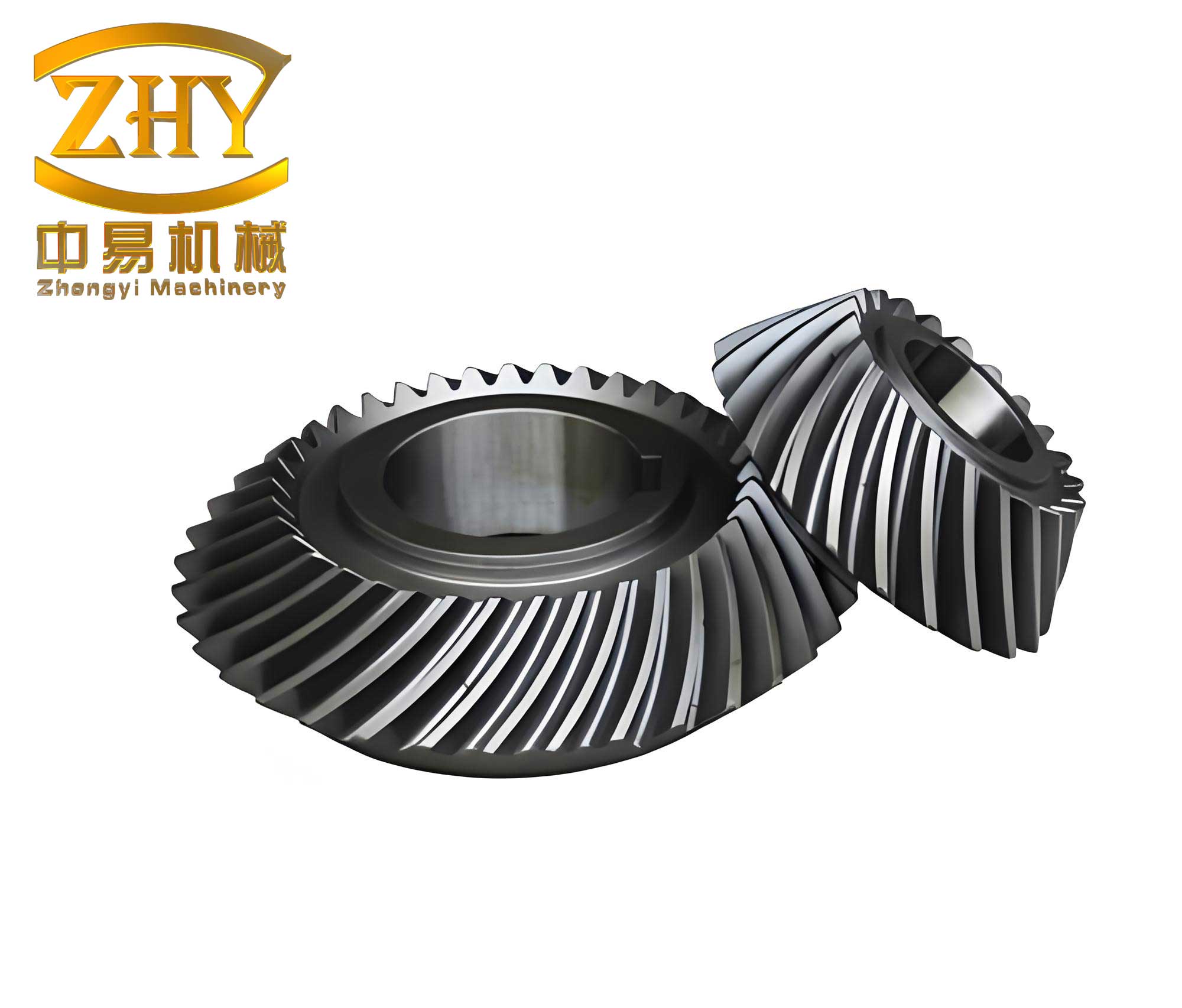
The core challenge in manufacturing the mold for such a spiral gear lies in replicating the complex, continuous helical tooth form. In contemporary practice, the cavity for the spiral gear teeth is most accurately produced using electroforming, specifically nickel electroforming. This additive manufacturing process allows for the creation of intricate, high-precision surfaces that are difficult to achieve with conventional machining. The process flow for creating the cavity insert is methodical. First, a master model of the spiral gear is fabricated, incorporating the calculated shrinkage allowance. This master must be conductive. It undergoes pre-treatment before being submerged in an electrolyte solution where nickel ions are deposited onto its surface. After sufficient thickness is achieved, the electroformed shell is backed up with a stronger material, the master is removed, and the nickel cavity is finished and integrated into the mold base. The quality of the final spiral gear part is directly contingent on the accuracy of this electroformed cavity.
The mold structure must facilitate not only precise cavity definition but also effective filling and ejection. I will now describe a proven mold design scheme for a spiral gear. The design follows a two-cavity layout for productivity, incorporates a two-stage ejection system, and uses a specific gating strategy. The overall assembly comprises several key plates and components. A detailed breakdown of the mold structure is provided in the table below, which correlates with the functional description.
| Item No. | Component Name | Primary Function |
|---|---|---|
| 1 | Fixed Clamping Plate | Mounts to the stationary platen of the injection machine. |
| 2 | Moving Retainer Plate (Active) | Holds the runner system and initiates first stage opening. |
| 3 | Cover Plate | Secures and aligns components in the moving half. |
| 5 | Sprue Bushing | Channels molten plastic from the machine nozzle into the mold. |
| 6 | Insert Sleeve I | Forms part of the gate and supports the core. |
| 7 | Insert Sleeve II | Provides structural support and alignment for the cavity insert. |
| 9 | Cavity Insert (Nickel Electroform) | Defines the external helical tooth form of the spiral gear. |
| 10 | Spacer Block | Creates space for ejector mechanism travel. |
| 12 | Core Pin | Defines the internal bore and hub of the spiral gear. |
| 13 | Ejector Sleeve | Directly contacts and pushes the spiral gear part off the core. |
| 15, 19 | Ejector Pins (Type I, II) | Eject the runner and sprue during the first ejection stage. |
| 20 | Push Rod | Transmits ejection force from the machine to the sleeve plate. |
| 24 | Return Pin | Ensures the ejector sleeve retracts during mold closing. |
| 26 | Cavity Retainer Plate | Securely holds the electroformed cavity insert. |
| 27 | Ejector Return Pin | Returns the main ejector plate during mold closing. |
The gating system is crucial for filling the delicate spiral gear cavity without inducing flow lines, weld lines, or excessive stress. Given the small size and the requirement that the tooth flanks remain free of gate marks, a peripheral gating approach is adopted. In this design, molten plastic enters the cavity through three uniformly spaced gates located between the core pin (Item 12) and Insert Sleeve I (Item 6). This forms a variant of a diaphragm or spider gate. The cross-section of this gate is optimized to minimize shear and ensure balanced filling. The clearance \( h \) between the core and the sleeve, which defines the gate height, is a critical parameter. It can be related to the nominal wall thickness \( t \) of the spiral gear’s hub. A typical rule is:
$$ h \approx 0.5 \times t $$
For a wall thickness of 1 mm, the gate height would be around 0.5 mm. The width \( w \) of each gate segment is determined to provide sufficient cross-sectional area \( A_g \) to allow filling before freeze-off:
$$ A_g = n \times (w \times h) $$
where \( n \) is the number of gates (3). The total gate area should satisfy the required flow rate based on the spiral gear’s volume \( V \) and the recommended fill time \( \tau \):
$$ \frac{V}{\tau} \approx A_g \times v $$
where \( v \) is the average flow velocity of the melt. This gating configuration promotes symmetrical flow around the core, reducing orientation and warpage in the final spiral gear.
Ejecting a spiral gear is non-trivial due to its helical geometry. During ejection, the part tends to rotate along its axis as it unscrews from the helical cavity. This rotation must be accommodated without damaging the part or the mold. The part design itself incorporates features (like a non-cylindrical hub or undercuts) that allow the ejector sleeve (Item 13) to engage and push the part without requiring positive anti-rotation in the cavity. The ejection force \( F_e \) must overcome the friction and the rotational resistance. The friction force \( F_f \) between the part and the core is:
$$ F_f = \mu \times F_n $$
where \( \mu \) is the coefficient of friction (for PA6 on steel) and \( F_n \) is the normal force due to shrinkage. The unscrewing torque \( T \) required is related to the lead \( L \) and the axial ejection force \( F_{axial} \):
$$ T = \frac{F_{axial} \times L}{2\pi} $$
However, in this mold design, the part is designed to slide out with controlled rotation, so the ejection system primarily provides axial force. The ejector sleeve applies this force uniformly to the back face of the spiral gear’s hub. A delayed ejection sequence is implemented to protect the fragile teeth. The runner system is ejected first, and only after a certain safe distance is reached does the secondary ejection for the spiral gear parts commence.
The operational sequence of the mold is a carefully choreographed process. Upon injection and cooling, the mold opens. The first parting occurs at the interface between the fixed plate (1) and the moving retainer plate (2) (the A-A plane). The solidified runner system is held on the moving side by an undercut in the sprue puller. The injection machine’s central ejector rod then activates, pushing the main ejector plate (18). This drives Ejector Pins I and II (15, 19), which in turn push the runner system and, consequently, cause the moving retainer plate (2) to separate from the cavity retainer plate (26) at the B-B plane. Limit screws (8) stop this travel, and the runner is fully ejected and drops away. This is the first-stage ejection. For the spiral gear parts themselves, ejection is delayed. The push rod (20) is only activated after the moving retainer plate has traveled a set distance. This rod then pushes the ejector sleeve plate (22, 23), driving the ejector sleeves (13) to axially push the two spiral gears off the core pins (12). The helical geometry allows the parts to rotate slightly as they are ejected, clearing the cavity without interference. During mold closing, return pins (27) and the specific return pin (24) ensure all ejector components—both for the runner and the parts—are fully retracted before the mold halves seal, preventing catastrophic damage.
Material selection for mold components interacting with the spiral gear cavity is vital. The electroformed nickel cavity insert offers excellent release properties and wear resistance for PA6. Core pins and ejector sleeves are typically made from hardened tool steels like H13 or stainless steels for corrosion resistance. The mechanical design of plates must account for clamping and injection pressures. The required clamping force \( F_{clamp} \) can be estimated from the projected area \( A_{projected} \) of the cavities (including runners) and the injection pressure \( P_{inject} \):
$$ F_{clamp} > A_{projected} \times P_{inject} $$
For our two spiral gear cavities and the runner, the projected area is small, but the calculation remains essential for mold integrity.
Cooling system design is another cornerstone for producing dimensionally stable spiral gears. Efficient cooling minimizes cycle time and reduces warpage. For a small spiral gear, cooling channels are drilled close to the cavity and core surfaces. The cooling time \( t_c \) can be estimated using the wall thickness \( s \) and the thermal diffusivity \( \alpha \) of the plastic:
$$ t_c \propto \frac{s^2}{\alpha} $$
For PA6, with a wall thickness of about 1 mm, cooling times are relatively short, but uniform cooling is critical to prevent uneven shrinkage that could distort the precise helix of the spiral gear.
In practical application, the mold design described has proven successful. It reliably produces spiral gear components that meet stringent dimensional and functional requirements. The integration of electroforming for the cavity, a carefully calculated gating system, and a robust two-stage ejection mechanism addresses the core challenges associated with helical plastic gears. Process optimization involves fine-tuning injection parameters—melt temperature, injection speed, packing pressure, and cooling time—to achieve the best balance between filling the intricate helix, minimizing internal stresses, and controlling shrinkage. Each spiral gear produced is a testament to the synergy between precise mold engineering and controlled processing.
To further illustrate the interrelationship of key design parameters for a spiral gear injection mold, the following table consolidates critical formulas and their application:
| Design Aspect | Formula / Relationship | Application Note |
|---|---|---|
| Gear Geometry (Pitch Diameter) | $$ d = \frac{m_n \cdot z}{\cos \beta} $$ | Foundation for all cavity sizing; must include shrinkage. |
| Shrinkage Compensation | $$ D_{cav} = \frac{D_{part}}{1 – S} $$ | Applied to \( d \), \( d_a \), \( d_f \), and critical hub dimensions. |
| Gate Cross-sectional Area | $$ A_g = n \cdot (w \cdot h) $$ | Ensures adequate flow for the spiral gear volume before freeze-off. |
| Required Clamping Force | $$ F_{clamp} > A_{proj} \cdot P_{inj} $$ | Prevents mold flashing during injection of the spiral gear cavities. |
| Cooling Time Estimation | $$ t_c \approx K \cdot \frac{s^2}{\alpha} $$ | K is a material-specific constant; crucial for cycle time and spiral gear flatness. |
| Ejection Force (Simplified) | $$ F_e > \mu \cdot \sigma_c \cdot A_{contact} $$ | \( \sigma_c \) is contraction stress; ensures reliable spiral gear ejection. |
In conclusion, the design and manufacture of an injection mold for a spiral gear is a multidisciplinary exercise that blends gear theory, material science, precision manufacturing, and mold flow dynamics. The success hinges on a deep understanding of the spiral gear’s geometry, the behavior of the polymer, and the mechanical design of the mold itself. By employing advanced techniques like electroforming for the cavity, implementing a balanced peripheral gating system, and designing a delayed, rotation-accommodating ejection sequence, high-quality spiral gears can be consistently mass-produced. The principles outlined here serve as a robust framework for engineers tackling similar challenges in precision plastic gearing. Continuous advances in simulation software for mold filling and cooling analysis further empower the optimization of such molds, pushing the boundaries of what is possible in plastic spiral gear manufacturing.