
The machining of spiral gear components, particularly those with a large prime number of teeth, presents a unique set of challenges in gear hobbing. The core difficulty lies in the simultaneous requirement for indexing (dividing) and generating the helical tooth flank. When the tooth count is a prime number greater than 100, standard indexing plates on universal hobbing machines are often insufficient. The established workaround involves a calculated approximation in the indexing train, which must then be precisely compensated for by the differential train. For years, a subtle but critical error has persisted in the common formula used to calculate this compensation. As an engineer deeply involved in this process, I will elucidate the correct derivation and provide a definitive formula for calculating the differential change gears when machining large prime spiral gears.
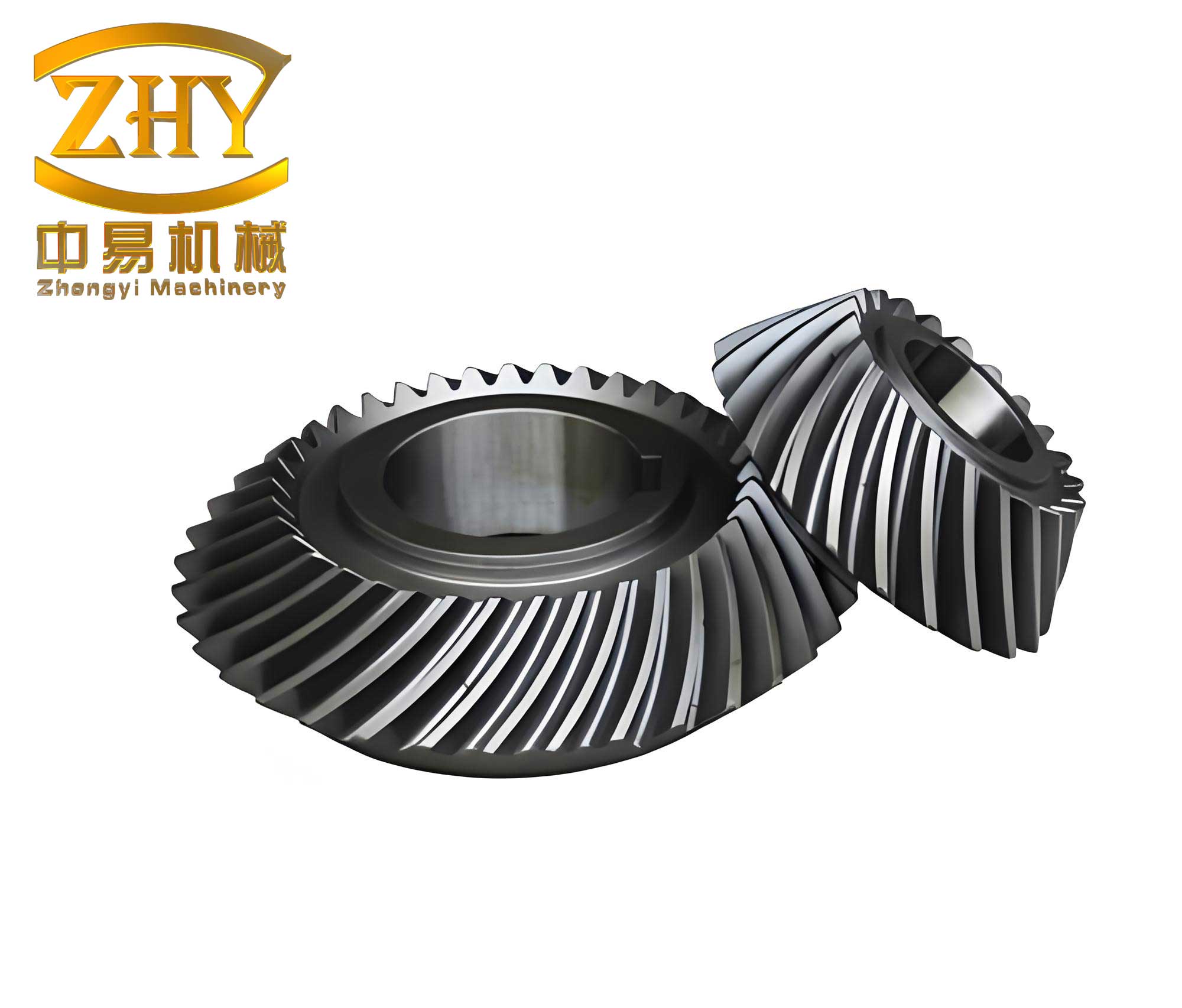
The fundamental principle of hobbing a spiral gear involves two synchronized movements: the rotation of the workpiece (indexing) relative to the rotation of the hob, and the axial feed of the hob along the workpiece axis. To generate the helix, the differential mechanism provides an additional rotational component to the workpiece, superimposing it onto the basic indexing motion. The total rotation of the workpiece during one complete cycle of the operation is the sum of these two components.
Let’s define the key variables involved in machining a spiral gear:
- $z$: The actual number of teeth on the workpiece (a large prime number).
- $k$: Number of starts on the hob.
- $L$: Lead (axial distance for one complete helix turn) of the workpiece spiral gear.
- $s$: Axial feed rate of the hob (distance per revolution of the workpiece).
- $\beta$: Helix angle of the spiral gear.
- $m_n$: Normal module.
The lead $L$ is related to the helix angle and geometry by: $$L = \frac{\pi \cdot d}{\tan(\beta)} = \frac{\pi \cdot z \cdot m_n}{\sin(\beta)}$$ where $d$ is the pitch diameter.
The Indexing Challenge and the Introduction of Δz
For a standard gear with tooth count $z$, the basic indexing ratio dictates that for $k$ revolutions of the hob, the workpiece must make $k/z$ revolutions. When $z$ is a large prime, the fraction $k/z$ often cannot be factored into the available change gears. The solution is to modify the tooth count by a small integer $\Delta z$ (where $|\Delta z| < 1$) to a number $z’ = z \pm \Delta z$ that is factorable. Therefore, the indexing train is set to achieve a ratio corresponding to $k/z’$. Consequently, when the hob makes $k$ revolutions, the indexing train alone causes the workpiece to rotate not $k/z$ revolutions, but $k/z’$ revolutions. The indexing error per hob revolution is:
$$ \text{Index Error} = \frac{k}{z} – \frac{k}{z’} = k\left(\frac{1}{z} – \frac{1}{z \pm \Delta z}\right) \approx \mp \frac{k \Delta z}{z^2} $$
To cut exactly $z$ teeth, the differential train must provide a compensatory rotation to correct this accumulated error over the full rotation of the workpiece. If the indexing train is set for $z’ = z + \Delta z$, it runs slightly “fast,” so the differential must slow it down by providing a negative compensation, and vice versa.
The Flawed Common Understanding and Correct Derivation
The prevalent mistake originates from a misunderstanding of what constitutes “indexing rotation” during the helical generation process. Let’s analyze the motion correctly.
When the hob carriage moves vertically through one full lead $L$ of the spiral gear, the workpiece must complete a specific number of turns, denoted as $N_{total}$. This $N_{total}$ is mandated by the machine’s kinematic chain linking the carriage lead screw to the workpiece via the differential. For a standard helical gear (where $z$ is factorable), this relationship is fixed by the differential change gear ratio. The key insight is that within this $N_{total}$ turns, only a portion represents the pure indexing motion required to cut $z$ teeth. The remainder is the extra rotation solely for forming the helix.
For a standard helical cut, the number of turns the workpiece makes during a lead $L$ feed is $N_{total} = L/s$. However, the number of turns needed purely for indexing to generate $z$ teeth over this travel is $k \cdot (L/s) / z = kL/(sz)$. The extra turns for the helix are therefore $N_{total} – kL/(sz)$. This extra rotation is precisely $\pm 1$ turn (sign depending on hand of helix relative to hob rotation), a fundamental condition for generating a continuous helix. Thus:
$$ \frac{L}{s} – \frac{kL}{sz} = \pm 1 $$
Solving for $L/s$ gives:
$$ \frac{L}{s} = \frac{\pm 1}{1 – \frac{k}{z}} = \frac{\pm z}{z – k} $$
This $N_{total} = L/s = \pm z / (z – k)$ is the total workpiece rotation per lead in a standard setup.
Now, for our large prime spiral gear, the indexing train is set for $z’$. If we used the standard differential calculation for $z’$, the machine would attempt to achieve $N_{total}’ = \pm z’ / (z’ – k)$ turns per lead. However, we need the workpiece to have the correct relationship for its actual lead $L$ and to have cut exactly $z$ teeth. Therefore, the differential must compensate for two discrepancies simultaneously:
- Indexing Compensation ($C_{index}$): Correcting for the use of $z’$ instead of $z$ in the indexing train over one full workpiece revolution.
- Helical Lead Compensation ($C_{lead}$): Adjusting the total turns per lead from the value suitable for $z’$ to the value required for the actual $z$ and $L$.
The common error is to treat the total rotation $N_{total}$ as pure indexing rotation. It is not. Part of it ($\pm 1$ turn per lead) is the helical component. Therefore, the compensation provided by the differential over one lead must account for the indexing shortfall only within the pure indexing portion of the motion.
Let’s derive correctly. During the movement of one lead $L$:
- The desired total rotation for the actual gear is $N_{total} = \frac{L}{s}$.
- Within this, the desired pure indexing rotation is $N_{index}^{desired} = \frac{kL}{sz}$.
- The indexing train, set for $z’$, on its own (if the differential were disengaged) would cause a pure indexing rotation of $N_{index}^{train} = \frac{kL}{sz’}$ over the same lead travel.
The differential must therefore supply the difference between the desired total motion and what the indexing train provides, but we must be careful: the indexing train’s output is only the indexing component. The differential must provide the rest, which includes both the helical component and the indexing correction. Therefore, the total supplemental rotation from the differential, $C_{diff}$, over one lead is:
$$ C_{diff} = N_{total} – N_{index}^{train} $$
Substituting $N_{total} = L/s$ and $N_{index}^{train} = kL/(sz’)$:
$$ C_{diff} = \frac{L}{s} – \frac{kL}{sz’} = \frac{L}{s}\left(1 – \frac{k}{z’}\right) $$
Now, we know for the actual gear, $L/s = \frac{\pm z}{z – k}$. Substituting this:
$$ C_{diff} = \frac{\pm z}{z – k} \cdot \left(1 – \frac{k}{z’}\right) $$
Since $z’ = z \pm \Delta z$, we get the precise formula:
$$ C_{diff} = \frac{\pm z}{z – k} \cdot \left(1 – \frac{k}{z \pm \Delta z}\right) $$
This can be simplified and is often expressed in its reciprocal form for calculating the differential gear ratio $i_{diff}$:
$$ i_{diff} = \frac{C}{A} \cdot \frac{\sin \beta}{m_n k} \quad \text{or more specifically,} \quad i_{diff} = \frac{25 \sin \beta}{m_n k} \left( \pm \frac{z}{z – k} \cdot \left(1 – \frac{k}{z \pm \Delta z}\right) \right) $$
where $C$ is a machine constant (often 25, 24, or 48).
The flawed formula, in contrast, incorrectly uses $N_{total}$ as the indexing base for compensation, leading to:
$$ C_{diff}^{flawed} = \frac{\pm z}{z – k} \pm \frac{\Delta z}{z’} \quad \text{(with sign confusion)} $$
which is equivalent to assuming the compensation per lead is simply the indexing error per workpiece revolution ($\pm \Delta z / z’$) multiplied by the total turns per lead ($L/s$), plus the standard helical term. This overlooks the fact that the indexing train’s contribution is not $L/s$ turns, but only $kL/(sz’)$ turns.
The difference between the correct and flawed formulas for a spiral gear is:
$$ \Delta C = C_{diff} – C_{diff}^{flawed} \approx \frac{\pm k \Delta z}{z(z-k)} $$
While often small, this error systematically affects the tooth spacing and helix angle accuracy of the finished spiral gear.
| Component | Correct Formula (Per Lead L) | Common Flawed Formula (Per Lead L) | Explanation of Discrepancy |
|---|---|---|---|
| Total Workpiece Rotation | $$ N_{total} = \frac{\pm z}{z – k} $$ | $$ N_{total} = \frac{\pm z}{z – k} $$ | Agreed. This is the target. |
| Indexing Train Contribution | $$ N_{index}^{train} = \frac{kL}{s z’} = \frac{k}{z’} \cdot N_{total} $$ | Implicitly treated as $N_{total}$ | The core error. The indexing train only provides the dividing motion fraction, not the total rotation. |
| Differential Compensation | $$ C_{diff} = N_{total} – N_{index}^{train} = \frac{\pm z}{z-k}\left(1-\frac{k}{z\pm\Delta z}\right) $$ | $$ C_{diff}^{flawed} = \frac{\pm z}{z-k} \pm \frac{\Delta z}{z’} $$ | The flawed formula adds a simple error proportion, missing the coupling factor $k/z’$. |
| Impact on Gear | Correct helix angle and tooth spacing. | Minor but systematic error in tooth spacing/timing relative to helix. | The flawed formula produces a spiral gear with a very slight deviation in cumulative indexing over the helix length. |
Practical Application and Sign Convention
Implementing the correct formula for a large prime spiral gear requires careful attention to signs. The following decision table ensures accurate application:
| Condition | Symbol in Formula | Rule |
|---|---|---|
| Hand of Helix (Workpiece vs. Hob) | First $\pm$ in $ \frac{\pm z}{z – k} $ | Use “+” if hands are same (e.g., both right-hand). Use “-“ if hands are opposite. |
| Indexing Train Adjustment | $\pm \Delta z$ in $z’ = z \pm \Delta z$ | This is chosen to make $z’$ factorable. If the indexing ratio is calculated as $i_{index} = \frac{a}{b} \cdot \frac{c}{d} = \frac{A \cdot k}{z’}$, then the sign of $\Delta z$ is defined by $z’ = z + \Delta z$. Use this $\Delta z$ value directly in the formula. |
| Differential Formula Term | $\pm \Delta z$ within $\left(1-\frac{k}{z \pm \Delta z}\right)$ | Use the same sign as used in the indexing train definition $z’ = z \pm \Delta z$. If $z’ = z + \Delta z$, use $+ \Delta z$ in the denominator. |
The complete workflow for machining a large prime spiral gear is therefore:
- Determine Actual Parameters: Obtain $z$, $\beta$, $m_n$, $k$, machine constants ($C$, feed $s$).
- Select Indexing Adjustment $\Delta z$: Find a small integer $\Delta z$ such that $z’ = z \pm \Delta z$ is factorable with available change gears.
- Calculate Indexing Change Gears: Set $i_{index} = (A \cdot k) / z’$, where $A$ is the machine’s indexing constant (e.g., 24, 48).
- Calculate Precise Differential Ratio: Use the formula:
$$ i_{diff} = C \cdot \frac{\sin \beta}{m_n k} \cdot \left[ \frac{\pm z}{z – k} \cdot \left( 1 – \frac{k}{z \pm \Delta z} \right) \right] $$
applying the sign conventions from the table above. - Select Feed Gears: Set the axial feed $s$ as desired.
Implications for Spiral Gear Quality and a Note on Spur Gears
Adopting the correct formula is essential for high-precision applications of spiral gears, such as in aerospace, robotics, and high-load transmissions. The angular error introduced by the flawed formula, while minute per tooth, accumulates over the circumference and along the helix. This can manifest as sub-micron level variations in tooth spacing when measured along the pitch helix, potentially affecting noise, vibration, and load distribution. For critical spiral gear applications, this correction is not merely academic but a practical necessity for achieving specified quality standards.
It is crucial to distinguish this from the simpler case of machining a large prime spur gear. For a spur gear, there is no helical component ($\beta=0$, $L=\infty$). The differential is used solely for index compensation. In this case, the compensation per workpiece revolution is simply $\pm \Delta z / z’$. The common mistake for spiral gears was to try to use a formula analogous to the spur gear case, simply adding the helical term. This is invalid because the motions are coupled. The correct spiral gear formula (with $\beta=0$) reduces correctly, as the term $\frac{\pm z}{z-k}$ becomes undefined (infinite lead), and the calculation follows a different, simpler kinematic path specific to the machine for spur gear differential indexing.
In conclusion, the accurate manufacturing of a large prime spiral gear demands a rigorous kinematic analysis. The differential system must compensate for both the helical lead and the indexing approximation in a coupled manner, not as independent additions. The formula
$$ i_{diff} = C \cdot \frac{\sin \beta}{m_n k} \cdot \left[ \frac{\pm z}{z – k} \cdot \left( 1 – \frac{k}{z \pm \Delta z} \right) \right] $$
derived from first principles, resolves the long-standing error in common practice. By applying this precise calculation and the associated sign conventions, engineers and machinists can ensure the geometric fidelity of these complex spiral gear components, optimizing their performance and longevity in demanding mechanical systems.