
In my research, I address the critical issue of gear cracks in industrial machinery, particularly focusing on spiral gears used in heavy-duty applications like ball mills. Spiral gears, due to their helical tooth design, offer smoother operation and higher load capacity compared to spur gears, but they are prone to fatigue cracks under fluctuating loads and harsh environments. These cracks often initiate at the tooth root, where stress concentrations are highest, leading to catastrophic failures if undetected. To tackle this, I propose a comprehensive finite element analysis (FEA) methodology using ANSYS, coupled with parameterized modeling in Pro/ENGINEER (Pro/E), to analyze and compare stress distributions in spiral gears with and without cracks. This approach aims to provide a robust framework for crack detection and preventive maintenance, enhancing the reliability of gear systems. Throughout this article, I will emphasize the importance of spiral gears in mechanical transmissions and delve into the technical details of my methodology.
The core of my work revolves around the stress analysis of spiral gears, which involves intricate modeling and simulation. Spiral gears, characterized by their helical teeth, exhibit complex contact patterns that require advanced computational tools for accurate stress prediction. In this study, I leverage the power of parameterization to create flexible gear models, enabling rapid iteration and analysis. The finite element method (FEM) in ANSYS allows for detailed examination of bending and contact stresses, crucial for understanding crack propagation. By comparing scenarios with and without simulated cracks, I can quantify the impact of defects on gear performance. This process not only validates theoretical stress calculations but also offers practical insights for non-destructive testing. Below, I outline the key steps in my analysis, from modeling to simulation, highlighting the role of spiral gears in modern engineering systems.
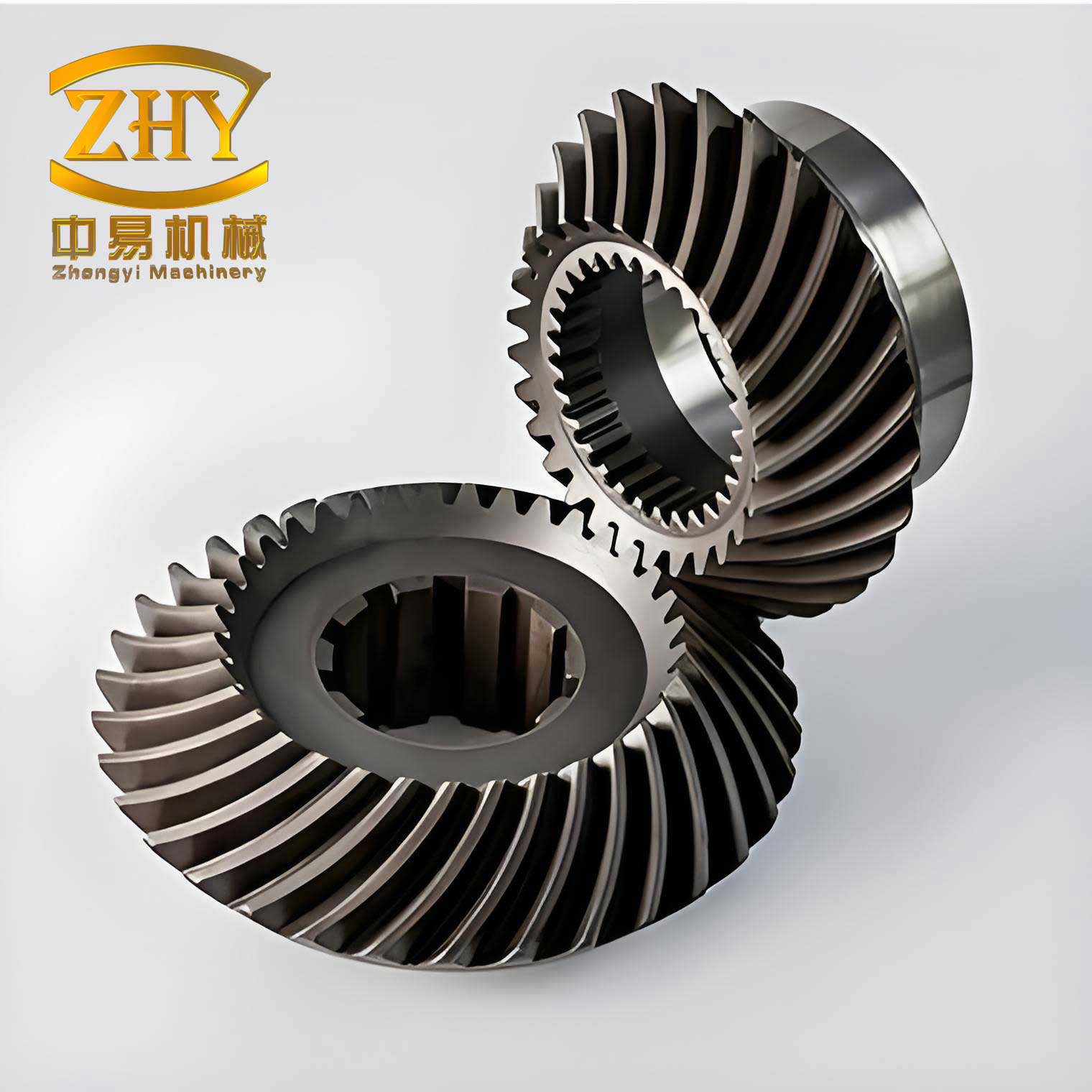
To begin, I developed a parameterized model of the spiral gear using Pro/E. Parameterization is essential for adapting the gear geometry to various design specifications, such as module, number of teeth, and helix angle. For spiral gears, the tooth profile is based on an involute curve, which must be accurately represented in 3D space. I defined key parameters in Pro/E’s program editor, allowing for dynamic updates to the model. The basic parameters for the spiral gear are summarized in Table 1, which includes factors like normal module, number of teeth, and helix angle. These parameters serve as inputs for generating the gear geometry, ensuring consistency and repeatability in the modeling process.
| Parameter | Symbol | Value | Unit |
|---|---|---|---|
| Normal Module | $$M_n$$ | 4 | mm |
| Number of Teeth (Pinion/Gear) | $$Z_1 / Z_2$$ | 36 / 112 | – |
| Face Width | $$B$$ | 125 / 120 | mm |
| Normal Pressure Angle | $$\alpha_n$$ | 20° | degrees |
| Helix Angle | $$\beta$$ | 9°22′ | degrees |
| Hand of Helix | – | Left / Right | – |
| Profile Shift Coefficient | $$X_n$$ | 0.404 / -0.025 | – |
| Addendum Coefficient | $$h_a^*$$ | 1 | – |
| Dedendum Coefficient | $$c^*$$ | 0.25 | – |
| Center Distance | $$a$$ | 300 | mm |
| Contact Ratio | $$\varepsilon$$ | 1.74 | – |
The involute curve for the spiral gear tooth is derived from mathematical equations. In Pro/E, I used the “From Equation” feature to create the curve. For the helical path, the spiral curve is defined by parametric equations in a cylindrical coordinate system. The equations are as follows, where $$t$$ is a parameter ranging from 0 to 1, $$d_b$$ is the base circle diameter, $$B$$ is the face width, $$\beta$$ is the helix angle, and $$\gamma_l$$ is the transverse pressure angle:
$$ r = \frac{d_b}{2} $$
$$ \theta = t \cdot 360 \cdot B \cdot \tan(\beta) \cdot \cos(\gamma_l) / (\pi \cdot d_b) $$
$$ z = t \cdot B $$
For the involute profile, the equations in Cartesian coordinates are:
$$ x = r_b \cdot (\cos(\theta) + \theta \cdot \sin(\theta)) $$
$$ y = r_b \cdot (\sin(\theta) – \theta \cdot \cos(\theta)) $$
where $$r_b$$ is the base radius. These equations ensure an accurate representation of the spiral gear tooth geometry. When the root circle diameter is smaller than the base circle diameter, a circular arc with radius $$r = 0.38 M_n / \cos(\beta)$$ is used to approximate the non-involute portion, ensuring smooth transitions. The single tooth is then created using a sweep blend operation along the helical path, and the full spiral gear is generated by patterning this tooth around the gear blank. This parameterized approach allows for quick modifications, making it ideal for analyzing different spiral gear configurations.
After modeling, I imported the spiral gear assembly into ANSYS for finite element analysis. The seamless data exchange between Pro/E and ANSYS facilitated this process, minimizing geometry repair efforts. I focused on a three-tooth contact model to simulate realistic loading conditions, as spiral gears typically have multiple teeth in contact due to their high contact ratio. To investigate crack effects, I introduced a simulated crack at the tooth root of one gear, with dimensions 0.1 mm in width, 0.7 mm in depth, and 7.6 mm in length. This crack model represents a typical fatigue-initiated defect in spiral gears. The finite element setup involved defining material properties, meshing, and applying boundary conditions. The materials used were alloy steels common in gear applications: 38SiMnMo for the pinion and 35SiMn for the gear, with properties listed in Table 2.
| Material | Elastic Modulus (E) | Poisson’s Ratio (ν) | Density (ρ) |
|---|---|---|---|
| 38SiMnMo (Pinion) | 2.06 × 10^5 MPa | 0.278 | 7.84 × 10^{-6} kg/mm³ |
| 35SiMn (Gear) | 2.06 × 10^5 MPa | 0.278 | 7.84 × 10^{-6} kg/mm³ |
For the FEA, I selected SOLID185 elements for the gear bodies, which are suitable for nonlinear stress analysis. Contact pairs were defined using TARGE170 and CONTA174 elements to model the gear tooth interactions. The friction coefficient was set to 0.2, reflecting typical lubrication conditions in spiral gear systems. Real constants were configured to control contact behavior, with key options such as KEYOPT(5)=3 for augmented Lagrangian method and KEYOPT(9)=1 to include frictional effects. The mesh was refined near the contact zones and tooth roots to capture stress gradients accurately, resulting in over 1 million elements for the three-tooth model. Loads and constraints were applied based on operational conditions: a torque of 1243 N·m was calculated from the motor power and speed, converted to tangential forces on the gear teeth. The force per node was distributed accordingly, and boundary conditions restricted radial and axial movements while allowing rotation.
The solving process involved nonlinear static analysis with multiple load steps. I set the number of substeps to 10 and allowed ANSYS to automatically determine time increments for convergence. After solving, I extracted results for bending stress and contact stress, comparing cases with and without cracks. The stress distributions revealed that maximum stresses occur at the contact points and tooth roots, consistent with theory for spiral gears. For the uncracked spiral gear, the maximum bending stress was 247.08 MPa, while the cracked spiral gear showed an increase to 286.12 MPa. Similarly, contact stresses rose from 669.11 MPa to 729.98 MPa due to the crack. These values are summarized in Table 3, highlighting the impact of cracks on spiral gear performance.
| Stress Type | Uncracked Spiral Gear (MPa) | Cracked Spiral Gear (MPa) | Percentage Increase |
|---|---|---|---|
| Maximum Bending Stress | 247.08 | 286.12 | 15.8% |
| Maximum Contact Stress | 669.11 | 729.98 | 9.1% |
To further analyze the stress behavior, I examined the von Mises stress contours. In the uncracked spiral gear, stress distribution along the tooth root was continuous and symmetric, with peak values at the fillet region. For the cracked spiral gear, stress concentrations were evident at the crack tip, causing localized spikes. The overall displacement increased slightly in the cracked case, indicating reduced stiffness. The contact stress patterns showed that the crack altered the load sharing among teeth, but the high contact ratio of spiral gears mitigated some effects, as multiple teeth continued to bear load. This resilience is a key advantage of spiral gears in crack scenarios. The stress intensity factors at the crack tip can be estimated using linear elastic fracture mechanics principles, such as:
$$ K_I = \sigma \sqrt{\pi a} $$
where $$K_I$$ is the stress intensity factor for Mode I loading, $$\sigma$$ is the remote stress, and $$a$$ is the crack length. For spiral gears, this helps predict crack growth rates under cyclic loading.
In addition to stress analysis, I evaluated the effect of gear parameters on performance. The helix angle $$\beta$$ plays a crucial role in spiral gears, influencing contact ratio and load distribution. The contact ratio $$\varepsilon$$ for spiral gears is given by:
$$ \varepsilon = \varepsilon_\alpha + \varepsilon_\beta $$
where $$\varepsilon_\alpha$$ is the transverse contact ratio and $$\varepsilon_\beta$$ is the overlap ratio due to helix. For my spiral gear design, $$\varepsilon_\beta$$ is calculated as:
$$ \varepsilon_\beta = \frac{B \cdot \tan(\beta)}{p_t} $$
with $$p_t$$ being the transverse pitch. This high contact ratio contributes to the smooth operation of spiral gears but complicates stress analysis due to multiple contact points. My FEA model accounted for this by including three pairs of teeth, providing a realistic simulation. I also varied parameters like module and pressure angle to study their impact on stress levels. For instance, increasing the normal module $$M_n$$ reduces bending stress, as shown by the Lewis equation for spiral gears:
$$ \sigma_b = \frac{F_t}{b m_n Y} $$
where $$F_t$$ is the tangential force, $$b$$ is the face width, $$m_n$$ is the normal module, and $$Y$$ is the Lewis form factor. This formula, though simplified, aligns with my FEA results, validating the model.
The detection of cracks in spiral gears is vital for preventive maintenance. My analysis demonstrates that even small cracks can significantly alter stress patterns, serving as early warning signs. Techniques like vibration analysis or thermography can be complemented with FEA-based predictions for accurate diagnostics. For spiral gears used in harsh environments, regular inspection and monitoring are essential. I propose integrating parameterized FEA into design workflows to simulate crack scenarios proactively. This approach not only enhances the durability of spiral gears but also optimizes their geometry for minimal stress concentrations. Future work could involve dynamic analysis or experimental validation with physical spiral gear tests.
In conclusion, my study on spiral gear stress analysis using ANSYS provides a robust methodology for assessing crack effects. The parameterized modeling in Pro/E enables efficient design iterations, while the finite element analysis offers detailed insights into stress distributions. Key findings include the stress concentration at crack tips and the moderating influence of high contact ratio in spiral gears. By comparing uncracked and cracked states, I established a basis for crack detection and life prediction. This work underscores the importance of advanced simulation tools in maintaining the reliability of spiral gear systems, which are integral to many industrial applications. I recommend further research on material fatigue properties and multi-physics simulations to fully capture the behavior of spiral gears under operational conditions.