
In my extensive experience with gear manufacturing, particularly in the milling of spiral gears, I have often faced the challenge of optimizing machining processes for efficiency and precision. Spiral gears, with their helical teeth, require careful coordination of tool and workpiece movements to achieve accurate tooth profiles. The traditional methods, while reliable, can be time-consuming, especially during the return stroke of the cutter. This article delves into an innovative rapid return technique that I have developed and implemented for milling spiral gears on machines without differential mechanisms. The focus is on maintaining tooth alignment while significantly reducing non-cutting time, thereby enhancing productivity. Throughout this discussion, I will emphasize the importance of understanding the kinematic relationships in spiral gear machining, and I will use formulas and tables to summarize key parameters and calculations. The term ‘spiral gear’ will be frequently mentioned to reinforce the context, as these gears are central to the process.
When machining a spiral gear on a gear hobbing machine equipped with a differential chain, the cutting motion involves a synchronized relationship between the hob rotation and the workpiece rotation. Specifically, for a spiral gear with a certain number of teeth and helical angle, the hob must rotate relative to the workpiece in a manner that accounts for the helical lead. In many cases, however, machines lack a differential mechanism, necessitating an alternative approach known as the non-differential adjustment method. This method relies on the principle that machining a spiral gear is equivalent to machining a spur gear with an adjusted effective number of teeth. The fundamental relationship can be expressed as follows:
$$ z_{\text{eff}} = z \pm \frac{f_a}{P_h} $$
Here, $z$ represents the actual number of teeth on the spiral gear, $f_a$ is the axial feed per revolution of the workpiece table, and $P_h$ is the helical lead of the gear. The sign ($\pm$) depends on the cutting conditions, such as the direction of hob rotation relative to the workpiece helix and whether the milling is up-cut or down-cut. This equivalence allows for the use of standard spur gear indexing calculations, bypassing the need for a differential chain. The helical lead $P_h$ is intrinsically linked to the gear’s geometric parameters. For a spiral gear with normal module $m_n$, tooth count $z$, and helix angle $\beta$ at the pitch circle, the lead is given by:
$$ P_h = \frac{\pi m_n z}{\sin \beta} $$
This formula highlights how the spiral gear’s lead increases with module and tooth count but decreases with a larger helix angle. Substituting this into the effective tooth number equation provides a direct connection to the gear’s design specifications. To implement the non-differential method on a specific machine, the indexing change gear ratio must be calculated. Based on the machine’s kinematic chain, this ratio can be derived as:
$$ \frac{A}{B} \cdot \frac{C}{D} = \frac{k m_n \sin \beta}{\pi f_a} $$
In this formula, $k$ is the machine’s indexing constant, often related to the hob’s number of starts. The terms $A$, $B$, $C$, and $D$ represent the change gears. The sign convention for the $\pm$ in the effective tooth formula translates into the sign here: a positive sign applies for up-cut milling when the hob and workpiece helices are in the same direction, or for down-cut milling when they are opposite; a negative sign is used for up-cut with opposite helices or down-cut with same helices. This adjustment ensures the correct relative motion for generating the spiral gear teeth.
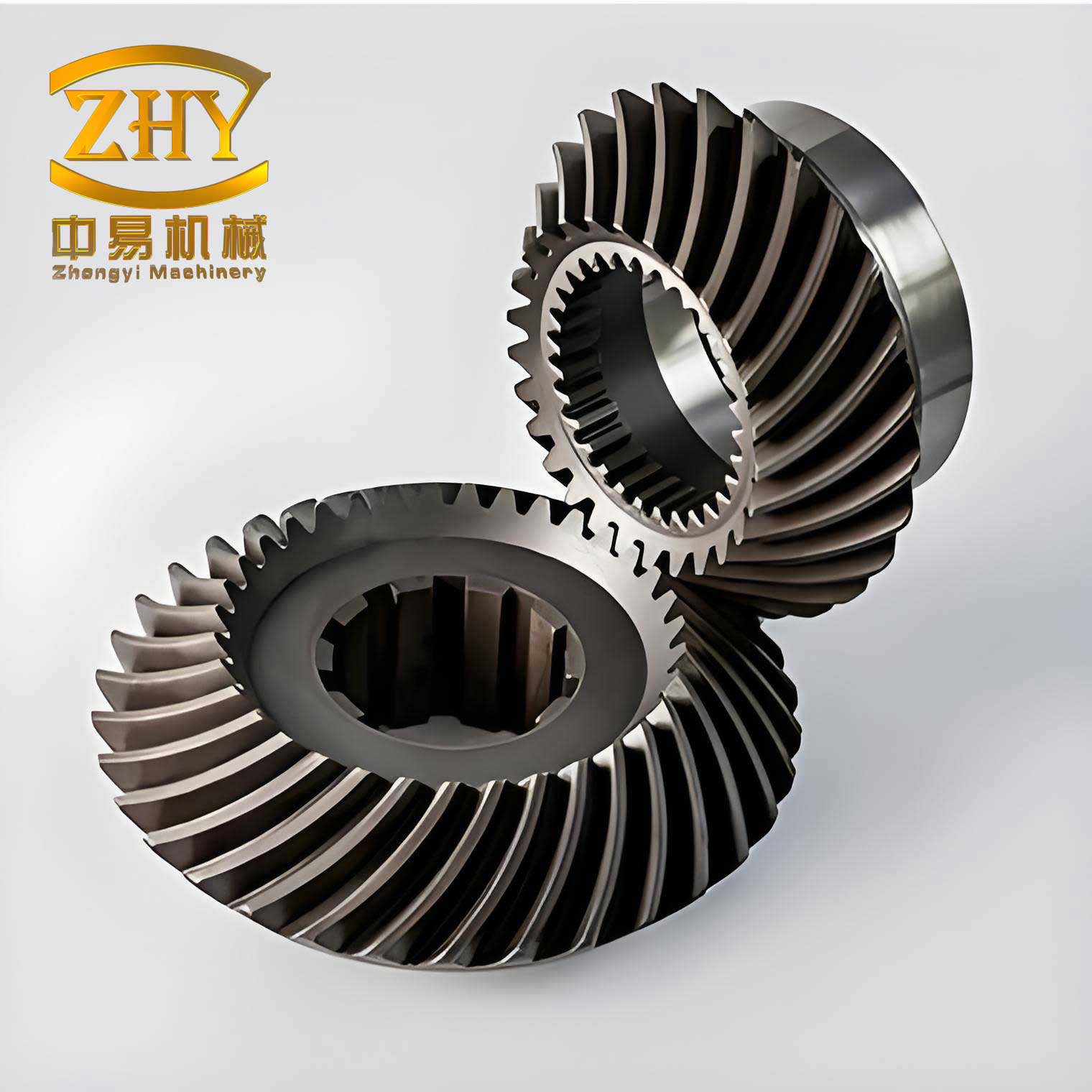
In practice, many machines used for spiral gear milling, especially older or specialized models like certain semi-automatic spline shaft millers, do not have a differential mechanism. While the non-differential method works well for the cutting stroke, it introduces a significant problem during the return stroke. Traditionally, to avoid disturbing the tooth alignment—a phenomenon known as “乱齿” or tooth disordering—the return is performed by running the machine in reverse. This means the main motor is reversed, causing the hob and workpiece to rotate in the opposite direction at the same speed as during cutting, while the feed direction is also reversed. Although this maintains the kinematic relationship, it is extremely time-consuming, often tripling the total machining time per spiral gear. This inefficiency motivated me to seek a faster return method that could preserve tooth alignment without requiring reverse operation.
After thorough analysis and experimentation, I developed a precise rapid return technique. The core idea is that at the end of the cutting stroke, when the hob has completely exited the workpiece, the relative position between the hob teeth and the gear teeth is fixed. Specifically, the highest point of the hob tooth aligns with the lowest point of the workpiece tooth space. If both the workpiece and hob remain stationary, and the milling head is moved backward by a distance equal to an integer multiple of the axial pitch of the spiral gear, then this alignment is preserved. Thus, rapid return without tooth disordering becomes possible. The axial pitch $P_a$ is a critical parameter for spiral gears, defined as the distance between corresponding points on adjacent teeth along the gear axis. It relates to the normal module and helix angle as:
$$ P_a = \frac{\pi m_n}{\sin \beta} $$
This derivation comes from the helical lead divided by the number of teeth: $P_a = P_h / z$. To determine the exact distance for milling head movement, consider the gear width $B$. The milling head should move a distance $L$ that is the smallest integer multiple of $P_a$ exceeding $B$, ensuring that the cutter retracts fully while maintaining alignment. Mathematically, if we let $n = \lfloor B / P_a \rfloor + 1$, then:
$$ L = n \cdot P_a $$
This ensures that the starting point for the next cutting stroke will be correctly aligned. In implementation, this distance $L$ must be translated into the rotation of the lead screw that drives the milling head. If the lead screw has a pitch $P_s$, then the number of revolutions $N_s$ required is:
$$ N_s = \frac{L}{P_s} $$
For precise control, it is advisable to manually rotate the lead screw using a handwheel attached to its end. This allows for fine adjustment to the degree level, achieving displacements on the order of micrometers. The following table summarizes the key parameters and their relationships for a typical spiral gear milling setup, illustrating how calculations are performed for different gear specifications.
| Parameter Name | Symbol | Relationship | Example Value 1 | Example Value 2 |
|---|---|---|---|---|
| Normal Module | $m_n$ | Design specification | 2 mm | 3 mm |
| Helix Angle | $\beta$ | Design specification | 15° | 20° |
| Number of Teeth | $z$ | Design specification | 30 | 45 |
| Axial Feed per Revolution | $f_a$ | Machine setting | 1.5 mm/rev | 2.0 mm/rev |
| Helical Lead | $P_h$ | $P_h = \frac{\pi m_n z}{\sin \beta}$ | $\approx 725.74$ mm | $\approx 1243.44$ mm |
| Axial Pitch | $P_a$ | $P_a = \frac{\pi m_n}{\sin \beta}$ | $\approx 24.19$ mm | $\approx 27.63$ mm |
| Gear Width | $B$ | Design specification | 50 mm | 60 mm |
| Integer Multiple | $n$ | $n = \lfloor B / P_a \rfloor + 1$ | 3 | 3 |
| Milling Head Move Distance | $L$ | $L = n \cdot P_a$ | $\approx 72.57$ mm | $\approx 82.89$ mm |
| Lead Screw Pitch | $P_s$ | Machine specification | 6 mm | 6 mm |
| Lead Screw Revolutions | $N_s$ | $N_s = L / P_s$ | $\approx 12.095$ rev | $\approx 13.815$ rev |
| Angular Rotation (degrees) | $\theta$ | $\theta = N_s \times 360°$ | $\approx 4354.2°$ | $\approx 4973.4°$ |
The table above provides a clear framework for calculating the rapid return parameters for any given spiral gear. Note that the actual helix angle $\beta$ used in calculations should be the measured or realized angle from the setup, as deviations from the design can affect the axial pitch. To achieve the required precision, the lead screw rotation must be controlled accurately. In my setup, I attached a graduated handwheel to the lead screw’s free end, allowing for manual rotation to the nearest degree. This translates to a linear displacement resolution of $P_s / 360$, which for a 6 mm pitch screw is about 0.0167 mm per degree—sufficient for spiral gear alignment.
However, a critical issue arises from the backlash between the lead screw and the nut. If not addressed, this backlash can introduce errors in the milling head position, potentially misaligning the spiral gear teeth. To mitigate this, my machine employs a dual-nut system (main and auxiliary nuts) adjusted to minimize clearance, typically around 0.02 mm. Before performing the rapid return, I recommend eliminating this backlash by using the traditional reverse method to move the milling head backward by a small distance, say 0.5 mm, and then stopping. This ensures that when the handwheel is used, the rotation readings correspond to actual movement without false turns. Once backlash is removed, the handwheel can be turned precisely according to the calculated angle $\theta$, guaranteeing that the milling head moves exactly by distance $L$.
An important consideration is the machine’s drive train. For the rapid return to work, the lead screw must be able to rotate independently of the feed transmission chain while the hob and workpiece are stationary. This is achieved through an overrunning clutch installed between the lead screw and the feed mechanism. When the auxiliary motor engages for rapid return, this clutch allows the screw to turn without driving the worm gear pair that connects to the workpiece spindle. Since worm gears are typically self-locking, without the clutch, manual rotation of the lead screw would be impossible. The schematic below illustrates this arrangement, though note that in practice, the exact configuration may vary by machine model.
The benefits of this rapid return method for spiral gear milling are substantial. First, it drastically reduces the cycle time per gear. Compared to the reverse method, which can triple machining time, the rapid return cuts non-productive time by over two-thirds, leading to higher throughput. Second, it makes efficient use of existing equipment, especially older machines without differentials, extending their capability to produce spiral gears competitively. Third, the method is precise and reliable, ensuring consistent tooth alignment across multiple parts. This is crucial for spiral gears used in applications like transmissions, where meshing accuracy affects noise and performance.
Beyond traditional gear milling, techniques like electrical discharge machining (EDM) have been adapted for complex components such as honeycomb seals, which sometimes incorporate spiral gear elements. While multi-axis CNC milling has replaced some EDM roughing, there remains a niche for specialized processes. The rapid return method exemplifies how optimizing a specific step—the return stroke—can have a broad impact on manufacturing efficiency. It underscores the value of deep process analysis in spiral gear production.
In conclusion, the rapid return method I have described offers a practical solution for enhancing productivity in spiral gear milling on non-differential machines. By leveraging the geometric properties of spiral gears, particularly the axial pitch, and implementing precise manual control of the lead screw, it is possible to achieve fast, accurate returns without tooth disordering. This approach not only saves time but also maximizes machine utilization. As industries continue to demand high-quality spiral gears for various mechanical systems, such process innovations play a key role in meeting production challenges. Future work could explore automating the handwheel control via servo mechanisms, further reducing manual intervention and increasing consistency.
To further illustrate the relationships involved, here are additional formulas that encapsulate the kinematics of spiral gear milling with the non-differential method. The effective tooth number concept can be expanded to include the machine’s indexing constant $k$ and the hob’s rotational speed $n_t$ relative to the workpiece speed $n_w$:
$$ n_t = \frac{k}{z_{\text{eff}}} n_w = \frac{k}{z \pm \frac{f_a}{P_h}} n_w $$
Since $P_h = \frac{\pi m_n z}{\sin \beta}$, we can substitute to get:
$$ n_t = \frac{k n_w}{z \pm \frac{f_a \sin \beta}{\pi m_n z}} $$
This shows how the hob speed must adapt for different spiral gear parameters. For the indexing change gears, the ratio formula can be rearranged to solve for the axial feed $f_a$:
$$ f_a = \frac{k m_n \sin \beta}{\pi \left( \frac{A}{B} \cdot \frac{C}{D} \right)} $$
This is useful when setting up the machine for a new spiral gear job. Another important aspect is the total machining time. Let $T_c$ be the cutting time and $T_r$ the return time. With the traditional reverse method, $T_r \approx T_c$, so total time $T_{\text{total}} \approx 2T_c$. With the rapid return method, $T_r$ is reduced to a fraction, say $0.1T_c$, so $T_{\text{total}} \approx 1.1T_c$, yielding a time savings of about 45%. This efficiency gain is significant in mass production of spiral gears.
The following table compares different scenarios for spiral gear milling, highlighting the impact of the rapid return method on productivity. The calculations assume a typical gear width and cutting parameters.
| Scenario | Cutting Time (min) | Return Time (min) | Total Time (min) | Time Savings | Notes |
|---|---|---|---|---|---|
| Traditional Reverse Method | 10.0 | 10.0 | 20.0 | 0% | Baseline for spiral gear |
| Rapid Return Method | 10.0 | 1.0 | 11.0 | 45% | Manual lead screw control |
| Ideal Automated Return | 10.0 | 0.5 | 10.5 | 47.5% | Potential future improvement |
| Spiral Gear with High Helix Angle | 12.0 | 1.2 | 13.2 | 34%* | Longer cut due to increased lead |
| Spiral Gear with Small Module | 8.0 | 0.8 | 8.8 | 56%* | Shorter cut, rapid return still applies |
*Savings compared to traditional method applied to same cutting time. This table demonstrates that the rapid return method is beneficial across various spiral gear types, though the absolute savings depend on gear geometry. The key is that the method is generic, relying on the axial pitch calculation, which applies to any spiral gear.
In summary, the successful implementation of this rapid return technique requires attention to detail: accurate calculation of the axial pitch $P_a$, careful measurement of the actual helix angle, elimination of lead screw backlash, and precise manual rotation. By following these steps, manufacturers can achieve efficient production of spiral gears on a wide range of milling machines. As the demand for spiral gears grows in automotive, aerospace, and industrial machinery, such process optimizations become increasingly valuable. I encourage practitioners to adopt and adapt this method, experimenting with different machine setups to further refine the approach for their specific spiral gear applications.