
In my extensive experience within the mechanical engineering and manufacturing sectors, I have observed that spiral gears, often referred to as helical cylindrical gears, are indispensable components in modern industrial systems. Their tooth lines follow a cylindrical helix, and the tooth surface is characterized by complex curved geometries, enabling efficient power transmission between non-parallel and non-intersecting shafts with a constant transmission ratio. The advantages of spiral gears are numerous, including high overlap coefficients, compact design, smooth and quiet operation, substantial load-bearing capacity, and energy efficiency. Consequently, they find critical applications across aerospace, automotive, and heavy machinery industries. The evolution of “smart and green” manufacturing philosophies has further heightened the demands on spiral gear design and processing, necessitating optimal approaches that balance performance, cost, and sustainability. This article delves deeply into the manufacturing methodologies, process flows, and precision machining techniques for spiral gears, integrating design principles akin to those in HVAC system optimization—such as energy conservation, operational efficiency, and lifecycle cost—to provide a holistic perspective.
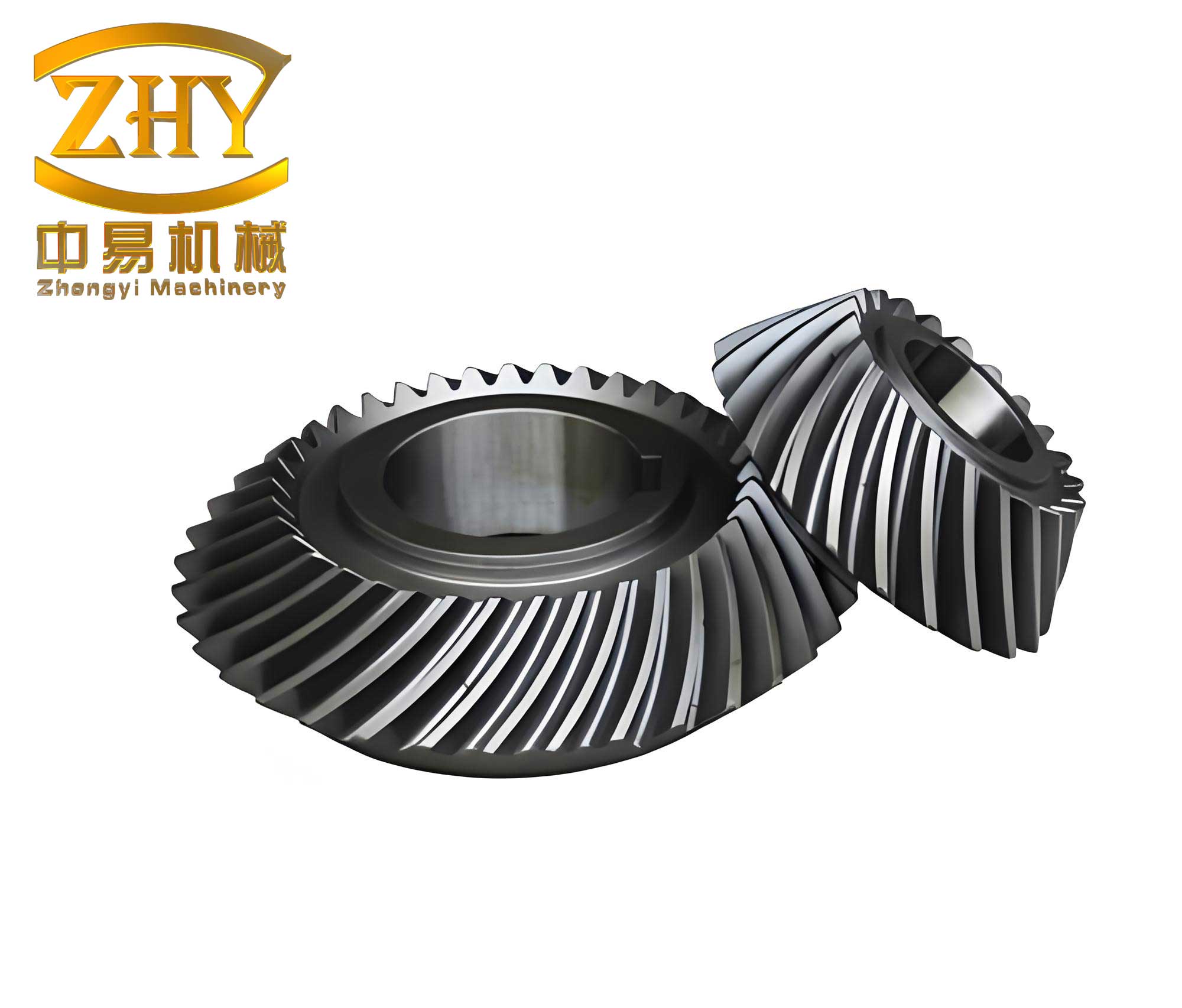
The design and production of spiral gears require meticulous attention to detail to ensure they are both “buildable and usable”—a concept paralleled in HVAC system design, where initial construction costs and long-term operational expenses must be harmonized. For spiral gears, this translates to selecting appropriate materials, machining processes, and heat treatments that minimize distortion and enhance durability. The interplay between geometric accuracy and functional performance is paramount, driven by the need for high precision in demanding applications. As I explore the various facets of spiral gear technology, I will emphasize the importance of advanced machining strategies, the integration of numerical control, and the application of mathematical models to achieve superior outcomes. Throughout this discussion, the term ‘spiral gear’ will be frequently reiterated to underscore its centrality in mechanical transmission systems.
To systematically address the complexities, I will first examine traditional and contemporary machining methods for spiral gears, followed by a detailed breakdown of the process workflow from roughing to finishing. Precision machining techniques, including generative methods and CNC-based approaches, will be analyzed with supporting formulas and comparative tables. Furthermore, I will draw analogies from HVAC design principles—such as optimizing for adjustability, automation, and energy efficiency—to propose enhancements in spiral gear manufacturing systems. The goal is to furnish a comprehensive guide that not only elucidates current practices but also anticipates future trends in spiral gear production.
Machining Methods for Spiral Gears
The fabrication of spiral gears involves several specialized techniques, each with distinct advantages and limitations. In my practice, I have evaluated methods ranging from conventional approaches to advanced数控 processes, all aimed at achieving the requisite gear quality for high-performance applications.
Unified Cutter Head Method
Originally developed to adapt universal machine tools for small-batch production, the unified cutter head method simplifies the machining of spiral bevel gears and hypoid gears. Its primary benefit lies in maintaining cutter head centrality while tilting to ensure gear rigidity during operation, which simplifies setup. However, this method is generally unsuitable for mass production of high-precision spiral gears due to limited accuracy and efficiency. The geometric constraints can be expressed using the relationship between cutter tilt angle ($$ \alpha $$) and gear spiral angle ($$ \beta $$):
$$ \alpha = f(\beta) = k \cdot \beta + c $$
where $$ k $$ and $$ c $$ are constants derived from machine tool parameters. This linear approximation facilitates quick adjustments but may not capture the nuanced tooth profile variations in high-accuracy spiral gears.
Hard Tooth Surface Lapping
Hard tooth surface lapping is a traditional finishing process that reduces surface roughness and corrects errors in tooth form and direction, thereby improving meshing performance. It is efficient but struggles to compensate for heat treatment-induced deviations such as radial runout, profile errors, and pitch errors. During lapping, the free fitting state between gear pairs often leads to non-uniform rolling across the tooth flank—greater at the tip and root, and lesser at the pitch circle. This non-uniformity can degrade tooth quality over prolonged cycles. To mitigate this, automated control of installation distance, offset distance, and shaft angle during lapping is essential. The material removal rate ($$ R_m $$) in lapping can be modeled as:
$$ R_m = K_p \cdot \Delta F \cdot t $$
where $$ K_p $$ is a material-dependent constant, $$ \Delta F $$ is the contact force variation, and $$ t $$ is time. Optimizing these parameters ensures consistent finishing across the spiral gear tooth surface.
Hard Tooth Surface Grinding
Hard tooth surface grinding is pivotal for achieving high precision in spiral gears and can be classified into generative (continuous generating) and form (copy) methods. Generative grinding involves relative generating motion between the tool and gear, maintaining a pure rolling contact to produce the enveloping tooth surface. Form grinding utilizes CAD, CNC, and material technologies for integrated modeling and manufacturing, widely adopted with数控机床 proliferation. For spiral gears, especially the driving wheel with varying tooth groove cross-sections, generative grinding is often mandatory due to geometric complexities. The tooth profile generation can be described by the equation of a helical surface:
$$ \vec{r}(u, v) = \begin{pmatrix} r_b \cos(v) + u \cdot \sin(\beta) \cdot \cos(v) \\ r_b \sin(v) – u \cdot \sin(\beta) \cdot \sin(v) \\ p \cdot v + u \cdot \cos(\beta) \end{pmatrix} $$
where $$ r_b $$ is the base radius, $$ \beta $$ is the spiral angle, $$ p $$ is the pitch parameter, and $$ u, v $$ are surface parameters. This parametric representation guides toolpath planning in grinding operations.
The following table summarizes these machining methods, highlighting their suitability for spiral gear production:
| Method | Principle | Advantages | Disadvantages | Best For |
|---|---|---|---|---|
| Unified Cutter Head | Cutter tilt with fixed center | Simple operation, good for small batches | Limited precision, not for mass production | Prototyping, low-volume spiral gears |
| Hard Tooth Surface Lapping | Abrasive finishing via relative motion | Improves surface finish, corrects minor errors | Poor control over heat treatment distortions | Final finishing of hardened spiral gears |
| Generative Grinding | Tool-gear generating motion | High accuracy, suitable for complex profiles | High equipment cost, complex setup | High-precision spiral gears in aerospace |
| Form Grinding | CNC-based contour copying | Flexible, integrates CAD/CAM | Requires precise tooling, slower for some geometries | Custom or small-batch spiral gears |
Selecting the appropriate method depends on factors like production volume, gear specifications, and cost constraints, mirroring the lifecycle cost considerations in HVAC system design.
Spiral Gear Processing Workflow
The manufacturing of spiral gears follows a sequential workflow to transform raw materials into finished components. Each stage must be carefully controlled to mitigate errors and ensure final gear performance. Drawing parallels from HVAC system design, where stages from planning to operation are interlinked, the spiral gear process flow emphasizes incremental refinement and quality assurance.
Rough Machining of Spiral Gears
Rough machining aims to remove excess material from the gear blank, establishing the basic form and preparing for subsequent operations. Common techniques include layer cutting, section line cutting, equidistant cutting, and drilling. Layer cutting, which confines tool motion to a 2D plane, is prevalent due to its simpler trajectory control and minimized air-cutting. In gear hobbing, the tooth thickness at the pitch circle must be controlled to leave a grinding allowance typically under 0.2 mm per side. Additionally, runout during hobbing should be restricted to prevent uneven carburized layers that could reduce wear resistance. The material removal volume ($$ V_{rm} $$) in roughing can be estimated as:
$$ V_{rm} = A_c \cdot v_f \cdot t $$
where $$ A_c $$ is the cross-sectional area of cut, $$ v_f $$ is the feed rate, and $$ t $$ is machining time. Optimizing these parameters ensures efficient stock removal while preserving integrity for the spiral gear.
Heat Treatment of Spiral Gears
Heat treatment, such as carburizing, quenching, or nitriding, follows rough machining to enhance the core mechanical properties of the spiral gear. This process induces thermal and transformational stresses, leading to distortion; hence, allowances must be预留. To minimize distortion, uniform heating with controlled ramp rates (e.g., 150–200 °C/h) is recommended, reducing temperature gradients between surface and core. Adequate tempering relieves residual stresses. During carburizing, the carbon concentration should be maintained at 1.0–1.2% to avoid peeling or flaking in later stages. Accelerated cooling, like forced air cooling, helps suppress carbide networks and ferrite formation. The distortion model can be approximated by:
$$ \delta = \alpha \cdot \Delta T \cdot L + \beta \cdot \sigma_{trans} $$
where $$ \delta $$ is distortion, $$ \alpha $$ is thermal expansion coefficient, $$ \Delta T $$ is temperature difference, $$ L $$ is characteristic length, and $$ \sigma_{trans} $$ is transformational stress. Controlling these factors is crucial for spiral gear dimensional stability.
Semi-Finishing of Spiral Gears
Semi-finishing removes heat treatment distortions and excess material from tooth flanks and bottoms, setting the stage for final precision machining. For spiral gears with complex curved surfaces, ball-end mills are often used to contour both flanks of the tooth groove. In high-volume production, gears are classified post-heat treatment based on size, backlash, and contact pattern using coordinate measuring machines (CMMs). This classification guides adjustments in grinding or lapping parameters to correct defects like tip-root contact, elongated contact, or diagonal contact. The contact pattern optimization involves iterative adjustments of machine settings, akin to tuning HVAC systems for optimal airflow and temperature distribution. The semi-finishing toolpath for a spiral gear tooth can be generated using CAM software, with tool diameter selection critical to avoid interference and reduce cutting forces.
Finishing of Spiral Gears
Finishing, primarily through precision lapping or grinding, achieves the final dimensional accuracy and surface quality specified in design drawings. For hard-tooth spiral gears, finishing eliminates residual stresses and heat treatment distortions, ensuring contact patterns meet design requirements. During lapping, the backlash variation must be smaller than in semi-finishing to prevent excessive clearance. A notable aspect is that a salvaged gear from a pair can be re-lapped with a new mate, though it is preferable to match with an un-lapped component for optimal performance. The finishing process emphasizes controllability and adjustability, much like modern HVAC systems that incorporate automation for efficiency. The surface finish ($$ R_a $$) improvement can be described by:
$$ R_a = R_{a0} \cdot e^{-k \cdot N} $$
where $$ R_{a0} $$ is initial roughness, $$ k $$ is a process constant, and $$ N $$ is number of finishing cycles. This exponential decay model highlights the importance of cycle control in spiral gear finishing.
The table below outlines the spiral gear processing stages with key parameters and objectives:
| Processing Stage | Primary Operations | Key Parameters | Objective | Quality Metrics |
|---|---|---|---|---|
| Rough Machining | Hobbing, milling, layer cutting | Cutting speed, feed, allowance | Remove bulk material, shape gear | Form accuracy, minimal runout |
| Heat Treatment | Carburizing, quenching, tempering | Temperature, time, cooling rate | Enhance hardness and toughness | Core hardness, case depth, distortion |
| Semi-Finishing | Contour milling, pre-grinding | Tool diameter, stepover,分类 | Correct distortions, prepare for finish | Tooth profile, surface consistency |
| Finishing | Lapping, grinding, honing | Pressure, cycle time, backlash | Achieve final accuracy and finish | Surface roughness, contact pattern |
This workflow ensures that each spiral gear meets stringent performance criteria, analogous to how integrated design in HVAC systems balances installation and operational phases.
Precision Machining Techniques for Spiral Gears
Precision machining is the cornerstone of producing high-accuracy spiral gears for critical applications. In my work, I have implemented both traditional generative methods and advanced数控 techniques, each offering unique capabilities for mastering the intricate geometries of spiral gears.
Generative Method for Precision Machining
The generative method, or continuous generating grinding, involves synchronizing tool motion with the workpiece to replicate the theoretical gear meshing. For spiral gears, the tool installation angle must vary cyclically according to the spiral angle ($$ \beta $$) variation along the tooth line. This relationship is linear: $$ \theta_t = \gamma \cdot \beta + \delta $$, where $$ \theta_t $$ is tool tilt angle, and $$ \gamma, \delta $$ are machine-specific constants. During adjustment, the pitch surface of the workpiece and the imaginary generating gear undergo pure rolling, ensuring accurate involute profile generation. The spiral gear’s tooth flank is a developable helicoid, and its equation in cylindrical coordinates is:
$$ \rho(\phi) = \frac{m_n \cdot z}{2 \cos \beta} \cdot \sqrt{1 + \left( \frac{\tan \beta}{\cos \alpha_n} \right)^2} $$
$$ z(\phi) = p \cdot \phi $$
where $$ \rho $$ is radial distance, $$ \phi $$ is angular parameter, $$ m_n $$ is normal module, $$ z $$ is tooth number, $$ \alpha_n $$ is normal pressure angle, and $$ p $$ is helical pitch. This formulation guides toolpath computation in generative grinding, ensuring each tooth segment conforms to design. The method’s advantage lies in its ability to handle variable spiral angles, essential for specialized spiral gear designs.
CNC Precision Machining for Spiral Gears
CNC machining enables multi-axis联动 (e.g., 3-axis, 5-axis) to achieve complex tooth geometries with high precision. For spiral gears, the machine tool typically controls three linear axes (X, Y, Z) and one or more rotational axes (A, B, C) to synchronize workpiece and tool movements. Since the spiral angle varies, the tool or workpiece must oscillate accordingly. In setups where the tool is fixed along Z-axis, the fixture rotates about X and Y axes to simulate helical motion. The toolpath is programmed to follow the spiral angle variation, with feed rates adjusted based on local导程 (lead). The lead ($$ L $$) for a spiral gear tooth is given by:
$$ L = \frac{\pi \cdot d \cdot \cot \beta}{z} $$
where $$ d $$ is pitch diameter. CNC systems dynamically compute $$ L $$ as $$ \beta $$ changes, enabling precise interpolation. The volumetric accuracy of CNC-machined spiral gears can be enhanced using error compensation models, such as:
$$ \Delta P = J \cdot \Delta Q $$
where $$ \Delta P $$ is position error vector, $$ J $$ is Jacobian matrix of machine kinematics, and $$ \Delta Q $$ is joint error vector. Minimizing these errors through calibration ensures the spiral gear meets tolerance specifications.
The integration of CNC with CAD/CAM allows for simulation and optimization before actual cutting, reducing trial runs and material waste. This aligns with the “smart building” concept in HVAC, where automation and predictive modeling enhance system efficiency. For spiral gears, such digital twins facilitate virtual testing of meshing performance and load distribution.
To illustrate the capabilities of precision methods, consider the following comparison table:
| Aspect | Generative Method | CNC Method |
|---|---|---|
| Axis Configuration | Typically 2-3 axes with continuous rotation | 3-5 axes with linear and rotary interpolation |
| Toolpath Control | Based on gear generating principles | Programmed via G-code from CAM software |
| Accuracy Potential | High for constant spiral angles | Very high for variable螺旋 angles |
| Flexibility | Limited to specific gear types | High, adaptable to custom spiral gear designs |
| Setup Complexity | Moderate, requires mechanical adjustments | High, involves software programming |
| Application | Mass production of standard spiral gears | Prototyping and low-volume high-precision spiral gears |
Both methods are vital in the spiral gear manufacturing ecosystem, and selection depends on production scale, gear complexity, and economic factors.
Design Considerations and Analogies from HVAC Systems
In designing and manufacturing spiral gears, principles from HVAC system design can be insightful. For instance, HVAC emphasizes lifecycle cost analysis—balancing initial investment with operational expenses—which parallels the need to optimize spiral gear production for both machining cost and in-service performance. Similarly, the requirement for HVAC systems to be “buildable and usable” mirrors the spiral gear imperative of being machinable and durable.
Energy efficiency is another cross-domain theme. In HVAC, variable refrigerant flow (VRF) and variable air volume (VAV) systems reduce energy consumption; analogously, in spiral gear processing, selecting efficient machining parameters (e.g., optimal cutting speeds and feeds) minimizes power usage. The energy consumption ($$ E $$) in gear machining can be modeled as:
$$ E = \int P(t) \, dt = \int (F_c \cdot v_c + F_f \cdot v_f) \, dt $$
where $$ P(t) $$ is instantaneous power, $$ F_c $$ and $$ F_f $$ are cutting and feed forces, and $$ v_c $$ and $$ v_f $$ are cutting and feed velocities. Minimizing $$ E $$ through process optimization contributes to sustainable manufacturing of spiral gears.
Adjustability and controllability are crucial in both fields. HVAC systems employ automation for temperature and airflow regulation; spiral gear machining benefits from CNC and adaptive control systems that compensate for real-time deviations. For example, in-situ measurement feedback can adjust tool offsets during grinding, ensuring consistent spiral gear tooth geometry. This aligns with the trend toward “intelligent manufacturing,” where data-driven decisions enhance quality.
Maintenance and longevity considerations also intersect. HVAC design accounts for equipment service life and repair needs; spiral gear design must consider wear resistance and fatigue strength, influenced by material selection and surface treatments. The contact stress ($$ \sigma_H $$) on a spiral gear tooth, per Hertzian theory, is:
$$ \sigma_H = \sqrt{ \frac{F_t \cdot E_{eq} \cdot \cos \beta}{2 \pi \cdot b \cdot \rho_{eq} \cdot \sin \alpha_n} } $$
where $$ F_t $$ is tangential load, $$ E_{eq} $$ is equivalent elastic modulus, $$ b $$ is face width, $$ \rho_{eq} $$ is equivalent curvature radius, and $$ \alpha_n $$ is normal pressure angle. Designing spiral gears to limit $$ \sigma_H $$ extends service life, reducing lifecycle costs.
Furthermore, the integration of green technologies in HVAC, such as heat recovery, parallels advancements in spiral gear manufacturing like dry machining or using biodegradable cutting fluids, which reduce environmental impact. These synergies underscore the importance of holistic design philosophies that transcend disciplinary boundaries.
Conclusion
Through this detailed exploration, I have endeavored to present a comprehensive overview of spiral gear technology, from foundational machining methods to advanced precision techniques. The spiral gear, with its unique helical geometry, demands meticulous attention throughout the manufacturing workflow—roughing, heat treatment, semi-finishing, and finishing—each stage contributing to the final gear’s performance and reliability. Precision machining, whether via generative methods or数控 approaches, leverages mathematical models and multi-axis control to achieve the high accuracies required in modern applications.
Drawing analogies from HVAC system design has illuminated parallel principles: optimizing for lifecycle cost, energy efficiency, adjustability, and automation. These principles can guide future innovations in spiral gear production, such as developing smart machining systems that self-adjust based on real-time sensor data or adopting sustainable practices that minimize resource consumption.
In summary, the effective manufacture of spiral gears hinges on a deep understanding of both traditional craftsmanship and modern technology. By embracing integrated design thinking and continuous improvement, the industry can produce spiral gears that not only meet but exceed the evolving demands of sectors like aerospace and automotive. As we advance, further research into materials, coatings, and digital twin simulations will undoubtedly unlock new potentials for spiral gear performance and efficiency, solidifying their role as critical components in mechanical transmission systems.