
In the realm of mechanical manufacturing, particularly when machining high-precision, non-involute spiral gear components such as the screws in hydraulic screw pumps, ensuring part accuracy is paramount. A practical and effective method employed on the shop floor for controlling tooth thickness is the use of a span micrometer (also known as a “公法线千分尺” or gear tooth micrometer) to measure the normal chordal thickness across the flanks of the gear teeth. The two parallel measuring faces of the span micrometer contact the helical tooth flanks tangentially. The location of these points of contact, and consequently the measured dimension, is intricately linked to the gear’s transverse profile, number of teeth, and helix angle. This measured dimension represents the minimum normal chordal thickness. This article details, from my engineering perspective, the derivation of precise formulas for calculating this minimum chordal length and the critical安置角 (settling angle or measurement angle) at which the micrometer must be positioned.
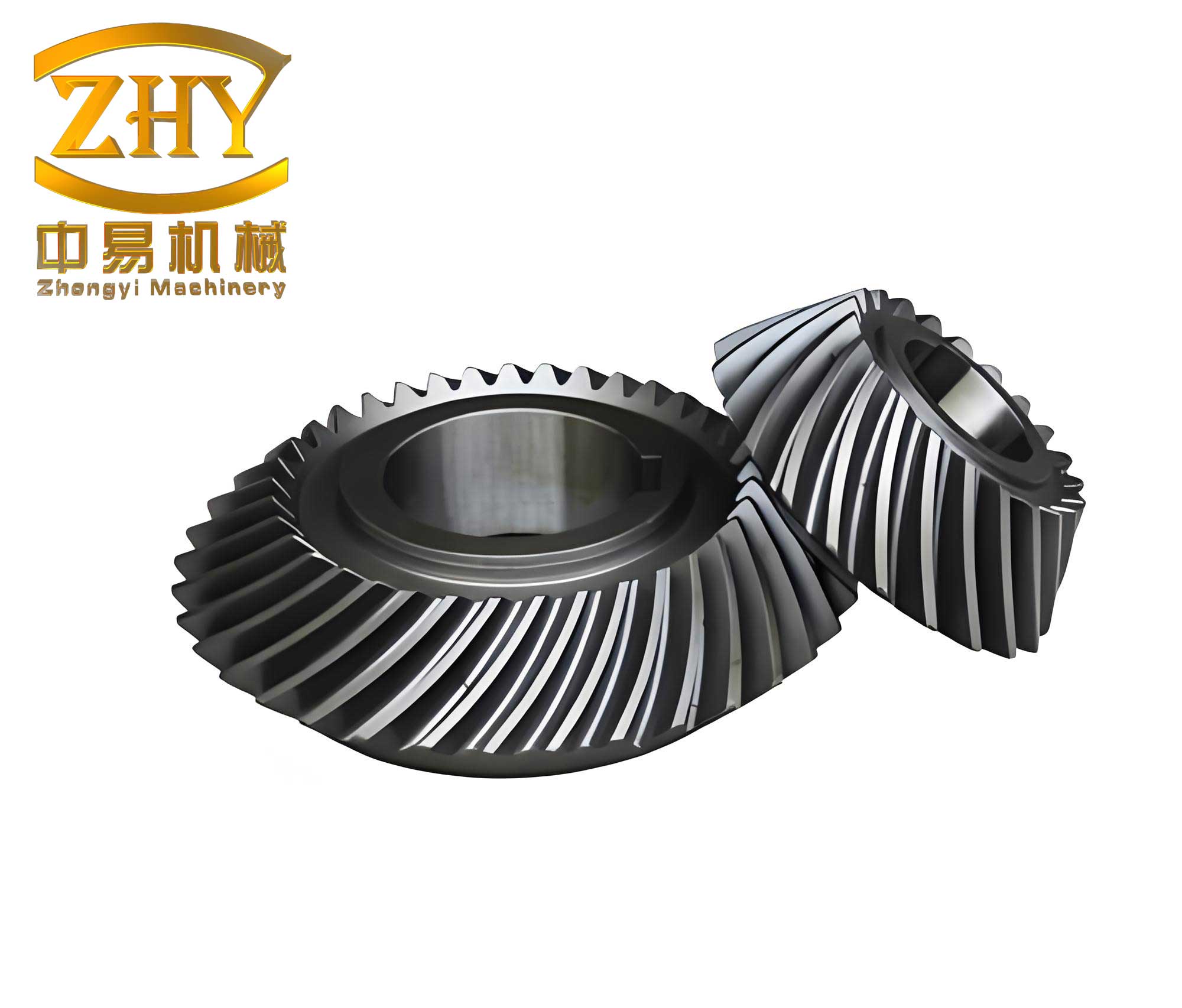
1. Mathematical Modeling of the Spiral Gear Tooth Surface
The foundation of the calculation lies in a rigorous mathematical description of the spiral gear tooth flank, which is a helical surface generated by a planar curve undergoing a screw motion.
1.1 Coordinate Systems and Profile Definition
We begin by establishing two right-handed coordinate systems fixed to the spiral gear workpiece.
| Coordinate System | Symbol | Description |
|---|---|---|
| Profile System | $$S_o(O; x_o, y_o, z_o)$$ | Fixed to the transverse (cross-sectional) profile. The $$z_o$$-axis coincides with the gear axis. |
| Workpiece System | $$S_1(O; x_1, y_1, z_1)$$ | Fixed to the spiral gear. The $$z_1$$-axis coincides with the gear axis. Initially coincides with $$S_o$$. |
The transverse profile curve $$\Gamma$$, which acts as the generating line or母线, is defined in $$S_o$$ by a parameter $$u$$:
$$ \mathbf{r}_o(u) = [x_o(u), y_o(u), 0]^T $$
Its derivative with respect to $$u$$ is:
$$ \frac{d\mathbf{r}_o}{du} = [x_o'(u), y_o'(u), 0]^T $$
1.2 Equation of the Helical Surface
The profile $$\Gamma$$, along with system $$S_o$$, undergoes a screw motion relative to the fixed system $$S_1$$. The resulting helical surface $$\Sigma$$, representing the spiral gear tooth flank, is expressed in $$S_1$$ as:
$$ \mathbf{r}_1(u, \varphi) = \begin{bmatrix}
x_1 \\
y_1 \\
z_1
\end{bmatrix} =
\begin{bmatrix}
x_o(u) \cos\varphi – y_o(u) \sin\varphi \\
x_o(u) \sin\varphi + y_o(u) \cos\varphi \\
p \varphi
\end{bmatrix} $$
Here, $$\varphi$$ is the angular parameter of the screw motion, and $$p$$ is the spiral parameter, related to the lead $$L$$ by:
$$ p = \frac{L}{2\pi} $$
1.3 Surface Normal Vector
The normal vector to the helical surface $$\Sigma$$ at any point is essential for determining tangency conditions. It is found by taking the cross product of the partial derivatives of $$\mathbf{r}_1$$ with respect to the parameters $$u$$ and $$\varphi$$.
$$ \frac{\partial \mathbf{r}_1}{\partial u} = \begin{bmatrix}
x_o’ \cos\varphi – y_o’ \sin\varphi \\
x_o’ \sin\varphi + y_o’ \cos\varphi \\
0
\end{bmatrix}, \quad
\frac{\partial \mathbf{r}_1}{\partial \varphi} = \begin{bmatrix}
-x_o \sin\varphi – y_o \cos\varphi \\
x_o \cos\varphi – y_o \sin\varphi \\
p
\end{bmatrix} $$
The surface normal vector $$\mathbf{n}$$ is:
$$ \mathbf{n}(u, \varphi) = \frac{\partial \mathbf{r}_1}{\partial u} \times \frac{\partial \mathbf{r}_1}{\partial \varphi} = \begin{bmatrix}
p (x_o’ \sin\varphi + y_o’ \cos\varphi) \\
-p (x_o’ \cos\varphi – y_o’ \sin\varphi) \\
x_o (x_o’ \cos\varphi – y_o’ \sin\varphi) + y_o (x_o’ \sin\varphi + y_o’ \cos\varphi)
\end{bmatrix} $$
We can simplify the $$z$$-component. Recognizing that in system $$S_o$$, the profile tangent is $$(x_o’, y_o’)$$ and the radial vector is $$(x_o, y_o)$$, their cross product (in a 2D sense, giving the determinant) appears. Thus, an alternative, often simpler expression is:
$$ \mathbf{n}(u, \varphi) = \begin{bmatrix}
p \frac{d y_o}{d s} \cos(\varphi – \theta) \\
p \frac{d y_o}{d s} \sin(\varphi – \theta) \\
\Delta(u)
\end{bmatrix} \quad \text{or} \quad \mathbf{n}(u, \varphi) = \begin{bmatrix}
p (x_o’ \sin\varphi + y_o’ \cos\varphi) \\
-p (x_o’ \cos\varphi – y_o’ \sin\varphi) \\
x_o y_o’ – y_o x_o’
\end{bmatrix} $$
where $$\frac{d y_o}{d s}$$ is the derivative with respect to arc length and $$\theta$$ is the tangent angle, and $$\Delta(u) = x_o(u) y_o'(u) – y_o(u) x_o'(u)$$. For our derivation, the vector form with component $$\Delta(u)$$ is perfectly adequate.
2. Coordinate System of the Span Micrometer and Tangency Condition
To model the measurement, we introduce a third coordinate system attached to the span micrometer.
| Coordinate System | Symbol | Description |
|---|---|---|
| Micrometer System | $$S(O; X, Y, Z)$$ | Fixed to the span micrometer. The $$Y$$-axis is parallel to the line connecting the centers of the two measuring anvils. The $$X$$-axis is perpendicular to the measuring faces. The $$Z$$-axis is the common normal. The system is rotated by an angle $$\beta$$ about the $$y_1$$-axis relative to $$S_1$$. |
Crucial Note: The angle $$\beta$$ is not simply the helix angle at the pitch cylinder of the spiral gear. It is a specific measurement angle that must be calculated to ensure the micrometer contacts the tooth flanks at the points yielding the minimum chordal thickness.
The transformation from the workpiece system $$S_1$$ to the micrometer system $$S$$ is a rotation about the $$y_1$$-axis:
$$ \begin{bmatrix}
X \\ Y \\ Z
\end{bmatrix} =
\begin{bmatrix}
\cos\beta & 0 & \sin\beta \\
0 & 1 & 0 \\
-\sin\beta & 0 & \cos\beta
\end{bmatrix}
\begin{bmatrix}
x_1 \\ y_1 \\ z_1
\end{bmatrix} $$
Substituting the expression for $$\mathbf{r}_1(u, \varphi)$$ gives the surface equation in $$S$$:
$$ \begin{aligned}
X &= x_1 \cos\beta + z_1 \sin\beta = (x_o \cos\varphi – y_o \sin\varphi) \cos\beta + p\varphi \sin\beta \\
Y &= y_1 = x_o \sin\varphi + y_o \cos\varphi \\
Z &= -x_1 \sin\beta + z_1 \cos\beta = -(x_o \cos\varphi – y_o \sin\varphi) \sin\beta + p\varphi \cos\beta
\end{aligned} $$
The normal vector transforms similarly:
$$ \mathbf{N} = \begin{bmatrix}
N_X \\ N_Y \\ N_Z
\end{bmatrix} =
\begin{bmatrix}
\cos\beta & 0 & \sin\beta \\
0 & 1 & 0 \\
-\sin\beta & 0 & \cos\beta
\end{bmatrix}
\mathbf{n} =
\begin{bmatrix}
n_{x_1} \cos\beta + n_{z_1} \sin\beta \\
n_{y_1} \\
-n_{x_1} \sin\beta + n_{z_1} \cos\beta
\end{bmatrix} $$
where $$\mathbf{n} = [n_{x_1}, n_{y_1}, n_{z_1}]^T$$ from our earlier calculation in $$S_1$$.
2.1 The Fundamental Tangency Condition
The two parallel measuring faces of the micrometer are perpendicular to its $$X$$-axis. For these faces to be tangent to the helical surfaces of the spiral gear tooth, the surface normal vector $$\mathbf{N}$$ at the points of contact must be parallel to the $$X$$-axis. This means the $$Y$$ and $$Z$$ components of $$\mathbf{N}$$ must be zero:
$$ N_Y = 0, \quad N_Z = 0 $$
This is the key condition that defines the contact points $$(u, \varphi)$$ for a given micrometer angle $$\beta$$.
Substituting the expressions for $$\mathbf{N}$$, the condition $$N_Z = 0$$ gives:
$$ -n_{x_1} \sin\beta + n_{z_1} \cos\beta = 0 \quad \Rightarrow \quad \tan\beta = \frac{n_{z_1}}{n_{x_1}} $$
Using the expressions for $$n_{x_1}$$ and $$n_{z_1}$$ from our derived normal vector:
$$ \tan\beta = \frac{x_o y_o’ – y_o x_o’}{p (x_o’ \sin\varphi + y_o’ \cos\varphi)} \tag{1} $$
The condition $$N_Y = 0$$ is simply $$n_{y_1}=0$$. From our normal vector:
$$ n_{y_1} = -p (x_o’ \cos\varphi – y_o’ \sin\varphi) = 0 \quad \Rightarrow \quad x_o’ \cos\varphi – y_o’ \sin\varphi = 0 \tag{2} $$
Equation (2) provides a critical relationship between the profile parameter $$u$$ (through $$x_o’, y_o’$$) and the screw motion parameter $$\varphi$$ at the point of contact.
3. Derivation of the Minimum Normal Chordal Thickness and Optimal Angle β
The dimension measured by the span micrometer is the distance between the two parallel contact planes, which is the difference in their $$X$$-coordinates. For a symmetric spiral gear tooth measured over $$k$$ teeth, this measured value $$M$$ is:
$$ M(\beta) = X(\text{contact point on left flank}) – X(\text{contact point on right flank}) $$
For a single tooth space measurement, the points are on opposite flanks of the same tooth or adjacent teeth. The function $$M(\beta)$$ has a minimum value. The goal is to find the specific angle $$\beta_m$$ that minimizes $$M$$, as this represents the most stable, well-defined measurement (the micrometer “settles” into the flanks). At this minimum, an additional condition must be satisfied: the derivative of $$M$$ with respect to the parameter governing the contact point along the tooth (often $$\varphi$$) must be zero. In practice, for a fixed $$\beta$$, as the micrometer is rocked, the contact point slides along the tooth flank. The minimum reading occurs when the derivative of the $$X$$-coordinate at the contact point with respect to this motion is zero.
A more direct approach combines our conditions. We have three equations from the tangency condition and the minimization principle for the specific spiral gear profile. Let’s denote the coordinates and derivatives for a contact point as $$x_o, y_o, x_o’, y_o’$$ at a specific $$u$$, and the corresponding $$\varphi$$. From (2):
$$ x_o’ \cos\varphi – y_o’ \sin\varphi = 0 \quad \Rightarrow \quad \frac{x_o’}{y_o’} = \tan\varphi \quad \text{(provided } y_o’ \ne 0\text{)} \tag{2a} $$
The $$X$$-coordinate is:
$$ X = (x_o \cos\varphi – y_o \sin\varphi) \cos\beta + p\varphi \sin\beta \tag{3} $$
The minimization condition requires that the derivative of $$X$$ with respect to the parameter defining motion along the line of contact (which can be shown to imply a condition on the derivative of $$X$$ with respect to $$\varphi$$, holding the tangency conditions) is zero:
$$ \frac{\partial X}{\partial \varphi} = 0 $$
Differentiating (3) and using the relations from the surface geometry and tangency condition leads, after significant algebraic manipulation, to the following equation that must hold at the minimum-measurement contact point:
$$ (x_o \cos\varphi – y_o \sin\varphi) \sin\beta – p\varphi \cos\beta = 0 \tag{4} $$
Equations (1), (2), and (4) form the complete system to solve for the three unknowns at the contact point: the profile parameter $$u$$, the angular parameter $$\varphi$$, and the optimal micrometer angle $$\beta_m$$. They define the unique setup for measuring the minimum normal chordal thickness of the spiral gear.
From (1) and (4), we can derive a useful relation. Dividing (4) by (1) (after expressing (1) as $$\sin\beta / \cos\beta = n_{z_1}/n_{x_1}$$) or manipulating them together yields a link between the transverse profile and the parameters:
$$ \frac{x_o \cos\varphi – y_o \sin\varphi}{p\varphi} = \cot\beta = \frac{n_{x_1}}{n_{z_1}} = \frac{p (x_o’ \sin\varphi + y_o’ \cos\varphi)}{x_o y_o’ – y_o x_o’} $$
Therefore:
$$ x_o \cos\varphi – y_o \sin\varphi = \frac{p^2 \varphi (x_o’ \sin\varphi + y_o’ \cos\varphi)}{x_o y_o’ – y_o x_o’} \tag{5} $$
Equation (5) together with (2) must be solved simultaneously for $$u$$ and $$\varphi$$. This typically requires a numerical iterative approach.
4. Summary of Key Formulas and Calculation Procedure
The following table consolidates the fundamental equations governing the measurement of a spiral gear with a span micrometer.
| Element | Symbol/Formula | Description |
|---|---|---|
| Transverse Profile | $$\mathbf{r}_o(u)=[x_o(u), y_o(u), 0]^T$$ | Parametric curve defining the gear tooth shape in cross-section. |
| Helical Surface | $$\mathbf{r}_1(u,\varphi)=[x_o c\varphi – y_o s\varphi, x_o s\varphi + y_o c\varphi, p\varphi]^T$$ | Equation of the spiral gear tooth flank. (Abbreviations: $$c\varphi=\cos\varphi, s\varphi=\sin\varphi$$). |
| Spiral Parameter | $$p = L / (2\pi)$$ | $$L$$ is the lead of the helix. |
| Surface Normal (in S₁) | $$\mathbf{n}=[p(x_o’ s\varphi + y_o’ c\varphi), -p(x_o’ c\varphi – y_o’ s\varphi), x_o y_o’ – y_o x_o’]^T$$ | Normal vector to the tooth surface. |
| Tangency Condition 1 | $$x_o’ \cos\varphi – y_o’ \sin\varphi = 0$$ | Ensures the normal is perpendicular to the micrometer’s Y-axis ($$N_Y=0$$). |
| Tangency Condition 2 / β Definition | $$\tan\beta = \dfrac{x_o y_o’ – y_o x_o’}{p (x_o’ \sin\varphi + y_o’ \cos\varphi)}$$ | Defines the required micrometer setting angle $$\beta$$ (from $$N_Z=0$$). |
| Minimization Condition | $$(x_o \cos\varphi – y_o \sin\varphi) \sin\beta – p\varphi \cos\beta = 0$$ | Ensures the measured chord is the minimum possible for that profile contact. |
| Combined Contact Point Equation | $$x_o \cos\varphi – y_o \sin\varphi = \dfrac{p^2 \varphi (x_o’ \sin\varphi + y_o’ \cos\varphi)}{x_o y_o’ – y_o x_o’}$$ | Derived from combining the above; used to solve for $$u$$ and $$\varphi$$. |
| Measured Chord M | $$M = 2 \cdot \left| (x_o \cos\varphi – y_o \sin\varphi) \cos\beta + p\varphi \sin\beta \right|$$ | For symmetric tooth measured at corresponding points on opposite flanks ($$\varphi$$ changes sign for opposite flank). |
4.1 Iterative Calculation Algorithm
For a given spiral gear profile $$x_o(u), y_o(u)$$ and lead $$L$$ (hence $$p$$), follow this procedure:
- Initialization: Make an initial guess for the contact point parameter $$u^{(0)}$$ (e.g., near the pitch point of the profile).
- Iteration for $$u$$ and $$\varphi$$:
- Step 1: For current $$u^{(i)}$$, compute $$x_o, y_o, x_o’, y_o’$$.
- Step 2: Solve equation (2), $$x_o’ \cos\varphi – y_o’ \sin\varphi = 0$$, for $$\varphi^{(i)}$$. This often gives $$\varphi^{(i)} = \arctan(x_o’ / y_o’)$$ or a similar relation, considering quadrant.
- Step 3: Using $$u^{(i)}$$ and $$\varphi^{(i)}$$, evaluate both sides of the combined equation (5).
- Step 4: Compute an error function, e.g., $$ \text{Err} = \left| \text{LHS of (5)} – \text{RHS of (5)} \right| $$.
- Step 5: Use a root-finding method (Newton-Raphson, secant, etc.) to update $$u^{(i+1)}$$ to minimize Err.
- Repeat Steps 1-5 until Err is within a desired tolerance (e.g., $$10^{-8}$$). This yields the converged values $$u_c$$ and $$\varphi_c$$.
- Calculate Optimal Micrometer Angle $$\beta_m$$:
$$ \beta_m = \arctan\left( \frac{x_o(u_c) y_o'(u_c) – y_o(u_c) x_o'(u_c)}{p (x_o'(u_c) \sin\varphi_c + y_o'(u_c) \cos\varphi_c)} \right) $$ - Calculate the Minimum Normal Chordal Thickness $$M_{\min}$$:
For a single tooth space, find the corresponding point on the opposite flank. For many symmetric profiles, if $$(u_c, \varphi_c)$$ is on the left flank, a point $$(u_c, -\varphi_c)$$ or $$(u_c, \varphi_c + \delta)$$ might be on the right flank, depending on profile symmetry and tooth count. The exact relation depends on the specific spiral gear geometry. Let the parameters for the two contact points be $$(u_1, \varphi_1)$$ and $$(u_2, \varphi_2)$$. Then:
$$ X_1 = (x_o(u_1) \cos\varphi_1 – y_o(u_1) \sin\varphi_1) \cos\beta_m + p\varphi_1 \sin\beta_m $$
$$ X_2 = (x_o(u_2) \cos\varphi_2 – y_o(u_2) \sin\varphi_2) \cos\beta_m + p\varphi_2 \sin\beta_m $$
$$ M_{\min} = |X_1 – X_2| $$
For a simple symmetric tooth measured over one tooth space, often $$u_1=u_2=u_c$$ and $$\varphi_2 = -\varphi_c$$, leading to:
$$ M_{\min} = 2 \cdot |(x_o(u_c) \cos\varphi_c – y_o(u_c) \sin\varphi_c) \cos\beta_m + p\varphi_c \sin\beta_m| $$
5. Application Example: Hydraulic Screw Pump Rotor
To illustrate the method, consider the active screw (a type of spiral gear) in a hydraulic pump. Its transverse profile is often a cycloidal or circular arc form. For a specific segment, the profile might be given in piecewise form. As a simplified demonstrative example, let’s assume a circular arc profile segment.
Given Parameters:
- Profile: A circular arc of radius $$R = 50 \text{ mm}$$, with center offset. Parameter $$u$$ is the arc angle.
- Coordinates: $$x_o(u) = a + R \cos u, \quad y_o(u) = b + R \sin u$$, for $$u \in [u_{min}, u_{max}]$$.
- Derivatives: $$x_o'(u) = -R \sin u, \quad y_o'(u) = R \cos u$$.
- Lead: $$L = 200 \text{ mm} \Rightarrow p = L/(2\pi) \approx 31.8309886 \text{ mm/rad}$$.
- Specific point for measurement zone: $$a = 5 \text{ mm}, b = 2 \text{ mm}, u_{target} \approx 0.5 \text{ rad}$$.
Iterative Solution (Conceptual):
- Guess $$u^{(0)} = 0.5$$ rad.
- From (2): $$x_o’ \cos\varphi – y_o’ \sin\varphi = -R\sin u \cos\varphi – R\cos u \sin\varphi = -R \sin(u+\varphi) = 0$$. Thus, $$\varphi^{(0)} = -u^{(0)} = -0.5$$ rad (one solution).
- Evaluate equation (5) LHS and RHS with these values.
- The error will be non-zero. A numerical solver would iterate on $$u$$ to drive the error to zero. Assume convergence yields: $$u_c \approx 0.5236 \text{ rad} (30^\circ), \quad \varphi_c \approx -0.5236 \text{ rad}$$.
- Calculate optimal angle:
$$ \Delta = x_o y_o’ – y_o x_o’ = R(a \cos u_c + b \sin u_c + R) $$
$$ \tan\beta_m = \frac{\Delta}{p (x_o’ \sin\varphi_c + y_o’ \cos\varphi_c)} = \frac{R(a \cos u_c + b \sin u_c + R)}{p R (-\sin u_c \sin\varphi_c + \cos u_c \cos\varphi_c)} = \frac{a \cos u_c + b \sin u_c + R}{p \cos(u_c + \varphi_c)} $$
Since $$u_c + \varphi_c \approx 0$$, $$\cos(u_c+\varphi_c)\approx 1$$.
Plugging numbers: $$\Delta \approx 50(5\cos 30^\circ + 2\sin 30^\circ + 50) \approx 50(4.33+1+50)=2766.5$$.
$$ \tan\beta_m \approx \frac{2766.5}{31.831 \cdot 1} \approx 86.92 \quad \Rightarrow \quad \beta_m \approx 89.34^\circ $$. - Calculate $$M_{\min}$$:
$$ X_c = (x_o(u_c) \cos\varphi_c – y_o(u_c) \sin\varphi_c) \cos\beta_m + p\varphi_c \sin\beta_m $$
$$ x_o \cos\varphi_c – y_o \sin\varphi_c \approx (a+R\cos u_c)\cos(-u_c) – (b+R\sin u_c)\sin(-u_c) = a\cos u_c + b\sin u_c + R $$
This simplifies to the same $$\Delta / R$$ structure. With $$\beta_m \approx 89.34^\circ$$, $$\cos\beta_m \approx 0.0115, \sin\beta_m \approx 0.9999$$.
$$ X_c \approx (2766.5/50) \cdot 0.0115 + 31.831 \cdot (-0.5236) \cdot 0.9999 \approx 0.6363 – 16.666 \approx -16.0297 \text{ mm} $$.
For the symmetric opposite flank ($$\varphi_2 = -\varphi_c = 0.5236$$ rad, same $$u_c$$):
$$ X_2 \approx 0.6363 + 16.666 \approx 17.3023 \text{ mm} $$.
$$ M_{\min} = |X_2 – X_c| \approx |17.3023 – (-16.0297)| \approx 33.332 \text{ mm} $$.
This example demonstrates the process. In reality, for complex non-involute spiral gear profiles like those in screw pumps, the profile equations are more complicated and the iterative numerical solution is essential. The final outputs are the precise micrometer setting angle $$\beta_m$$ and the expected minimum reading $$M_{\min}$$, which are used to control the machining and inspection of the spiral gear tooth thickness.