
The pursuit of compact, efficient, and powerful actuation systems in modern machinery is a continuous engineering challenge. Among various solutions, the helical swing cylinder stands out for its unique ability to directly convert linear hydraulic motion into a high-torque rotary output. This conversion is elegantly achieved through a double-stage spiral gear transmission system embedded within the cylinder’s core. The performance, size, and cost of such a cylinder are intrinsically linked to the design parameters of these spiral gear pairs. Traditional design approaches often rely on conservative, iterative calculations to meet strength requirements, which can lead to material overuse and suboptimal volume. This article details a methodological shift, applying a computational optimization strategy to minimize the total volume of the spiral gear assembly. By harnessing the power of Python programming and an Adaptive Genetic Algorithm (AGA), we transition from manual iteration to automated global search, systematically exploring the design space defined by gear module, tooth count, and helix angle to find the most volume-efficient configuration that still satisfies all mechanical constraints.
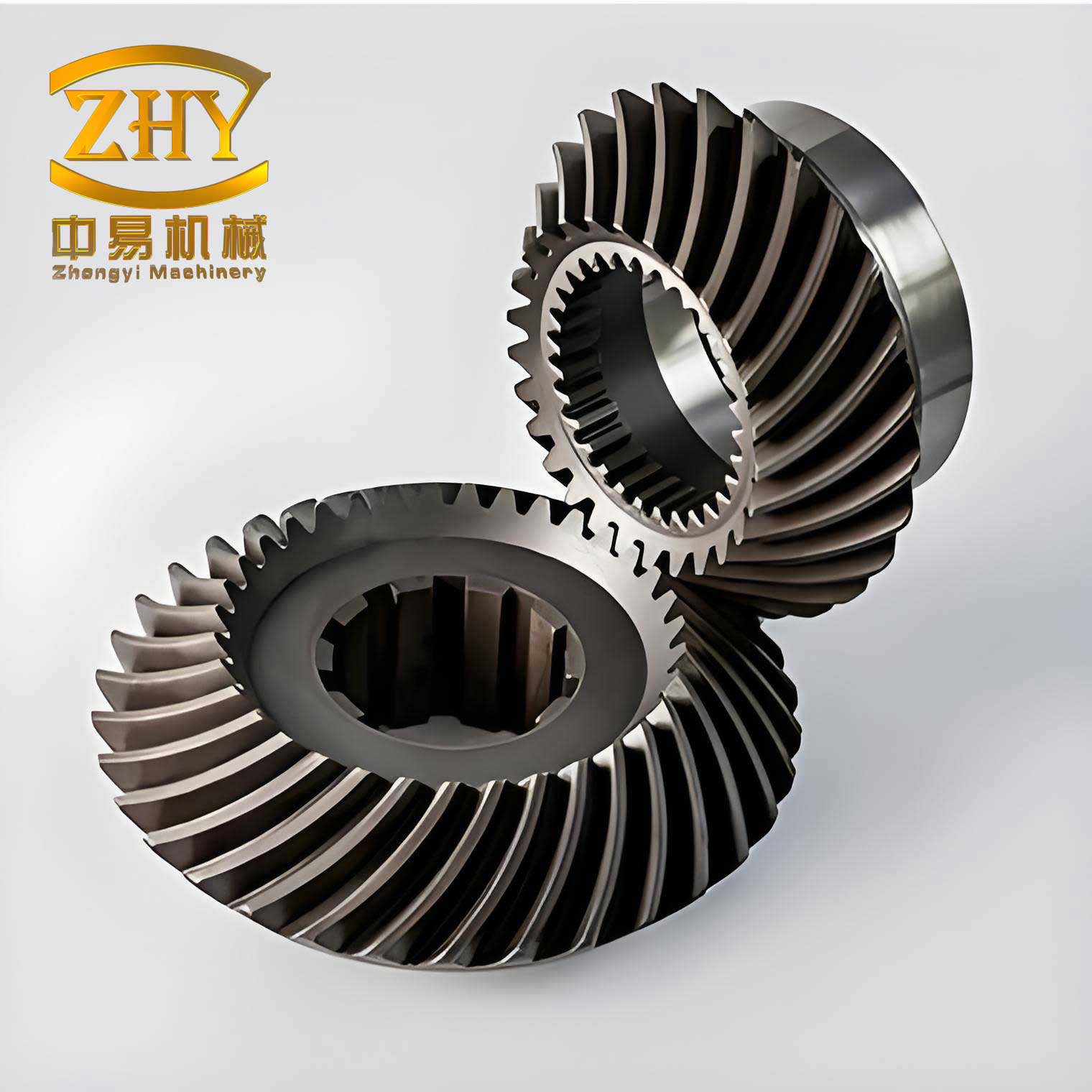
1. Helical Swing Cylinder Design and Spiral Gear Assembly
The helical swing cylinder is a sophisticated hydraulic actuator where a piston’s linear travel, driven by pressurized fluid, is transformed into a partial rotation of an output shaft. This mechanism is prized in applications like robotics, construction equipment, and material handling for its high torque-to-size ratio and integrated design. At the heart of this transformation lies a compact planetary gear system composed entirely of spiral gears. The key technical parameters for a medium-duty cylinder, which form the baseline for our optimization, are summarized below:
| Parameter | Value | Unit |
|---|---|---|
| Maximum Output Torque, T | 190,000 | N·mm |
| Maximum System Pressure, P | 36 | MPa |
| Allowable Swing Angle | 384 | ° |
| Displacement, V | 190 | mL |
The gear assembly consists of three main components forming two meshing pairs. The first-stage spiral gear pair comprises a central shaft gear (with external teeth) and a piston internal gear (with internal teeth). The second-stage pair consists of the piston external gear (external teeth) and the stationary cylinder body gear (internal teeth). The piston itself is thus a complex component integrating both internal and external spiral gear teeth. The kinematic relationship is governed by the helix angles and the number of teeth on each gear. The linear force from hydraulic pressure acting on the piston annulus creates a tangential force component at the gear meshes, ultimately producing the output torque. The fundamental geometry of a spiral gear is defined by its module \(m\), number of teeth \(z\), and helix angle \(\beta\). The reference pitch diameter \(d\) is given by:
$$d = \frac{m \cdot z}{\cos(\beta)}$$
The design challenge is to select the combination of \(m\), \(z_1\) (shaft gear teeth), \(z_2\) (piston internal gear teeth), and \(\beta\) that minimizes the overall material volume while ensuring structural integrity and functional requirements.
2. Foundation of the Genetic Algorithm and Adaptive Enhancement
Genetic Algorithms (GAs) are population-based metaheuristic optimization techniques inspired by the process of natural selection. They are particularly effective for navigating complex, non-linear, and discrete design spaces where traditional gradient-based methods struggle. A GA operates on a set of candidate solutions (a population), each represented as a string of parameters (a chromosome). Through iterative cycles of selection, crossover (recombination), and mutation, the population evolves toward better regions of the search space. The mathematical model of a basic GA can be described as:
$$S_{GA} = (C, E, P_0, M, \Phi, \Gamma, \Psi, T)$$
where \(C\) is the coding scheme, \(E\) is the fitness evaluation function, \(P_0\) is the initial population, \(M\) is the population size, \(\Phi\) is the selection operator, \(\Gamma\) is the crossover operator, \(\Psi\) is the mutation operator, and \(T\) is the termination criterion.
In a standard GA, the probabilities of crossover (\(P_c\)) and mutation (\(P_m\)) are fixed throughout the evolution. This can lead to inefficiencies: early on, high diversity is needed to explore the search space, while later, lower disruption is beneficial to converge on an optimum. The Adaptive Genetic Algorithm (AGA) addresses this by dynamically adjusting \(P_c\) and \(P_m\) based on the fitness of individual solutions relative to the population’s average fitness. This promotes better exploration in early generations and finer exploitation in later ones. The adaptive rules are typically defined as follows:
For an individual with fitness \(f’\), population average fitness \(f_{avg}\), and maximum fitness \(f_{max}\):
$$
P_c = \begin{cases}
K_1 + \frac{(K_2 – K_1)(f_{avg} – f’)}{f_{avg}}, & \text{if } f’ < f_{avg} \\
K_2, & \text{if } f’ \ge f_{avg}
\end{cases}
$$
$$
P_m = \begin{cases}
K_3 + \frac{(K_4 – K_3)(f_{max} – f’)}{f_{max} – f_{avg}}, & \text{if } f’ > f_{avg} \\
K_4, & \text{if } f’ \le f_{avg}
\end{cases}
$$
Here, \(K_1, K_2, K_3, K_4\) are constants between 0 and 1 that set the bounds for the adaptive rates. The key parameters for both the standard GA (SGA) and the AGA implemented in this study are listed in the table below.
| GA Parameter | Condition | Standard GA (SGA) | Adaptive GA (AGA) |
|---|---|---|---|
| Population Size | – | 500 | 500 |
| Generations | – | 30 | 30 |
| Crossover Rate, \(P_c\) | \(f’ < f_{avg}\) | 0.60 (Fixed) | \(0.70 + \frac{(0.21 – 0.70)f’}{f_{avg}}\) |
| \(f’ \ge f_{avg}\) | 0.60 (Fixed) | 0.21 | |
| Mutation Rate, \(P_m\) | \(f’ > f_{avg}\) | 0.05 (Fixed) | \(0.05 + \frac{(0.20 – 0.05)(f_{max} – f’)}{f_{max} – f_{avg}}\) |
| \(f’ \le f_{avg}\) | 0.05 (Fixed) | 0.02 |
3. Mathematical Formulation of the Spiral Gear Optimization Problem
3.1 Design Variables and Constraints
The optimization targets three primary design variables for the first-stage spiral gear pair: the module \(m\), the number of teeth on the shaft gear \(z_1\), and the helix angle \(\beta\). The material selected is 45CrNiMoV alloy steel with yield strength \(\sigma_s = 1324 \text{ MPa}\). The second-stage gear teeth counts are derived from kinematic and force balance equations. Each variable is subject to practical and strength-based constraints.
1. Shaft Diameter Constraint: The transmission shaft must withstand the torsional load. The minimum shaft diameter \(d_{1,min}\) is calculated from torsional strength, considering a safety factor and stress concentration from keyways:
$$\tau_T = \frac{K \cdot T}{W_T} \leq [\tau_T]$$
where \(K=1.5\) is a correction factor, \(W_T = \frac{\pi d_1^3}{16}\) is the torsional section modulus, and \([\tau_T]\) is the allowable shear stress, taken as \(0.5\sigma_s / 4\). Accounting for two keyways (10% increase), the constraint linking shaft diameter to spiral gear geometry is:
$$d_1 = \frac{m \cdot z_1}{\cos(\beta)} \geq 1.1 \times \sqrt[3]{\frac{16 \cdot K \cdot T}{\pi \cdot [\tau_T]}} \approx 61 \text{ mm}$$
2. Module Bending Strength Constraint: The module must be sufficient to prevent tooth bending failure under load. A simplified verification formula is used:
$$m \geq 12.6 \times \sqrt[3]{\frac{K T \cos^2(\beta)}{\psi_d z_1^2 \sigma_{FP}} Y_{FS} Y_{\varepsilon\beta}}$$
where \(\psi_d\) is the face width coefficient, \(Y_{FS}\) is the combined tooth form factor, \(Y_{\varepsilon\beta}\) is the contact ratio and helix angle factor, and \(\sigma_{FP}\) is the permissible bending stress.
3. Practical Range Constraints:
- Tooth Count (\(z\)): To avoid undercutting and ensure manufacturability, \(17 \leq z \leq 50\).
- Module (\(m\)): Standardized values between \(1.0 \leq m \leq 4.0\) mm are considered.
- Helix Angle (\(\beta\)): For smooth engagement and axial force balance, \(20^\circ \leq \beta \leq 44^\circ\).
4. Kinematic Derivation of Second-Stage Teeth: The number of teeth on the piston external gear \(z_3\) is not a free variable but is determined by the force equilibrium between hydraulic pressure and the axial component of the gear mesh force, and geometric compatibility. It can be derived as:
$$z_3 = \text{ceil}\left\{ \sqrt{ \left( \frac{m z_1}{\cos \beta} \right)^2 + \frac{4 \sin \beta}{7\pi^2 m z_1 \times 10^{-6}} \times \frac{A_{piston}}{P} } \times \frac{\cos \beta}{m} \right\}$$
where \(A_{piston}\) is the effective piston area. The cylinder body gear teeth \(z_4\) is then determined by the fixed transmission ratio.
3.2 Objective Function and Fitness Evaluation
The primary goal is to minimize the total volume of the three metallic spiral gear components: the shaft gear, the piston gear (modeled as a ring), and the cylinder body gear (modeled as a hollow cylinder). The total volume \(V_{total}\) is formulated as:
$$
V_{total} = \frac{\pi}{4} \left( \frac{m z_1}{\cos \beta} \right)^2 b_1 + \frac{\pi}{4} \left[ \left( \frac{m z_3}{\cos \beta} \right)^2 – \left( \frac{m z_2}{\cos \beta} \right)^2 \right] b_2 + \frac{\pi}{4} \left[ d_{cyl}^2 – \left( \frac{m z_3}{\cos \beta} \right)^2 \right] b_3
$$
where \(b_1, b_2, b_3\) are the face widths of the respective gears, and \(d_{cyl}\) is the cylinder bore diameter. For the genetic algorithm, we define the fitness function \(F(x_i)\) for an individual solution \(x_i\) as the reciprocal of the volume, so that minimization of volume corresponds to maximization of fitness:
$$
F(x_i) = \frac{1}{V_{total}(x_i)}
$$
A higher fitness score directly indicates a smaller, more volume-efficient spiral gear assembly design.
4. Algorithm Implementation in Python
The core optimization engine was built using Python. The process follows the algorithmic structure outlined below, incorporating the specific constraints and fitness function for the spiral gear problem.
Algorithm: Adaptive Genetic Algorithm for Spiral Gear Volume Optimization
Input: teeth_range, module_range, beta_range, population_size, generations
Output: Optimal gear parameters and minimum volume

1.  Initialize Population P with size M.
    For each individual in P:
        - Randomly assign z1 within teeth_range.
        - Randomly assign m within module_range, validate against bending constraint.
        - Randomly assign β within beta_range.
        - Calculate derived parameters (z2, z3, d1).
        - Enforce shaft diameter constraint. Discard invalid individuals.
        - Calculate fitness F(x_i) = 1 / V_total.

2.  For generation g = 1 to generations:
    a. Selection:
        - Rank population by fitness.
        - Select top-performing individuals to form a mating pool (using roulette wheel or tournament selection based on fitness rank).
    b. Adaptive Crossover:
        - For each pair in the mating pool:
            * Calculate population average fitness f_avg.
            * For each parent, compute adaptive P_c using f_avg and parent's fitness.
            * Generate random number r. If r < P_c, perform crossover (e.g., single-point) on the binary-encoded chromosomes to produce offspring.
            * Decode offspring, apply all geometric and strength constraints. Discard invalid offspring.
    c. Adaptive Mutation:
        - For each gene in the new offspring population:
            * Calculate population f_max and f_avg.
            * For the individual, compute adaptive P_m using its fitness, f_max, and f_avg.
            * Generate random number r. If r < P_m, flip the bit (for binary encoding) of that gene.
            * Decode mutated individual, apply all constraints. Discard invalid individuals.
    d. Elitism:
        - Preserve a copy of the best individual(s) from the previous generation.
        - Form the new generation by combining valid offspring and the elite individual(s), filling to population size M.
    e. Evaluation:
        - Calculate fitness for all individuals in the new generation.
        - Record the best individual and its fitness for this generation.

3.  Return the best individual found over all generations.
The binary encoding scheme allocated 6 bits for the module (precision 0.1), 6 bits for the shaft gear teeth, and 7 bits for the helix angle (precision 1°), resulting in a 19-bit chromosome for each individual representing a potential spiral gear set.
5. Results and Comparative Analysis
A baseline traditional design was established with parameters: \(m=2.0 \text{ mm}\), \(z_1=30\), \(\beta=30^\circ\), resulting in a total gear volume of \(4.21 \times 10^5 \text{ mm}^3\). Both the Standard Genetic Algorithm (SGA) and the Adaptive Genetic Algorithm (AGA) were executed for 30 generations with a population of 500. The convergence progress and final results are compelling.
| Generation | Standard GA (SGA) | Adaptive GA (AGA) | ||
|---|---|---|---|---|
| Volume (cm³) | Reduction vs. Baseline | Volume (cm³) | Reduction vs. Baseline | |
| 1 | 404,944 | 3.81% | 400,035 | 4.97% |
| 4 | 398,815 | 5.26% | 397,784 | 5.51% |
| 7 | 397,563 | 5.29% | 396,281 | 5.87% |
| 11 | 396,497 | 5.82% | 396,281 | 5.87% |
| 16 | 396,389 | 5.84% | 396,281 | 5.87% |
| 17 | 396,281 | 5.87% | 396,281 | 5.87% |
The final optimized parameters from both algorithms converged to an identical solution: a smaller module, a specific tooth count, and an adjusted helix angle that collectively reduced the material volume by 5.87%. The most significant insight comes from analyzing the convergence behavior. The AGA achieved the global optimum volume of \(3.963 \times 10^5 \text{ mm}^3\) by the 7th generation. In contrast, the SGA required 17 generations to reach the same optimum. The AGA’s dynamic adjustment of \(P_c\) and \(P_m\) allowed for more aggressive exploration in the initial phase, quickly weeding out poor designs, and then refined the search effectively, leading to faster convergence. The SGA, with its fixed operators, exhibited a slower, more gradual improvement, spending more time exploring less promising regions of the design space. This demonstrates the AGA’s superior efficiency in navigating the constrained parameter landscape of the spiral gear design problem.
6. Conclusion and Future Work
This study successfully demonstrates the application of a computational optimization framework, integrating Python and an Adaptive Genetic Algorithm, to the engineering design problem of minimizing the volume of a spiral gear assembly within a helical swing cylinder. The methodology systematically incorporated critical mechanical constraints—including torsional shaft strength, gear bending strength, and kinematic relationships—into the algorithmic search process. Both standard and adaptive GA variants proved capable of finding a superior design compared to a conventional baseline, achieving a significant 5.87% reduction in material volume. Crucially, the Adaptive Genetic Algorithm showcased a distinct advantage in convergence speed, locating the global optimum in less than half the generations required by the standard version. This efficiency translates directly into reduced computational time and cost during the design phase.
The practical value of this approach extends beyond the single optimal solution. The evolutionary process inherently generates and evaluates a vast array of feasible, near-optimal spiral gear configurations. This provides designers with a valuable palette of alternative solutions that may offer different trade-offs (e.g., slightly larger volume for greatly improved manufacturability or stress distribution). Future work can expand this model in several meaningful directions. The objective function could be extended to a multi-objective optimization, simultaneously minimizing volume, maximizing efficiency, and minimizing peak contact stresses. The model’s fidelity can be increased by integrating more detailed analysis, such as finite element-based stress calculation for bending and contact (e.g., using ISO or AGMA standards) directly into the fitness evaluation loop, creating a fully automated design-analysis-optimization pipeline. Furthermore, this Python-based AGA framework is highly generalizable and can be adapted to optimize other critical parameters in rotary actuators, such as bearing selection, seal placement, or port sizing, fostering the development of more compact, efficient, and high-performance hydraulic systems.