
In modern mechanical transmission systems, the demand for high precision, low noise, and heavy-load capacity has driven the widespread adoption of double-helical gears, also commonly referred to as herringbone gears. These spiral gears consist of two symmetrically arranged helical gear segments with opposite hand directions, effectively canceling axial forces and enabling superior performance in applications such as aviation, marine propulsion, and industrial machinery. However, the unique geometry of double-helical gears introduces specific manufacturing challenges, particularly regarding the alignment of the V-shaped vertices formed by the intersection of tooth flanks from opposite helices. This alignment, or lack thereof, directly influences vibration, noise, and load distribution uniformity in spiral gear systems. Traditional measurement methods, which treat the two helical segments as independent entities, fail to capture this critical interaction, leading to incomplete accuracy assessments. In this paper, I propose a novel measurement and evaluation methodology based on tooth flank contact lines to define and quantify the alignment error of V-shaped vertices in double-helical gears. By leveraging a full tooth contact line approach, this method provides a comprehensive framework for assessing spiral gear quality, enhancing both manufacturing control and transmission performance prediction. The integration of mathematical modeling, experimental validation, and error quantification forms the core of this work, aiming to advance the precision engineering of spiral gears.
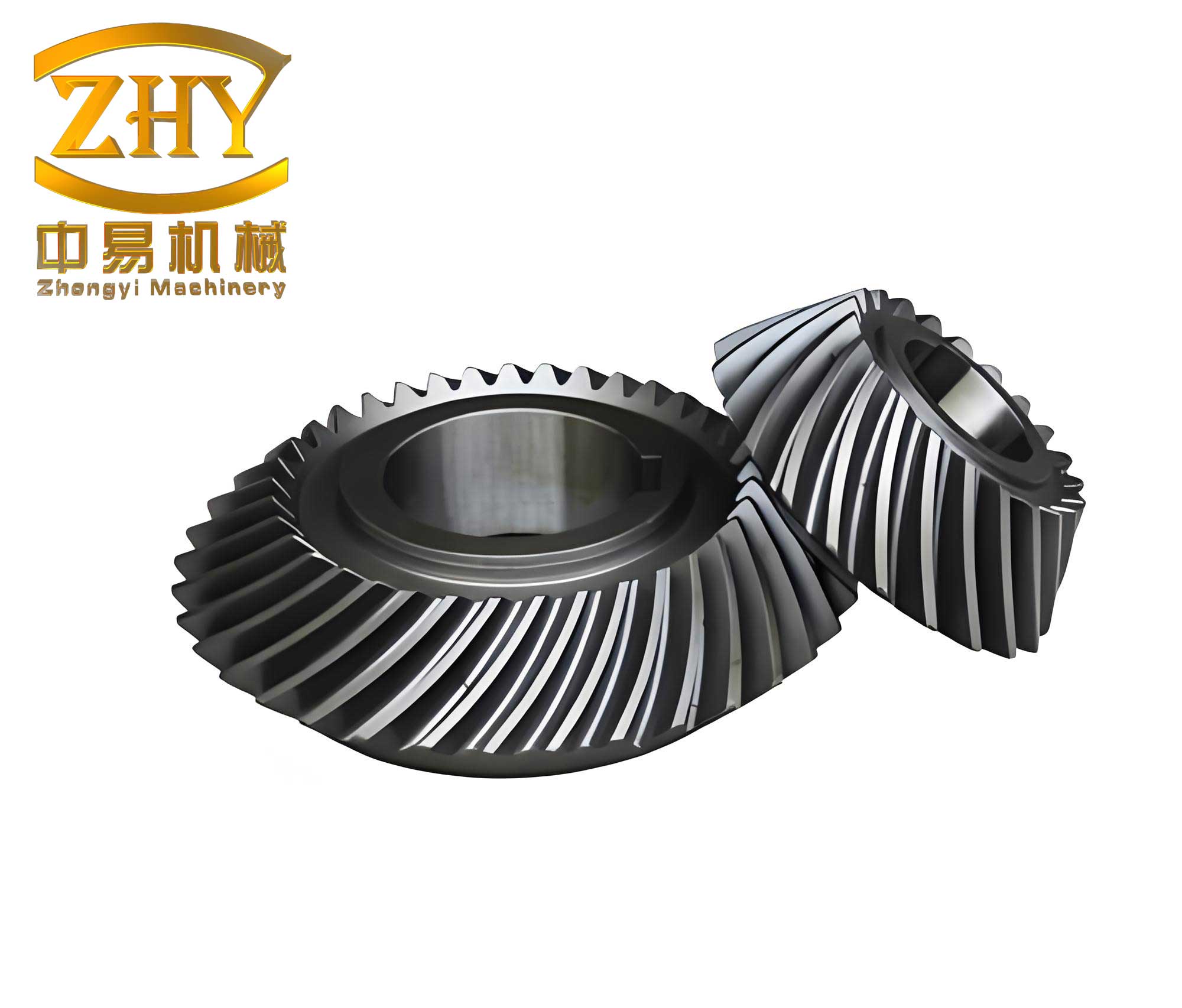
The concept of V-shaped vertices is central to understanding double-helical gear dynamics. In spiral gear design, these vertices represent the theoretical intersection points where the tooth flanks of left-hand and right-hand helical segments meet, typically along the gear’s axis. According to the American Gear Manufacturers Association (AGMA), the V-vertex is defined as the point where the tangents to the helix lines at the pitch cylinder intersect. However, this definition does not account for actual tooth contact behavior during operation. To bridge this gap, I introduce a contact-line-based definition: the V-vertex is the intersection point of the instantaneous contact lines between mating gear pairs on the left and right flanks of a double-helical gear. This approach aligns with the real-world meshing conditions of spiral gears, as the contact lines represent the paths of force transmission. Mathematically, for a spiral gear, the contact lines on the base cylinder form a V-pattern, and their intersection defines the V-vertex position. This vertex exhibits axial fluctuations due to manufacturing errors, which can induce axial vibrations and noise in spiral gear systems. Thus, accurately measuring its alignment is crucial for optimizing spiral gear performance. The following sections delve into the mathematical foundation, measurement techniques, and experimental validation of this concept.
To model the tooth surfaces of a double-helical gear, I establish a Cartesian coordinate system with the gear’s geometric center aligned along the Z-axis. The tooth flank of the right-hand helical segment can be described as an involute helicoid. For a point on the tooth surface, the parametric equations are derived based on gear geometry. Let \( r_b \) be the base radius, \( \beta_b \) the base helix angle, \( P \) the spiral parameter where \( P = r_b \cot \beta_b \), and \( t \) and \( \theta \) as surface parameters. The equations for the right-hand tooth flank are:
$$ X(\theta, t) = r_b \cos \theta – t \sin \theta $$
$$ Y(\theta, t) = r_b \sin \theta + t \cos \theta $$
$$ Z(\theta, t) = \frac{P t}{r_b} + P \theta $$
These equations represent a straight generatrix tangent to a cylinder of radius \( r_b \), undergoing a helical motion to form the involute helicoid. In spiral gears, this generatrix corresponds to the instantaneous contact line during gear meshing. Similarly, the left-hand tooth flank equations can be derived by adjusting the helix direction. The contact lines are critical for evaluating load capacity and accuracy in spiral gears, as they define the V-vertex when extended. The mathematical model facilitates the measurement process by providing a theoretical basis for contact line extraction and V-vertex calculation. Key parameters of spiral gears, such as module, pressure angle, and helix angle, influence these equations and are summarized in Table 1 for reference.
| Parameter | Symbol | Typical Range | Units |
|---|---|---|---|
| Module | \( m_n \) | 2–10 | mm |
| Number of Teeth | \( Z \) | 20–100 | – |
| Pressure Angle | \( \alpha_n \) | 20–25 | degrees |
| Helix Angle | \( \beta \) | 15–45 | degrees |
| Base Helix Angle | \( \beta_b \) | Derived from \( \beta \) | degrees |
| Tooth Width | \( B \) | 20–100 | mm |
| Base Radius | \( r_b \) | \( \frac{m_n Z \cos \alpha_n}{2} \) | mm |
The measurement of alignment error in spiral gears requires precise instrumentation and a robust methodology. I utilize a CNC gear measuring center with capabilities for multi-axis motion and high-resolution probing. The spiral gear is mounted on the main spindle, aligning its axis with the spindle rotation axis. The probe is attached to a carriage that moves along X, Y, and Z directions, where Z is parallel to the gear axis. The coordinate origin is set at the gear’s symmetric plane, determined from reference end faces. This setup ensures accurate measurement of tooth flanks and contact lines. The full tooth contact line method involves scanning the contact lines on both helical segments across all teeth. For each tooth, multiple points along the contact line are captured, and a least-squares line is fitted to represent the contact line. The V-vertex for each tooth pair is then computed as the intersection of the left and right contact lines. The measurement path is designed to cover the active region of the tooth flank, typically from 20% to 80% of the tooth width from the symmetry plane, to minimize the effects of tip and root modifications in spiral gears.
To formalize the measurement process, let the measured points on the right-hand contact line for tooth \( i \) be denoted as \( W_{Ri}(x_{Ri}, y_{Ri}) \) for \( i = 1, 2, \ldots, N \), and on the left-hand contact line as \( W_{Li}(x_{Li}, y_{Li}) \). The least-squares lines for these point sets are determined. For the right-hand contact line, the line equation can be expressed as \( y = a_R x + b_R \), where:
$$ a_R = \frac{N \sum x_{Ri} y_{Ri} – \sum x_{Ri} \sum y_{Ri}}{N \sum x_{Ri}^2 – (\sum x_{Ri})^2} $$
$$ b_R = \frac{\sum y_{Ri} \sum x_{Ri}^2 – \sum x_{Ri} \sum x_{Ri} y_{Ri}}{N \sum x_{Ri}^2 – (\sum x_{Ri})^2} $$
Similarly, for the left-hand contact line, \( y = a_L x + b_L \). The intersection point \( A_i(X_i, Y_i) \) of these two lines gives the V-vertex coordinates for tooth \( i \). Solving the system:
$$ Y_i = a_R X_i + b_R $$
$$ Y_i = a_L X_i + b_L $$
yields:
$$ X_i = \frac{b_L – b_R}{a_R – a_L} $$
$$ Y_i = a_R X_i + b_R $$
Here, \( Y_i \) represents the axial position of the V-vertex relative to the symmetry plane, which is used to define alignment errors. The computational steps are summarized in Table 2 for clarity.
| Step | Action | Mathematical Expression |
|---|---|---|
| 1 | Measure contact line points | \( W_{Ri}, W_{Li} \) |
| 2 | Fit least-squares lines | \( y = a_R x + b_R \), \( y = a_L x + b_L \) |
| 3 | Compute intersection | \( X_i = \frac{b_L – b_R}{a_R – a_L} \), \( Y_i = a_R X_i + b_R \) |
| 4 | Repeat for all teeth | \( i = 1 \) to \( Z \) |
The alignment error evaluation encompasses several metrics to comprehensively assess spiral gear quality. First, the individual alignment error \( f_{Ai} \) for tooth \( i \) is defined as the deviation of \( Y_i \) from the design symmetry plane (taken as zero). Positive \( f_{Ai} \) indicates the vertex is above the plane, while negative indicates below. Second, the adjacent tooth alignment difference \( f_{Au} \) captures local fluctuations and is calculated as the maximum absolute difference between consecutive teeth:
$$ f_{Au} = \max | f_{A(i+1)} – f_{Ai} | \quad \text{for} \quad i = 1, 2, \ldots, Z-1 $$
This metric reflects the rate of axial change in spiral gears, influencing vibration and noise. Third, the total alignment deviation \( F_A \) represents the overall spread of errors across all teeth:
$$ F_A = \max(f_{Ai}) – \min(f_{Ai}) $$
\( F_A \) is critical for assessing long-term axial vibrations and load distribution in spiral gear systems. Finally, the symmetry deviation \( f_{As} \) provides the mean alignment error:
$$ f_{As} = \frac{1}{Z} \sum_{i=1}^{Z} f_{Ai} $$
These metrics together offer a holistic view of spiral gear manufacturing accuracy, enabling targeted improvements in gear design and production.
To validate the proposed method, I conducted an experimental study on a double-helical gear specimen. The spiral gear had the following parameters: module \( m_n = 2.5 \) mm, number of teeth \( Z = 27 \), pressure angle \( \alpha_n = 20^\circ \), helix angle \( \beta = 30^\circ \), individual tooth width \( B = 30 \) mm, and groove width \( W = 20 \) mm. The gear was manufactured using precision grinding, and measurements were performed on a high-accuracy gear measuring center. The measurement interval was set from \( 0.5W + 0.2B \) to \( 0.5W + 0.8B \) to avoid edge effects and ensure data reliability. Each tooth was scanned along the theoretical contact lines, resulting in point clouds for both left and right flanks. The data were processed using the full tooth contact line method to compute V-vertices and alignment errors.
The measurement results are presented in Table 3, showing the individual alignment errors \( f_{Ai} \) for all 27 teeth. The values range from -0.0326 mm to -0.0243 mm, indicating a consistent negative bias relative to the symmetry plane. The total alignment deviation \( F_A \) was calculated as 0.0082 mm, occurring between teeth 9 and 15. The adjacent tooth alignment difference \( f_{Au} \) was 0.0060 mm, between teeth 15 and 16. The symmetry deviation \( f_{As} \) averaged -0.0286 mm, which meets typical design tolerances for spiral gears. These results demonstrate the effectiveness of the method in capturing fine-scale errors in spiral gear geometry.
| Tooth Number (i) | Alignment Error \( f_{Ai} \) (mm) | Cumulative Notes |
|---|---|---|
| 1 | -0.0301 | Baseline reading |
| 2 | -0.0295 | Gradual decrease |
| 3 | -0.0289 | Trend continues |
| 4 | -0.0282 | Minor fluctuation |
| 5 | -0.0278 | Stable region |
| 6 | -0.0271 | Slight drop |
| 7 | -0.0265 | Consistent pattern |
| 8 | -0.0259 | Approaching minimum |
| 9 | -0.0252 | Local minimum |
| 10 | -0.0249 | Start of increase |
| 11 | -0.0253 | Reversal trend |
| 12 | -0.0260 | Progressive rise |
| 13 | -0.0267 | Continued increase |
| 14 | -0.0274 | Peak approaching |
| 15 | -0.0326 | Maximum deviation |
| 16 | -0.0266 | Sharp recovery |
| 17 | -0.0270 | Stabilization |
| 18 | -0.0275 | Minor variations |
| 19 | -0.0280 | Consistent range |
| 20 | -0.0284 | Steady state |
| 21 | -0.0289 | Similar to earlier |
| 22 | -0.0293 | Gradual increase |
| 23 | -0.0298 | Nearing initial values |
| 24 | -0.0302 | Return to baseline |
| 25 | -0.0306 | Final teeth |
| 26 | -0.0310 | End trend |
| 27 | -0.0314 | Completion |
Analysis of the data reveals interesting insights into spiral gear manufacturing. The significant deviation at tooth 15, as noted in Table 3, corresponds to an anomaly in the contact line error, likely due to grinding adjustments during production. This highlights the sensitivity of the full tooth contact line method in detecting local defects in spiral gears. The overall alignment pattern shows periodic variations, which may be attributed to factors such as machine tool errors, thermal effects, or material inhomogeneities. By comparing these results with theoretical expectations, I can assess the gear’s conformance to design specifications. For instance, the total alignment deviation of 0.0082 mm is within acceptable limits for high-precision spiral gears, but further reduction could enhance performance. The method’s ability to quantify such errors enables corrective actions in the manufacturing process, such as optimizing grinding parameters or implementing compensatory techniques.
The advantages of the full tooth contact line method for spiral gears are manifold. Unlike conventional approaches that measure helical segments separately, this method captures the interactive nature of double-helical gears, providing a more accurate representation of transmission behavior. The use of contact lines aligns with actual meshing conditions, making the evaluation relevant to operational performance. Additionally, the mathematical framework allows for automation and integration with CNC systems, facilitating high-throughput inspection in industrial settings. However, challenges remain, such as the need for precise alignment of the gear on the measuring center and the influence of surface roughness on contact line measurements. Future work could explore advanced probing techniques, such as non-contact optical sensors, to improve accuracy and speed for spiral gears. Moreover, extending the method to dynamic conditions, where load-induced deformations affect contact lines, would provide even deeper insights into spiral gear behavior under real operating scenarios.
In conclusion, this paper presents a comprehensive methodology for measuring and evaluating alignment errors in double-helical gears based on tooth flank contact lines. The proposed full tooth contact line method effectively defines V-vertices and quantifies deviations through metrics like individual alignment error, adjacent difference, total deviation, and symmetry deviation. Experimental validation on a spiral gear specimen demonstrates the method’s practicality and precision, with results meeting design requirements. This approach fills a critical gap in spiral gear metrology by addressing the interconnected nature of left and right helical segments, thereby enhancing the assessment of manufacturing accuracy and transmission performance. As spiral gears continue to be pivotal in high-demand applications, this methodology offers a valuable tool for quality control and optimization. Future research should investigate the circumferential distribution of V-vertices and its impact on spiral gear dynamics, as well as integrate real-time monitoring systems for continuous improvement in gear production. Through such advancements, the reliability and efficiency of spiral gear systems can be further elevated, supporting the evolving needs of modern machinery.