
In the domain of high-speed centrifugal separation, the disk centrifuge stands out for its efficiency in clarifying liquids. The heart of its operation lies in the rapid rotation of the bowl assembly, a motion that is almost universally transmitted via a critical mechanical component: the spiral gear pair. This discussion will delve into the intricacies of spiral gear drives as the principal transmission system in such machines, moving beyond basic description to a detailed, first-principles analysis of their performance characteristics, geometric design, and the paramount issue of scoring (galling) failure. The application of spiral gears in this context presents a unique set of engineering challenges and solutions, which we will explore through analytical formulations, computational criteria, and practical design tables.
The dominant drive configurations for disk centrifuges are the spiral gear drive and the belt drive. While belt drives have their applications, they are often limited by factors such as maximum permissible linear speed and maintenance intervals. Consequently, the spiral gear transmission remains the most prevalent and reliable choice for heavy-duty, continuous operation. The typical configuration involves a horizontal motor shaft driving a vertical bowl shaft through a pair of spiral gears with a shaft angle of 90°, achieving a speed increase ratio generally between 3 and 5. The start-up process for these massive rotating assemblies is gradual, often taking between 3 to 15 minutes to reach operational speed, a characteristic influenced by the gear design and system inertia.
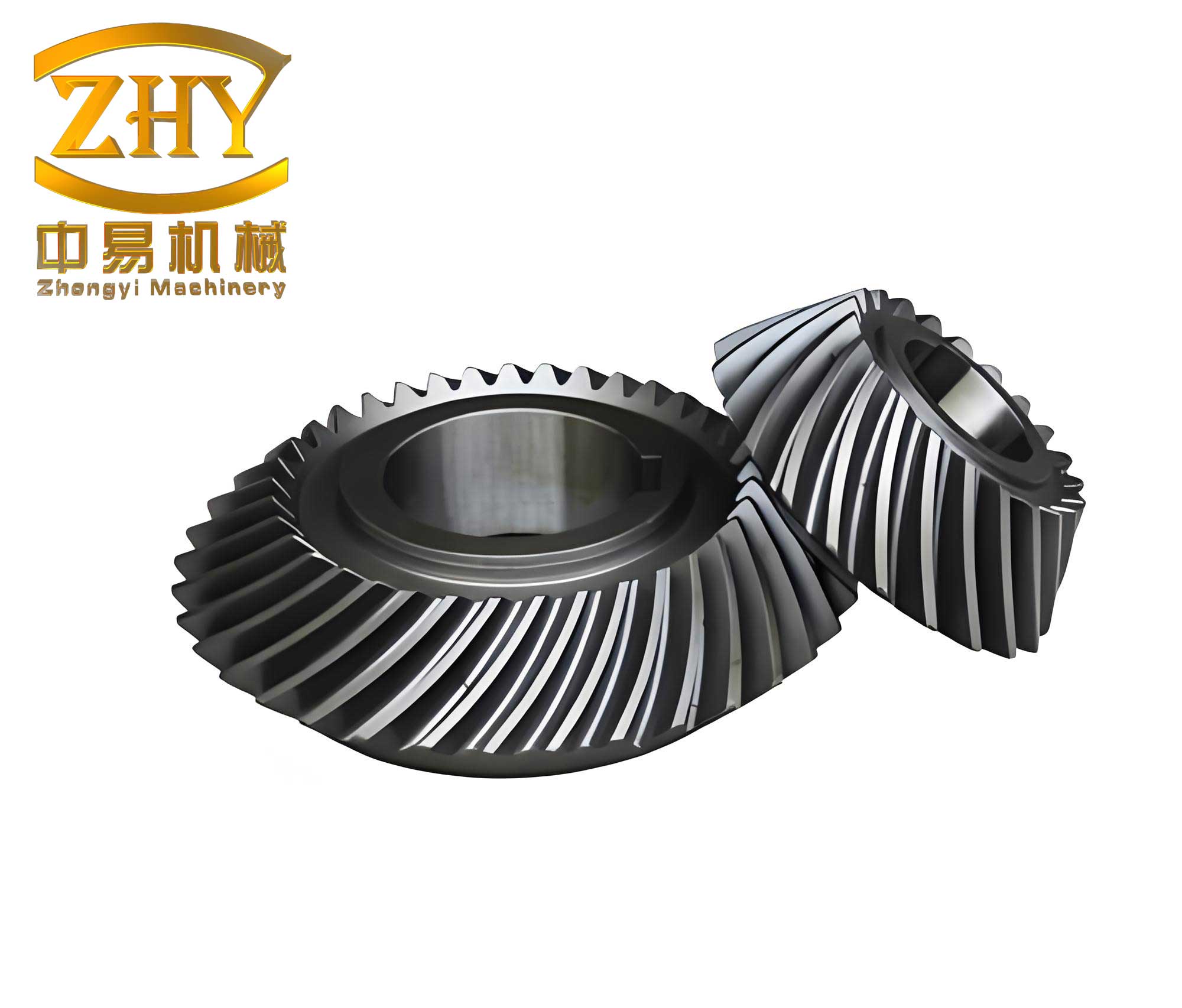
The spiral gear drive, while elegant in its simplicity for intersecting non-parallel shafts, exhibits distinct behavioral traits that directly inform its design constraints for centrifuge applications.
Characteristics of Cylindrical Spiral Gear Drives
1. Point Contact at Meshing Surfaces: Unlike parallel axis helical or spur gears which engage in line contact, spiral gears operate with axes that are non-parallel and non-intersecting (crossed axes). Mathematically, their tooth surfaces contact at a single point. Under load, elastic deformation creates a small elliptical contact area. This concentrated contact leads to very high Hertzian contact stresses, inherently limiting the power transmission capacity. In practice, spiral gear sets in disk centrifuges are typically not employed for powers exceeding 45 kW. The contact stress calculation is fundamental and will be addressed in the scoring analysis section.
2. High Sliding Velocity: The kinematics of spiral gear meshing involve significant sliding in two directions: along the profile (as in all gear types) and along the tooth’s length. This compounded sliding action accelerates wear and reduces transmission efficiency. The sliding velocity along the common tangent, a critical parameter for wear and heat generation, is given by:
$$ V_g = \frac{V_{u1}}{\cos\beta_1} = \frac{V_{u2}}{\cos\beta_2} $$
Where \( V_{u1} \) and \( V_{u2} \) are the pitch line velocities (in m/s) of the driving and driven spiral gear, respectively, and \( \beta_1 \) and \( \beta_2 \) are their helix angles. For a 90° shaft angle (\( \Sigma = 90^\circ \)), \( \beta_1 + \beta_2 = 90^\circ \).
3. Sensitivity to Center Distance Variation: Spiral gears lack the “center distance freedom” common to parallel-axis gears. A change in the installed center distance (increase or decrease) shifts the point of contact away from the pitch cylinders to new operating pitch cylinders. Since the helix angle varies with cylinder diameter (\( \tan\beta \propto 1/\text{diameter} \)), the operating helix angles (\( \beta_{1j}, \beta_{2j} \)) differ from the standard pitch helix angles. This alters the effective shaft angle, degrading meshing quality, increasing vibration, and elevating noise levels—all unacceptable in a precision centrifuge.
4. Speed Ratio and Design Flexibility: The speed ratio is determined solely by the number of teeth:
$$ i = \frac{n_2}{n_1} = \frac{Z_1}{Z_2} $$
However, the relationship between pitch diameters and helix angles offers unique design flexibility:
$$ i = \frac{d_1 \cos\beta_1}{d_2 \cos\beta_2} $$
For a fixed ratio \( i \), an engineer can adjust the helix angles to achieve desired pitch diameters that satisfy a specific center distance. Conversely, for given diameters, the ratio can be modified by changing the helix angles. This flexibility is absent in parallel shaft gears. Spiral gear drives are best suited for low to moderate ratios, typically under 5.
5. Axial Float and Buffering: A beneficial characteristic in the centrifuge context is the ability of spiral gears to tolerate a degree of controlled axial movement without disengagement. This provides a crucial buffering effect during the start-up and shutdown phases, accommodating thermal expansion and damping transient shocks within the drive train.
Geometric Design and Dimension Calculations for Spiral Gears
The design of a spiral gear pair begins with the establishment of basic parameters: power, input speed, desired speed ratio, center distance constraints, and material selection. The following sequential calculations define the geometry. A fundamental rule is that the normal module (\(m_n\)) and normal pressure angle must be identical for both mating spiral gears.
1. Normal Circular Pitch and Module:
The normal pitch is common:
$$ t_n = t_{n1} = t_{n2} = \pi m_n $$
Relating it to the transverse pitches:
$$ t_n = t_{s1} \cdot \cos\beta_1 = t_{s2} \cdot \cos\beta_2 $$
Similarly, for the module:
$$ m_n = m_{s1} \cdot \cos\beta_1 = m_{s2} \cdot \cos\beta_2 $$
Since \( \beta_1 \neq \beta_2 \) (except when \( \beta_1 = \beta_2 = 45^\circ \)), the transverse pitches and modules are not equal: \( t_{s1} \neq t_{s2} \), \( m_{s1} \neq m_{s2} \).
2. Pitch Diameter:
$$ d = m_s \cdot Z = \frac{m_n \cdot Z}{\cos\beta} $$
where \( Z \) is the number of teeth.
3. Outside and Root Diameter (for standard full-depth teeth):
$$ D_o = \frac{m_n \cdot Z}{\cos\beta} + 2m_n $$
$$ D_r = \frac{m_n \cdot Z}{\cos\beta} – 2.5m_n $$
4. Helix Angle Selection:
For a shaft angle \( \Sigma = 90^\circ \), \( \beta_1 + \beta_2 = 90^\circ \). The helix angles are chosen considering:
- Driven gear often has the larger angle (e.g., 55° max for manufacturability).
- Both gears must have the same hand (both right-hand or both left-hand).
- A symmetric design with \( \beta_1 = \beta_2 = 45^\circ \) is common and simplifies force analysis.
The relationship derived from geometry is:
$$ \tan\beta_1 = i \cdot \frac{d_1}{d_2} $$
and consequently \( \beta_2 = 90^\circ – \beta_1 \).
5. Center Distance:
$$ A = \frac{d_1 + d_2}{2} $$
This is a critical installation parameter with no allowance for adjustment due to the lack of center distance freedom in spiral gear operation.
6. Face Width Determination:
Given the point-contact nature, increasing face width does not proportionally increase load capacity but is necessary for axial stability and to ensure continuous contact during axial float. The minimum face width to prevent premature loss of contact is:
When \( \beta_1 = \beta_2 \): \( b \approx (5 \text{ to } 10)m_n \).
When \( \beta_1 \neq \beta_2 \), the minimum face width for each gear should be greater than the transverse pitch of its mate to ensure overlap:
$$ b_{min1} > t_{s2}, \quad b_{min2} > t_{s1} $$
| Parameter | Formula | Notes |
|---|---|---|
| Normal Module | \( m_n = m_{s} \cos\beta \) | Must be equal for both gears. |
| Pitch Diameter | \( d = m_n Z / \cos\beta \) | |
| Transverse Module | \( m_s = m_n / \cos\beta \) | Different for each gear if \( \beta_1 \neq \beta_2 \). |
| Speed Ratio | \( i = Z_1 / Z_2 = (d_1 \cos\beta_1)/(d_2 \cos\beta_2) \) | |
| Center Distance | \( A = (d_1 + d_2)/2 \) | Fixed, non-adjustable. |
| Min. Face Width | \( b_{min} > t_s \) of mating gear | \( t_s = \pi m_s \). |
Spiral Gear Scoring (Galling) Strength Calculation
The primary failure mode for high-speed, heavily loaded spiral gears is not necessarily bending fatigue but rather surface failure due to scoring, also known as scuffing or galling. This phenomenon occurs when localized frictional heat generation at the meshing point breaks down the protective lubricant film. This leads to instantaneous welding and subsequent tearing of the surface metal. Light scoring manifests as fine streaks along the profile, while severe, destructive scoring causes significant material transfer, increased noise and vibration, and eventual catastrophic failure. Preventing scoring is therefore the cornerstone of spiral gear design for centrifugal applications.
1. Calculation Based on Wear Condition (Historical Approach):
An early method evaluates the allowable normal force \( P_N \) based on wear:
$$ P_N = \frac{k \theta d_1}{2 \phi} $$
where:
- \( k \): Allowable stress related to run-in condition (N/mm²).
- \( \theta \): Ratio factor, \( \theta = \left( \frac{2d_2}{d_1 + d_2} \right)^2 \).
- \( \phi \): Velocity factor, \( \phi = \frac{1 + 0.5V_g}{1 + V_g} \).
- \( d_1 \): Pitch diameter of driver (mm).
The design requires the actual normal force \( P \) to be less than \( P_N \). This method can be overly conservative, sometimes leading to unrealistically large gear dimensions.
2. AGMA Scoring Index (SI) Method:
The American Gear Manufacturers Association provides a more refined empirical index for scoring risk assessment:
$$ SI = 9.1 \frac{(W_{te}/b)^{0.75}}{n_p^{0.5} m_s^{0.25}} $$
where:
- \( W_{te} \): Effective transmitted tangential load (kgf).
- \( b \): Face width (mm).
- \( n_p \): Pinion speed (rpm).
- \( m_s \): Transverse module (mm).
The calculated SI value is compared against allowable values dependent on the lubricant type and operating temperature. If the calculated SI exceeds the allowable value from the table below, the risk of scoring is considered high.
| Lubricant Type | Gear Temperature (°F) | 100 | 150 | 200 | 250 | 300 |
|---|---|---|---|---|---|---|
| AGMA 1 | 9000 | 6000 | 3000 | — | — | |
| AGMA 3 | 11000 | 8000 | 5000 | 2000 | — | |
| AGMA 5 | 13000 | 10000 | 7000 | 4000 | — | |
| AGMA 7 | 15000 | 12000 | 9000 | 6000 | — | |
| AGMA 8A | 17000 | 14000 | 11000 | 8000 | — | |
| MIL-L-6082B, Grade 1065 | 15000 | 12000 | 9000 | 6000 | — | |
| Synthetic Oil (Turbo 35) | 17000 | 14000 | 11000 | 8000 | 5000 |
3. PVck Criterion (Comprehensive Scoring Check):
A robust methodology recommended for spiral gear analysis combines pressure and sliding velocity into a single criterion:
$$ P \cdot V_{ck}^{0.25} \leq [C] $$
where:
- \( P \): Maximum contact pressure at the tooth interface (kgf/cm²). This is derived from Hertzian contact theory for point contact, simplified for gear application:
$$ P = 42 k_p \sqrt[3]{\frac{N_1 E^2}{n_1 d_1^2}} $$
Here, \( N_1 \) is power in horsepower, \( d_1 \) is in cm, \( E \) is the modulus of elasticity (kgf/cm²), \( n_1 \) is driver speed (rpm), and \( k_p \) is a geometry factor obtained from design charts based on the spiral angles and number of teeth. - \( V_{ck} \): Sliding velocity at the pitch point (cm/s), as previously defined (\( V_g \)).
- \( [C] \): Allowable value for the scoring criterion: \( [C] = \frac{c}{\phi} \).
- \( c \): A material and lubricant constant, typically in the range of 17,500 to 19,000.
- \( \phi \): Reliability factor, between 1.0 and 1.5.
This \( PV^{0.25} \) approach directly incorporates the key physical drivers of scoring: contact stress (leading to flash temperature) and sliding speed (leading to heat generation rate). It is considered one of the more accurate methods for evaluating the scoring risk in spiral gear applications.
Design Synthesis and Material Selection
The successful implementation of a spiral gear drive in a disk centrifuge requires a holistic synthesis of the above analyses. The process is iterative: initial geometry is proposed based on speed ratio and center distance; stresses and scoring indices are calculated; geometry is adjusted to meet all criteria. Material selection is critical. Gear pairs are often made from case-hardened alloy steels (e.g., AISI 8620, 9310) to provide a hard, wear-resistant surface over a tough, fatigue-resistant core. The precision of manufacturing—especially for helix angle, tooth profile, and surface finish—is paramount to ensure smooth operation and minimize the localized stress concentrations that initiate scoring.
Lubrication is not merely ancillary but a fundamental part of the spiral gear system design. A forced-circulation oil system is essential to remove the significant frictional heat generated, maintain a separating film, and prevent the temperature rise that lowers the allowable scoring index. The oil must have appropriate extreme pressure (EP) additives to withstand the high contact stresses inherent in spiral gear operation.
In conclusion, the spiral gear drive, despite its seemingly simple construction, represents a finely tuned engineering system within the disk centrifuge. Its design is a balancing act between kinematic requirements, geometric constraints, and the relentless physics of surface failure. A deep understanding of its point-contact mechanics, sensitivity to alignment, and propensity for scoring guides the engineer away from rule-of-thumb design towards a calculated, analytical approach. By rigorously applying the geometric relationships, utilizing scoring prevention criteria like the AGMA SI and the PV factor, and paying meticulous attention to metallurgy and lubrication, a reliable and efficient spiral gear transmission can be achieved, forming the dependable backbone of high-performance centrifugal separation technology. The continued evolution of materials, coatings, and analysis software promises to further push the boundaries of power density and reliability for these essential mechanical components.