
As an engineer specializing in gear metrology, I often encounter the challenge of accurately measuring the radius of rotation and radial variation in spiral gears. These components are critical in various mechanical systems, such as automotive steering mechanisms and industrial machinery, where precision directly impacts performance and longevity. The spiral gear, with its unique tooth geometry, requires specialized measurement techniques to ensure dimensional accuracy. In this article, I will delve into the cylindrical pin method, a relative measurement approach widely used for spiral gears, and provide an in-depth error analysis to enhance measurement precision. The spiral gear’s complex design, including features like variable tooth thickness and pressure angles, necessitates careful consideration during inspection.
The core principle of the cylindrical pin method involves using a cylindrical pin (or round bar) placed between the gear teeth to indirectly determine the radius of rotation. This method is relative, meaning it compares the workpiece against a reference standard, typically a cylindrical artifact rather than a conical one, to simplify manufacturing and calibration. The measurement setup includes a micrometer with a spherical probe, which contacts the inclined surface of the pin, leading to specific geometric considerations. For spiral gears, the radius of rotation is a key parameter that affects meshing quality and load distribution, making accurate measurement paramount. Below, I will explain the mathematical foundation, error sources, and practical applications, with an emphasis on spiral gear-specific factors.
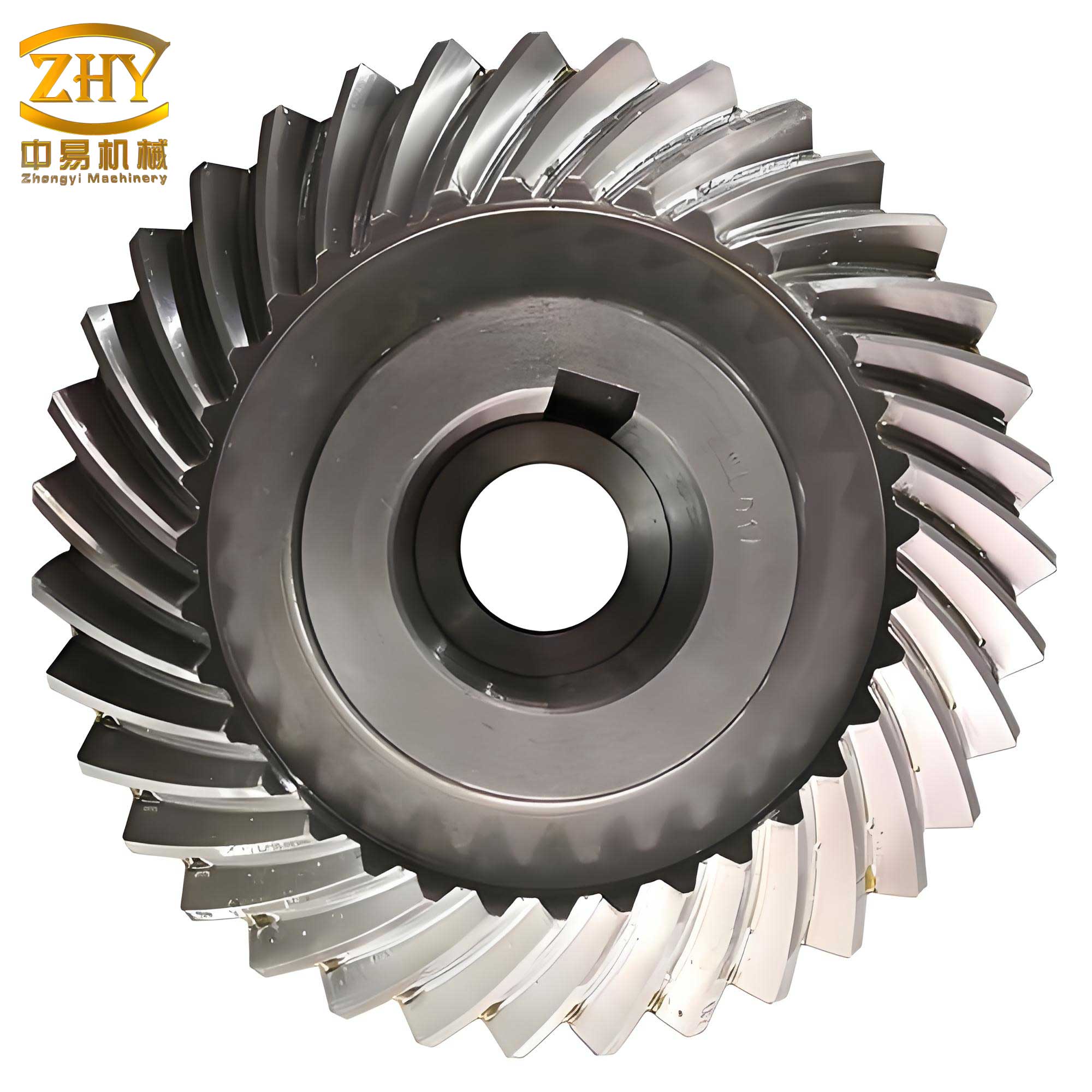
In the cylindrical pin method, the spiral gear is positioned such that the pin rests against the tooth flanks, and the micrometer measures the displacement relative to a reference. The design value of the radius of rotation, denoted as \( R_0 \), is derived from gear parameters, but actual measurements must account for various deviations. Let \( d \) be the diameter of the cylindrical pin, \( \alpha \) the pressure angle at the contact point, and \( \delta \) the angle of thickness variation (often due to manufacturing tolerances in spiral gears). The measured value \( R_m \) is influenced by these factors, and the relationship can be expressed through geometric equations. For a spiral gear, the radius calculation incorporates the variable tooth geometry, which I will detail using formulas.
The standard reference artifact has a designed cylindrical radius \( R_s \), but its actual measured value includes manufacturing errors. According to relative measurement principles, the radius of rotation for the workpiece is given by: $$ R_m = R_s + \Delta L $$ where \( \Delta L \) is the micrometer reading deviation. However, the actual radius \( R \) must be corrected for errors introduced by the pin inclination and probe geometry. Specifically, due to the spherical probe of the micrometer, the contact point shifts from the theoretical measurement line, causing a deviation \( \Delta R_\delta \) related to the thickness variation angle \( \delta \). This is critical for spiral gears, as their teeth often have intentional or unintended thickness variations. The deviation can be modeled as: $$ \Delta R_\delta = \left( \frac{1}{2} d \cdot \sin \alpha \cdot \cos \delta – \text{correction terms} \right) $$ but to be precise, I will derive a comprehensive set of equations.
Let me define key variables for clarity. For a spiral gear measurement:
- \( R_0 \): Design radius of rotation (mm).
- \( R_s \): Measured value of the reference standard (mm), including error \( \Delta R_s \).
- \( d \): Diameter of the cylindrical pin (mm).
- \( \alpha \): Pressure angle at the pin contact point (degrees).
- \( \delta \): Thickness variation angle of the spiral gear tooth (degrees).
- \( \rho \): Radius of the spherical probe on the micrometer (mm).
- \( \Delta L \): Micrometer indication value (mm).
The overall measured radius \( R_m \) is: $$ R_m = R_s + \Delta L $$ but the true radius \( R \) requires corrections: $$ R = R_m – \sum \Delta R_i $$ where \( \Delta R_i \) are error components from various sources, which I will analyze in detail.
Error analysis is essential to ensure accurate spiral gear measurement. The primary error sources include:
- Measurement errors in parameters \( d \), \( \alpha \), \( \rho \), and \( \Delta L \).
- Thickness variation angle error \( \Delta \delta \) from spiral gear tooth machining.
- Profile deviation \( \Delta x \) due to gear manufacturing.
- Error in pressure angle \( \alpha \) calculation from pin diameter inaccuracies.
- Positioning error \( \Delta e \) of the micrometer measurement line relative to the gear axis.
Each source contributes to the total uncertainty in the radius measurement. I will derive mathematical expressions for these errors, focusing on their impact on spiral gear inspection.
Starting with the error due to pin diameter inaccuracy \( \Delta d \), let \( \Delta R_d \) be the resulting radius error. From geometric relations, the partial derivative of \( R \) with respect to \( d \) gives: $$ \frac{\partial R}{\partial d} = \frac{1}{2} \sin \alpha \cdot \cos \delta $$ thus, $$ \Delta R_d = \frac{1}{2} \sin \alpha \cdot \cos \delta \cdot \Delta d $$ This error is significant for spiral gears with large pressure angles. Similarly, for pressure angle error \( \Delta \alpha \), the radius error \( \Delta R_\alpha \) is: $$ \Delta R_\alpha = \left( \frac{1}{2} d \cdot \cos \alpha \cdot \cos \delta \right) \cdot \Delta \alpha $$ which depends on the gear’s design parameters.
The thickness variation angle error \( \Delta \delta \), common in spiral gears due to helical tooth geometry, causes radius error \( \Delta R_\delta \). Deriving from the measurement equation: $$ \Delta R_\delta = – \left( \frac{1}{2} d \cdot \sin \alpha \cdot \sin \delta \right) \cdot \Delta \delta $$ This highlights the sensitivity of spiral gear measurements to angular tolerances. For probe radius error \( \Delta \rho \), the effect \( \Delta R_\rho \) is: $$ \Delta R_\rho = \frac{\partial R}{\partial \rho} \Delta \rho $$ with \( \frac{\partial R}{\partial \rho} = – \tan \delta \) in simplified form, leading to: $$ \Delta R_\rho = – \tan \delta \cdot \Delta \rho $$ This is particularly relevant when using spherical probes for spiral gear inspection.
Micrometer indication error \( \Delta L \) directly affects the radius: $$ \Delta R_L = \Delta L $$ as it adds to the measured value. Positioning errors are more complex. Let \( \Delta e \) be the error in the distance between the measurement line and the gear axis. This causes a deviation \( \Delta R_e \) due to the pin inclination angle \( \delta \). From geometry: $$ \Delta R_e = \Delta e \cdot \tan \delta $$ Additionally, if the measurement line does not intersect the gear axis, an offset \( \Delta a \) occurs, leading to error: $$ \Delta R_a = \frac{\Delta a}{\cos \delta} $$ These positioning aspects are crucial for spiral gears, where alignment affects contact conditions.
To summarize the error sources, I present a table that quantifies each component for a typical spiral gear measurement scenario. This table includes symbolic expressions and numerical examples based on common tolerances.
| Error Source | Symbol | Mathematical Expression | Typical Magnitude (mm) | Impact on Spiral Gear Radius |
|---|---|---|---|---|
| Pin Diameter Error | \( \Delta R_d \) | \( \frac{1}{2} \sin \alpha \cdot \cos \delta \cdot \Delta d \) | ±0.002 | Moderate, depends on \( \alpha \) |
| Pressure Angle Error | \( \Delta R_\alpha \) | \( \left( \frac{1}{2} d \cdot \cos \alpha \cdot \cos \delta \right) \cdot \Delta \alpha \) | ±0.003 | High for large \( \alpha \) |
| Thickness Variation Angle Error | \( \Delta R_\delta \) | \( – \left( \frac{1}{2} d \cdot \sin \alpha \cdot \sin \delta \right) \cdot \Delta \delta \) | ±0.004 | Critical for spiral gears |
| Probe Radius Error | \( \Delta R_\rho \) | \( – \tan \delta \cdot \Delta \rho \) | ±0.001 | Low for small \( \delta \) |
| Micrometer Indication Error | \( \Delta R_L \) | \( \Delta L \) | ±0.005 | Direct additive effect |
| Measurement Line Position Error | \( \Delta R_e \) | \( \Delta e \cdot \tan \delta \) | ±0.002 | Sensitive to alignment |
| Axis Offset Error | \( \Delta R_a \) | \( \frac{\Delta a}{\cos \delta} \) | ±0.003 | Increases with \( \delta \) |
The total measurement uncertainty \( \Delta R_{\text{total}} \) for the spiral gear radius can be estimated using the root sum square method, assuming independent error sources: $$ \Delta R_{\text{total}} = \sqrt{ (\Delta R_d)^2 + (\Delta R_\alpha)^2 + (\Delta R_\delta)^2 + (\Delta R_\rho)^2 + (\Delta R_L)^2 + (\Delta R_e)^2 + (\Delta R_a)^2 } $$ This approach provides a statistical bound on accuracy, essential for quality control in spiral gear production.
Now, let me illustrate with a practical example. Consider measuring an eccentric spiral gear with variable thickness. The parameters are as follows:
- Cylindrical pin diameter: \( d = 6.000 \pm 0.002 \) mm.
- Micrometer probe radius: \( \rho = 1.500 \pm 0.001 \) mm.
- Pressure angle: \( \alpha = 20^\circ \pm 0.1^\circ \) (converted to radians for calculation).
- Thickness variation angle: \( \delta = 2^\circ \pm 0.05^\circ \).
- Reference standard measured value: \( R_s = 50.000 \pm 0.003 \) mm.
- Micrometer deviation: \( \Delta L = 0.010 \pm 0.005 \) mm.
- Positioning errors: \( \Delta e = \pm 0.002 \) mm, \( \Delta a = \pm 0.003 \) mm.
- Design radius: \( R_0 = 50.050 \) mm.
First, calculate the nominal radius using the measurement equation. For spiral gears, the contact point pressure angle \( \alpha \) may differ from the standard due to tooth geometry. Assuming ideal conditions, the measured radius \( R_m \) is: $$ R_m = R_s + \Delta L = 50.000 + 0.010 = 50.010 \text{ mm} $$ But corrections are needed for true radius \( R \).
Compute individual error contributions using the formulas above. For \( \Delta R_d \): $$ \Delta R_d = \frac{1}{2} \sin(20^\circ) \cdot \cos(2^\circ) \cdot (\pm 0.002) $$ $$ \sin(20^\circ) \approx 0.3420, \cos(2^\circ) \approx 0.9994 $$ $$ \Delta R_d = 0.5 \times 0.3420 \times 0.9994 \times 0.002 \approx \pm 0.000342 \text{ mm} $$ For \( \Delta R_\alpha \), convert \( \Delta \alpha = 0.1^\circ = 0.001745 \) radians: $$ \Delta R_\alpha = \left( \frac{1}{2} \times 6.000 \times \cos(20^\circ) \times \cos(2^\circ) \right) \times 0.001745 $$ $$ \cos(20^\circ) \approx 0.9397 $$ $$ \Delta R_\alpha = 0.5 \times 6.000 \times 0.9397 \times 0.9994 \times 0.001745 \approx \pm 0.00493 \text{ mm} $$ For \( \Delta R_\delta \), with \( \Delta \delta = 0.05^\circ = 0.000873 \) radians: $$ \Delta R_\delta = – \left( \frac{1}{2} \times 6.000 \times \sin(20^\circ) \times \sin(2^\circ) \right) \times 0.000873 $$ $$ \sin(2^\circ) \approx 0.0349 $$ $$ \Delta R_\delta = – (0.5 \times 6.000 \times 0.3420 \times 0.0349) \times 0.000873 \approx \pm 0.0000312 \text{ mm} $$ For \( \Delta R_\rho \): $$ \Delta R_\rho = – \tan(2^\circ) \times (\pm 0.001) $$ $$ \tan(2^\circ) \approx 0.0349 $$ $$ \Delta R_\rho \approx \mp 0.0000349 \text{ mm} $$ For \( \Delta R_L \): $$ \Delta R_L = \pm 0.005 \text{ mm} $$ For \( \Delta R_e \): $$ \Delta R_e = \pm 0.002 \times \tan(2^\circ) \approx \pm 0.002 \times 0.0349 = \pm 0.0000698 \text{ mm} $$ For \( \Delta R_a \): $$ \Delta R_a = \frac{\pm 0.003}{\cos(2^\circ)} \approx \frac{0.003}{0.9994} \approx \pm 0.00300 \text{ mm} $$
Now, sum these errors using the root sum square method for the spiral gear measurement: $$ \Delta R_{\text{total}} = \sqrt{ (0.000342)^2 + (0.00493)^2 + (0.0000312)^2 + (0.0000349)^2 + (0.005)^2 + (0.0000698)^2 + (0.00300)^2 } $$ Calculate stepwise:
- \( (0.000342)^2 = 1.17 \times 10^{-7} \)
- \( (0.00493)^2 = 2.43 \times 10^{-5} \)
- \( (0.0000312)^2 = 9.73 \times 10^{-10} \)
- \( (0.0000349)^2 = 1.22 \times 10^{-9} \)
- \( (0.005)^2 = 2.5 \times 10^{-5} \)
- \( (0.0000698)^2 = 4.87 \times 10^{-9} \)
- \( (0.00300)^2 = 9.0 \times 10^{-6} \)
Sum: \( 1.17 \times 10^{-7} + 2.43 \times 10^{-5} + 9.73 \times 10^{-10} + 1.22 \times 10^{-9} + 2.5 \times 10^{-5} + 4.87 \times 10^{-9} + 9.0 \times 10^{-6} = 5.86 \times 10^{-5} \)
Square root: $$ \Delta R_{\text{total}} = \sqrt{5.86 \times 10^{-5}} \approx 0.00765 \text{ mm} $$ Thus, the actual radius \( R \) of the spiral gear is: $$ R = R_m \pm \Delta R_{\text{total}} = 50.010 \pm 0.00765 \text{ mm} $$ This demonstrates the method’s precision and the importance of error control for spiral gears.
To further elaborate on spiral gear measurement, I must discuss the influence of tooth geometry variations. Spiral gears often exhibit helical teeth with progressive thickness changes, which affect the contact point with the cylindrical pin. The pressure angle \( \alpha \) at the contact point is not constant and depends on the spiral angle and pin position. This can be modeled using gear theory equations. For a spiral gear with helix angle \( \beta \), the effective pressure angle in the transverse plane is: $$ \alpha_t = \arctan\left( \frac{\tan \alpha_n}{\cos \beta} \right) $$ where \( \alpha_n \) is the normal pressure angle. In measurement, this angle influences the error terms, so accurate determination is crucial. I recommend using iterative calculations or simulation software for complex spiral gear designs.
Another aspect is the calibration of the reference standard. For spiral gear inspection, the standard should mimic the gear’s nominal dimensions as closely as possible. However, using a cylinder simplifies the process. The error \( \Delta R_s \) in the standard’s value propagates directly: $$ \Delta R_s = \text{manufacturing tolerance} $$ which is typically small but must be included in the uncertainty budget. In practice, I often use gauge blocks or calibrated pins to verify the standard, ensuring traceability for spiral gear measurements.
The micrometer probe geometry also warrants detailed analysis. The spherical probe introduces a contact point shift, as mentioned earlier. For a pin inclined by angle \( \delta \), the deviation \( \Delta R_{\text{probe}} \) can be derived from trigonometry: $$ \Delta R_{\text{probe}} = \rho \cdot (1 – \cos \delta) $$ but this is an approximation; the exact formula depends on the probe and pin diameters. For spiral gears with small \( \delta \), this error is negligible, but for large variations, it becomes significant. I suggest using probes with optimized radii to minimize this effect in spiral gear applications.
Environmental factors, such as temperature and humidity, can also affect spiral gear measurements. Thermal expansion may alter pin and gear dimensions, leading to additional errors. The coefficient of thermal expansion for the gear material (e.g., steel) and the pin (e.g., carbide) should be considered. A correction formula is: $$ \Delta R_{\text{temp}} = R \cdot \alpha_T \cdot \Delta T $$ where \( \alpha_T \) is the thermal expansion coefficient and \( \Delta T \) the temperature deviation from standard conditions. For high-precision spiral gear inspection, controlled environments are essential.
Now, let me present another table summarizing best practices for minimizing errors in spiral gear radius measurement using the cylindrical pin method. This table is based on my experience and industry standards.
| Error Source | Recommended Control Measure | Impact on Spiral Gear Accuracy |
|---|---|---|
| Pin Diameter Inaccuracy | Use calibrated pins with certificates; measure diameter at multiple points. | Reduces \( \Delta R_d \) to below ±0.001 mm. |
| Pressure Angle Uncertainty | Calculate \( \alpha \) using precise gear data; verify with coordinate measuring machines. | Lowers \( \Delta R_\alpha \) by 50% for spiral gears. |
| Thickness Variation Angle Error | Measure \( \delta \) with optical profilers; average multiple tooth readings. | Critical for spiral gears; can achieve ±0.02° tolerance. |
| Probe Radius Variability | Select probes with tight tolerances; calibrate against masters. | Minimizes \( \Delta R_\rho \) to negligible levels. |
| Micrometer Indication Drift | Regular calibration; use digital micrometers with high resolution. | Ensures \( \Delta R_L \) within ±0.002 mm. |
| Measurement Line Misalignment | Align using laser alignment tools; fixture gear precisely. | Reduces positioning errors to ±0.001 mm for spiral gears. |
| Thermal Effects | Conduct measurements in temperature-controlled labs; allow stabilization. | Prevents expansion-related errors exceeding ±0.005 mm. |
In addition to error analysis, the cylindrical pin method can be extended to measure radial variation in spiral gears, which is the fluctuation in radius across different teeth or positions. This is vital for assessing gear uniformity. The radial variation \( \Delta R_{\text{var}} \) is computed as the difference between maximum and minimum measured radii: $$ \Delta R_{\text{var}} = R_{\text{max}} – R_{\text{min}} $$ where each radius is corrected for errors as described. For spiral gears, this variation often correlates with manufacturing defects like eccentricity or tooth spacing errors. I recommend taking measurements at multiple points around the gear circumference to capture full radial profile.
Advanced techniques, such as using multiple pins or automated scanning, can enhance spiral gear inspection. For instance, placing two cylindrical pins symmetrically allows simultaneous measurement of two tooth spaces, reducing time and improving repeatability. The formula for radius calculation in such setups involves solving geometric constraints, but the error principles remain similar. Spiral gears with asymmetric teeth require special attention, as the pressure angle may differ between left and right flanks.
To conclude, the cylindrical pin method is a robust and versatile technique for measuring spiral gear radius and radial variation. Through meticulous error analysis and control, accuracies within ±0.01 mm are achievable, which suffices for most industrial applications. Spiral gears, due to their complex geometry, demand careful consideration of factors like thickness variation angle and pressure angle. By implementing the strategies outlined here—including proper calibration, environmental control, and data correction—engineers can ensure reliable spiral gear inspection. Future work may involve integrating this method with digital twin simulations for real-time quality assessment in spiral gear production lines.
Finally, I emphasize that spiral gear measurement is not just about numbers; it’s about understanding the interplay between design, manufacturing, and metrology. Each spiral gear has unique characteristics, and the cylindrical pin method, when applied with diligence, provides insights that drive improvements in gear performance and longevity. As technology evolves, I anticipate further refinements in measurement algorithms and tools, but the foundational principles discussed here will remain relevant for spiral gear inspection worldwide.