
This work delves into the meshing characteristics of spiral gear drives, a type of gear transmission used for transferring motion between non-parallel, non-intersecting (skew) axes. I aim to systematically analyze their tooth contact performance, challenge prevailing misconceptions, and propose practical design guidelines. The spiral gear pair can consist of two helical gears with the same or opposite hand, or a combination of a spur gear and a helical gear, offering unique advantages in implementation.
Historically, the analysis of spiral gears has been relatively limited, often concluding that their point-contact nature leads to low load capacity and rapid wear, relegating them to low-speed, motion-only applications. This perception has overshadowed their significant advantages: simple manufacturing using standard gear-cutting tools, the ability to accommodate virtually any shaft angle, and ease of center distance adjustment, making them a compact and cost-effective solution for space skew-axis drives. My goal is to demonstrate that through a thorough understanding and proper parameter selection, the performance of spiral gears can be significantly enhanced for broader applications.
The core of my research involves establishing a mathematical model for tooth contact analysis (TCA). Instead of the more complex dual-degree-of-freedom theory, I employ a method of directly writing the tooth surface equations and installing them in appropriately defined coordinate systems. For a pair of helical gears with the same hand (e.g., both right-handed), I establish four right-handed Cartesian coordinate systems: two stationary and two rotating with the gears. The shaft angle is denoted as $\Sigma$.
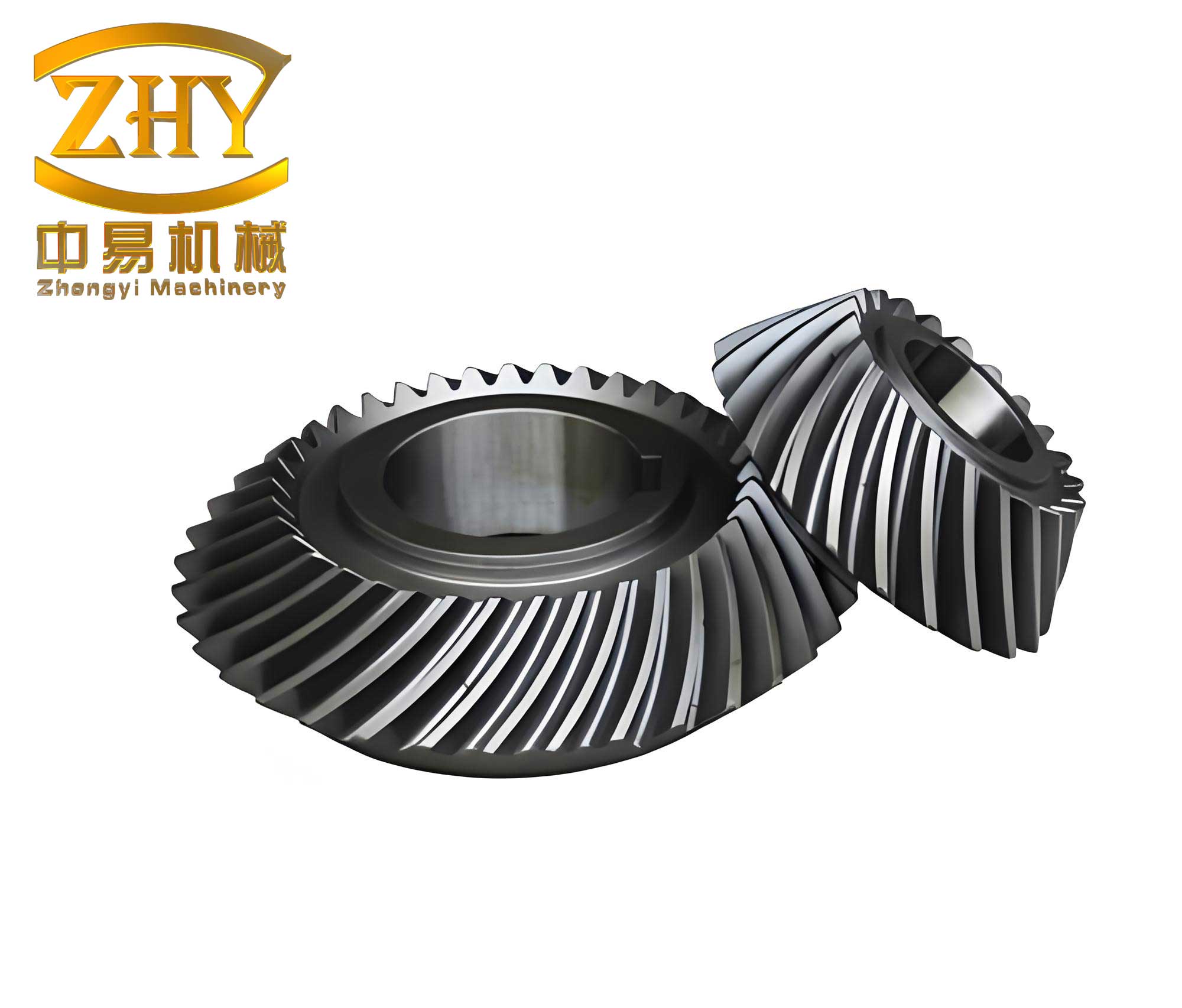
The tooth surface of a helical gear is an involute helicoid. In its attached coordinate system $O_1(x_1, y_1, z_1)$, the surface $\Sigma_1$ can be expressed using circular vector functions and spherical vector functions. Let $u_1$ and $\theta_1$ be the surface parameters, $\lambda_{o1}$ the lead angle on the base cylinder, and $p_1$ the spiral parameter. The position vector is:
$$\mathbf{r}_1^{(1)}(u_1, \theta_1) = \mathbf{e}(\theta_1)u_1\cos\lambda_{o1} + \mathbf{k}_1 u_1 \sin\lambda_{o1} + p_1\theta_1 \mathbf{k}_1$$
Through coordinate transformations, the equations of both gear surfaces in the fixed frame $O(x, y, z)$ are obtained. The unit normal vectors $\mathbf{n}_1$ and $\mathbf{n}_2$ are derived from the partial derivatives of these surface equations.
The condition for contact at a point is the coincidence of position vectors and the collinearity of unit normals (with consideration for direction):
$$\mathbf{r}_1^{(0)}(u_1, \theta_1, \phi_1) = \mathbf{r}_2^{(0)}(u_2, \theta_2, \phi_2)$$
$$\mathbf{n}_1^{(0)}(u_1, \theta_1, \phi_1) = -\mathbf{n}_2^{(0)}(u_2, \theta_2, \phi_2)$$
Here, $\phi_1$ and $\phi_2$ are rotation angles. For a given point parameter $u_1$ on gear 1, this system of equations can be solved analytically for the other five unknowns ($\theta_1$, $\phi_1$, $u_2$, $\theta_2$, $\phi_2$), determining a unique contact point. The relative velocity $\mathbf{v}^{(12)}$ at the contact point is calculated as:
$$\mathbf{v}^{(12)} = \mathbf{v}_1^{(0)} – \mathbf{v}_2^{(0)} = \omega^{(12)} \times \mathbf{r}_1^{(0)} – \omega_2^{(0)} \times \mathbf{a}$$
where $\mathbf{a}$ is the center distance vector and $\omega^{(12)}$ is the relative angular velocity.
The meshing function $\Phi$ is given by $\Phi = \mathbf{n} \cdot \mathbf{v}^{(12)}$, which equals zero at the contact point. The path of contact (meshing line) in the fixed space is derived and shown to be a straight line coincident with the common normal direction. The contact traces on each gear tooth surface are also formulated. To assess contact quality, I calculate the principal curvatures and directions for each surface. The relative principal curvatures $k_f^{(I)}$ and $k_f^{(II)}$ between the two surfaces are then found using the Euler-Savary formula. The major axis length $a$ of the instantaneous contact ellipse, a key indicator of contact area, is:
$$a = \sqrt{ \frac{w}{|k_f^{(I)}|} }$$
where $w$ is a constant related to the approach distance. Models for spiral gear pairs with opposite hand helical gears and for a spur-and-helical gear pair are established following a similar methodology, with adjustments to the surface equations and normal vector directions.
Based on the mathematical model, I developed a C-language program to perform numerical TCA. The program calculates the contact points, the major axis length and orientation of the contact ellipse, and the relative velocity vector for a given set of gear parameters. The boundaries of the active tooth surface are determined geometrically to define the calculation domain. The results are visualized as contact pattern diagrams and relative velocity diagrams projected onto a planar representation of the gear tooth (width vs. height).
I systematically investigated the influence of basic parameters on the contact pattern and relative sliding. The table below summarizes the effect of varying the spiral angles for a small shaft angle ($\Sigma=15^\circ$) gear pair.
| $\beta_1$ (Driver) | $\beta_2$ (Driven) | Contact Pattern Characteristic |
|---|---|---|
| $0^\circ$ (Spur) | $15^\circ$ | Straight contact trace across face width. |
| $5^\circ$ | $10^\circ$ | Moderately inclined contact trace. |
| $7.5^\circ$ | $7.5^\circ$ | Symmetrical, moderately inclined trace. |
| $10^\circ$ | $5^\circ$ | Steeply inclined contact trace. |
| $15^\circ$ | $0^\circ$ (Spur) | Steeply inclined trace (driven is spur). |
The key findings from parametric studies are:
- Spiral Angle Distribution: For small $\Sigma$, it mainly affects the inclination of the contact trace, influencing overlap ratio but not drastically changing the ellipse size or relative speed magnitude. For large $\Sigma$, it significantly affects ellipse size, orientation, and relative speed.
- Shaft Angle $\Sigma$: Larger $\Sigma$ leads to shorter contact ellipses (smaller potential contact area) and significantly increased relative sliding velocity.
- Number of Teeth on Pinion ($z_1$): Increasing $z_1$ lengthens the contact ellipse major axis, enlarging the contact pattern.
- Pressure Angle ($\alpha_n$): A smaller $\alpha_n$ results in a longer contact ellipse and a more favorable contact pattern.
- Module ($m_n$): Increases contact ellipse size proportionally but also increases relative speed.
- Transmission Ratio ($i$): Larger ratios favor longer contact ellipses without severely impacting relative speed.
- Installation Errors: The spiral gear contact pattern shows low sensitivity to center distance errors. Sensitivity to shaft angle error is higher for small $\Sigma$ configurations, especially for same-hand helical pairs.
The relative velocity vector field in 3D space was plotted using OpenGL, visually confirming that its magnitude remains fairly constant along the path of contact for well-chosen parameters. Furthermore, to deeply inspect the local contact geometry, I derived equations for the normal section at a contact point in an arbitrary direction defined by angle $\sigma$. By intersecting the gear surface equations with the normal section plane, the profiles of both teeth in that section are obtained. Plotting these reveals the tangency condition at the contact point. Flatter profiles around the contact point indicate better conformity.
To validate the theoretical model and conclusions, I designed and conducted an experimental study. Three representative shaft angles ($15^\circ$, $45^\circ$, $90^\circ$) were chosen, covering both small and large angles. Gears were manufactured with module $m_n=2 \text{mm}$ and appropriate tooth numbers to avoid undercutting. A test rig with an adjustable spindle housing was built to accommodate these angles and different center distances. The gears were run under load, and contact patterns were recorded using marking compound.
| Shaft Angle $\Sigma$ | Gear Combination | Theoretical Contact Pattern | Experimental Observation | Conclusion |
|---|---|---|---|---|
| $15^\circ$ | Spur + Helical ($0^\circ+15^\circ$) | Wide, straight trace across face. | Broad, consistent band across tooth. | Excellent agreement. Low sensitivity to error. |
| Helical + Helical ($7.5^\circ+7.5^\circ$, same hand) | Inclined trace. | Inclined band, narrower than spur-helical. | Good agreement. Shows predicted inclination. | |
| $90^\circ$ | Helical + Helical ($45^\circ+45^\circ$, same hand) | Short ellipses, highly inclined trace. | Small, distinct elliptical patch near center. | Validates model for large shaft angles. Confirms smaller contact area. |
The experimental patterns closely matched the theoretical predictions in shape, size, and location, strongly validating the correctness of the mathematical model and the TCA program.
Based on the comprehensive theoretical and experimental analysis, I draw the following main conclusions and design recommendations for spiral gears:
- Performance Potential: Spiral gears can be designed for effective power transmission, not just motion transfer, especially at small to moderate shaft angles. The prevailing misconception about their universally poor load capacity is clarified.
- Small Shaft Angle ($\Sigma < 40^\circ$):
- For $\Sigma \approx 5^\circ-15^\circ$, a spur+helical combination is highly recommended. It produces a large, stable contact pattern, low relative speed, and minimal sensitivity to alignment errors.
- For $\Sigma \approx 15^\circ-40^\circ$, a pair of opposite-hand helical gears is preferable. It offers a good compromise of favorable contact pattern, manageable relative speed, and lower axial forces.
- Large Shaft Angle ($\Sigma \ge 40^\circ$): A pair of same-hand helical gears should be used. To mitigate the inherent challenges of short contact ellipses and high sliding:
- Use the supplement of the required angle if it exceeds $90^\circ$.
- Assign a larger spiral angle to the pinion to lengthen the contact ellipse.
- Consider increasing pinion tooth count or reducing pressure angle to improve the contact pattern, bearing in mind the trade-offs with size and sliding speed.
- General Robustness: Spiral gear drives exhibit low sensitivity to center distance errors. Sensitivity to shaft angle error is most pronounced for small-$\Sigma$, same-hand helical pairs.
- Methodological Contribution: The modeling approach of direct surface equation formulation and installation provides a straightforward and practical method for TCA of gear pairs whose surfaces can be explicitly described.
This research provides a solid theoretical foundation and practical guidelines for designing spiral gear drives, potentially expanding their application in mechanisms requiring compact, economical solutions for skew-axis power transmission.