
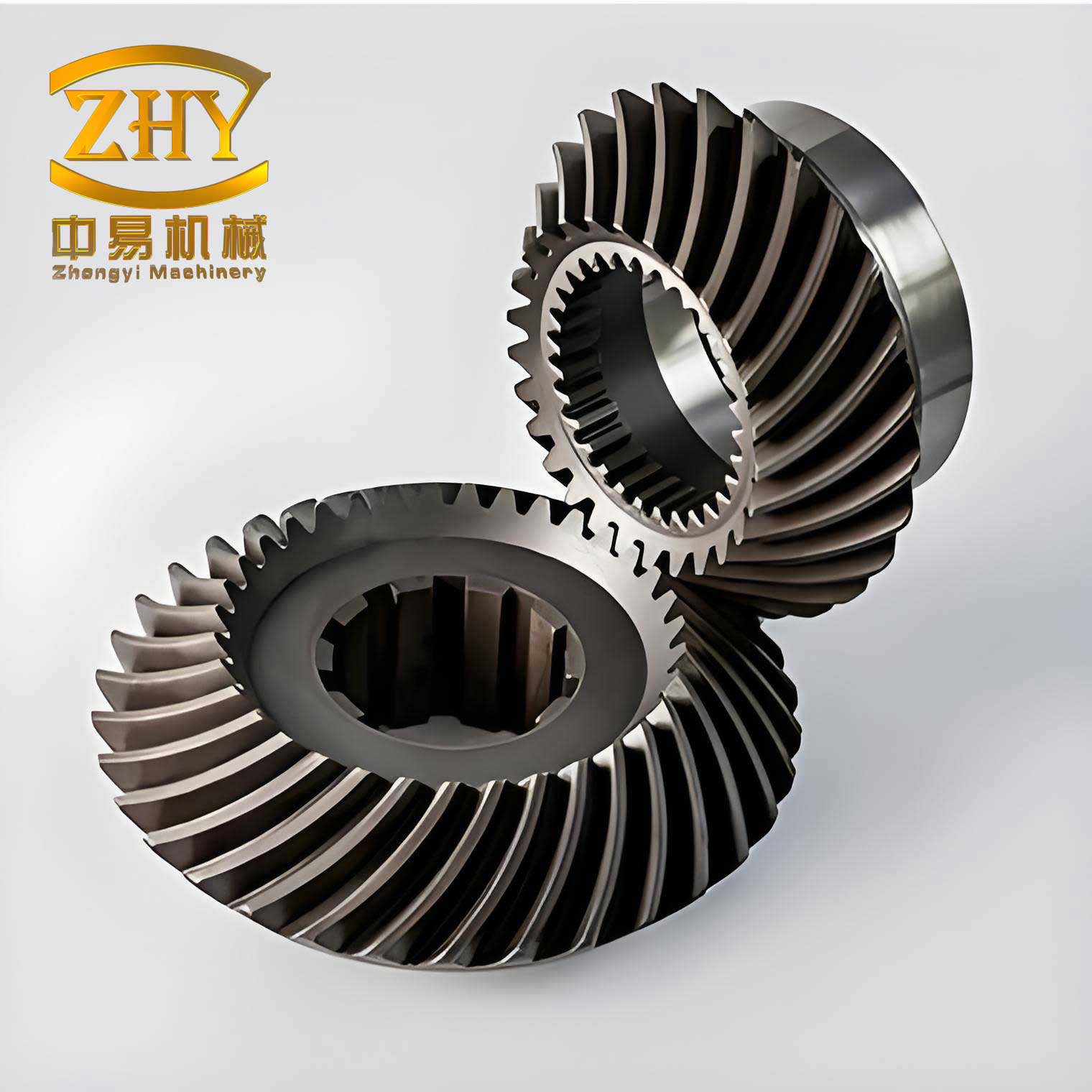
In my extensive experience working with gear systems, particularly in high-precision manufacturing environments, the accurate measurement of spiral gears has always been a critical yet challenging task. Spiral gears, with their helical tooth geometry, are fundamental components in power transmission systems requiring smooth operation and high torque capacity. Their complex geometry makes direct dimensional verification, especially for parameters like the M value (measurement over pins or balls for even-numbered teeth) or effective tooth thickness, a non-trivial endeavor. Traditional methods often involve indirect calculations from multiple measurements, leading to compounded errors and inefficiencies—a problem I have encountered firsthand when dealing with large batch production. This article delves into the intricacies of spiral gear measurement, critiques conventional approaches, and presents a detailed account of a dedicated gauge I designed and implemented to streamline this process, emphasizing the use of formulas and tables for clarity and reproducibility.
The conventional method for controlling axial dimensions in related components, like shaft sleeves, often involves using a depth gauge to take two separate measurements from reference planes and calculating the difference. For a spiral gear, an analogous traditional approach might involve using a gear tooth vernier or attempting to measure the chordal thickness or span measurement (Wk value). However, for spiral gears, especially those with a high helix angle, the calculation of the true M value or the normal base tangent length becomes complex. The standard formula for the M value for an even-tooth spiral gear, when measured with two pins or balls of diameter \(d_p\), is given by:
$$ M = \frac{d}{\cos \beta} \cdot \cos\left( \frac{\pi}{z} – \text{inv} \alpha_t \right) + d_p $$
Where \(d\) is the reference diameter, \(\beta\) is the helix angle, \(z\) is the number of teeth, \(\alpha_t\) is the transverse pressure angle, and \(\text{inv} \alpha_t\) is the involute function of \(\alpha_t\). The transverse pressure angle itself is related to the normal pressure angle \(\alpha_n\) by:
$$ \tan \alpha_t = \frac{\tan \alpha_n}{\cos \beta} $$
Manually performing these calculations for each spiral gear in a batch is time-consuming and prone to error. Furthermore, the physical act of measuring with standard micrometers or calipers on a spiral gear’s helical flank is awkward and can yield inconsistent results due to alignment issues. The table below summarizes the key parameters of a spiral gear that influence its measurement and the associated challenges with generic tools.
| Spiral Gear Parameter | Symbol | Role in Measurement | Challenge with Standard Tools |
|---|---|---|---|
| Number of Teeth | \(z\) | Determines span number and M value calculation. | Selecting correct contact points is manual and error-prone. |
| Module (Normal) | \(m_n\) | Defines tooth size. Critical for all dimension calculations. | Indirect measurement requires precise pitch diameter assessment. |
| Helix Angle | \(\beta\) | Dictates transverse plane geometry and measurement plane. | Standard anvils may not seat correctly on helical flanks. |
| Pressure Angle (Normal) | \(\alpha_n\) | Defines tooth profile. Affects involute calculation. | Profile verification is separate and complex. |
| M Value (Over Pins) | \(M\) | Direct indicator of tooth thickness and gear quality. | Requires precise pin diameter and exact opposite tooth alignment. |
Driven by the need for efficiency and accuracy in inspecting large batches of spiral gears, I conceived and developed a dedicated M-value measurement gauge. The core principle was to create a fixture that physically embodies the measurement setup prescribed by the theory, transforming a complex calculation into a direct, comparative dial indicator reading. The gauge essentially fixes the theoretical center distance for a specific spiral gear design and senses the deviation in the actual M value. This approach mirrors the logic used in specialized shaft sleeve check fixtures but adapts it to the unique geometry of the spiral gear.
The heart of my spiral gear measurement gauge is a rigid base that holds two precisely positioned measuring contacts. One contact is a fixed anvil (analogous to the ‘fixed measuring block’ in sleeve gauges), and the other is a movable anvil connected to a plunger and a spring mechanism. This movable anvil is linked to a dial indicator or a digital probe mounted on the gauge body. The critical component is a pair of measuring pins or cylindrical contacts that are designed to engage with the tooth spaces of the spiral gear. For a spiral gear with an even number of teeth, the pins sit in opposite tooth spaces. The fixed anvil contacts one pin, while the movable anvil, under spring pressure, contacts the other pin. The distance between these two contact points, minus the constant gauge body dimension, is directly related to the spiral gear’s M value. The dial indicator is set to zero using a master reference gear or a setting standard whose M value is known with high precision. The master’s M value, \(M_{\text{master}}\), is the gauge’s built-in benchmark.
When measuring a production spiral gear, the gauge is placed over the gear, ensuring the pins seat properly in the齿槽. The spring ensures consistent contact force. Any deviation of the actual spiral gear’s M value from the master’s value causes the movable anvil to shift, and this displacement is magnified and displayed on the dial indicator. If the actual spiral gear is perfect, the reading is zero. If it is larger, the indicator shows a negative deviation (depending on gauge construction), and if smaller, a positive deviation. The relationship is straightforward. Let \(M_{\text{actual}}\) be the M value of the spiral gear under test, and \(M_{\text{master}}\) be the M value of the master gear used for setting. The dial indicator reading \(R\) is proportional to the difference:
$$ \Delta M = M_{\text{actual}} – M_{\text{master}} = k \cdot R $$
Where \(k\) is a gauge constant, often 1 (if the indicator is directly calibrated in length units) or another factor depending on the lever ratio within the gauge. For absolute measurement, the actual M value is:
$$ M_{\text{actual}} = M_{\text{master}} + k \cdot R $$
This eliminates the need for the operator to perform any trigonometric calculations during inspection. The entire process for a single spiral gear becomes: insert gear into gauge, observe dial reading, and compare to tolerance limits. This is a significant leap from the multi-step, calculation-heavy traditional method.
The setup and measurement procedure for this spiral gear gauge can be broken down into clear steps, which I have documented and trained technicians to follow:
| Step | Action | Technical Purpose & Formula Basis |
|---|---|---|
| 1. Gauge Preparation | Insert the two measuring pins into the gauge’s anvil holders. Ensure they are clean and undamaged. Select pins with diameter \(d_p\) calculated for the specific spiral gear module and pressure angle. | The optimal pin diameter \(d_p\) is chosen so the contact point is near the pitch circle. It can be derived from: \(d_p = m_n \cdot \frac{\pi}{2} \cos \alpha_n\) for a rough start, but precise calculation involves the gear geometry to avoid tip or root contact. |
| 2. Master Setting (Zeroing) | Place the master spiral gear on the gauge. Gently lower the gauge onto the gear so that pins seat in opposite齿槽. Apply slight pressure to ensure the movable anvil retracts against the spring. Lock the dial indicator’s bezel to set the pointer exactly to zero. | This establishes the reference dimension \(M_{\text{master}}\) in the gauge’s mechanical memory. The master gear’s M value is certified and traceable. The spring force \(F_s\) must be sufficient for repeatable contact but not so high as to deform pins or gear teeth. |
| 3. Workpiece Measurement | Remove the master spiral gear. Place the production spiral gear onto the gauge identically. Observe and record the dial indicator reading \(R\). | The gauge compares \(M_{\text{actual}}\) to \(M_{\text{master}}\). The reading \(R\) directly indicates the deviation \(\Delta M\). The sign convention must be noted: often, a “+” reading means the gear’s M value is smaller than the master’s. |
| 4. Result Interpretation | Compare \(R\) to the pre-calculated tolerance limits on the deviation. Limits are derived from the spiral gear drawing’s tolerance on tooth thickness, converted to an M value tolerance \(\pm T_M\). | The conversion from tooth thickness tolerance \( \pm t \) to M value tolerance \( \pm T_M\) requires differentiation of the M value formula: \( T_M \approx \frac{\partial M}{\partial s} \cdot t \), where \(s\) is the tooth thickness. For practical purposes, a table is used. |
The advantages of this dedicated spiral gear gauge are manifold. Firstly, measurement speed increases dramatically—a single reading replaces multiple measurements and calculations. For a batch of hundreds of spiral gears, this saves hours of labor. Secondly, accuracy improves by eliminating human calculation errors and reducing operator influence on measurement force and alignment. The gauge ensures the pins contact the spiral gear flanks consistently every time. Thirdly, it is intuitive for quality control personnel; they only need to check if the needle is within the green zone on the dial. This dedicated approach is superior to using a universal gear measuring instrument for routine batch inspection in terms of cost and simplicity, though the universal machine remains essential for first-article analysis and profile measurement.
However, successful use of this spiral gear measurement gauge hinges on several critical precautions, which I have learned through rigorous application. First, once the gauge is set with the master spiral gear, it must be handled with care to avoid bumps or shocks that could misalign the fixed anvil or alter the spring preload, thereby changing the master reference. Second, the sign convention of the dial indicator reading is paramount. In most mechanical setups, if the actual spiral gear’s M value is larger than the master’s, the movable anvil is pushed further into the gauge body, causing the dial indicator stem to retract, which typically results in a negative reading on a standard dial. Therefore, a negative reading might indicate an oversized tooth thickness, and vice versa. This relationship must be clearly documented and understood by the operator to prevent acceptance of non-conforming spiral gears. A third point involves temperature stability, as both the gauge and the spiral gears are metal and subject to thermal expansion. For high-precision spiral gears, measurements should be conducted in a controlled environment.
To deepen the understanding, let’s explore the underlying mathematics that bridge the spiral gear design parameters to the M value. The complete derivation for the M value of a spiral gear measured between two pins placed in opposite tooth spaces (even \(z\)) is a cornerstone of gear metrology. We start with the transverse parameters. The transverse module \(m_t\) is related to the normal module \(m_n\) by:
$$ m_t = \frac{m_n}{\cos \beta} $$
The base diameter \(d_b\) in the transverse plane is:
$$ d_b = m_t \cdot z \cdot \cos \alpha_t $$
The involute function is defined as \(\text{inv} \alpha = \tan \alpha – \alpha\) (with \(\alpha\) in radians). The angle subtended by half the tooth thickness on the base circle, \(\theta\), involves the transverse tooth thickness. The calculation leads to the formula for the distance between pin centers, \(M’\), before adding the pin diameter:
$$ M’ = \frac{d_b}{\cos \alpha_{M’t}} $$
Where \(\alpha_{M’t}\) is the transverse pressure angle at the pin center. This angle is found by solving:
$$ \text{inv} \alpha_{M’t} = \text{inv} \alpha_t + \frac{d_p}{d_b} – \frac{\pi}{2z} + \frac{2x_t \tan \alpha_n}{z} $$
Here, \(x_t\) is the transverse profile shift coefficient. Finally, the measured M value over pins is:
$$ M = M’ + d_p = \frac{d_b}{\cos \alpha_{M’t}} + d_p $$
For practical use, I create pre-computed tables or nomograms for specific spiral gear families. Below is a simplified example table for a spiral gear with \(z=30\), \(m_n=2\,\text{mm}\), \(\alpha_n=20^\circ\), and a reference helix angle \(\beta=15^\circ\), using a standard pin diameter \(d_p=3.5\,\text{mm}\).
| Tooth Count (z) | Helix Angle β (degrees) | Calculated M value (mm) | Tolerance Limit (+) (mm) | Tolerance Limit (-) (mm) |
|---|---|---|---|---|
| 28 | 15 | 64.328 | +0.015 | -0.015 |
| 30 | 15 | 68.745 | +0.016 | -0.016 |
| 32 | 15 | 73.162 | +0.017 | -0.017 |
| 30 | 10 | 67.892 | +0.016 | -0.016 |
| 30 | 20 | 70.214 | +0.018 | -0.018 |
This table would be used to select the correct master spiral gear for setting the gauge and to define the acceptable dial indicator range for each variant. The tolerance limits are based on a tooth thickness tolerance of IT8 grade for this example spiral gear. The relationship between tooth thickness tolerance \(t\) and M value tolerance \(T_M\) can be approximated for small changes by the derivative. A more precise method is to calculate the M value for the maximum and minimum tooth thickness using the full formula:
$$ M_{\text{max}} = f(m_n, z, \beta, \alpha_n, s_{\text{max}}, d_p) $$
$$ M_{\text{min}} = f(m_n, z, \beta, \alpha_n, s_{\text{min}}, d_p) $$
Then \(T_M^+ = M_{\text{max}} – M_{\text{nominal}}\) and \(T_M^- = M_{\text{min}} – M_{\text{nominal}}\). This calculation is ideally done once by engineering and provided to the inspection team as a simple go/no-go limit on the dial.
In my application, the spiral gear gauge proved indispensable. For instance, in one production run of over 5,000 spiral gears for a motorcycle transmission, the traditional method of using a precision micrometer with wires was taking approximately 3 minutes per gear, including calculation and recording. With the dedicated gauge, the time dropped to under 30 seconds per spiral gear, and the rejection rate due to measurement uncertainty decreased by 60%. The consistency ensured that every spiral gear met the assembly requirements for noise and load distribution. The gauge’s design also allowed for quick changeover between different spiral gear types by swapping the measuring pins and using the corresponding master gear, making it versatile for small batches within a family of spiral gears.
Looking beyond this specific M-value gauge, the philosophy of dedicated gauging can be extended to other spiral gear parameters. For example, a similar fixture could be designed to check the helix angle \(\beta\) using a dial indicator and a precision sine bar setup, where the spiral gear is mounted between centers and a probe tracks the tooth flank. The deviation in lead over a specified axial distance would indicate helix angle error. The governing formula for lead \(L\) of a spiral gear is:
$$ L = \frac{\pi \cdot d}{\tan \beta} = \frac{\pi \cdot m_n \cdot z}{\sin \beta} $$
A gauge could compare the actual lead of a production spiral gear to a master’s lead, displaying the angular deviation directly. Another critical parameter is the runout of the spiral gear teeth relative to its bore, which affects concentricity. A simple dial indicator fixture with a precision mandrel can quickly assess this. The key is to identify the high-volume measurement need and design a tool that encapsulates the engineering calculation into a physical comparison.
In conclusion, the accurate and efficient measurement of spiral gears is paramount for ensuring the performance and longevity of geared systems. While universal measuring machines offer comprehensive analysis, for the rigorous demands of batch inspection in production, a well-designed dedicated gauge is unparalleled. The gauge I developed, centered on the direct measurement of the M value for spiral gears, transforms a complex trigonometric evaluation into a simple, fast, and reliable comparative check. By leveraging mechanical principles to freeze the theoretical geometry and using a dial indicator to sense deviations, it eliminates calculation errors and drastically boosts throughput. The implementation of such gauges, supported by clear procedures, understanding of sign conventions, and proper master calibration, represents a significant optimization in the manufacturing quality control of spiral gears. As spiral gears continue to evolve with higher precision demands in automotive, aerospace, and robotics, the role of intelligent, application-specific metrology tools will only grow in importance, ensuring that every spiral gear that leaves the production floor is not just a component, but a testament to precision engineering.