
In the realm of mechanical transmission design, the spiral gear, or helical gear, presents a significant modeling challenge due to its complex three-dimensional geometry featuring involute profiles and helical flanks. Achieving a precise finite element model is paramount for accurate stress, strain, and dynamic analysis. This article details a comprehensive methodology I have developed for the parameterized and exact finite element modeling of involute cylindrical spiral gears utilizing the ANSYS Parametric Design Language (APDL). The core of this approach lies in generating the model programmatically from first principles within the ANSYS environment, ensuring geometric fidelity, controlled mesh quality, and full parametric control for any spiral gear configuration.
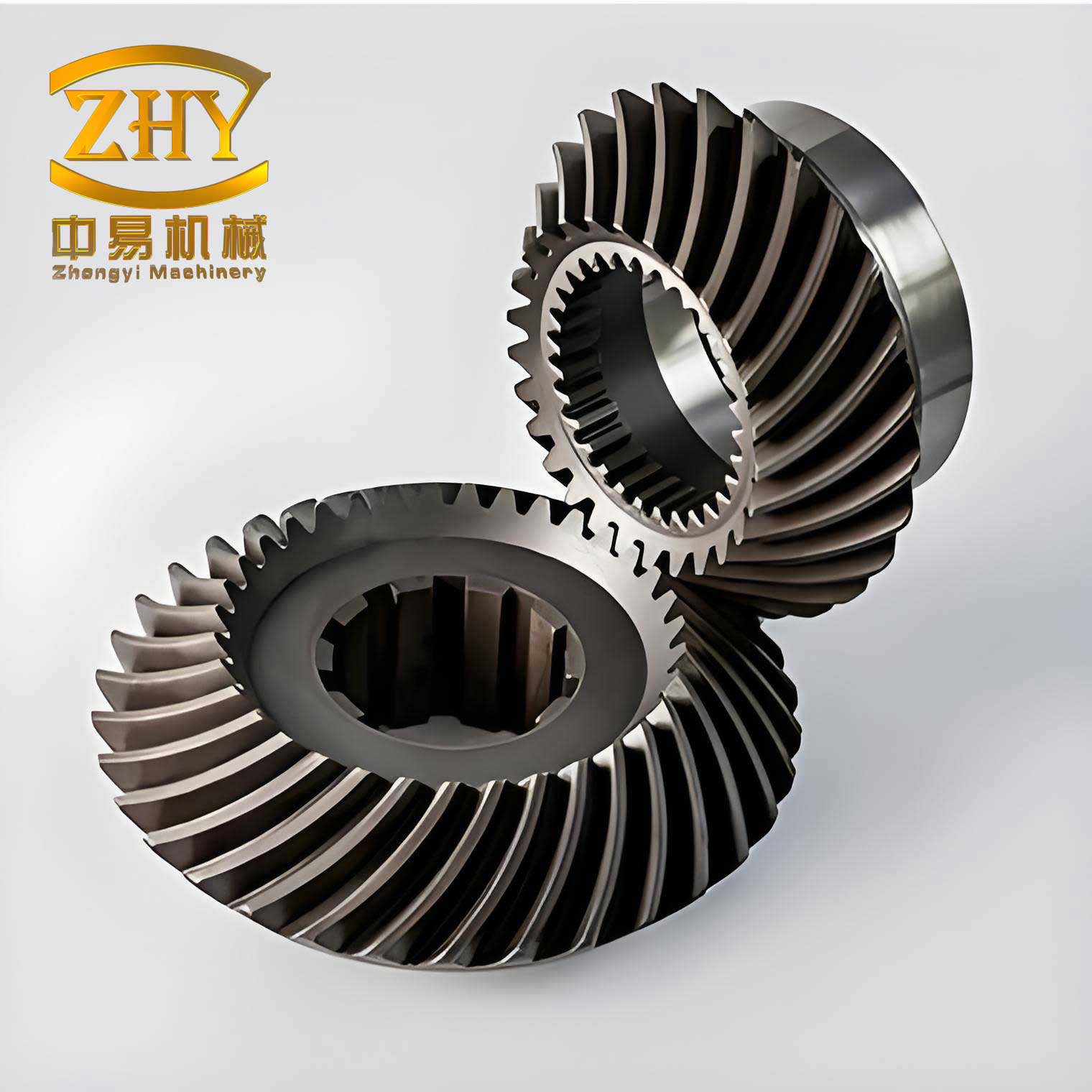
The geometric foundation of an involute spiral gear tooth consists of several key curves in its transverse section: the root circle, the fillet transition curve, the involute profile, and the addendum circle. The generation of these curves, especially the involute and the non-standard fillet, is critical for an accurate model.
The parametric equation for a point on the involute curve in the transverse plane is given in Cartesian coordinates as:
$$x = \pm r_K \sin(\theta)$$
$$y = r_K \cos(\theta)$$
where,
$$r_K = \frac{r_b}{\cos(\alpha_K)} = \frac{r \cos(\alpha)}{\cos(\alpha_K)}$$
$$\theta = \frac{\pi + 4x m_n \tan(\alpha_n)}{2Z} + \text{inv}(\alpha) – \text{inv}(\alpha_K)$$
Here, \(Z\) is the number of teeth, \(\alpha\) is the transverse pressure angle, \(\alpha_n\) is the normal pressure angle, \(m_n\) is the normal module, \(x\) is the profile shift coefficient, \(r\) is the pitch radius, \(r_b\) is the base radius, and \(\alpha_K\) is the pressure angle at the arbitrary point \(K\) on the involute, ranging from the pressure angle at the start of the active profile to the pressure angle at the addendum circle. The involute function is defined as \(\text{inv}(\alpha) = \tan(\alpha) – \alpha\).
Perhaps more critical for stress analysis is the accurate representation of the root fillet transition curve. This curve is generated by the tip of the cutting tool (e.g., a hob). For a rack-type cutter with a tip radius \(\rho\), the fillet curve can be derived from the gear generation process. Its parametric equations are:
$$x = (\rho \cos(\theta) – r \varphi) \cos(\eta) + (r – h_a + x m_n – \rho – \rho \sin(\theta)) \sin(\eta)$$
$$y = -(\rho \cos(\theta) – r \varphi) \sin(\eta) + (r – h_a + x m_n – \rho – \rho \sin(\theta)) \cos(\eta)$$
where,
$$\eta = \varphi – \zeta$$
$$\varphi = \frac{-h_a + x m_n + \rho}{r \tan(\theta)}$$
$$\zeta = \frac{\pi m_n / 4 + h_{a0}^* m_n \tan(\alpha_n) + \rho \cos(\alpha_n)}{r}$$
The parameter \(\theta\) (the pressure angle at the generation point) varies from the tool pressure angle \(\alpha_n\) to \(\pi/2\). Here, \(h_a\) is the addendum of the gear and \(h_{a0}^*\) is the tool addendum coefficient.
The helical nature of the spiral gear is defined by the helix angle \(\beta\). The intersection of the tooth flank with any cylinder of radius \(r_y\) is a helix. On the pitch cylinder, this helix is described by:
$$x = r \cos(\psi)$$
$$y = r \sin(\psi)$$
$$z = (r \tan(\beta)) \psi$$
where \(\psi\) is the angular parameter.
| Primary Gear Parameter | APDL Variable | Description |
|---|---|---|
| Normal Module | Mn | Fundamental size parameter |
| Number of Teeth | Z | Defines gear ratio and size |
| Helix Angle | He_ang | Angle of tooth twist, defines spiral nature |
| Normal Pressure Angle | Afan | Angle defining tooth flank shape |
| Profile Shift Coefficient | X | Modifies tooth thickness and root geometry |
| Addendum Coefficient | Hax | Relates to tooth height |
| Dedendum/Clearance Coefficient | Cx | Relates to root depth |
| Face Width | B | Axial length of the gear |
| Tool Tip Radius | Rr | Defines root fillet geometry |
The APDL-based modeling strategy employs a “bottom-up” approach, meticulously constructing points, curves, surfaces, and finally volumes. A key innovation is the systematic management of entity numbers. Before creating a new entity (like a keypoint), all entities of that type are deselected. After creation, the `*GET` command captures its automatically assigned number, storing it in a user-defined array for future reference. This grants absolute control over the model’s topology.
*DIM, K_Points,,10,2  ! Array to store keypoint numbers
KSEL, NONE             ! Deselect all keypoints
K,, x_val, y_val, 0    ! Create keypoint at (x_val, y_val, 0)
*GET, K_Points(1,1), KP,, NUM, MAX  ! Store its number
KSEL, ALL              ! Reselect all keypoints
The complete spiral gear model is built strategically to enable high-quality mapped and swept meshing. The most effective method involves partitioning a single tooth into several axial segments. This is crucial for large helix angles or wide face widths, as attempting to sweep-mesh a full-height tooth often fails near the small, complex root fillet. The process follows these steps:
- Generate One Axial Segment of One Tooth: Create the 3D solid model for a single, thin slice (e.g., 1/n-th) of a single tooth.
- Replicate to Form Full Tooth: Use the APDL `VGEN` command with copy operation to replicate this segment axially and rotate it appropriately around the axis to build the complete, solid tooth model with nodes and elements.
- Replicate to Form Full Gear: Circularly pattern this meshed tooth model Z times around the gear’s axis.
- Merge Entities: Use `NUMMRG` commands to merge coincident nodes and keypoints, creating a continuous finite element model.
Creating the single axial segment is the core geometric operation. It begins by calculating and generating keypoints for the transverse profile on the bottom face. These points define the root arc, fillet curve, involute, and addendum arc. The fillet and involute curves are created using the `BSPLIN` command through their calculated defining points. These keypoints are then copied to the top face of the segment, offset axially by \( \Delta z = B/n \) and rotated azimuthally by \( \Delta \theta = \Delta z / (r \tan(\beta)) \).
| Modeling Step | APDL Commands/Techniques | Purpose |
|---|---|---|
| 1. Parameter Input | `MULTIPRO` / `*CSET` | Create dialog boxes for user input of gear parameters. |
| 2. Point Generation | `K`, `*GET`, `*DIM`, Array Math | Calculate and create keypoints for curves, store their numbers. |
| 3. Curve Creation | `L`, `BSPLIN`, `CIRCLE`, `*GET` | Generate lines and splines from keypoints, store line numbers. |
| 4. Surface Creation | `A`, `AL` | Create areas (bottom, top, side faces) from bounding lines. |
| 5. Volume Creation | `V`, `VA` | Create a volume from the enclosing areas. |
| 6. Mesh Attributes | `ET`, `MP`, `SMRTSIZE`/`ESIZE` | Define element type, material properties, and global mesh size. |
| 7. Surface Meshing | `AMESH` | Perform mapped meshing on the bottom and top faces. |
| 8. Volume Sweeping | `VSWEEP` | Generate high-quality hexahedral elements by sweeping. |
| 9. Pattern Copying | `VGEN` with `COPY` & `KINC` | Replicate the meshed segment axially and circumferentially. |
| 10. Model Completion | `AGEN`, `VGEN`, `NUMMRG` | Copy teeth, merge coincident nodes for a continuous gear. |
Mesh generation is a deliberate two-stage process for the segment. First, identical mapped meshes are generated on the bottom and top faces. This requires using the same meshing controls and executing the `AMESH` command for both faces simultaneously to ensure node pattern correspondence. Subsequently, the `VSWEEP` command generates a regular, hex-dominant mesh throughout the volume by sweeping the 2D mesh from the bottom face to the top face. This yields elements with excellent aspect ratios.
Full parameterization is achieved through interactive dialog boxes and internal variable tracking. Initial dialogs collect all necessary geometric parameters to define any spiral gear. Internally, arrays store the IDs of all generated entities (points of the involute, fillet lines, etc.), making the model completely adaptable. Changing a primary parameter like the helix angle or module triggers a regeneration of all dependent geometry through the script’s logic.
Once the parameterized finite element model of the spiral gear is built, it can be seamlessly used for analysis. Boundary conditions are applied to the bore nodes, typically constraining all degrees of freedom to simulate a mounted shaft. Loading a spiral gear accurately is non-trivial due to its elliptical contact pattern. The contact force, calculated from transmitted torque, is distributed over a small elliptical area on the driving flank, defined by contact mechanics formulas for helical gears. The resultant force components are applied as pressure or nodal forces on the elements within this contact ellipse.
Solving the model reveals detailed stress and deformation fields. The von Mises stress contour typically shows two critical regions: a localized high-stress zone at the theoretical contact point (contact stress) and a region of elevated stress at the root fillet on the loaded side (bending stress). Displacement plots clearly show deformation concentrating in the loaded tooth, with maximum deflection at the contact region. The precision of the geometry and mesh directly translates to the reliability of these results, particularly for bending stress which is highly sensitive to root fillet geometry.
| Analysis Result | Typical Observation | Significance |
|---|---|---|
| Von Mises Stress | High stress at contact ellipse and tensile root fillet. | Identifies potential failure zones (pitting, bending fatigue). |
| Deformation/Displacement | Maximum deflection at loaded flank; overall tooth bending. | Critical for assessing mesh stiffness and dynamic behavior. |
| Contact Pressure | Elliptical distribution matching Hertzian theory. | Validates the loading method and contact analysis setup. |
In conclusion, this APDL-driven methodology establishes a robust framework for the parameterized and precise finite element modeling of spiral gears. By deconstructing the complex geometry into a bottom-up, segmental building process and rigorously controlling entity generation and mesh patterns, it achieves several key advantages. The resulting models possess exact geometric representation, particularly of the critical root fillet and involute profile. The use of swept meshing from mapped surface meshes guarantees regular, high-quality hexahedral elements, which enhance solution accuracy and numerical stability. Most importantly, the entire process is encapsulated within a parameterized APDL script, functioning as an independent module capable of generating the finite element model for any arbitrary spiral gear defined by its basic design parameters directly within the ANSYS environment, eliminating translation errors and enabling automated design studies.