
In the field of gear engineering, the common normal is a critical parameter for inspection and quality control. As an engineer specializing in gear design, I have often encountered the challenge of determining the common normal length for various gear types, especially spiral gears. This parameter is essential for assessing manufacturing accuracy, ensuring proper meshing, and optimizing performance. With the continuous development of technology, new gear tooth profiles are constantly emerging, making it imperative to derive universal formulas for calculating the common normal. In this article, I will explore the common normal of spiral gears from a general perspective, deriving a universal expression that applies not only to existing profiles like involute, cycloidal, and circular arc but also to future innovative designs. The focus will be on spiral gears, a key component in many mechanical systems, and I will emphasize the term “spiral gear” throughout to highlight its relevance.
The common normal between two surfaces in space represents the shortest line segment that is perpendicular to both surfaces at their points of intersection. For gears, this translates to the line normal to both tooth flanks, which is vital for measuring tooth thickness and backlash. When dealing with spiral gears, the tooth surface is a helicoid, characterized by a spiral structure that complicates the geometry. However, by starting from first principles, we can derive a general formula. I will begin by considering two arbitrary surfaces in space and then specialize to spiral gears, leveraging their symmetric properties. This approach not only simplifies the derivation but also yields a versatile result.
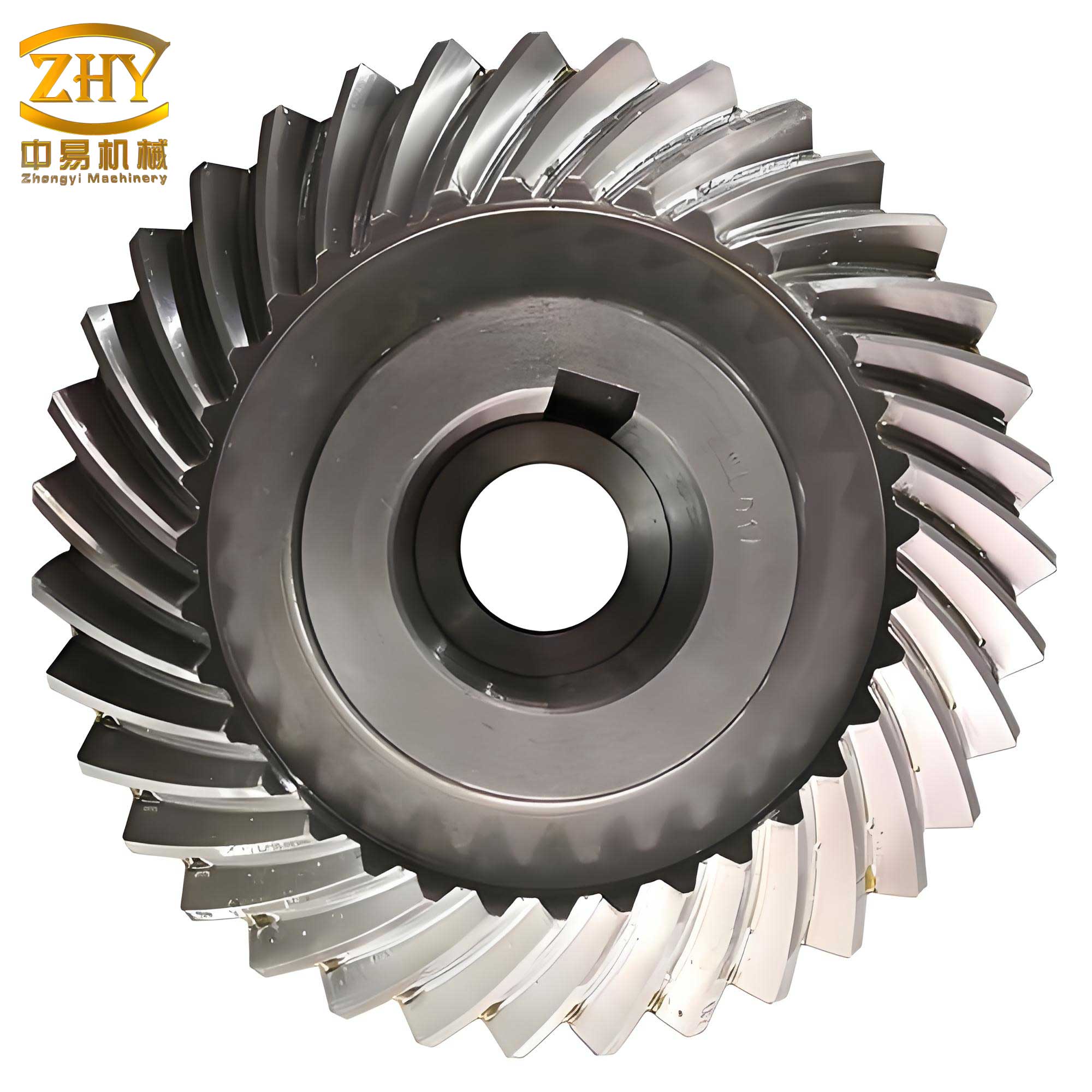
Let us define two surfaces in a three-dimensional space. Surface Σ₁ is parameterized by coordinates (x₁, y₁, z₁) with parameters (u₁, v₁), and surface Σ₂ is parameterized by (x₂, y₂, z₂) with parameters (u₂, v₂). The common normal line L connects points P₁ on Σ₁ and P₂ on Σ₂, with direction cosines (l, m, n). The condition for L to be normal to both surfaces is that it is perpendicular to the tangent planes at P₁ and P₂. Mathematically, this leads to a set of equations based on partial derivatives. For surface Σ₁, the normal vector components are given by the cross product of partial derivatives with respect to u₁ and v₁. Similarly for Σ₂. The common normal length W is the distance between P₁ and P₂, which can be expressed as:
$$ W = \sqrt{(x_2 – x_1)^2 + (y_2 – y_1)^2 + (z_2 – z_1)^2} $$
To find W, we need to solve for the parameters that satisfy the normality conditions. This typically involves a system of four nonlinear equations, which can be complex. However, for spiral gears, the symmetry of the tooth profile simplifies the problem. A spiral gear tooth surface is generated by a helical motion, where the cross-sectional shape is symmetric about an axis. This symmetry allows us to reduce the dimensionality of the problem.
Consider a spiral gear with a tooth surface Σ₁ described by parametric equations in terms of parameters (θ, φ). Due to the helical nature, the coordinates can be written as:
$$ x_1 = f(\theta) \cos \phi – g(\theta) \sin \phi $$
$$ y_1 = f(\theta) \sin \phi + g(\theta) \cos \phi $$
$$ z_1 = p \phi $$
Here, p is the spiral parameter (constant), and f(θ) and g(θ) are functions defining the profile, with f being even and g odd relative to θ, reflecting symmetry. This representation captures the essence of a spiral gear surface. The second tooth surface Σ₂ is obtained by rotating Σ₁ by an angle ψ around the gear axis. Thus, its equations become:
$$ x_2 = f(\theta) \cos (\phi + \psi) – g(\theta) \sin (\phi + \psi) $$
$$ y_2 = f(\theta) \sin (\phi + \psi) + g(\theta) \cos (\phi + \psi) $$
$$ z_2 = p (\phi + \psi) $$
We now seek the common normal between Σ₁ and Σ₂. Substituting these into the normality conditions and exploiting symmetry, we can derive a simplified system. The key steps involve setting up the partial derivatives and equating them to the direction cosines. After algebraic manipulations, we arrive at a set of equations that depend on θ, φ, and ψ. Notably, due to symmetry, we can assume ψ = π/N, where N is the number of teeth, but for generality, we keep ψ as a variable.
The common normal length W for spiral gears can be expressed in terms of these parameters. The derivation yields the following universal formulas:
$$ \frac{\partial x_1}{\partial \theta} \cdot l + \frac{\partial y_1}{\partial \theta} \cdot m + \frac{\partial z_1}{\partial \theta} \cdot n = 0 $$
$$ \frac{\partial x_2}{\partial \theta} \cdot l + \frac{\partial y_2}{\partial \theta} \cdot m + \frac{\partial z_2}{\partial \theta} \cdot n = 0 $$
$$ (x_2 – x_1)l + (y_2 – y_1)m + (z_2 – z_1)n = 0 $$
Solving these, we obtain expressions for l, m, n, and eventually W. For spiral gears, the symmetry reduces the system to a single equation in φ. Specifically, we find:
$$ \tan \phi = \frac{g'(\theta)}{f'(\theta)} $$
where f’ and g’ are derivatives with respect to θ. This relation simplifies the computation. The common normal length W is then given by:
$$ W = \sqrt{ \left[ f(\theta) \sin \psi + g(\theta) (1 – \cos \psi) \right]^2 + \left[ p \psi \right]^2 } $$
This formula is universal for any spiral gear with symmetric profile functions f and g. To illustrate, let’s summarize the key parameters in a table:
| Symbol | Meaning | Role in Spiral Gear Common Normal |
|---|---|---|
| f(θ) | Radial function (even) | Defines the profile shape in the cross-section |
| g(θ) | Tangential function (odd) | Captures the asymmetry due to helix |
| p | Spiral parameter | Determines the lead of the helix; constant for a given spiral gear |
| θ | Profile parameter | Variable along the tooth depth |
| φ | Helical angle parameter | Variable around the gear axis |
| ψ | Rotation angle between teeth | Related to the tooth spacing; often ψ = 2π/N |
| W | Common normal length | Final distance to be calculated for inspection |
The beauty of this derivation is that it provides a general framework. For any new spiral gear design, one simply needs to plug in the specific f(θ) and g(θ) functions to obtain the common normal formula. This universality makes it invaluable for future innovations in gear technology. As a case study, I will apply this to circular arc “point contact” gears, a type of spiral gear known for high load capacity.
For circular arc spiral gears, the tooth profile is based on a circular arc. The functions f and g are derived from the arc geometry. Suppose the arc has radius R and center offset e. Then, in parametric form, we have:
$$ f(\theta) = R \cos \theta + e $$
$$ g(\theta) = R \sin \theta $$
These satisfy the even-odd conditions. Substituting into the universal formula, we get:
$$ \tan \phi = \frac{R \cos \theta}{-R \sin \theta} = -\cot \theta $$
Thus, φ = π/2 – θ. The common normal length W becomes:
$$ W = \sqrt{ \left[ (R \cos \theta + e) \sin \psi + R \sin \theta (1 – \cos \psi) \right]^2 + (p \psi)^2 } $$
This matches the results derived by previous researchers for circular arc spiral gears, confirming the correctness of our universal approach. To delve deeper, let’s consider a numerical example. Assume a spiral gear with R = 50 mm, e = 5 mm, p = 10 mm/rad, ψ = 0.2 rad (about 11.46°), and θ = 0.1 rad. Then:
$$ f(0.1) = 50 \cos(0.1) + 5 \approx 50 \times 0.9950 + 5 = 54.75 \, \text{mm} $$
$$ g(0.1) = 50 \sin(0.1) \approx 50 \times 0.0998 = 4.99 \, \text{mm} $$
$$ W = \sqrt{ \left[ 54.75 \times \sin(0.2) + 4.99 \times (1 – \cos(0.2)) \right]^2 + (10 \times 0.2)^2 } $$
$$ \sin(0.2) \approx 0.1987, \quad \cos(0.2) \approx 0.9801 $$
$$ W \approx \sqrt{ \left[ 54.75 \times 0.1987 + 4.99 \times 0.0199 \right]^2 + 4 } $$
$$ W \approx \sqrt{ (10.88 + 0.099)^2 + 4 } = \sqrt{ 120.42 + 4 } \approx \sqrt{124.42} \approx 11.15 \, \text{mm} $$
This example illustrates how the formula is used in practice. For accurate results, one must solve the equation for θ precisely, often requiring iterative methods with tolerance on the order of 10⁻⁶ to 10⁻⁸. The universal formula streamlines this process for spiral gears of any profile.
To further emphasize the applicability, let’s compare different spiral gear types. The table below shows how f and g vary, leading to distinct W expressions:
| Spiral Gear Type | f(θ) Function | g(θ) Function | Common Normal Length W (Simplified) |
|---|---|---|---|
| Involute Spiral Gear | r_b (\cos \theta + \theta \sin \theta) | r_b (\sin \theta – \theta \cos \theta) | $$ W = \sqrt{ [r_b (\theta \sin \psi + (1 – \cos \psi))]^2 + (p \psi)^2 } $$ |
| Cycloidal Spiral Gear | R (1 – \cos \theta) | R (\theta – \sin \theta) | $$ W = \sqrt{ [R (\sin \psi + \theta (1 – \cos \psi))]^2 + (p \psi)^2 } $$ |
| Circular Arc Spiral Gear | R \cos \theta + e | R \sin \theta | As derived above |
| New Design (Example) | Any even function | Any odd function | Use universal formula with specific f and g |
The universal formula thus serves as a master template. In engineering applications, measuring the common normal of spiral gears is crucial for quality assurance. For instance, in automotive transmissions, spiral gears are used for smooth torque transfer, and deviations in common normal length can lead to noise and wear. By using this formula, manufacturers can compute theoretical values and compare them with measured data from coordinate measuring machines or gear testers.
From a mathematical perspective, the derivation hinges on variational principles. The common normal length is essentially the extremum of the distance function between two surfaces. For spiral gears, the helicoidal structure imposes constraints that simplify the Euler-Lagrange equations. This connection to calculus of variations underscores the elegance of the solution. I have often found that appreciating this mathematical foundation enhances practical implementation.
In conclusion, the universal formula for the common normal of spiral gears is a powerful tool in gear metrology. It applies to existing profiles and future designs, ensuring longevity and relevance. The derivation from first principles guarantees mathematical rigor, and the case of circular arc spiral gears validates its correctness. As spiral gear technology evolves, this formula will facilitate rapid development and inspection of new tooth forms. I encourage engineers to adopt this approach in their work, as it not only saves time but also provides deep insights into the geometry of spiral gears. The key takeaway is that by understanding the underlying symmetry, we can tame the complexity of spiral gear surfaces and derive concise, universal expressions.
To reiterate, the common normal is more than just a measurement—it is a bridge between design and performance. For spiral gears, with their helical teeth and complex contact patterns, this parameter is indispensable. Through this article, I have aimed to demystify its calculation and highlight the universality of the derived formula. Whether you are working on traditional involute spiral gears or pioneering new profiles, the framework presented here will serve as a reliable guide. Remember, the spiral gear’s unique geometry demands specialized treatment, and with the universal formula, you are equipped to handle any variation that comes your way.