
Spiral gear drives, characterized by non-parallel and non-intersecting axes, have found applications in modern industry due to their relative ease of manufacture and lower cost compared to other gear types like hypoid or worm gears. However, a significant obstacle to their wider adoption has been the lack of a mature, universally accepted method for calculating their load-carrying capacity, particularly concerning contact fatigue strength. This limitation often forces designers to rely on over-conservative estimates or avoid their use altogether. This article aims to address this gap. By analyzing the unique geometrical characteristics of the contact point in spiral gear meshing, we will derive a practical engineering formula for calculating the contact fatigue strength of spiral gear teeth. We will then systematically analyze the key factors influencing this strength and their patterns of influence. The objective is to provide a clear, applicable methodology that can empower engineers to design more effective and reliable spiral gear transmissions.
The foundational step in understanding the contact strength of spiral gears lies in a detailed geometrical analysis of the point where two teeth make contact. Unlike parallel-axis gears where contact occurs along a line, spiral gear contact is theoretically a point contact, which under load deforms into a small elliptical area. The size and shape of this ellipse are critical for stress calculation. Consider a pair of spiral gears with shafts at an angle $\Sigma$. Their pitch cylinders are tangent at the node P. Let $\beta_1$ and $\beta_2$ be the helix angles of gear 1 and gear 2, respectively. A key direction on the tooth surface is along the straight generatrix of the involute helicoid. In this direction, the normal curvature is zero for both gears. The other principal direction is perpendicular to this generatrix. The corresponding normal curvatures $\kappa_{I1}$ and $\kappa_{I2}$ for gears 1 and 2 in this direction are essential for finding the principal curvatures.
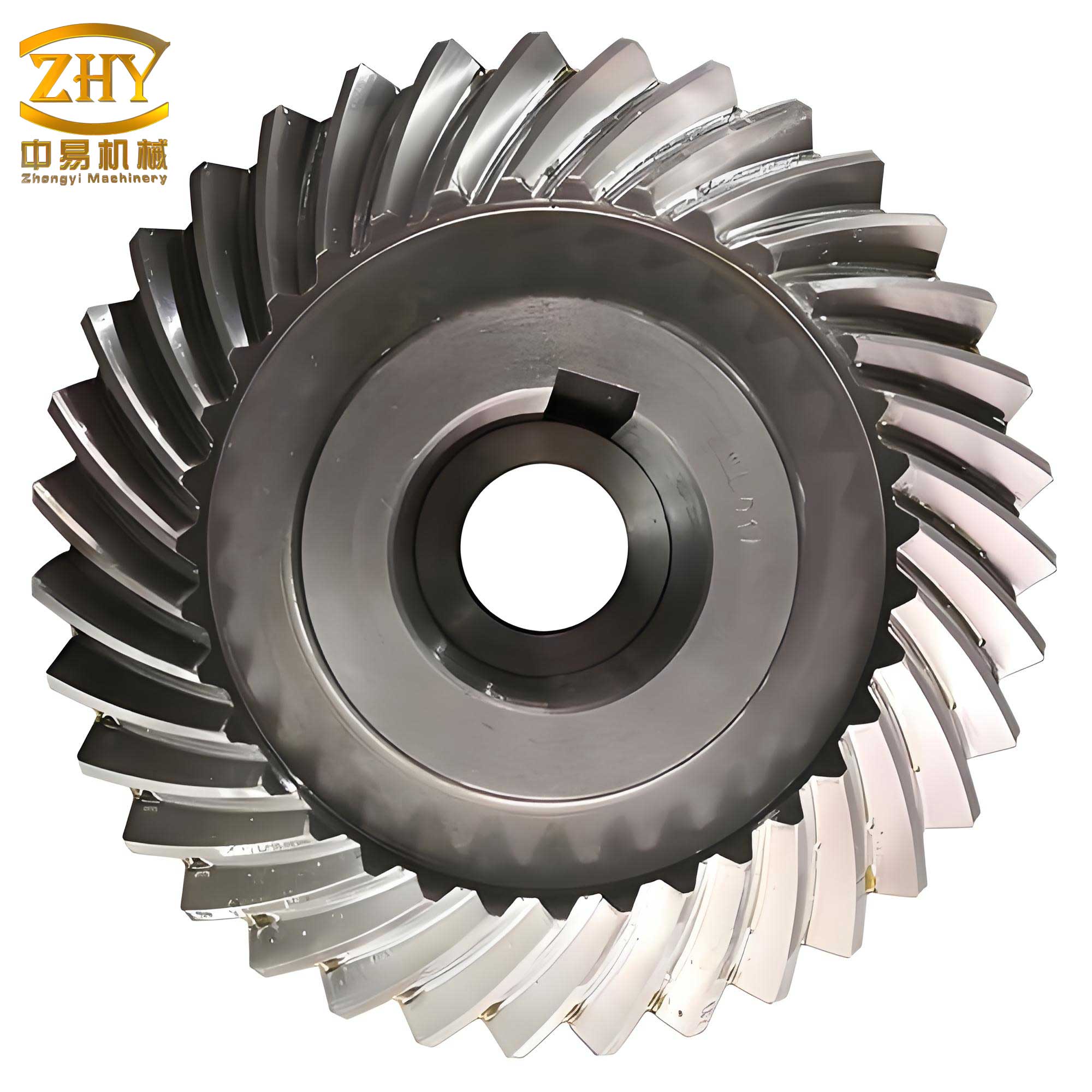
The geometry at the contact point of a spiral gear pair is complex because the principal directions of the two tooth surfaces are not aligned. The angle between the generatrix and the common tooth tangent line at the node differs for each gear. Let $\psi_1$ and $\psi_2$ be these angles for gear 1 and gear 2, respectively. Their values depend on the helix angles and the base helix angles $\beta_{b1}, \beta_{b2}$. For a right-hand spiral gear, $\psi$ is taken as positive; for a left-hand one, it is negative. The angle between the principal directions of the two surfaces at the contact point is then $\psi = \psi_1 – \psi_2$. This misalignment fundamentally influences the contact ellipse. The ratio of the relative (induced) principal curvatures in the directions of the major and minor axes of the contact ellipse, denoted as $\lambda$, is a function of this angle $\psi$ and the principal curvatures. A critical parameter for stress calculation is the ratio of the ellipse axes, $k = b/a$, where $a$ is the semi-major axis and $b$ is the semi-minor axis. This ratio $k$ is directly related to $\lambda$. The complete elliptical integral of the second kind, denoted by $\mathfrak{E}$, is also a function of $k$ and is required for the Hertzian contact stress formula. For spiral gears, $\lambda$ and consequently $k$ are uniquely determined by the helix angles $\beta_1, \beta_2$ and the gear ratio $u = z_2/z_1$. This is a crucial insight: the shape of the contact ellipse in a spiral gear pair is not arbitrary but is fixed by these three design parameters.
The derivation of the contact stress formula starts from the classical Hertzian theory for the contact of two elastic bodies. The maximum compressive stress $\sigma_H$ at the center of the elliptical contact area is given by:
$$\sigma_H = \sqrt[3]{\frac{F_n \cdot \sum \rho}{(\pi \cdot \mathfrak{E})^2} \cdot \frac{3}{2} \cdot E’^2}$$
where $F_n$ is the normal load at the calculation point, $\sum \rho$ is the sum of principal curvatures, $\mathfrak{E}$ is the complete elliptic integral of the second kind, and $E’$ is the composite elastic modulus:
$$E’ = \frac{2}{\frac{1-\nu_1^2}{E_1} + \frac{1-\nu_2^2}{E_2}}$$
Here, $E_1, E_2$ are the elastic moduli and $\nu_1, \nu_2$ are the Poisson’s ratios of the pinion and gear materials, respectively. The normal load $F_n$ is derived from the transmitted torque, considering application factors:
$$F_n = \frac{K \cdot T_1}{d_1 \cdot \cos \alpha_n \cdot \cos \beta_1}$$
where $K$ is the load factor (incorporating application, dynamic, and load distribution factors), $T_1$ is the pinion torque, $d_1$ is the pinion pitch diameter, and $\alpha_n$ is the normal pressure angle.
The sum of principal curvatures $\sum \rho$ for spiral gears, after substituting the expressions for $\kappa_{I1}$ and $\kappa_{I2}$, can be expressed in a form that highlights the influence of helix angles. This allows us to define a coefficient $Z_\beta$ that encapsulates the influence of $\beta_1, \beta_2$, and $u$ on the composite curvature radius:
$$Z_\beta = \sqrt[3]{\frac{2 \cdot \sin \beta_1 \cdot \sin \beta_2}{(\sin(\beta_1+\beta_2))^2} \cdot \frac{u^2}{(1+u)^2} \cdot \frac{\cos^4 \beta_{b1}}{\sin^2 \alpha_{t1}}}$$
Substituting all components into the Hertz formula, we arrive at the fundamental design equation for the contact stress in a spiral gear drive:
$$\sigma_H = Z_E \cdot Z_\beta \cdot Z_k \cdot \sqrt[3]{\frac{K \cdot T_1}{d_1^3} \cdot \frac{u+1}{u}}$$
where:
- $Z_E = \sqrt[3]{\frac{E’}{2\pi(1-\nu^2)}}$ is the elastic coefficient.
- $Z_\beta$ is the spiral angle coefficient defined above.
- $Z_k = \sqrt[3]{\frac{3}{2\mathfrak{E}^2}}$ is the contact ellipse shape coefficient.
The allowable contact stress $[\sigma_H]$ is defined based on the material endurance limit: $[\sigma_H] = Z_L \cdot Z_v \cdot \frac{\sigma_{H \lim}}{S_H}$, where $\sigma_{H \lim}$ is the test gear contact fatigue limit, $S_H$ is the safety factor, and $Z_L, Z_v$ are life and speed factors. For design purposes, the formula is rearranged to solve for the required pinion pitch diameter $d_1$ to prevent contact fatigue failure:
$$d_1 \geq \sqrt[3]{\frac{K \cdot T_1}{[\sigma_H]^3} \cdot \frac{u+1}{u} \cdot (Z_E \cdot Z_\beta \cdot Z_k)^3}$$
This is the core design formula for spiral gear contact fatigue strength. The coefficient $Z_k$ depends on $k$, which in turn depends on $\lambda(\beta_1, \beta_2, u)$. To facilitate engineering application, the values of $Z_k$ have been computed for a range of $\beta_1, \beta_2$ and $u$, for both same-hand and opposite-hand spiral gear pairs. A portion of these results is summarized in the tables below.
| $\beta_1$ / $\beta_2$ | 5° | 10° | 15° | 20° | 25° |
|---|---|---|---|---|---|
| 5° | 0.92 | 0.89 | 0.86 | 0.83 | 0.80 |
| 10° | 0.89 | 0.85 | 0.81 | 0.77 | 0.74 |
| 15° | 0.86 | 0.81 | 0.76 | 0.71 | 0.68 |
| 20° | 0.83 | 0.77 | 0.71 | 0.66 | 0.62 |
| 25° | 0.80 | 0.74 | 0.68 | 0.62 | 0.57 |
| $\beta_1$ / $\beta_2$ | 5° | 10° | 15° | 20° | 25° |
|---|---|---|---|---|---|
| 5° | 0.92 | 0.93 | 0.95 | 0.96 | 0.97 |
| 10° | 0.93 | 0.94 | 0.96 | 0.98 | 0.99 |
| 15° | 0.95 | 0.96 | 0.98 | 1.00 | 1.02 |
| 20° | 0.96 | 0.98 | 1.00 | 1.02 | 1.05 |
| 25° | 0.97 | 0.99 | 1.02 | 1.05 | 1.08 |
The data clearly shows that for opposite-hand spiral gears, $Z_k$ is generally less than 1 and decreases as the absolute difference between the helix angles decreases. For same-hand pairs, $Z_k$ increases and can exceed 1, indicating a more unfavorable contact ellipse shape that increases stress. When $\beta_1 = \beta_2$ and $\Sigma=0$, the case degenerates to parallel-axis helical gears with line contact ($k=0$, $\mathfrak{E}=1$, $Z_k=\sqrt[3]{1.5} \approx 1.14$), which serves as a reference point. These tables, along with the defining formulas, allow designers to determine $Z_k$ efficiently for their specific spiral gear configuration.
Now we analyze the primary factors influencing the contact fatigue strength of spiral gears and their patterns of influence:
1. Pinion Pitch Diameter ($d_1$): This is the most influential parameter. The contact stress $\sigma_H$ is inversely proportional to $d_1$, as seen in the formula $\sigma_H \propto 1/d_1$. A larger pitch diameter dramatically reduces contact stress and increases load capacity. Notably, for a given center distance and ratio, increasing $d_1$ means reducing the gear ratio $u$, which has a secondary effect. The face width $b$ does not explicitly appear in the contact stress formula. However, it is crucial for bending strength and transverse stability; a practical rule is $b \geq 0.8 \cdot d_1$.
2. Helix Angles ($\beta_1, \beta_2$): The helix angles of the spiral gear pair are critical and influence strength through two mechanisms:
- Composite Curvature Radius: Generally, increasing the magnitudes of $\beta_1$ and $\beta_2$ increases the composite curvature radius $\rho_{\Sigma}$, which tends to decrease contact stress.
- Contact Ellipse Shape: Changes in $\beta_1$ and $\beta_2$ alter the ellipse shape factor $Z_k$.
- For opposite-hand spiral gears, the first effect dominates. $Z_k$ is typically less than 1 and becomes smaller (more favorable) as $|\beta_1| – |\beta_2|$ decreases, further reducing stress. Thus, for opposite-hand pairs, using helix angles with similar absolute values is beneficial for contact strength.
- For same-hand spiral gears, the second effect is significant. As shown in Table 2, $Z_k$ increases with helix angles, often exceeding 1. This unfavorable ellipse shape counteracts the benefit of increased curvature radius. There exists a combination where the stress is maximized. Therefore, the selection of helix angles for same-hand spiral gear drives requires careful evaluation using the $Z_k$ tables.
3. Gear Ratio ($u$): The gear ratio affects spiral gear contact strength in two synergistic ways:
- It influences the composite curvature radius $\rho_{\Sigma}$.
- It affects the ellipse shape parameter $\lambda$ and thus $Z_k$.
For a given pinion, increasing $u$ generally increases $\rho_{\Sigma}$ and decreases $Z_k$. Both effects lead to a reduction in contact stress $\sigma_H$. Consequently, higher ratio spiral gear drives tend to have higher inherent contact fatigue capacity, all other factors being equal.
4. Material Pairing: The choice of materials for the pinion and gear has a profound effect via the elastic coefficient $Z_E$ and the allowable stress $[\sigma_H]$. Common pairings for spiral gears are listed below. Hardened steel against softer materials like bronze or cast iron can yield high load capacity, provided the hardened gear has a precise, smooth tooth finish. Excessive roughness on a hard gear can cause severe wear in a “hard-soft” pairing.
| Material Pairing | Composite Modulus $E’$ (GPa) | Elastic Coeff. $Z_E$ (√MPa) | Typical $\sigma_{H \lim}$ Range (MPa) |
|---|---|---|---|
| Boronized Steel / Boronized Steel | 210 | 189 | 1200-1500 |
| Case-Hardened Steel / Case-Hardened Steel | 206 | 188 | 1300-1650 |
| Case-Hardened Steel / Bronze | 124 | 159 | 600-900 |
| Case-Hardened Steel / Pearlitic Cast Iron | 170 | 181 | 700-1000 |
| Quenched & Tempered Steel / Bronze | 124 | 159 | 500-800 |
| Quenched & Tempered Steel / Grey Cast Iron | 155 | 176 | 400-700 |
| Grey Cast Iron / Grey Cast Iron | 110 | 152 | 300-500 |
5. Lubrication and Running-in: Proper lubrication is vital for spiral gear performance. The initial point contact under load undergoes a running-in (wear-in) process where mild wear polishes the surfaces and slightly expands the contact into a narrow band. This effectively increases the local curvature radii, reducing operational contact stress. For heavy-duty spiral gear drives, using a suitable running-in oil is recommended to promote this beneficial wear phase and extend service life.
To illustrate the application of the proposed method, consider a design example based on a known parallel-axis spur gear case. The working conditions are: Input torque $T_1 = 150 \text{ Nm}$, speed $n_1 = 1450 \text{ rpm}$, pinion stress cycles $N_L = 2 \times 10^9$, power source is an electric motor with moderate shock. The original spur gear design used module $m=3 \text{ mm}$, center距 $a=150 \text{ mm}$, with a 45 steel quenched & tempered pinion and a ZG310-570 normalized gear.
We will design a spiral gear pair for the same conditions with a shaft angle $\Sigma = 90^\circ$. Materials remain the same. The design steps are:
- Select Preliminary Parameters: Choose $\beta_1 = 45^\circ$, $\beta_2 = 45^\circ$ (opposite hand for $\Sigma=90^\circ$). Let $u=3$. From material tables, estimate $[\sigma_H] \approx 500 \text{ MPa}$ for the Q&T steel/Normalized cast steel pair (adjusted for life). Assume $K=1.5$. $Z_E \approx 189 \sqrt{\text{MPa}}$ for steel/steel.
- Determine Coefficients: For $\beta_1=45^\circ, \beta_2=45^\circ$ (opposite hand), from the trend in Table 1 (extrapolating), $Z_k \approx 0.55$. Calculate $Z_\beta$ using its formula. For $\beta_{b1} \approx \beta_1$ and $\alpha_{t1} \approx \alpha_n / \cos \beta_1$, with $\alpha_n=20^\circ$, we find $Z_\beta \approx 0.85$.
- Calculate Required $d_1$:
$$d_1 \geq \sqrt[3]{\frac{1.5 \cdot 150}{500^3} \cdot \frac{3+1}{3} \cdot (189 \cdot 0.85 \cdot 0.55)^3} \approx \sqrt[3]{0.0009 \cdot 1.333 \cdot (88.4)^3} \approx \sqrt[3]{0.0012 \cdot 690,000} \approx \sqrt[3]{828} \approx 94 \text{ mm}$$ - Determine Module and Teeth: Choose $z_1 = 20$. Then, $m_n = d_1 \cos \beta_1 / z_1 = 94 \cdot \cos 45^\circ / 20 \approx 3.32 \text{ mm}$. Standardize to $m_n = 3.5 \text{ mm}$.
Recalculate: $d_1 = m_n \cdot z_1 / \cos \beta_1 = 3.5 \cdot 20 / \cos 45^\circ \approx 99 \text{ mm}$. Then $d_2 = u \cdot d_1 = 3 \cdot 99 = 297 \text{ mm}$. Center距 $a = (d_1 + d_2)/2 = 198 \text{ mm}$. - Finalize Helix Angles: To exactly maintain $a=198 \text{ mm}$ and $u=3$ with the standardized module, the helix angles might need slight adjustment from the initial $45^\circ$ guess using the formula $a = \frac{m_n}{2} \left( \frac{z_1}{\cos \beta_1} + \frac{z_2}{\cos \beta_2} \right)$ with $\beta_2 = \Sigma – \beta_1$. An iterative solution yields $\beta_1 \approx 46.5^\circ$, $\beta_2 \approx 43.5^\circ$. The coefficients $Z_\beta$ and $Z_k$ can be recalculated for this final pair, and the contact stress verified to be below $[\sigma_H]$.
This spiral gear design ($d_1=99 \text{ mm}$, $m_n=3.5 \text{ mm}$, $a=198 \text{ mm}$) results in a significantly larger center distance than the original spur gear ($a=150 \text{ mm}$), highlighting the trade-off for using spiral gears: potentially larger dimensions for the same power, but with simpler manufacturing of individual gears.
In summary, the contact in a spiral gear drive is elliptical, with the ellipse’s eccentricity uniquely defined by the helix angles and the gear ratio. The calculation method presented here, centered on the coefficients $Z_\beta$ and $Z_k$, provides a practical and applicable engineering approach for evaluating spiral gear contact fatigue strength. The analysis confirms that the pinion pitch diameter is the most dominant factor. The helix angles exert a dual influence through curvature radius and ellipse shape; opposite-hand pairs generally benefit from similar angle magnitudes, while same-hand pairs require careful evaluation due to potentially unfavorable ellipse shapes. The gear ratio also provides a beneficial effect on strength. Intelligent material pairing and proper lubrication for running-in are essential practices to maximize the performance and durability of spiral gear drives. By applying these principles, engineers can overcome the historical lack of calculation standards and utilize spiral gears more effectively and confidently in appropriate applications.